Juvenile Impulsivity
"That's [renaming Lake Ontario] going to take place right now as I sign the order.""And we filed all the necessary papers, documents, everything else. We've notified all of the various people that we have to notify.""So we've done everything that you have to do. And this is official effective immediately.""No message. Canada has been ripping us off for a long time on trade, very sadly. We defend Canada for nothing; they don't pay us."United States President Donald J. Trump
 |
| U.S. President Donald Trump signed an executive order directing the interior secretary to rename Lake Ontario to 'Lake America,' as the trade war with Canada continues. Screen grab from video |
Playing the role of a trade ogre by unilaterally slapping ruinous trade tariffs on one country after another, President Trump has of late focused his attention more closely on one particular country that just happens to neighbour the United States, as the northern half of North America. Defense and security is big on the agenda for the U.S., the wealthy nation that commands world events through its invaluable work as an international interventionist in the never-ending cycle of events that threaten world stability, while at the same time intervening at other times in foreign affairs by committing its military to endless conflicts with no endgame success.
This is a relatively new, in recent times, self-directed, wide-targeting economic bullying of allies and foes alike that Mr. Trump derides for not sufficiently respecting and being grateful to the America he now controls, for its generosity in stabilizing the world from conflicts (those not led by American might) and in offering its goods and services to trading partners at what he now feels to be cut-rate prices. All of which he proclaims has come to an end under his watch, with new eye-opening tariffs and demands of military spending by nations far too dependent on the United States' without adequate commitments of their own.
Canada has been particularly remiss, resting on the assurance that the United States would always come to its rescue in response to foreign threats. That assurance lies in the fact that the U.S. would be geographically vulnerable if Canada were to be invaded or forced into self-protective conflict. There have been military partnerships between the two countries and complete trust in one another in the past. Canada was lulled into a state of complacency over its own obligations to the partnership and is now being pulled up short by accusations of coasting along for its security through reliance on the U.S. But it has been the trade issue and economic threats that has proven to be the breaking point in formerly congenial and respectful relations between the two countries, brought to a head by Mr. Trump.
This is a president for whom diplomacy is a concept for weaklings. He has continued to needle Canada as a 'pretend country', one that deserves nothing better than to surrender its sovereignty to the U.S. by agreeing to become the union's 51st state, its prime ministers converted to 'governor' status. That Canada and Canadians have not the slightest interest in becoming a vassal state of America riles this president. All the more so that his diktats over tariff rates imposed on that neighbour are resisted. Punishment, therefore in order.
North America's Great Lakes, one of nature's geographic-hydrology gifts to the continent, suddenly took on focus in center-stage when Lake Ontario's name was found offensive to this president. In the verbal-hydrology naming assault analogous to a schoolyard fight and ensuing black eyes, President Donald J. Trump triumphed in his power to rename Lake Ontario to Lake America. Musing at the same time that the renaming of the Atlantic and/or the Pacific appealed greatly to him, as well, as Oceans America.
 |
| A map labelling Lake Ontario as 'Lake America' is seen behind U.S. President Donald Trump as he speaks in the Oval Office of the White House on Thursday. (Andrew Harnik/Getty Images) |
The U.S. Department of the Interior was ordered to update maps and databases to reflect this impromptu renaming exercise. Located between New York state and the province of Ontario, Mr. Trump seriously expects the world to henceforth refer to Lake America as one of the five Great Lakes. The naming of the lake, in point of fact, predates both Canada and the United States by hundreds of years. Lake Ontario's name, according to the Center for Great Lakes Literacy, comes from the Iroquoian word "oniatari:io", though the Hurons had a similar etymology.
"The body of water currently known as Lake Ontario is a tremendous asset to the United States and part of our Nation's heritage.""With the deepest parts of the Lake's waters lying within United States territory, the United States claims most of the Lake's volume.""[America is] the greatest protector of the Great Lakes". U.S. Executive Order 14420
Toronto skyline from Lake Ontario
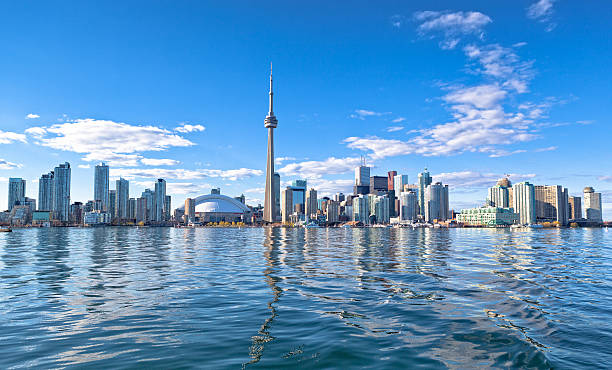
Lake Ontario, the easternmost of the Great Lakes, has a rich history and many unique characteristics. Here are some cool facts about Lake Ontario:
- Smallest of the Great Lakes: Lake Ontario is the smallest of the Great Lakes by surface area, covering about 7,340 square miles (19,000 square kilometers). However, it is the second smallest by volume, holding approximately 393 cubic miles (1,639 cubic kilometers) of water.
- Lowest Elevation: Lake Ontario sits at the lowest elevation of all the Great Lakes, at about 243 feet (74 meters) above sea level.
- Natural Outlet: The lake serves as the natural outlet for the Great Lakes system, draining into the Saint Lawrence River, which flows into the Atlantic Ocean.
- Deep Waters: Despite its smaller size, Lake Ontario is relatively deep, with a maximum depth of 802 feet (244 meters) and an average depth of 283 feet (86 meters).
- Niagara Falls: The lake receives water from Lake Erie via the Niagara River, which includes the world-famous Niagara Falls. The water from Lake Erie travels over the falls before reaching Lake Ontario.
- Thousand Islands: The lake is home to the Thousand Islands, an archipelago of more than 1,800 islands located in the Saint Lawrence River, which begins at the lake’s eastern end. These islands are a popular destination for boating and tourism.
- Toronto: The largest city on the shores of Lake Ontario is Toronto, Canada’s largest city and a major cultural and economic center. Other significant cities on the lake include Hamilton and Kingston in Ontario, Canada, and Rochester in New York, USA.
- Important Ports: The lake supports significant commercial shipping traffic, with major ports in Toronto, Hamilton, and Rochester. These ports are crucial for trade and transportation.
- Diverse Ecosystem: Lake Ontario supports a rich and diverse ecosystem, including various fish species such as salmon, trout, bass, and perch. Efforts are ongoing to preserve and protect the lake’s natural environment.
- Historical Significance: The lake has played a crucial role in the history of the region, from Native American settlements to European exploration and colonization. It was a key route for trade and transportation.
- Lake Ontario’s Name: The name “Ontario” is derived from the Huron word “Ontarí’io,” which means “great lake” or “beautiful water.”
- Ice Volcanoes: During winter, the lake’s shores can form “ice volcanoes,” which are mounds of ice created by waves pushing water through cracks in the ice, resulting in mini-eruptions of water and ice.
- Military History: The lake has been the site of significant military activity, particularly during the War of 1812 between the United States and Britain. Forts such as Fort Ontario in Oswego, New York, and Fort Henry in Kingston, Ontario, are historical sites related to this period.
- Water Source: Lake Ontario serves as a vital source of drinking water for millions of people living in the surrounding regions in both the United States and Canada.
- Recreational Activities: The lake is a popular destination for recreational activities such as boating, fishing, swimming, and bird watching, with numerous parks and beaches along its shores.
Labels: Compulsive Punishment, Inviting Global Scorn, Punitive Tariffs, Renaming Lake Ontario, Trade Disagreements, U.S. President Donald J. Trump
posted by Pieface @ 8:15 PM


0 Comments:
Post a Comment
<< Home