Blog dedicated primarily to randomly selected news items; comments reflecting personal perceptions
Friday, December 12, 2025
Pew: Breaking the Plastic Wave
"There's a good reason why the plastics recycling rate has never reached double digits."
"It's because its chemical and polymer complexity makes large-scale recycling technically and economically infeasible."
"We're wasting valuable time by relying on a system that has not worked for decades."
Judith Enck, president, Beyond Plastics
"One of the most critical solutions will be to lower production of
primary plastic to sustainable levels – those at which the amount of
waste generated matches what can be managed."
"This balance will also be
essential to reducing the global plastic system’s GHG emissions and
human health impacts."
"Return- and refill-based reuse systems will be a
cornerstone of right-sizing primary production and transforming how
businesses and consumers think about and use packaging and other plastic
products."
Breaking the Plastic Wave 2025, Pew Charitable Trusts/ICF International
In the manufacture of plastics, some 16,000 different chemicals are used -- more than one fourth of those chemicals have been identified by scientists as possibly harmful to human health. A research wave has made an effort to fully comprehend how a class of chemicals in particular, known as endocrine disrupters widely used in makeup and cookware, may affect digestive, reproductive and cognitive function.
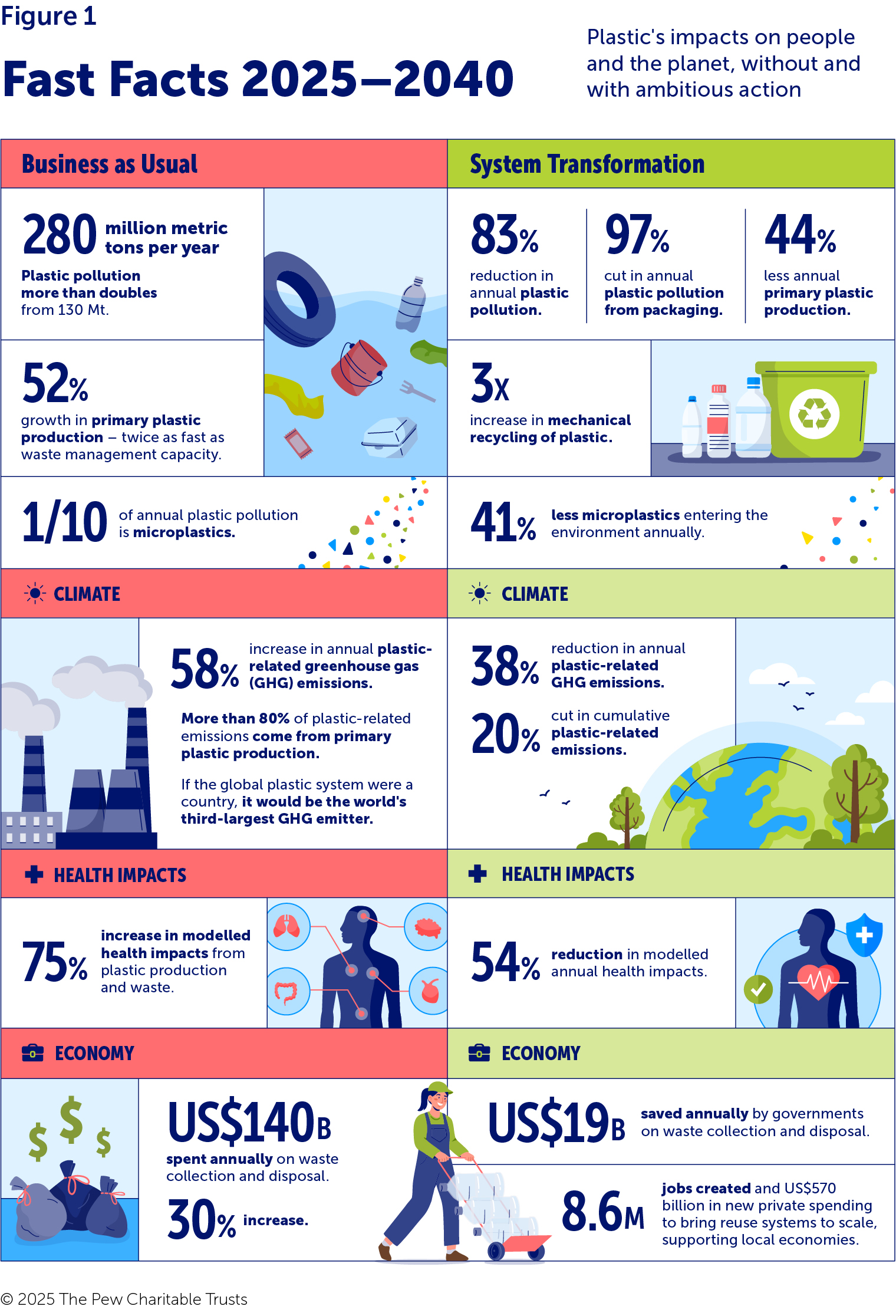
Global plastic pollution is set to reach 280 million metric tons annually by 2040. Yet despite clear evidence that plastic particles clog oceans and beaches eventually breaking down into microplastics, plastics are being continually produced and their production rate is set to rise, to the level of a dump truck load every second
A report by the Pew Charitable Trusts in conjunction with ICF International, Breaking the Plastic Wave 2025, provided those alarming statistics. Countries that produce the major share of plastic blocked proposals to limit the creation of new plastic regulations, despite discussions meant to forge an international treaty for the purpose of controlling plastic pollution.
Data from recent research is compiled to predict outcomes under various policy scenarios in reflection of the fact that recycling rates remain low. This was an initiative by Winnie Lau, director of Pew's Preventing Ocean Plastics project who explained that the research team "wanted to pull it all together in one integrated analysis to look at impacts across the board".
The bleak outlook, warns the report, is that global production of new plastic will increase by 52 percent, to 4.2 gigatons of carbon dioxide equivalent annually. The Pew report authors estimate that the world's population will be absent 5.6 million total years of healthy life in 2025, growing to 9.8 million years by 2040; a grim forecast. As it is, the majority of human health impacts links to cancers and respiratory diseases through primary plastic production.
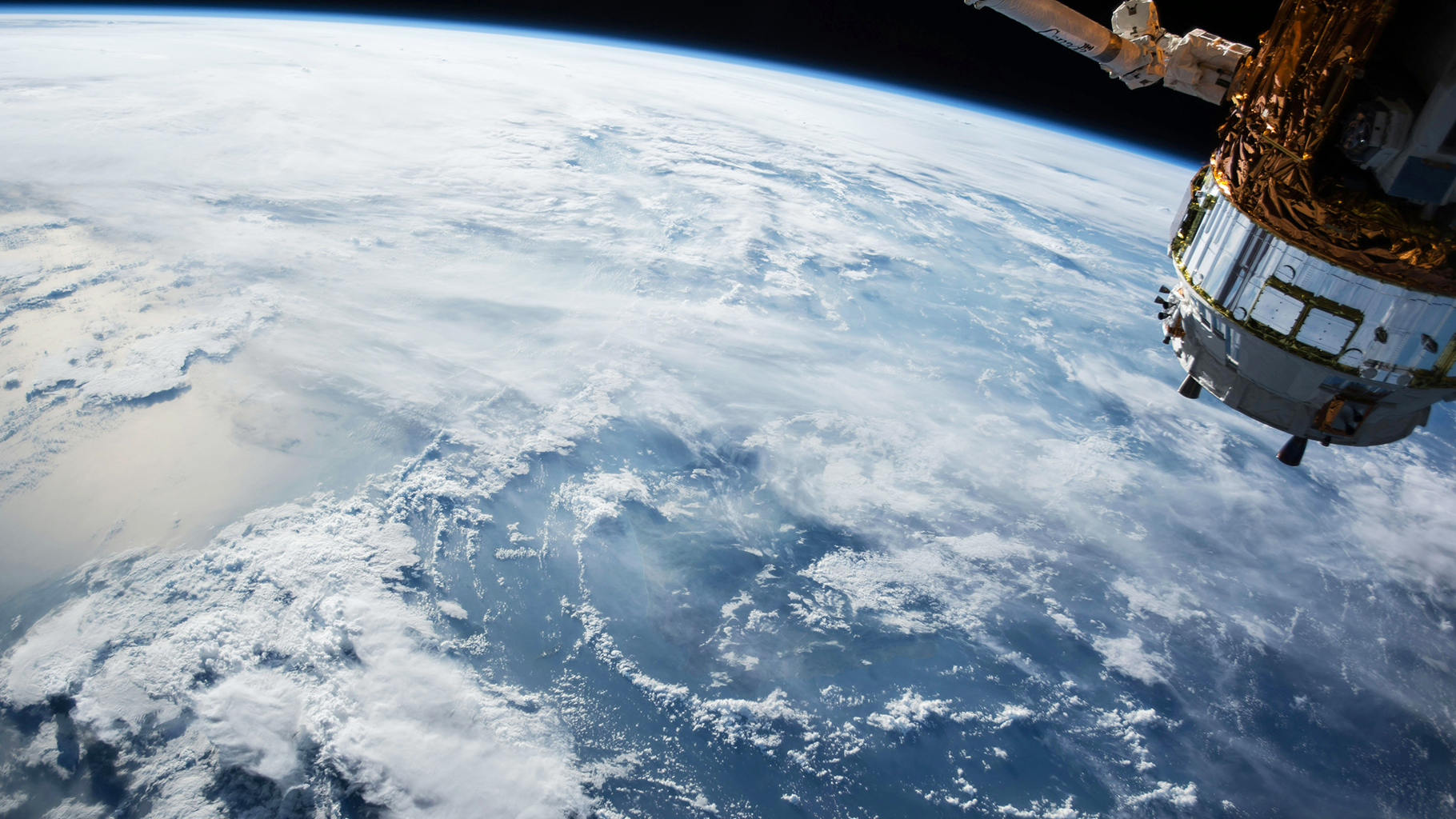
NASA
The Earth as seen from the
International Space Station. With global political attention, a
commitment of resources and technologies, and strategic policy
approaches, plastic pollution can be reduced by 83% by 2040, unlocking
significant benefits for both people and the planet.
If the Pew version of an appropriate response were to materialize, plastic production subsidies should be eliminated and waste collection expanded. In that scenario, close to 100 percent of consumer packaging could be collected, with recycling rates doubling. Which still leaves the dilemma of microplastics which are more difficult to control since their main source is vehicle tire dust, paint, and agriculture-related products.
There are few substitutes for plastic pods in which fertilizer is sold and plastic sheeting used for mulch that dissolve into soil. Beyond Plastics' regional administrator was of the opinion that the Pew report's authors were too optimistic over the growth of plastic recycling, spurred by different regulation policies.

Jeff J MitchellGetty Images
People walk past overflowing
bins and piles of plastic rubbish bags in Edinburgh, Scotland, during a
waste workers strike. Without action, by 2040, the amount of plastic
produced each year will grow at least twice as fast as waste management
capacity.
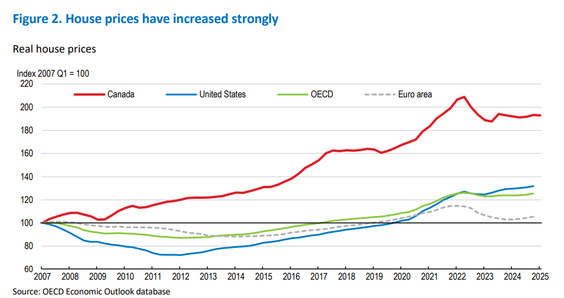
Canada's Gross Mismanagement Under Trudeau Liberals : OECD
"Rapid population growth has exacerbated previous housing affordability challenges. Housing supply should keep pace with immigration targets."
"The skill composition of recent immigration, which included many students and temporary workers, has also likely reduced average labour productivity."
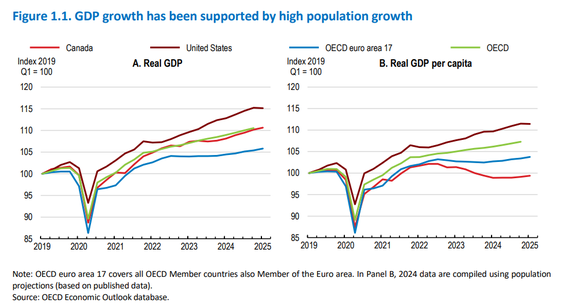
"[Canada's] GDP per capita growth has lagged in recent years, particularly compared to its close neighbour, the United States."
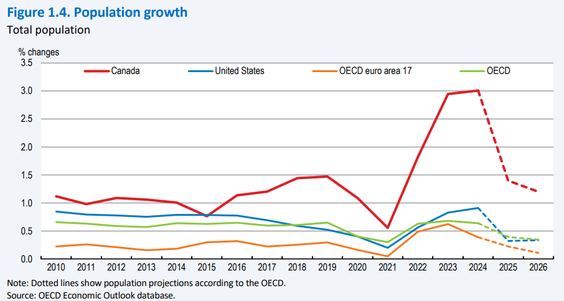
"Canada's population grew rapidly, by 3.0 percent in 2023 and 2.5 percent in 2024. This is much faster than in other OECD countries such as the United States or countries in Europe."
Organisation for Economic Co-operation and Development (OECD)
A Canadian flag is shown near the GM Oshawa assembly plant in Oshawa,
Ont. (Carlos Osorio/Reuters)
A group of 38 countries representing the developed world, the OECD conducts a comprehensive "economic survey" of each of its members, produced by economists from within the OECD every two years, presenting the completed survey to the member-country for its edification. In the latest issue of its survey for Canada, the report was anything but flattering to the way in which the Canadian government under the Liberal Party under the leadership of its former prime minister Justin Trudeau had governed the country. Under that leadership productivity suffered; openly excess immigration resulted in a crippling of the country's universal health care system, and its unaffordable housing stock, all the while doing its utmost to conceal from the Canadian public the state of economic growth in Canada.
The most recent survey presented to Canada placed a particular focus on housing, goods affordability and worker productivity, areas where the country now ranks with the developing world's most laggardly. Record high immigration was singled out for its effect on worsening the problems. Canada, warns the OECD, has accepted millions of new immigrant workers into its labour force, lacking comparable increases in "productivity-enhancing investment". The stagnant economy that has resulted relates to workers in Canada receiving an increasingly short share of the economic pie in total.
Canada's previous immigration intake system prioritized high-skilled immigrants in professions such as medicine and engineering. In contrast, migration flows now are mostly comprised of low-skilled workers. Statistics have indicated that Canada has become an outlier on housing affordability, placing in the OECD's most recent tally of "price to income" ratio the regrettable situation that identifies Canadian housing to be the highest of all member states other than Portugal.
In OECD rankings of gross-domestic-product growth per capita, Canada has been identified as one of the worst performers over the past ten years that correlate with the governance of the Trudeau Liberals. For comparison, GDP growth per capita from 2014 to 2022 was close to three times higher than Canada's in the United States, at 1.7 percent. A note of optimism appeared in the report in its summary with the declaration that Canada's economy is "resilient", endowed with "robust public finances".
Canada's immigrant intake represented a million newcomers absorbed annually. In 2022 the Canadian population was about 38.5 million; three years later it stands at 41.6 million, increased by over three million, judged to be some six times faster than its peers in the OECD where in 2023 the average OECD country grew by 0.5 percent, in comparison. The report confirms as well a phenomenon Canadian analysts have warned of since 2023: that Canada has been in a "per capita" recession for several years.
This worked out to about one million newcomers entering Canada each
year. At the beginning of 2022, the Canadian population stood at about 38.5 million. Now, it’s at 41.6 million, an increase of more than three million.
While the injection of three million people appeared to increase GDP, given their impact on the economy paying rent, buying groceries and thus contributing to the amount of money circulating within the economy, on an individual basis the reality is that the average Canadian's wealth and purchasing power has been notably dropping. When ranked by "real GDP per capita", Canada's economic performance falls behind dramatically. The subtitle of the report aptly reads: "GDP growth has been supported by high population growth".
"Inflationary pressures from higher tariffs will require a more
cautious approach to lowering interest rates."
"Increased government spending, particularly on housing
affordability and new social programs, has recently worsened the
general government balance, although it had previously been in surplus." Organisation for Economic Co-operation and Development
"The struggle to uncover the whole truth of Mexico’s Dirty War has been
long and arduous. For years, the Mexican government maintained a policy
of denial and obfuscation regarding its actions during this period."
"It
wasn’t until the early 2000s that significant efforts were made to
investigate these crimes, leading to the establishment of the Special
Prosecutor’s Office for Social and Political Movements of the Past
(Femospp)."
"However, despite these efforts, justice has been slow, and
many cases remain unresolved."
The Latin American Post
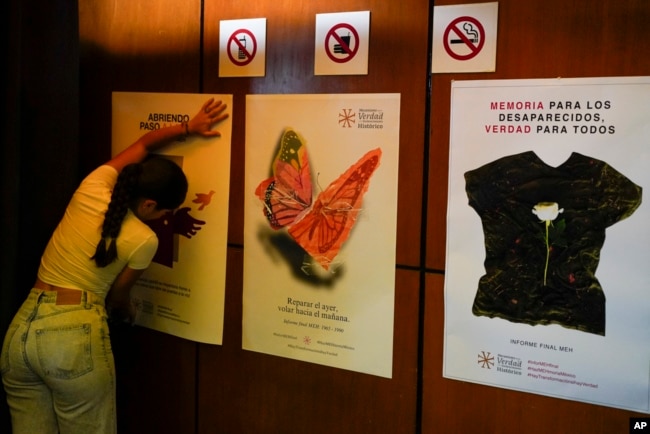
Posters about missing people are placed on a wall
for the presentation of a report about the country’s 1965-90 “dirty war”
by Mexico's governmental Truth Commission in Mexico City, Aug. 16,
2024.
Argentina's infamous 1976-1983 military dictatorship and its well-earned reputation of 'disappearing' its critics and political opponents is an internationally recognized representation of the corrupting power of such powerful groups in their victimization of populations whose human rights have been regularly violated. The well-publicized horrors undergone by Argentinians never knowing where their family members suddenly disappeared to, and the sinister rumours of macabre death missions when secret prisoners were disposed of by dumping their bodies into the sea represented the stuff of nightmares.
Now, though similar, but limited-scale, such operations that took place in Mexico have long been rumoured and Mexicans called upon their government, one administration after another, to investigate and finally produce a true picture of what had occurred, to put to rest the agony of families whose members had disappeared without trace. Finally a governmental Truth Commission has done just that, revealing the scope of the decades-long secret operation and the scope of its impact.
Mexico's 1965-1990 "dirty war" mystery is finally unravelling with emerging evidence of Mexican authorities having disposed of dissident bodies. The revelations by the country's governmental Truth Commission's report relied on witnesses and documents that were leaked over the years which detailed victims' chilling last moments in executions reflecting the Mexican government's efforts to eliminate leftist and guerrilla movements challenging the legitimacy of the military government.
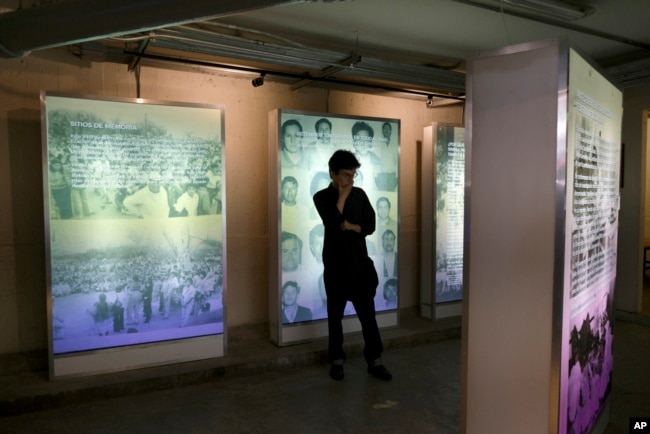
A visitor looks at an exhibit during the
inauguration of a memorial to victims of Mexico's "dirty war" at the
former Federal Security headquarters where protesters were taken in 1971
following a violent crackdown in Mexico City, June 10, 2019.
Apprehended individuals, as yet individually unidentified, one by one were directed to stand beside a bench at a military airfield located near Acapulco, believing their photographs were to be taken. Instead, each was shot in the back of the head, and their bodies disposed of by being dumped out in the Pacific Ocean by planes dispatched to that very specific government mission. Testimony given by a man who served in a military police unit of the time related that the gun used in the killings most often, was given a nickname: "the sword of justice".
It is speculated that up to 1,500 victims met their end in this way, though there is no way to be certain of numbers, much less the identification of them as missing individuals. Another witness who worked as a military aviation mechanic, described having taken part in fifteen of the death flights. He spoke of female victims that were offered release or that of their husbands dependent on their agreeing to have sex with soldiers. None of them, to his recollection, had been released.
Log books for about 30 flights by one plane from the base between 1974 and 1979 were located by the truth commission. Another 25 flights were claimed through another witness statement dating two decades in the past, from a man claiming to have been an armed forces deserter. A list of 183 names of likely victims of "death flights" had been held in the possession of a deceased rights activist. Matches were found for people who had disappeared during the counter-insurgency campaign led by the government.
Small rural guerrilla movements in Guerrero state where Acapulco is located appear to have been the target. Swept up in the disappearances and killings, a broad range of people were included; fishermen in the area recalled seeing bodies wash up on shore. This obvious evidence of what many had suspected led the military to begin placing the bodies in sacks weighted with rocks, before disposing of them in the ocean.
These are but a small part of details within the 4,000-page report whose contents include executions, torture, disappearances and forced displacement against farmers, students, union activists and members of Indigenous groups, by the government.
The truth commission cited evidence that there were roughly 4,500 identified victims of severe abuse during the "dirty war" in Mexico; another 1,450 were documented as killed, while 517 were categorized as disappeared with no trace. Excavations have been carried out by the government, in and around military bases in recent years in an effort to relocate remains of the buried in clandestine grave sites, realizing scant success.
600 possible perpetrators of the abuses were asked by the commission to be investigated for involvement.
"Descriptive studies like this are like paintings -- different people will see different things in the numbers."
"But the reality is that what lies behind the earnings differences reported is nuanced, complex, and largely unknown."
"It's almost a fundamentally unidentified problem. [Rather then automatically believing gaps in earnings and education to be rooted in] injustice or unfairness [it is important to remember] people make different choices."
Mikal Skuterud, economist, University of Waterloo
"[The report set out to measure weekly incomes of Canadian-born people between the
ages of 25 to 44 in 2016, a census year, based on a dozen visible
minority categories. as a setting for the country's Anti-Racism
Strategy, committed to] removing barriers and promoting a country where
every person is able to fully participate and have an equal opportunity
to proceed."
"Only about one in twenty [visible minority members] live in smaller cities, towns and rural areas, compared with about one in three white people."
StatsCan Report, Theresa Qiu and Grant Schellenberg
People
of colour born in Canada are more likely than white people to have
university degrees. That contributes to higher earnings.Photo by Handout /Vancouver Sun
Statistics Canada has issued its latest report emanating from research on ethnic groups, focusing on earnings and educational achievements. Their results challenge the fairly universal social belief in discrimination in the workplace against visible minorities and people from ethnic minorities holding back advancement. What the report points out is that earnings vary widely for each ethnic cohort studied; some groups clearly flourishing, and others struggling to attain earnings parity.
Those of South Korean, Chinese and South Asian heritage appear to represent the top echelon of earners in Canada by and large, while Latin-American and Black groups tend to be among the lowest earners. Whites, on the other hand, are stuck for the most part in the middle of the pack with respect to wages and surprisingly enough are in the lower echelons regarding university education.
Such details, according to economist Frances Woolley of Carleton University, are critical to understanding the situation pertaining to achievement in both these areas regarding visible minorities. The federal Employment Equity Act places visible minorities as one of four groups covered; women, people with disabilities and Indigenous Canadians, make up the other three.
White Canadians were used as a majority baseline, enabling the report to pinpoint that some ethnic groups are performing significantly better than others in earnings and education. Striking differences between men and women is examined as is how people of colour tend to overwhelmingly choose to live in major cities in Canada.
The report also gently turns the table on preconceptions over outcomes being directly responsible by the presence in workplaces and educational opportunities by racist workplace supervisors or discriminatory educators. Outcomes in both areas are far more likely to be the result of complex life decisions people tend to make, for those people who fail to move up the ladder of opportunity.
According to the report, most visible-minority Canadian women earn more than do white females, whose average was $1,120 weekly. Korean-Canadian women earned $1,450 a week while Chinese women earned $1,440; South Asian women $1,360;and Arab and Iranian women, $1,120. Black women on the other had, earned less, at $1,080, and Latin-American women made $1,000 a week.
Slightly more was earned by Korean, Japanese and South Asian men than white males, who took in $1,530, while Chinese-Canadian men earned about the same and Filipino and South-East Asian men earned roughly 15 percent less than white males, and Latin-Americans and Black males earned about 20 percent less.
When variables such as age, place of residence and educational levels are taken into account, other issues remain significant. The Statistics Canada report makes no suggestion where discrimination might be occurring in Canada, but both Schellenberg and Skuterud feel the data appears to raise at minimum one red flag: Black males fell further behind others in earnings in the period between 2006 and 2016.
Another surprise: People of colour born in Canada are likelier than are white people to gain university degrees. Over 60 percent of Chinese and Korean men earned a bachelor's degree at the very least, or higher, in comparison to 24 percent of white males, a gulf in educational attainment considered "astonishing", by Dr.Skuterud. Over 40 percent of South Asian, Arab, West Asian and Japanese men sought and gained university degrees.
The only ethnic groups less likely to have degrees as compared to white males were Black males, at 20 percent, and Latin-American males at 17 percent. And then there is the different lifestyle choices made by people of colour and whites, where 60 percent of all people of colour in Canada choose to live in just three cities; Montreal, Toronto and Vancouver, in comparison to a mere 27 percent of white people.
One reason many people of colour earn more than do white people, is the very fact that they live in metropolises where wages tend to be higher. White people, found the authors, were also likelier to be married, have children and not be living with their parents. U.S. research in particular has explored whether employers discriminate based on race or ethnicity, despite which, Dr.Skuterud points out "It's almost a fundamentally unidentifiable problem."
Sixty per cent of all people of colour in Canada
live in just three cities — Montreal, Toronto and Vancouver — where
wages are generally higher. That compares to only 27 per cent of white
people.Photo by KENA BETANCUR /AFP via Getty Images
How Good Is Canada's Universal Health Care System?
"Despite Canada's high level of spending, availability and access to medical resources is generally worse than in comparable countries."
"Canada's performance is mixed, performing well, or at higher rates than the average OECD country, on about half of the indicators examined, and at average to lower rates on the rest."
"Clearly, there is an imbalance between the value Canadians receive and the relatively high amount of money they spend on their health-care system."
Report, Fraser Institute, Canada
Biologics and Biosimilars: A Primerfinds that
Canadian patient access to potentially life-saving biologic medicines
is comparatively limited because Canada’s protection of intellectual
property in the life sciences—including biology and biochemistry—lags
behind other industrialized countries.
Canadians are justifiably proud of their universal health care system, paid through federal transfers to the provinces which are responsible for health-care delivery. It is Canadians' tax dollars that support this costly but vital service to all Canadians and residents of the country. Equal access to a comparable level of service transferable between provinces was the goal and although there are clear differences between some provinces and territories in their application of the mandated services, in general their delivery and quality satisfies most Canadians.
Yet there is ample room for improvement; starting with the fact that there are not enough physicians servicing Canadians in general practise as family doctors. And there is a clear shortage of nurses and other health-care workers. The new report issued by the Fraser Institute representing the fifth such annual critique of Canada's universal health care system, points out some of the more egregious failures pinpointed by the think tank which compares 28 developed countries with universal health-care systems to Canada's.
The purpose of the study was to compare and analyze just how the Canadian health care system performs in comparison to peer countries world-wide. Over 11 percent of Canadian GDP is spent on health care, representing the steepest of all countries which the study included, but for Switzerland. In Canada's case, the level of expenditure does not necessarily reflect top-level medical care, despite Canadian politicians routinely vaunting the system for its excellence.
Out of the 28 countries included in the survey Canada ranks 26th for the number of physicians per capita; ahead of South Korea and Japan, lagging the United Kingdom. And its ranking is 17th comparing the number of nurses per capita; again, ahead of Slovenia and behind France, beating the OECD average, but not in the case of doctors. On other indices Canada remains a laggard; with 10.5 MRI machines per each million population, and 16 CT scanners per one million people; in comparison the OECD average is 18 per one million and 29 per one million respectively.
On the other hand, by some other measures, Canada ranks relatively well, as for example on doctor consultations where Canada scores slightly above the OECD average, and as well above average on the rate of CT scans. Behind, however, on the average on MRIs and absolute last on the rate of acute-care discharges. Ranking really low are wait times; with a mere 43 percent of Canadians able to obtain a same-day doctor's appointment when ill, giving Canada a dead last tie with Norway.
The Netherlands was at the top with close to 80 percent of patients able to book a same-day appointment with a doctor when they're sick. Wait times for a specialist appointment also gives Canada a bottom rating, with 63 percent of patients waiting over four weeks, and 30 percent more than eight weeks. Elective surgery takes Canada to a poor rating with 18 percent of people waiting four months or more for treatment. Clearly ample room for improvement.
The Private Cost of Public Queues for Medically Necessary Care, 2020is a new study that finds long waits for surgery and medical treatment
cost Canadians almost $2.1 billion in lost wages and productivity last
year-costs that could increase now that many provinces have postponed
elective (or scheduled) surgeries as a result of COVID-19. Crucially,
more than one million Canadian (1,064,286) patients waited for medically
necessary treatment last year, and each lost an estimated $1,963 (on
average) due to lost wages and reduced productivity during working
hours.
"The same is not necessarily true with alcohol [Decreased tobacco use cost to the public]. In many ways, alcohol has become more widely available and allowing industry self-regulation results in a loss of policy control over alcohol marketing and advertising, especially online." "We have not invested in public health interventions designed to reduce alcohol use to the same degree as we have with tobacco and the data are showing this." "When we look at use [of opioids], the main measure of that is past-year use. So what you're seeing there is the effective public health messaging and prescription monitoring programs and better education in doctors to not use prescription opioids for chronic pain conditions -- all of these kinds of things." "But at the same time, the harms tend to be concentrated among a smaller group of people, and among that group of people, the harms are increasing." Canadian Centre on Substance Abuse (CCSA) scientist Matthew Young
Substance use in Canada costs $46 Billion
According to figures newly released by the Canadian Centre on Substance Use and Addiction, its Canadian Substance Use Costs and Harms report informs that substance use by Canadians costs close to $46 billion annually, representing just over $1,250 borne by every individual in the country. Fallout of substance use accorded with 275,000 hospitalizations and close to 78,000 deaths in the country, given figures reflecting 2017 data.
The report was meant to examine health-care and criminal justice costs, along with costs relating to lost productivity and other factors that can be attributed to the use of substances such as alcohol, tobacco, opioids, cannabis and cocaine, by the Canadian public. The years 2015-17 were covered by the report which shows alcohol and tobacco to represent the most damaging financially, accounting for $16.6 and $12.3 billion respectively (close to 63 percent of total costs).
Substance abuse costs 75,000 lives
When addictive drugs are examined, opioids accounted for $6 billion in public expenditures (12.9 percent), cocaine $3.7 billion (8.1 percent), cannabis $3.2 billion (7.0 percent) and categories of other central nervous depressants and stimulants, each of which accounted for close to $2 billion. The issues of lost productivity, associations of premature deaths, short- and long-term disabilities represented the largest proportion of substance-use costs at $20 billion, while health care at $13.1 billion and criminal justice costs $9.2 billion followed, as did other direct costs representing federal research funding, fire and motor vehicle damage, workplace drug testing and employee-assistance programs at $3.6 billion.
In comparison to a decade earlier, the per-person costs have steadily increased to about 30 percent with the costs associated with opioids having jumped over 20 percent and the costs confirmed for central nervous system stimulants including amphetamines and methamphetamines (excluding cocaine) to $54 per person. This, while alcohol consumption-related costs increased to $455 per person while the financial burdens reflecting tobacco use decreased to $336 per person.
With cannabis legalization, justice system costs will likely decrease. (CBC )
Cocaine is linked to the most significant trend, its costs and harms reflecting the impact it has on the larger society. "This matches a lot of reports we're getting from people working in harm-reduction and police enforcement. It was decreasing (during the years 2007 to 2014) because a lot of people saw cocaine as really dirty, with a lot of contaminants", explained Dr. Young.
Ontario accounts for the lowest per-person cost for substance use in the country where Nunavut and Northwest Territories had the highest because rates of alcohol and tobacco consumption are higher, and health care delivery is more expensive. COVID-19 is recognized as having an impact on the use of substances given initial increases of alcohol consumption at the pandemic onset -- since reduced and stabilized. Anticipation that the legalization of cannabis may lead to a decrease in criminal-justice costs is yet to be established.
"But the question some people are asking is are we going to see commensurate increases in health-related costs? My suspicion is not to the same degree because there aren't as many conditions associated with cannabis", concluded Dr. Young.
Alcohol and tobacco are costing Canada more than illegal substances per person. (Master1305/Shutterstock )