Truckers Convoy ... Liberal Government Overreach
"We are therefore of the view [like the Federal Court] that, on the basis of the record, Cabinet could not reasonably come to the conclusion that existing provincial capacity and authority could not effectively address the situation.""We are of the view that Cabinet did not have reasonable grounds to believe that a national emergency existed, taking into account the wording of the Act, its constitutional underpinning and the record that was before it at the time the decision was made."Chief Justice de Montigny, Federal Court of Appeal"This is an affirmation from the court that these are fundamental freedoms that Canadians have that were violated by the freezing of bank accounts, by the invocation of this act, by the banning of assemblies.""We're thrilled with the decision, and we think the court got this right."Christine Van Geyn, litigation director, Canadian Constitution Foundation"To claim that the threshold for declaring a public order emergency ... could be lower than the threshold for using the surveillance powers ... under the CSIS Act would make little sense. If anything, it should be the reverse. [Emergency powers demand more justification, not less -- particularly when they authorize] a vast array of draconian powers without any prior authorization.""When properly understood as requiring bodily harm, the evidence is quite simply lacking. As disturbing and disruptive as the blockades and protests could be, they fell well short of a threat to national security."Federal Court of Appeal
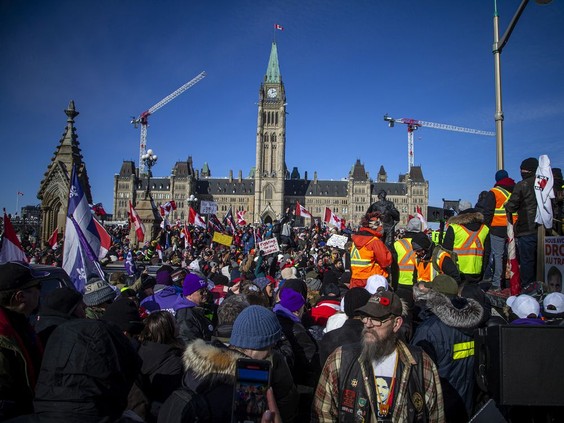 |
| Protesters gathered around Parliament Hill and the downtown core for the Freedom Convoy protest, some making their way from various locations across Canada, Sunday January 30, 2022. Photo by Ashley Fraser /Postmedia |
A ruling by the Federal Court in 2024 that the invocation of the Emergencies Act in 2022 as a federal government response to a convoy of truckers that drove from across Canada to Ottawa in a planned protest against the Liberal government's COVID lockdown procedures which required truckers to be masked at all times, mandating that immunization against COVID be an accepted protocol, struck this group as radical. In refusing to comply with the government's demands they risked losing their licenses to operate which drove them to mount their protest.
The national capital police and the municipality itself reacted in a confused manner in response to complaints from people living within the vicinity where the truckers congregated for a month, complaining of restraints to their daily routines, difficulty in accessing markets, disruptions to work schedules and day-and-night noise from incessant blaring of truck horns. When judicial stop orders to the noise were brought to play, the truckers complied, but their ongoing presence became a major local irritant. They were, nonetheless, practising their right to free assembly and citizen protest.
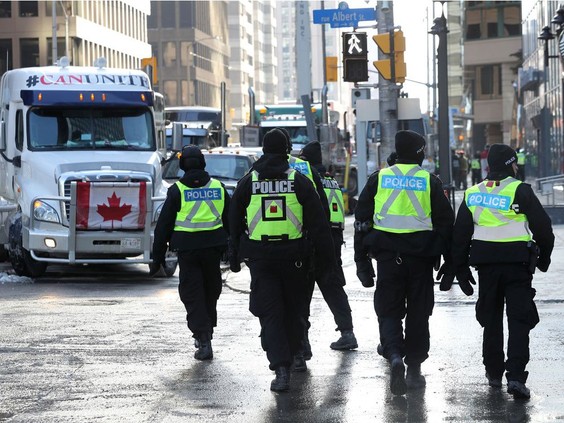 |
| Police patrol downtown Ottawa as a protest against COVID-19 public health measures enters its 11th day, with trucks and other vehicles blocking several streets on February 7, 2022. Photo by Tony Caldwell /Postmedia |
The federal government under then-prime minister Justin Trudeau was less than enamoured at the crude and rude truckers' messages in their disdain and disregard for his and his Cabinet's decision making. Which led to the decision to evoke the past when Mr. Trudeau's father as prime minister well before him, brought in the War Measures Act during the October Crisis emergency in Quebec when the Quebec nationalist group Front de libération du Québec began placing explosives in mailboxes, then turned to kidnapping politicians. Because of the stringent nature of the Act it was replaced by the Emergencies Act.
However, in resorting to the Emergencies Act, the Trudeau Cabinet overstepped its authority. The provinces did not support its use, the first time such an act was invoked since that of the War Measures Act in 1970 when its invocation was supported by the provincial premiers in the face of a violently dangerous situation which led to the murder of a Quebec politician. Once the Act was in motion, police stepped in to do essentially what they had already initiated in bringing order to the city center. Towing companies which refused to tow any of the trucks of the convoy were then forced to do so. Bank accounts of people who had written cheques to help fund the protest had their bank accounts frozen. The federal government began a campaign of legal intimidation against the convoy organizers.
It has taken three years for the courts to settle the case brought against the federal government by the Canadian Constitution Foundation and the Canadian Civil Liberties Association as well as a few individuals affected by the emergency measures, but the court in its wisdom accepted the CCF's position that the use of the Emergencies Act in this situation was unneeded and hugely overreactive. The court's judgment was unanimous, upholding the lower court's 2024 decision: the federal government cannot invoke emergency powers in a domestic protest.
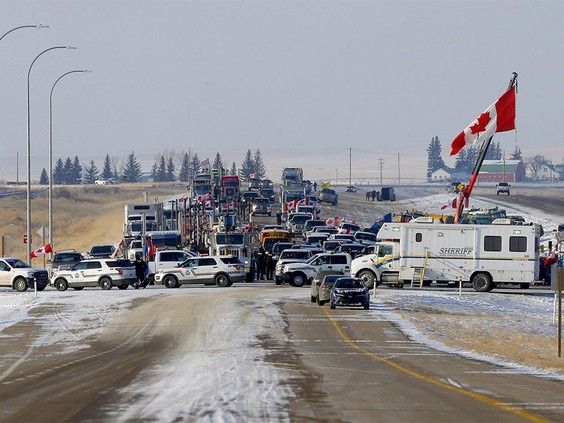 |
| Trucks were coming and going at the Coutts border crossing in this protest file photo. Photo by Darren Makowichuk /POSTMEDIA NETWORK |
The court pointed out that the federal Cabinet would have to believe Canada was facing a "threat to the security of Canada" before it would attempt to respond through the use of the Emergencies Act. In this instance, the government obviously felt that the truckers had no right to criticize and deride a decision impacting the entire population as overdone and an assault on individual liberties, where in Canada citizens have the right to express themselves freely, through the Charter of Rights and Freedoms which guarantee freedom of assembly and free speech.
The Canadian Security Intelligence Service itself assessed that no threat to national security was involved. The emergency powers act was brought into play even before a requested alternative threat assessment had been completed. The protests in question were cleared within the Criminal Code, with the RCMP commissioner advising the government that existing powers had not been exhausted by police.
"In a federation, provinces should be left to determine for themselves how best to deal with a critical situation, especially when it largely calls for the application of the Criminal Code by police forces." Should the situation not exceed capacity or provincial authority The court noted that privacy of individuals was invaded based on "potentially unfounded, subjective beliefs", which violated the protection of the Charter against unreasonable search, and was unjustifiable.
The Liberal government thought otherwise, and when the Federal Court issued its 2024 ruling that the government had erred in calling the Emergencies Act into play, they appealed that decision. Now the Federal Court of Appeal upheld the earlier Court ruling and in the process chastised the government for its decision-making. A federal government that went on to charge two of the convoy's organizers with criminal offences, putting them through years-long persecution in the courts.
 |
'Freedom Convoy' leaders Tamara Lich, Chris Barber given conditional sentences. Found guilty of mischief, both will spend a year at home with limited freedom. |
"There's a long history of courts in Canada and elsewhere in the common law world, being very deferential to politicians when they make decisions about emergency powers, and that can be very dangerous, and it's heartening to see the courts taking a rigorous approach and not just accepting what the executive says at face value.""It requires governments, no matter how high in the apex of the country's government you sit, that you have to be able to justify your exercised authority in reasons that are convincing to the courts and ultimately to ordinary citizens."Paul Daly, chair of administrative law and governance, faculty of law, University of Ottawa
Labels: COVID Restrictions, Emergencies Act, Federal Court of Appeal, Government of Justin Trudeau, Truckers Convoy
posted by Pieface @ 7:57 PM


0 Comments:
Post a Comment
<< Home