Ruminations

Blog dedicated primarily to randomly selected news items; comments reflecting personal perceptions

Wednesday, February 11, 2026

Terrorism Abounds in Pakistan

https://i.cbc.ca/ais/a8549788-a75f-4e4c-9682-3042b2359ea0,1770388878046/full/max/0/default.jpg?im=Crop%2Crect%3D%280%2C0%2C6209%2C4140%29%3BResize%3D796
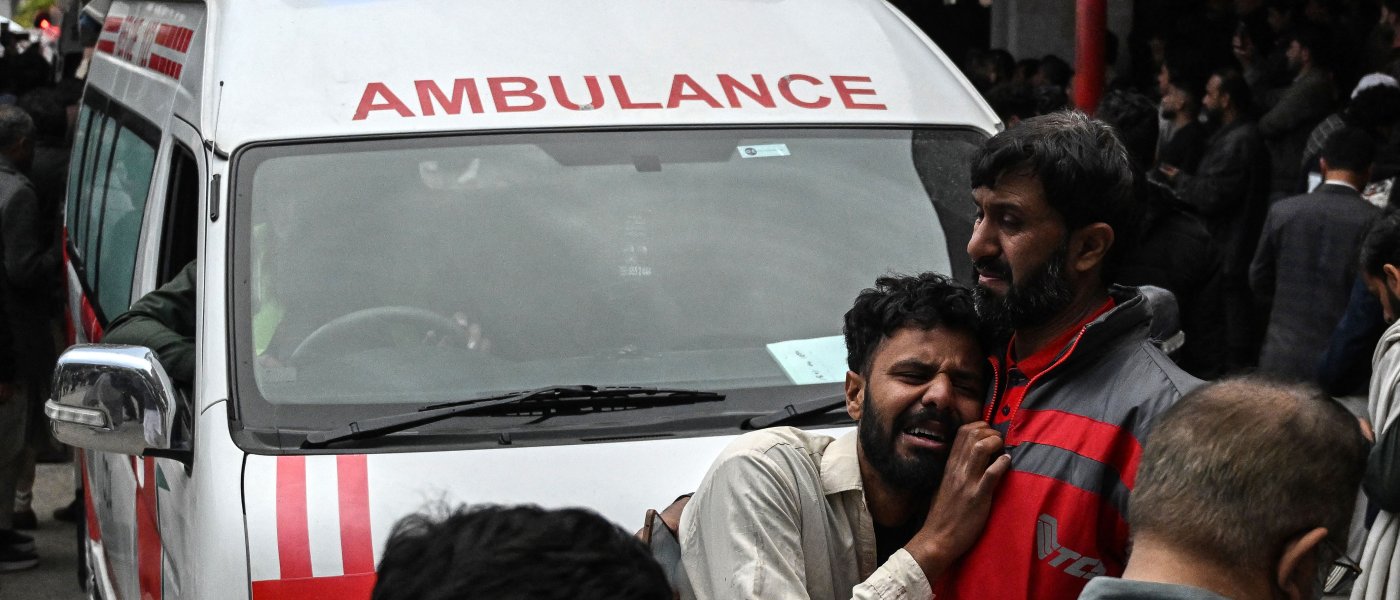
Rescue workers transport one of the many injured victims of the bomb explosion at a mosque in Islamabad on Friday. (M.A. Sheikh/The Associated Press)
 
"By the time I reached it there had already been an explosion."
"Bodies were lying everywhere, some were missing arms, some missing legs."
"We took the most injured in our own vehicle [to hospital]." 
Mosque caretaker Syed Ashfaq  
"The morning of February 6, a suicide bomber attacked a Shia mosque in Islamabad, Pakistan. The attack risks worsening regional instability amid a deteriorating security situation in Pakistan. Early reports suggest the attack was carried out by a single actor, who opened fire at security personnel outside a mosque before entering and detonating a suicide vest. In an official statement, Islamabad’s deputy commissioner announced that 31 people had been killed, with another 169 people hospitalized locally, but the death toll is likely to rise."
"No group has yet claimed the attack. Pakistan is home to an enormous variety of terrorist organizations: U.S. officials have identified at least 15 groups, while the Indian nonprofit South Asian Terrorism Portal has listed 44 terrorist organizations operating in the country. Most terrorist violence in Pakistan is associated with three actors: the Islamic State, Baloch militants, and Tehreek-e-Taliban Pakistan (TTP).
The most likely perpetrator appears to be the Islamic State–⁠Khorasan Province (IS-KP), which operates both in Afghanistan and Pakistan but has a significant interest in mass-casualty international attacks. The group has been implicated in a variety of recent international attacks and plots, including mass-casualty attacks against Crocus City Hall in Moscow and a memorial for Iranian General Qasem Soleimani in Tehran, and plots against the Paris Olympics, cathedrals in Cologne and Vienna, and protests outside of the Swedish parliament."
Center for Strategic and International Studies  
"[India -- Pakistan's eastern neighbour was] assisting the Taliban regime and threatening not only Pakistan but regional and global peace."
"[Pakistan takes strong exception to the situation in Afghanistan where the Taliban regime has created conditions similar to or worse than pre-9/11, when terror organizations posed threats to global peace." 
Pakistan President Asif Ali Zardari
https://csis-website-prod.s3.amazonaws.com/s3fs-public/styles/1400x600/s3/2026-02/GettyImages-2259595663_cropped.jpg?VersionId=86XBNuSeIR7tmmurw_5fSR7c55o8.CoY&h=266da715&itok=gCS_2sxu
Photo: Aamir QURESHI / AFP via Getty Images
 
Tension between Pakistan and the Taliban government next door are high, as Pakistan accuses the Afghan Taliban of supporting Pakistan's own Taliban. How things have changed; before and during the U.S.-led, UN-approved invasion of Afghanistan by NATO forces following the 9/11 atrocities in New York, Washington and Pennsylvania it was Pakistan  through its military and its Inter-agency Intelligence group that supported and gave haven to the Afghan Taliban, at the very time that it declared itself in league with the U.S. in combating terrorism.
 
Afghanistan was invaded by the combined Western forces led by the U.S. because the-then-governing Taliban was sheltering al-Qaeda and its leader, Osama bin Laden. Refusing to surrender Osama bin Laden, known to have been the mastermind of 9/11, a 20-year conflict was launched when the U.S. sought the elusive al-Qaeda leader in the mountains of Afghanistan. It was, in fact, in Abbottabad, Pakistan, at a secret compound, where U.S. Navy Seal commandos found bin Laden and killed him.
 
That compound was not far from a Pakistan army base. It was clear that Pakistan's military knew of the presence of the secretive head of al-Qaeda and likely facilitated his stay there. Next to the compound lived a Pakistani medical doctor who suspected that his neighbour was the infamous bin Laden, and in the belief that his country was in league with the U.S. to discover his whereabouts, he confirmed to the U.S. that the man whose suspicious presence was thought to be bin Laden, really was.
 
For his efforts, Shakil Afridi, the Pakistan physician who had been so helpful to the U.S. was later arrested, charged and convicted in a Pakistan court of treason, and sentenced to 33 years in prison. So much for Pakistan's double game of supporting the war on terrorism while enabling it and giving haven to its leaders. It's fairly rich that now, the country overrun with terrorist groups, portrays itself as an innocent victim. 
 
https://ichef.bbci.co.uk/news/1024/cpsprodpb/32ae/live/5a3a34c0-0443-11f1-9972-d3f265c101c6.jpg.webp
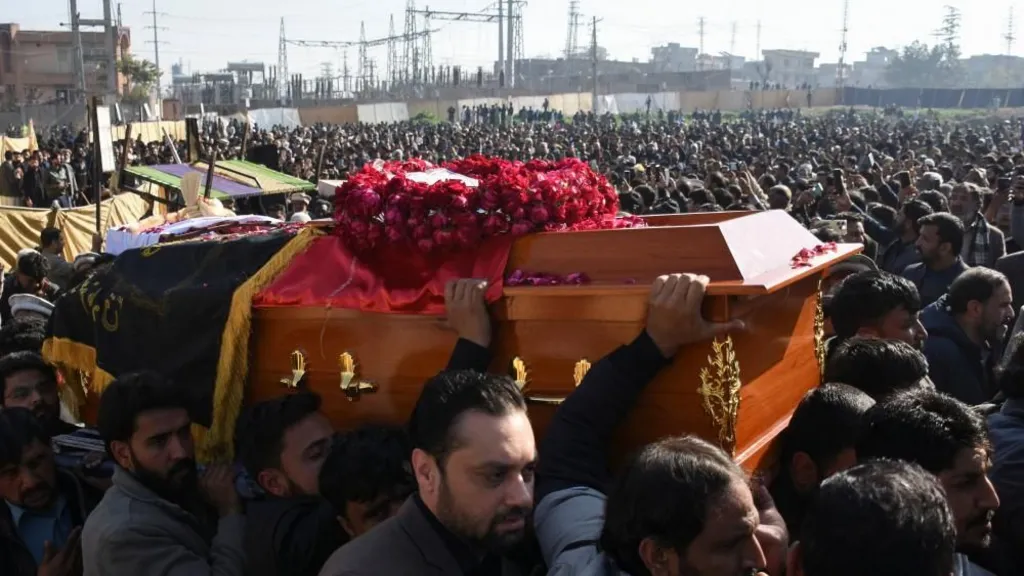
Thousands gathered in Islamabad to mourn the 32 victims of Friday's attack   Reuters
 
Pakistan accuses India of planning terrorist attacks on Pakistan's soil, but it was a Pakistani terrorist group, Lashkar e-Taiba that conducted a 2008 attack on India's financial hub in Mumbai. A dozen coordinated attacks took place over a period of three days of chaos and violence. Fire, grenade attacks and gunfire took its terror-toll of over $1-billion in damage. No fewer than 166 innocent people died in that series of attacks, with some 300 people wounded. India has much to blame Pakistan for; not the other way around.
 
Last Friday's suicide bombing that took place at a Shiite mosque killing 31 worshippers and wounding 169 was the work of Pakistan's own Islamic State terrorist group, which in fact claimed the glory for the gore it had created. The assertion by Pakistan that terrorism cannot be confronted by any single country in isolation, arrived after global reaction condemning the attack, but Pakistan's role in aiding and abetting terrorists that prey on other countries reveals them for the hypocrites that they are.
 
The government in Afghanistan responded to the claims from Pakistan by proclaiming its innocence in the affair. Its focus is on terrifying its own population, which apparently takes up all its energies, particularly addicted to characterizing women as somewhat subhuman whose role is to complement male desires and to produce following generations, with no self-agency, no rights, no access to education or personal fulfillment. 
 
https://i.cbc.ca/ais/df2aafd9-afb2-4a7c-85fd-4e9f3ffe8054,1770388593715/full/max/0/default.jpg?im=Crop%2Crect%3D%280%2C0%2C5819%2C3273%29%3BResize%3D860
Police commandos take positions at the site of a bomb explosion at a mosque in Islamabad, Pakistan's capital, on Friday. (Anjum Naveed/The Associated Press)
 
Both New Delhi and Afghanistan's Defence Ministry separately rejected the allegation of the Pakistan government, decrying Islamabad's irresponsibility. The Taliban in Afghanistan, returned to government with the withdrawal of U.S. forces and its allies in 2011, has continued its persecution of its  population and is itself the locus of the presence of other terrorist groups, including ISIS. The Pakistani Taliban, Tehrik-e-Taliban Pakistan, has also denied any link to the mosque bombing. 
 
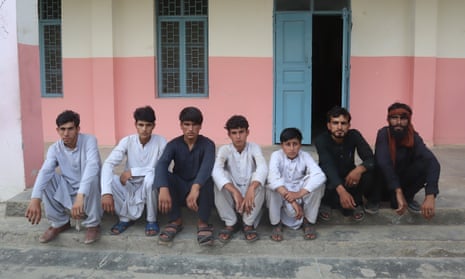
Pakistan's security forces arrested four suspects, among them an Afghan national accused of links to the IS group in Afghanistan, said to have assisted in masterminding the attack. The bomber's mother and brother-in-law have evidently also been detained, with the investigation ongoing. 
 

Labels: , , , , ,

Tuesday, December 12, 2023

A Problem-Plagued Airline in a Problem-Plagued Country

"On its scheduled return to Islamabad, the steward did not show up in Toronto."
"The flight of the national flag carrier had to return to Islamabad without the crew member."
"Another PIA [Pakistan International Airlines] crew member vanishes in Canada."
Simple Flying, aviation news site report
 
"A legacy of resilience: PIA's history as a national institution is the key to its future."
"The reason for this [disappearance of flight crew members] is [the] overly liberal asylum and asylum program by the Canadian government."
"We normally terminate the services of such individuals and penalize them by denying them of any benefits."
Abdullah H. Khan, PIA spokesperson
A legacy of resilience
 
Flight attendants from Pakistan International Airways have for years conducted themselves as their profession demands and in line with the airline's expectations on hiring them; taking care of passengers on flights from Lahore or Islamabad to Toronto. Somehow, mysteriously, they seem to disappear into the ether, failing to return to Pakistan on the returning flight. They deplane at Pearson, and from there are not heard from again. 

Aviation news site Simple Flying in the latest such incident reported that a flight attendant whose name is Ayaz arrived from Lahore on flight PK-784, but failed to report back and return when the plane flew back to Pakistan. Pakistan-based Ary News reported on November 13 that two flight attendants "slipped away" following their arrival on flight PK-772 from Islamabad to Toronto. On that occasion, crew members named Khalid and Fida failed to show up for their return flight as scheduled.

Over the past two  years, at least eight missing crews have puzzled the airline. A predictable pattern has emerged where the crew member exits the plane with colleagues, failing to show up for the return flight. A PIA spokesperson confirms the incident, notifies police and immigration officials, and contacted authorities claim to be investigating the incidents.

An earlier, April 2019 report made note of a crew member named Shazia vanishing following a Lahore-to-Paris flight, so this is not a problem unique to Toronto. Sources claimed she had left a resignation letter in her hotel room, a rumour denied by the airline. Stricter measures were announced by the airline last month to keep track of its employees on flights to Canada and Europe.

Among those measures is an age limit for flight attendants on such routes, requiring they be 50 years of age or older. More frequent check-ins are to be required and improved communications from staff members during periods of layover. 
 
In August, Pakistan International Airlines was reportedly unable to pay its employees and was forced to ground several aircraft, cutting some routes, as a result of unpaid bills; the same month that employees announced a two hour "token strike" over privatization plans and disappointment over salary raises that failed to materialize.

A crash in 2020 killed all but two passengers and crew aboard one of its Airbus A320 craft, along with one person on the ground and several others injured. The Airlines is awaiting a buy-out and a new owner in the hopes it can be guided to profitability once again.

https://smartcdn.gprod.postmedia.digital/nationalpost/wp-content/uploads/2023/12/PJT-Planes-Landing-Pearson-4.jpg?quality=90&strip=all&w=1128&h=846&type=webp&sig=G3vg2Oa6yuFb9QFW9b0Uhg

Labels: , , , ,

Wednesday, August 23, 2023

Deathly Suspense and Timely Rescue

"I had heard stories about miracles, but I saw a miraculous rescue happening with my own eyes."
"We suddenly felt a jolt, and it all happened so suddenly that we thought all of us are going to die."
"They were telling us don't worry, help is coming,"
"We cried, and tears were in our eyes, as we feared the cable car will go down."
Osama Sharif, 15, rescued schoolboy
 
"I thought I was the smallest and I would die before anyone. I had no hope when I did not see any help and failed the attempt till 4pm [….]"
"I became hopeful when the army rescued Irfanullah and I lost hope again when it became dark and the army halted heli operations. I regained hope when a local man rescued the second boy."
Ibrar Ahmed, 13
 
"After four hours, the first military helicopter hovered over our heads and he tried his best but it did not succeed."
"The second heli returned with no success as well. It made me very worried that helicopters were not succeeding and we will die soon."
"I was hell scared and all the children started screaming. We started holding each other as it kept dangling. I thought I was dead now."
Attualah, 16

"I could see death in front of my eyes."
"The wind pressure was too fast and the cable car was dangling and it had no doors from one side for over a year."
"Everyone was crying."
Rizwanullah, 15
 
"To be honest, no matter how I was making children calm and telling them we would survive, I did not see any chance that we would."
"It was a chaotic situation. But I was struggling to find ways and my phone saved us."
Gul Faraz, 24, local man
From left: Niaz, Attaullah, Usama, Ibrar Ahmed, Rizwanullah, Gul Faraz and Sher Nawaz, after their rescue.
From left: Niaz, Attaullah, Usama, Ibrar Ahmed, Rizwanullah, Gul Faraz and Sher Nawaz, after their rescue. Photograph: Shah Meer Baloch/The Guardian

Pakistan suffered a day of suspense praying for the rescue of six children and two adults on a makeshift chairlift that regularly transported people living in the area over a deep and wide ravine, that had suddenly malfunctioned, losing one of its guideropes, a cable that had broken, leaving the car dangling hundreds of metres above the canyon in a remote part of Pakistan. 

The passengers, in a routine method of transportation for the area and many others like it in geologically mountainous terrain where these makeshift chairlifts act as the sole means of travel and communication, became trapped early in the day on Tuesday. They were crossing a river canyon in Khyber Pakhtunkhwa province, Battagram district. The six children, all adolescents on the car, were on their way to school.
 
Military personnel are seen using ropes and harnesses carrying people to another location.
Pakistani military and local rescue workers bring people from the dangling cable car to safety using ropes and harnesses. (Pakistan Rescue Military/The Associated Press)
 
Nearby residents watched in horror as the cable car was suspended on its single cable, hoping it too would not break and send those clinging to it to certain death, as they awaited a government response that would bring the trapped people to safety. Throughout the country Pakistanis in their offices, shops, restaurants, homes and hospitals crowded around televisions in the grip of drama, clasping hope of rescue.

"Relieved to know that ... all the kids have been successfully and safely rescued", commented caretaker Prime Minister Anwaar-ul-Haq Kakar as he congratulated the military and other rescuers for that ultimate success of their endeavours. "Great team work by the military, rescue departments, district administration as well as the local people."

The rescue helicopters were  unable to fly after sunset, and it was feared that the wind created by the helicopter blades might further weaken the remaining cable. That concern resulted in rescuers shifting from an airborne rescue effort to an operation with high risks involving the use of one cable still intact to approach the car with the chairlift.

The commandos' rope was seen swaying in the wind against the mountainous landscape on footage played on television stations showing a child in a harness pulled to safety. Helicopter rescues in these circumstances described by an expert, are extremely delicate, emphasizing wind generated by helicopter blades threatening to weaken the remaining cable, it alone holding the car aloft.
 
The backs of dozens of people are shown in a mountainous area as they look up to watch a helicopter travelling through the area.
People watch as an army soldier slings down from a helicopter during the rescue mission. (AFP/Getty Images)
 
Most of the rescued children, handed over to their families burst into tears. "Everyone was praying for this moment" commented Nazir Ahmed, a senior police officer in the area where the rescue mission took place. Before the rescue was completed those on the stranded, swaying car were provided with food and water. Some of the trapped were enabled contact by cellphone with their families.

The cable cars are often poorly maintained to the extent that yearly people die or become injured while using them. They are a necessity in the region however, frequently used by villagers to get around the mountainous regions of Pakistan. After this heart-stopping episode that garnered the bated breath of the wider public, the president stated his intention that safety inspections be undertaken for the country's cable cars and chairlifts.

The group of eight, the two adults and six children, were marooned in those dangerous conditions for six hours, suspended precariously 350 metres above ground, even before the helicopters were dispatched after appeals were sent for an emergency response to a potentially deadly situation. In the event, the disaster management authority rose to the occasion.
 
Three children receive medical attention.
Youngsters who were trapped in a broken cable car receive first aid following their rescue, in Pashto village, a mountainous area of Battagram district in Pakistan's Khyber Pakhtunkhwa province, on Tuesday. (Nazir Mahood/The Associated Press)


Labels: , , , , , ,

Tuesday, March 08, 2022

What Goes Around Comes Around

"Panic spread among the worshippers when the firing started. I ran to save my life."
"Suddenly a man came in and started firing... He shot many people [and] then closed his eyes and blew himself up."
"After that, I have no idea what happened."
Hospitalized Pakistani worshipper at Shi'ite Peshawar mosque
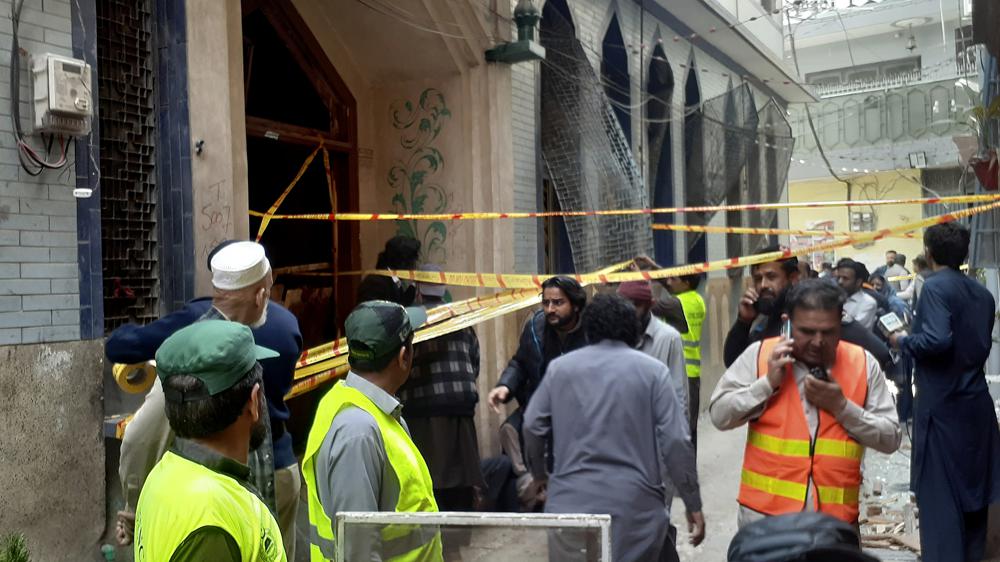
Soldiers inspect the mosque after Friday's bomb blast in Peshawar. (Abdul Majeed/AFP/Getty Images)
 
The death toll of 58 Shi'ite worshippers last Friday at a Peshawar mosque is likely to rise, according to police, given that among the 194 that had been wounded in the attack, many were in critical condition. The suicidal attacker is among the dead. It had not immediately been confirmed who was responsible for the attack. The Pakistani Taliban claim they were not involved, and initially no other group had come forward to boast of the attack.

Pakistan's Shi'ites have long been under threat by the Sunni majority, targeted by Muslim Islamist militants; Islamic State and Tehreek-e-Taliban Pakistan. In a sense, this deadly sectarian conflict can be laid at the responsibility of Saudi Arabia whose Wahhabist sect of puritanical Islam, dating back centuries and more recently renewed, was spread, courtesy of Saudi oil money that enabled the building of madrasas built everywhere in the Muslim world and beyond.

Students attending such schools are taught the fundamentals of 'pure' Islam, in which the concept of violent jihad is considered one of the pillars of Islam, an obligation of all true faithful of Islam to engage. One of the better-known, modern day illuminati of the Wahhabist school of Islamism none other than Osama bin Laden. The targeted mosque was the sole place of worship for Pakistani Shi'ites in the old city of Peshawar.

"We are in a state of emergency and the injured are being shifted to the hospital", disclosed police officer Mohammad Sajjan Khan. Wahhabist Islam considers Shi'ism to be false Islam and those who practise it, no more and no less practising apostasy. Jihad is directed to destroy their lives since they are regarded as opponents not supporters of Islam. 
 
An armed assassin arrived at the mosque on a motorcycle. He fired at police when he was stopped, then forced his way into the mosque hall crowded with the faithful, began firing, and finally detonated his suicide vest. Prior to entering the mosque the attacker shot at police guards standing at the entrance to the mosque, killing one. Police had the impression there were two men involved, initially. 
 
An injured man sits on a stretcher in Peshawar, after a bomb blast in a mosque during Friday prayers. (Khuram Parvez/Reuters)

There is deadly irony in this situation in Pakistan. While ostensibly a partner in the global war against terrorism, Pakistan's Inter-Intelligence Agency trained and armed the Afghan Taliban which found haven inside Pakistan's mountainous regions bordering Afghanistan following the U.S.-led invasion of Afghanistan to roust Osama bin Laden and al-Qaeda whom the Taliban were sheltering in Afghanistan. 
 
Bin Laden himself was eventually domiciled in Abbottabad, Pakistan, his compound located near a Pakistani military garrison, where US special forces eventually caught up with him.

And while surreptitiously Pakistan, through its military was aiding and abetting the Afghan Taliban, in their own Islamist mountain tribal communities their own Taliban sprang up. The Pakistani Taliban became a threat the government of Pakistan had to reckon with, and still attempts to clamp down on. Although a unit of Islamic State eventually claimed it was involved in the suicide attack, it is entirely likely it was indeed the work of the Pakistani Taliban.

With the ascension to power in Afghanistan, the Afghan Taliban have emboldened the activities of the Pakistani Taliban. And they have launched attacks into Pakistan from the safe haven that Afghanistan has now become for them, despite that the Afghan Taliban had publicly vowed that the country they once again govern will never become a launching pad for terrorist attacks against their neighbours. 
 
Which was precisely what Pakistan had been from 2001 forward. Now, is is the government of Pakistan that has appealed to the governing Afghan Taliban to hand over any Pakistani Taliban on their soil who launch attacks into Pakistan. So far, none have been.

Rescue workers and volunteers gather at the site of bomb explosion in Peshawar, Pakistan, Friday, March 4, 2022. A powerful bomb exploded inside a Shiite Muslim mosque in Pakistan's northwestern city of Peshawar on Friday, killing more than 30 worshippers and wounding dozens more, many of them critically, police said. (AP Photo/Muhammad Sajjad)

Labels: , , , ,

Thursday, April 20, 2017

Civilizing Rural Pakistan

"Back home, you have to go anywhere with your father, mother or brother, because you are a girl."
"We are really proud. We follow her [Nobel Laureate Malala Yousafzai] and we will follow her in the future."
"In some areas, [of Swat, Pakistan] girls and boys are now even being taught in the same classroom."
"However we can help [by returning to Pakistan], we will."
Shazia Ramzan, 19, Pakistani woman studying in the United Kingdom

"If I'm wearing jeans and my friends [in Pakistan] see pictures online, they say: 'You forgot your culture'."
"Before [prior to being educated in the United Kingdom], my mind was closed. I thought education just related to my family. But now I think about all girls. I want to stand up for them."
"I believe I should go back to my country and try to make change there."
Kainat Riaz, 19, Pakistani woman studying in the United Kingdom
Malala Yousafzai (centre) with Kainat Riaz (left) and Shazia Ramzan, pictured in 2013. Picture: Jane Barlow
    Malala Yousafzai with Kainat Riaz (left) and Shazia Ramzan (right) in 2012. Photo by Jane Barlow

The two young women now studying abroad were 14 (Shazia) and 15 (Kainat) when they became victims of an infamous attack by Pakistani Taliban against young girls living in the Swat Valley who claimed an education for themselves. They were seated alongside their friend, 15-year-old Malala Yousafzai, when the encounter took place: "The Taliban stopped us, two boys -- or men. One was in the front and the other one came to the back (of the bus).

"He said: Who is Malala? [We had our faces covered (with niqabs) but Malala didn't. We were looking at him and then he shot Malala in the forehead. He shot me on my hand and shoulder, and Kainat's shoulder as well. Then he started shooting randomly", explained Shazia. The girls had been in fact, returning from a chemistry exam and the bus they were in was actually a converted truck, the girls sitting among others, on benches, when their attackers stopped the truck and entered it, searching for Malala.

Malala had gained a reputation for herself as a campaigner for girls' right to an education. She had deliberately made a target of herself by speaking up in an interview on Pakistani television, and by expressing her determination to become educated in an online blog posting, where she also emphasized that girls had a right to an education. Kainat went to a local hospital, and Shazia was treated in Peshawar, in a military hospital which hadn't the wherewithal to treat Malala.

Her injuries were too seriously life-threatening and too complicated and she was flown to the United Kingdom where surgeons there saved her life. The infamy of the attack spread like wildfire around the world, and focused on the plight particularly of Malala. Though other girls were in a similar position to Malala's own, it was she who had brought attention to herself through her public proclamations of dissent and defiance, supported by her father.

When Kainat and Shazia returned home to the Swat Valley after their recovery, the locals viewed them as unwelcome. Neighbours informed Kainat's family they should leave; her presence endangered the rest of the villagers because she had become a target for the Taliban. Neither bus nor taxi drivers would take her to school.The shooting of the girls took place in October of 2012, but by July of 2013 when Malala turned 16, she was invited to address the United Nations to deliver her message.

Offers came flooding in to her from prestigious schools eager to grant her the education she sought, at no charge to her family. Malala settled with her family in Birmingham, England and was enrolled at the private Edgbaston High School for Girls. Mindful of her two injured friends, she asked the international boarding school UWC Atlantic College in the Vale of Glamorgan which had extended an invitation to her which she declined for herself, if her friends could be offered the same opportunity.

And this is how Shazia and Kainat were recognized with full scholarships (paid attendance for a two-year period amounts to $100,000). Former British Prime Minister Gordon Brown, at that time a UN special envoy on global education, helped the girls procure visas. The girls settled in to study at Atlantic College, accustoming themselves to their newfound freedom to go wherever they wished, along with the pleasure of learning to swim.

Malala is now expected to go on to study at Oxford University. Both Shazia and Kainat have been given offers to study nursing at Edinburgh University, with mentor Gordon Brown assisting in finding the required funding. They both plan, on graduation, to return to their country of birth, to do what they can to ensure that all girls and young women have the opportunity to receive an education, and to never have to face the dread situation that they had encountered.
Malala's friends Kainat Riaz and Shazia Ramzan were also shot by the Taliban
Malala's friends Shazia Ramzan (left) and Kainat Riaz (right) were also shot by the Taliban Credit:  JAY WILLIAMS

Labels: , , , , ,

Friday, March 18, 2016

Condoning Cultural-Inspired Killing

"If my film ["A Girl in the River: The Price of Forgiveness"]can hopefully play a small part in getting legislation passed and [inspiring] introspection on why this exists in our society, how it manifests, it's a victory."
"We cannot compromise on the 52 percent of Pakistan [Pakistani women's human rights]. That is not the way [legislation protecting women's rights, but lacking implementation]."
Sharmeen Obaid-Chinoy, Karachi, Pakistan
"My firm opinion is that honour killings are community-sanctioned violence, and this cannot only be changed by laws. The perpetrator walks proudly with his chest puffed up with pride [having fulfilled his cultural obligation to restore honour by killing the one who brought dishonour]."
"There was one shelter for women in Karachi when its population was two million, and there's still one shelter, and the city's population is 24 million."
Zia Ahmed Awan, Pakistani lawyer
Ms. Obaid-Chinoy's documentary short film depicting the horror experienced by an 18-year-old Pakistani woman when her father and her uncle attempted to murder her, followed by the cruel imposition on her survival of the murderous attack, that she oblige convention and public opinion by forgiving the two men for their unforgivable assault upon her struck a powerful note for women in Pakistan. The cultural social practise of restoring honour by killing the woman responsible for flouting convention by eloping or embarking on an unsanctioned personal relationship outside of marriage, or marrying an 'unsuitable' man is not only a stain on Pakistan, it is also a frequently exported custom when Pakistanis emigrate to live elsewhere.

In 2014 over 700 women have been documented as having been killed, according to statistics arrived at by the Aurat Foundation women's advocacy group, though other groups cite much higher figures. The film, "A Girl n the River" had a special screening for Pakistan's Prime Minister Nawaz Sharif who after congratulating the film maker for having received an Oscar, made an announcement that his government would be "in the process of legislating to stop such brutal and inhumane acts in the name of honour". While he's at it, he might consider enacting legislation that he plans to have fully implemented, against persecuting Christian women, including those who spurn Islam.

Islamist fundamentalists and their political parties in Pakistan will resist any attempts to turn around long-standing and publicly respected customs that imperil women who refuse to comply with societal custom that dictates how they may live as women in an Islamist society. The kind of resistance that women like Ms. Obaid-Chinoy face in agitating and campaigning for justice and human rights assurances for Pakistan's women is not easily bypassed, for those women themselves place themselves in danger by their public condemnation of the status quo.

In rural areas of the country in particular tribal leaders make it their first order of business to respond when a woman in their community has done the unthinkable, taken the initiative to make a personal choice that will dictate her future in the decision to seek a divorce, elope with someone her parents have not chosen for her, or insolently insist on making her own choice in these matters. Eloping couples are hunted down and killed, as an example to others who might wish to emulate their unsanctioned behaviour bringing dishonour to the community.

"There is so much pressure from the tribal leaders and landlords, and even from the families [in support of honour killings]. There is maybe one case out of dozens that ends up in court", explains Farida Hashmat, a lawyer. "Very few people get to the court." And should a woman attempt to report her fears to police she will come hard up against disinterest and an unwillingness o intervene. Police involvement with upholding the law is lax, there are few resources dedicated to giving haven and support to abused and threatened women, and existing legislation has few mechanisms for implementation.

When, in Punjab Province, a new law was enacted by legislators offering protection to victims of domestic violence, it faced condemnation by right-wing parties. Conservative politician Maulana Fazlur Rehmen described the law as a "humiliation of husbands". During a television broadcast cleric Mufti Muhammad Naeem spoke of Ms. Obaid-Chinoy as an "obscene woman".

Labels: , , ,

Tuesday, June 02, 2015

Pakistani Jihadist Deportees

"We anticipate Mr. Ansari's removal will be effected in the near future."
"We do expect that it will be within the next month, but I can't get any more specific than that right now."
Naureen Ismail, officer, Canada Border Services Agency

"[Muhammad Aqeeq Ansari refused to acknowledge the Sipah-e-Sahaba Pakistan had] murdered thousands of people in Pakistan for not sharing their religious views [that it was] a reflection of either wilful blindness or a shared mentality that it is permissible to eliminate anyone who does not share your faith perspective."
"It could have been acceptable that the reason he spent $20,000 purchasing guns and ammunition was the result of the financial irresponsibility of youth and the novelty of having hundreds of thousands of dollars at his disposal."
"The fact, however that he amassed $20,000 in guns and ammunition over such a short period raises questions and concerns, that remain plausibly unanswered, regarding his motives and whether there was an underlying plan given that he also spent a fair amount of time at the gun range practising his shot."
Immigration and Refugee Board
Muhammad Aqeeq Ansari has lived in Canada since 2007 when he arrived on a student visa. But he is now destined to be removed and returned to Pakistan when travel arrangements are finalized. CBSA officers will escort the man back to Pakistan. Mr. Ansari has waived his right to an assessment of the risks he could face on returning to his native country; he has previously insisted that he wishes to return.

A very nice match for Canada's wish to expel him. Immigration and Refugee Board member Karina Henrique has ordered that Mr Ansari, considered a potential flight risk as someone suspected of plotting harm in Canada, remain in detention, his release being "out of the question". His permanent residency status was removed, and he was ordered deported last month after a ruling that he was a member of the terrorist group Sipah-e-Sahaba Pakistan.

Aside from stockpiling firearms in his brother's basement in Peterborough, Ontario, he had made trips to Pakistan to visit with a cleric who fought "jihad" in Afghanistan. His Internet ramblings about his fundamentalist beliefs also marked him as someone Canada would best be rid of. He was found to be linked to the Pakistan terrorist group by association with a Pakistani Deobandi cleric, formerly a jihadist fighter.

It is known by Canadian intelligence authorities that he was involved with the terrorist jihadi group before his arrival in Canada, and while in Canada had solicited funds for them while promoting the group's goals online. One down, another yet to go. Jahanzeb Malik, arrested in Toronto in March is still awaiting a decision whether to be deported as a threat to Canadian security.

In May an undercover officer with the RCMP testified that Mr. Malik had planned to travel to Syria to join the Islamic State but decided to conduct a terrorist attack in Toronto instead, since he feared he would be detained while attempting to leave the country for his Syrian destination.

Jahanzeb Malik, 33, making an appearance at the Immigration Refugee Board hearing in Toronto on Monday.
Stewart Bell/National Post    Jahanzeb Malik, 33, making an appearance at the Immigration Refugee Board hearing in Toronto on Monday.

Labels: , , ,

Thursday, August 28, 2014

Britain's Shameful Conscience

"There were examples of children who had been doused in petrol and threatened with being set alight, threatened with guns, made to witness brutally violent rapes and threatened they would be next if they told anyone. Girls as young as eleven were raped by large numbers of male perpetrators."
"The collective failures of political and officer leadership were blatant. From the beginning, there was growing evidence that child sexual exploitation was a serious problem in Rotherham."
"Some councillors seemed to think it was a one-off problem, which they hoped would go away. Several staff described their nervousness about identifying the ethnic origins of perpetrators for fear of being thought racist; others remembered clear direction from their managers not to do so."
Alexis Jay, author, independent report

"Cultural sensitivities should never stand in the way of protecting children."
"It is hard to imagine the damage caused to victims who were preyed upon with almost impunity over many years, because of a reluctance to comprehend or address what was widely happening."
John Cameron, head of helpline, National Society for the Prevention of Cruelty to Children

"[Rotherham victims: They were the ones with troubled family backgrounds, with] a history of domestic violence, parental addiction, and in some cases serious mental health problems. A significant number of the victims had a history of child neglect and/or sexual abuse when they were younger. Some had a desperate need for attention and affection. [A third were already known to social services because of child protection and child neglect, domestic violence and school truancy.]"
"I didn't want the story to be true because it made me deeply uncomfortable. [However] I could not escape a nagging feeling that I hadn't done my job properly [in 2003 in Leeds; stories of young teenage girls targeted by 'Asian men']. I'd looked the other way rather than sought to establish the truth."
"[His conscience nagged by 'strikingly similar' stories from towns and cities across northern England and the Midlands]. It was always more than one man in the dock. And it was hard not to notice that ... the convicted men in each case had something else in common. They invariably had Muslim names."
Andrew Norfolk, reporter, The Times

The report found 1400 children were abused in Rotherham from 1997 to 2013. The report found 1400 children were abused in Rotherham from 1997 to 2013. Photo: Getty Images


What was widely happening was the gross sexual and violent abuse of defenseless children by predators whose success in their venture went unopposed, leaving them with the correct impression that because they were of Pakistani origin no one would dare confront them for fear of social backlash in a country that has become too 'liberal' in its multicultural consciousness to 'stand in judgement' of violent crime committed by minorities.

Rotherham, a borough of 250,000 people, sits in England's industrial north. Rotherham, a borough of 250,000 people, sits in England's industrial north. Photo: Getty Images

And not just any minorities, but those of southeast Asian descent, Muslims whose takeover of parts of Great Britain is so complete that their cultural heritage predominates leaving them to feel quite at home in their demands for Sharia law and unquestioning surrender to their very particular entitlements. So the "collective failures" by authorities over a period of sixteen years to protect children from the gang violence and sexual predation of criminals was left unchecked.

This, even while in some media reports were being circulated of these despicable crimes against children and no one in authority appeared ever to take notice. Not that the abused children and their frightened families never complained to authorities. More that those in public office chose not to react in fear of exposing themselves to charges of racism.

Those accusations seemingly more to be avoided than to act in defence of the defenceless. Britain does have a well-earned reputation for the lax manner in which it chooses to give safe haven to child predators ranging from public figures to these gangs.

Ms. Jay, formerly chief social work advisor to the government of Scotland, informed the British Broadcasting System that she was "very shocked" by what was revealed to her when she investigated what had been happening in Rotherham. From her understanding that police "regarded many child victims with contempt", to the first of the reports being "effectively suppressed" because senior officers chose not to place any trust in the data.

So, in a town of some 250,000 individuals as many as 1,400 children were beaten, raped and trafficked between 1997 and 2013. Blame points directly now to mostly British Pakistanis who trafficked children to other towns and cities in northern England; the children abducted, beaten and completely intimidated. Five men were jailed in 2010 convicted of grooming teens for sex. And from that time forward the full spectrum of the sex trade in young children was finally revealed.

Implicating Pakistani criminal rings plying their trade in Rochdale, Derby and Oxford, as well as the now-infamous Rotherham, England.

Labels: , , , ,

Saturday, July 26, 2014

First Pakistan team of climbers scale K2 summit

The first team of Pakistani climbers to scale the world's second tallest mountain, K2, has arrived at the summit.

K2 lies in Pakistan, near the northern border with China. The climbers made it to the summit at 02:30 (22:30 GMT on Friday).

Mountaineers regard K2 as more challenging to conquer than Mount Everest, the world's highest peak.

Correspondents, however, say descending from the top is more dangerous.
The Pakistani climbers were undertaking their expedition on the 60th anniversary of the first successful ascent of K2.

Two Italians - Achille Compagnoni and Lino Lacedelli - reached the top of K2 on 31 July 1954.
View from the top of the mountain Individual Pakistanis have reached the top before
 
The current expedition - called K2 60 Years Later - includes six Pakistanis: Hassan Jan, Ali Durani, Rahmat Ullah Baig, Ghulam Mehdi, Ali and Muhammad Sadiq. Three Italians are also part of the group.

Individual Pakistan climbers have reached the top before - but this is Pakistan's first successful team attempt.

The BBC's Shahzeb Jillani in Islamabad says many have died returning to the base camp in the past as the descent is trickier.

In June, the Italian organisation supporting the Pakistani effort announced it had installed a weather station feeding data to the climbers and researchers monitoring activity in high mountain regions.

Graphic

Labels: , , ,

Monday, June 30, 2014

Just Another Honour Killing

It is a case of honour killing. The couple were not beheaded, but were killed with the knives and had severe signs of torture on their heads."
Muhammad Pervaiz, Satrah, Punjab police chief
According to the FIR, the couple
According to the FIR, the couple's family tied them up in public and beheaded them in a village near Sialkot.—File photo
"Their legs and arms were tied while their mouths were gagged with pieces of cloth. The father of the girl announced loudly that he was going to slit the throat of [his] daughter and her husband."
"He said they should learn what would happen to them [children urged to witness the murders] if they married someone of their own choice."
Muhammad Ijaz, neighbour
It was first reported that Sajjad Ahmed, 31 and his bride Muafia Bibi 17, had been beheaded in a grisly 'honour killing' that took place in Satrah, Punjab province in Pakistan. Neighbours have since denied the beheading; they were, they claim, stabbed to death in the presence of family and neighbours, including children whom the young woman's father who led the killing, insisted it would be instructive to the children to watch.

The young couple had their throats slit and onlookers watched as they then bled to death. This is Pakistan, after all, where honour killings are common enough that human rights groups claim 900 were reported in 2013, though it is generally believed that the number is grossly under-reported.

 A Pakistani woman Nargas Bibi shows family pictures of her son Sajjad Ahmed and his wife Muafia Bibi, who were killed by Bibi’s parents, at her house in Hussain Abad village near Sialkot, Pakistan, Sunday, June 29, 2014. AP Photo/K.M. Chaudary

Residents of this town explained that relatives of the young woman had convinced the couple they supported the marriage, inviting them to the town. Once there, they were drugged.They hadn't long to live, after that. It was a particularly gruesome honour killing. Hundreds of which go virtually unnoticed every year, considered by authorities as representative of domestic accidents or suicides.

They were slaughtered to restore family honour. The young woman evidently married without the consent of her father. For that cardinal cultural social sin she paid dearly. Police are said to have arrested five people who were involved in the atrocity, which is to say 'honour' killing.

In an earlier well publicized case of a couple who had married without her father's consent and who had been bludgeoned to death by her relatives outside a courthouse on a busy Lahore street, Pakistan's prime minister demanded that police chiefs explain why they had done nothing to intervene.

Labels: , , ,

Monday, June 02, 2014

Cultural Mysogyny

"I strangled her. I liked Farzana since she was a child."
"When Farzana was killed, I fell on her body. "But they pulled me off and started beating her body and her face with their shoes."
"[Muhammad Iqbal said his wife’s family was still threatening him.] "They say they will kill me and remove her body from the grave and burn it".
Muhammad Iqbal, grieving husband of Farzana Parveen, Faisalabad, Lahore, Pakistan
Ayesha Bibi was the name of Muhammad Iqbal's first wife. She bore him five children, more than adequately performing her duty as a pious, obedient Muslim wife. But his eye was taken by a girl, little more than a child, and he dispensed with his wife. Under Sharia, men of substance are able to have more than one wife. Clearly, Muhammed Iqbal wanted only one and when the girl on whom he had his eye matured he courted her.

But only after he had become single and eligible though her parents were eager to sell her to the highest bidder.

When the fact that Mr. Iqbal had once been arrested for murder -- but then charges dropped because he had paid blood money to escape punishment (to replenish his honour) to the family of the woman he had murdered, his very wife -- became public, revealed during the murder investigation of his second wife, it was hard to believe. But Aurang Zeb, the oldest of his five children said his father killed his mother in 2009; that his father was arrested but the children forgave him.

"We don't want to discuss whatever had happened in the past, but I confirm that we had forgiven our father Iqbal", said Mr. Zeb.The later second wife whose death he now sincerely grieves, was pregnant with her first child by him. She was set upon by her own family members in broad daylight in a busy thoroughfare outside the Lahore High Court to plea a case they had lodged in defence of charges brought by her family that Mr. Iqbal had abducted Farzana Parveen.

She died on Tuesday as she walked with her husband from their lawyer's office to the Lahore High Court to render a statement testifying that she had married Mr. Iqbal in free will. As they strode toward the court, they were surrounded by a crowd of men from her family village led by her father, two brothers and other relatives. A gun was fired, the bullet grazing her ankle. Her father Azeem, struck her with a brick he had taken from the road.

Her brother Zahid, and a cousin joined in the attack, her husband later recounted. "When Farzana was killed, I fell on her body. But they pulled me off and started beating her body and her face with their shoes. They say they will kill me and remove her body from the grave and burn it", he said in an interview. Her father Muhammad Azeem was arrested soon after the attack that killed his daughter, and he stated his lack of repentance in restoring family 'honour'.

The chief minister of Punjab province has ordered police to make certain the suspects face justice speedily. International embarrassment merits that kind of swift response.

After Mr. Iqbal had murdered his first wife, he hid from justice. And the very place where he stayed was with Ms. Parveen's family, until his arrest in April 2013, after the 2009 murder. Charged with that murder, blood money forgave him. This is the manner in which Sharia law makes murder of a woman a trifling matter and soothes the grief of family members.

He earned the ill graces of Parveen's family when he asked for her hand in marriage. The transaction was carried through with Mr. Iqbal agreeing to pay $800 in exchange for a dowry. When the family demanded more money, he objected and they never did come to an acceptable agreement between the family and Mr. Iqbal.

But Ms. Parveen was happy to marry Mr. Iqbal and they did just that, though her family informed police she had been married to a cousin, and Mr. Iqbal had kidnapped her.

Bizarre, Byzantine, and sad beyond belief that women in societies such as this are disposal objects taken in trade whose lives are firmly attached to those of the males in their family, while the women are denied free will and social equality, owned in essence by their fathers, their brothers, their uncles, their husbands.

Labels: , , ,

Wednesday, April 09, 2014

Is This A Demented World?

Musa Khan
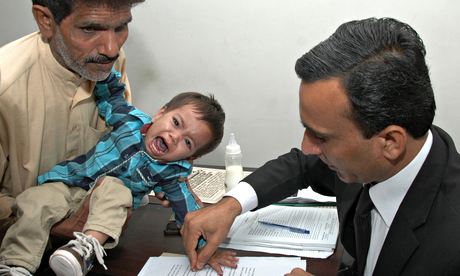
A lawyer takes a thumb impression from nine-month-old Musa Khan, who has been charged with attempted murder. Photograph: AFP/Getty Images

This is not a photograph of a fearful child receiving a life-saving inoculation against polio in Pakistan. This is a photograph of a nine-month-old child not yet able to walk, charged with attempted murder. Set to stand trial in a court of law. Held by his grandfather for the process of fingerprinting to take place, since the baby is not yet able to scrawl his signature. Shortly after the photograph was taken the baby became a fugitive from justice.

Sent into hiding by his family, to prevent any further indignities to occur to the tyke, unaware that he was born into a country where inoculation against poliomyelitis is considered a crime against Islam in some tribal areas, and where health workers attempting to administer protective serum are murdered for their humanitarian efforts. This is a country where the crime of apostasy can result in a death sentence. A country where blasphemy against the Prophet Mohammed can result in death.

It is a country so absurd that Mohammed "Musa" Khan from Lahore in Punjab province has been formally accused of attempting to kill gas company officials. "The child has been charged with attempted murder, with stoning the team, and injuring them", the baby's lawyer, Irfan Tarar explained. "He does not even know how to pick up his milk bottle properly, how can he stone the police?", asked the baby's grandfather Muhammad Yasin.

No matter, the official charge is an attempt "to murder with intention or knowledge". And the infant could face a maximum of ten years in prison with stricter penalties should a judge determine that the crime had taken place in "the name or on the pretext of honour", if he is convicted as charged. "Everyone in the court was saying, 'How can such a small child be implicated in any case? What kind of police do we have?'" the child's grandfather said to Agence France-Presse from the court.

The incident began when Pakistan's Sui Southern Gas Co. dispatched gas company representatives who were accompanied by a police escort, to enter the Ahata Thanedaran neighbourhood to investigate claims of natural gas theft. The police "First Information Report" stated the child, then all of seven months, together with a gang of 35 other people, attacked the officials with rocks.

Shahbaz Sharif, Punjab's chief minister, "in a bid to avoid further shame" suspended the officer responsible for the report, ordering the convening of an "inquiry committee" to investigate the matter, according to the country's largest English-language newspaper. The Pakistani Penal Code has a provision, Section 82 that states: "nothing is an offence which is done by a child under seven years of age".

Meanwhile the child has been spirited away for safety where he will not be found, after a judge released him on bail. And his grandfather believes the charge to be a fabrication in an attempt to have the family evicted from their land. It is what, after all, happens in Pakistan to Christians, falsely charged by Muslim clerics, even if they are little girls, of insulting Islam, happy to inflict the punishment of a jail term in an expression of contempt for religions other than Islam.

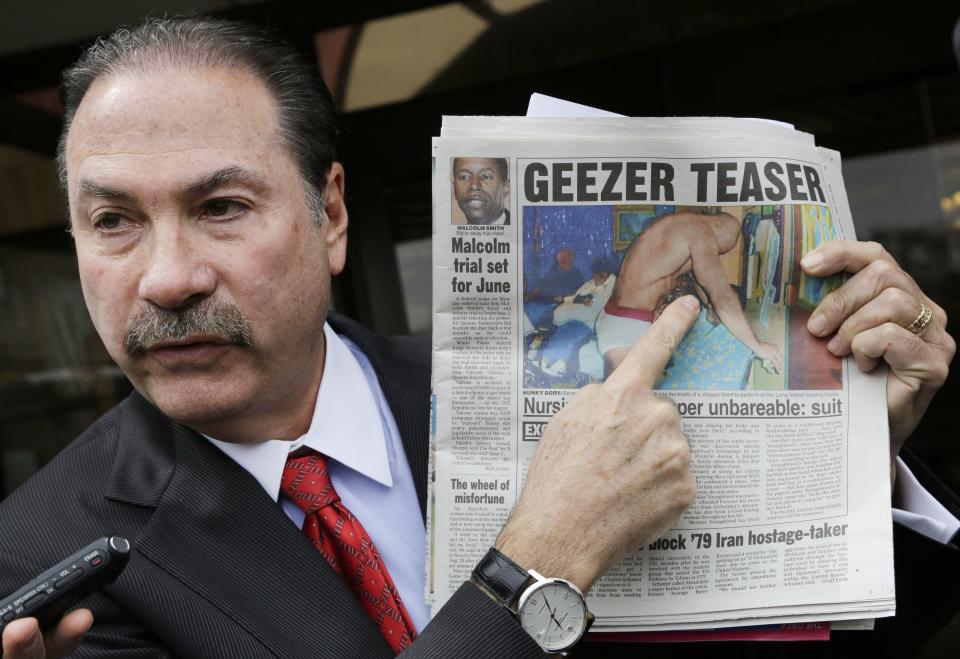
Oh, wait a moment ... I did mention that took place in Pakistan, a backward country, didn't I? How about a thirteen-year-old New Jersey boy suspended from school for twirling a pencil about in math class? Ethan Chaplin, in grade 7 at Glen Meadow Middle School in Vernon Township, New Jersey was playing with his pencil when another student shouted "He's making gun motions, send him to juvie!"

Well, thank heavens for a civilized, civil, mutually respectful society that boasts its way of life is a beacon of light unto the world. The school suspended Ethan, ordering him to undergo a physical and psychological evaluation. The boy was stripped and forced to give blood and urine samples for drug testing. A school superintendent affirmed that school policy requires an investigation should anyone in the school feel uncomfortable or threatened by another student.
Ethan Chaplin, 13 years old, discusses the motions that got him suspended (Photo credit: News 12) Ethan Chaplin, 13 years old, discusses the motions that got him suspended (Photo credit: News 12)

The shocked father said "I'm absolutely livid. I think it's gross misconduct at its finest. They took something so minimal and took it so far over the edge."

Right, no denying that ... and speaking of taking something minimal over the edge, we go from infancy to childhood to the elderly years, and this time for a little visit to the State of New York. Far, far away from Pakistan, to a democratic country that represents itself as a beacon of hope for the oppressed, but cannot represent itself as proudly boasting an intelligent citizenry, for people, it seems are cookie-cutter similar anywhere one ventures in this great, wide world.

The son of one resident of a New York state nursing home is suing the East Neck Nursing Centre in West Babylon, Long Island. Who can blame the man? His mother, he states was "violated", his highly religious mother. In an effort to bring some entertainment into the lives of their elderly residents, strippers were hired to cheer them up. The mother of the outraged Franklin Youngblood set to sue, was so entertained she stuffed dollar bills into a dancer's briefs.
Yahoo news
She, at least, among her peers, found relief from the boredom of being surrounded by others awaiting release from life, no long able to enjoy it. And if her son has anything to say about it, she will no longer be exposed to such outrageous events. "Bernice Youngblood has lived 85 years as a traditional Baptist, hard-working lady and now she has been defiled. We will be seeking at least a million dollars", stated family lawyer John Ray.


Does Bernice Youngblood know about this conspiracy to defend her religious honour and commitment to die bored and unentertained?

Labels: , , , ,

Saturday, January 11, 2014

The Pakistani servant girl tortured to death 

BBC News online -- 11 January 2014
File photo of Iram (left) with a family member in Lahore Iram (left) is believed to have suffered a horrific death
 
The case of a 10-year-old girl in Pakistan's Punjab province, whose employers confessed to beating her to death last week, has highlighted concerns about child rights. The BBC's Saba Eitizaz reports on a case that shocked the nation. 

Human rights organisations argue that Pakistan's labour laws ignore child abuse in a country where almost half the population is under the age of 18. It is an oversight which often has tragic consequences.

Evidence of that can be found in a small village in the province of Punjab, where a haunting wailing echoes off the crumbling mud walls of a ramshackle home.
It sounds like many mothers crying for lost children.

It is called the "wayne" - the song for the dead and is an integral part of the local funeral ritual.
Tortured
 
The village is called Moza Jindraakha which means "the place where life is protected".
Nasira Mahmood Nasira Mahmood has confessed to repeatedly beating the child with the pipe while her 16-year-old son stood by and watched
 
But things are different now - a young girl's death is being mourned.
Iram Ramzan was sent to Lahore to cook for a middle class family - so her own family could eat. Her two sisters are also employed as domestic helps for different families.

But Iram came back in a white shroud - apparently tortured to death by her employers.
Her mother Zubaida Bibi, who has lost her hand in a threshing accident, faced the prospect of bringing up three young daughters without a husband's financial support.

Zubaida says that she had little option but to send her daughters out to earn money as domestic servants.

She thought they would be safer in more affluent homes rather than on the streets. But she was wrong and has had to go through the torture of burying her youngest child - and now she does not know where to bury her guilt.

"Maybe we should have begged for scraps instead," the inconsolable mother laments. "How was I to know I was sending my daughter to her tormentors?"

Last year Iram's family was telephoned by a distant uncle in Lahore telling them to rush to the hospital.

Doctors said she had died on arrival. There were torture marks on her body and rope burns on her wrists and feet.
Child labourers in Pakistan It is commonplace to see children working on the streets in most Pakistani towns and cities
 
Her employers, the Mahmood family had brought her in. The police immediately took the family into custody.

The girl had been beaten to death with an iron pipe, which was later found in the Mahmood's home, along with the ropes used to tie her up.

Nasira Mahmood has confessed to repeatedly beating the child with the pipe while her 16-year-old son stood by and watched.

In jail, Mrs Mahmood is having tea and biscuits. She is almost casual when asked why she did it, saying it was all an accident and that no one expected Iram to die.

"Three times she stole money from me. I got angry, that's all," she says. "She said she was getting sleepy so I tied her up and left to make dinner."

Police investigators say that Iram died slowly, not accidentally and breathed her last while still tied up.
Police in Lahore Police and the authorities in Lahore and in other big cities are under pressure to eradicate child labour
 
"Right away, they admitted to having tortured her," says Police Superintendent Umar Cheema.
"There were marks of violence, indications of beating, swelling, indicating that the girl was tortured with a heavy instrument which later turned out to be a domestic gas pipe."

Iram's employers were paying her $23 (£14) a month - a small price to pay for her life.

In the same week that Iram died, another 15-year-old domestic maid, Azra, was found strangled to death in her employer's home in Lahore, allegedly the victim of sexual abuse before she was killed.

The Society For the Protection of the Rights of the Child (Sparc) say they receive about 20 cases like Iram and Azra's every year. These are just the cases where a child has died. There are many others featuring assault and abuse, many of which go unreported.

Sparc representative Sajjad Cheema says that whatever legislation for children that does exist is not being implemented because there are no administrative mechanisms in place to regulate child workers.

"The United Nations has sent a recommendation to the Pakistan government to adopt a child protection policy," Mr Cheema says. "We need to know whether we are going to let these children work like this, to die, or are we going to protect them, and how will we do it?"

Human rights groups say more than 12 million children are pushed onto the streets and the homes of strangers to seek an income.

Without a legal safety net, these children are slipping through the cracks with no one to catch them.
Meanwhile, in the village of Moza Jindraakha, a child-sized mound of earth marks Iram's resting place.

Right next to the graveyard, is a green and yellow field where she used to play with the other children - before her childhood and her life was cut short by a combination of cruelty, official indifference and poverty.

Labels: , ,

 
()() Follow @rheytah Tweet