Vladimir V. Putin's Deadly Obsession
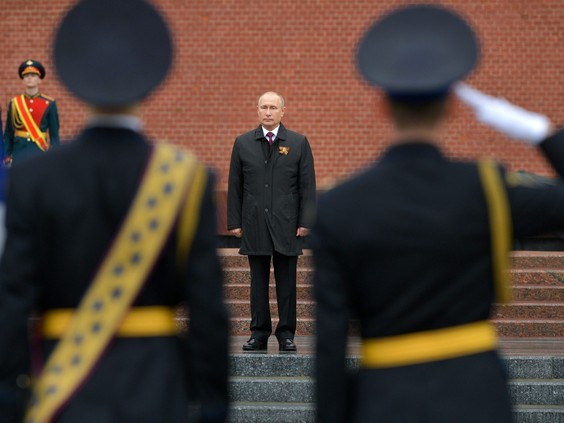 |
| While predictions of Russia’s economic collapse “are not without grounds,” Vladimir Putin's war in Ukraine is driven by profound mistrust of the West and will continue until that’s resolved. Photo by ALEXEY DRUZHININ/SPUTNIK/AFP via Getty Images |
"Four years after Vladimir Putin ordered an invasion of Ukraine, Russia’s economy has entered a 'death zone'.""Russia’s economy is stuck in what might be described as negative equilibrium: holding itself together while steadily destroying its own future capacity.""The most dangerous feature of this new structure is the fuel it burns. Russia’s economy now runs on what might be called ‘military rent’: budget transfers to defense enterprises that generate wages and economic activity.""The body is metabolizing its own muscle tissue for energy.""[Unlike a cyclical downturn such as a recession, what Russia is suffering from is more akin to altitude sickness] —the longer you stay, the worse it gets, regardless of rest.""Russia can probably continue waging war for the foreseeable future. But no climber can survive the death zone indefinitely—and not all climbers who attempt the descent survive it."Alexandra Prokopenko, a fellow at the Carnegie Russia Eurasia Center
Russian President Vladimir V. Putin is entirely fixated on his 'special military operation' in Ukraine, determined to see it through, irrespective of the sacrifices, and there have been many sacrifices; in human life, in political capital; in strained relations with most of Europe; in isolation as a war-mongering outcast; in a conflict-made economic downtown; in resorting to extraordinary wartime measures at home to silence his critics. The single-mindedness of his fixation is in fact, a pathology.
Mr. Putin's war, which really began in 2014 but was formalized in February of 2022 with a full invasion of Ukraine that the Russian president felt confident would result in no more than a few months of combat as Ukraine, with its much smaller, much less-well equipped military would simply fold, allowing the Kremlin to see a quick victory and a Ukraine subdued to the point of subservience which in Russia's opinion, is how it has always been and always will be, despite Ukraine's historical push-back to its neighbour's aggressive occupation.
Prior to the war, warning signals of economic stagnation loomed in long-term prospects for the country, with an economy dominated by extraction of natural resources leading to a situation where a need to diversify was never acknowledged as a priority for future prosperity. Now, for the past four years and counting, Russia has poured vast state resources into its president's war that has bogged down alarmingly, draining ever greater resources and forcing a move for higher taxation and prospects of rationing.
 |
| Volunteers depart for positions with the Akhmat battalion in Russia's military campaign in Ukraine, at an airport in Grozny, Russia. Reuters |
The financial cushion built over the years with oil and gas revenues, the National Wealth Fund that stood at $112 billion pre-war, has now been reduced to $55 billion even as 40 percent of the national budget is devoted to the military campaign and national security. Interest payments on the debt required to finance the war eats up another 9 percent of the federal budget. Technical innovation looking into the future of artificial intelligence is ignored while the two world powers, China and the U.S. compete, while Russia remains focused on weapons production.
Foreign investment is Russia is a thing of the past. High interest rates to tame inflation has crimped domestic investment. Up to an estimated 1.2 million Russians have been killed or wounded. Some 325,000 Russian troops, according to the Center for Strategic and International Studies in Washington, have died on the battlefield. There are predictions that the Russian population could plummet under 100-million, from a pre-war population of 145-million. Hundreds of thousands of Russians have fled abroad to escape wartime legal crackdowns on dissent.
 |
| A Ukrainian serviceman fires a Bohdana howitzer toward Russian troops at the frontline at Donetsk region. Reuters |
Chronicles, an independent Russian polling group, found 59 percent of Russians age 18 to 29 support withdrawal from Ukraine in the absence of Mr. Putin's goals being achieved, as opposed to 42 percent of all surveyed Russians; younger Russians are not enamoured of this war. Russia's oil and gas revenues experienced a steep drop as global prices fell and sanctions struck to impose Russian crude discounts. While businesses related to the military have profited, Russia's other businesses are struggling. Manufacturing has dropped, while higher taxes and costly loans are taking their toll.
"You have lots of money spent on tanks, shells, bombs, military benefits and other things -- no long-lasting value, nothing that works on what we call development.""This is a structural change of the Russian economy, of the design of the Russian economy, which is not easy to turn back."Alexandra Prokopenko, Carnegie Russian Eurasia Center, Berlin
Labels: Economic Stagnation, Oil and Gas Revenues, Russian Invasion of Ukraine, Sanctions
posted by Pieface @ 9:02 PM


0 Comments:
Post a Comment
<< Home