Chernobyl's Exclusion Zone ... A Theatre of War
"On April 26, 1986, technicians at Unit 4 in Chernobyl, Ukraine, were conducting a test of their RBMK nuclear reactor when they inadvertently started a runaway reaction. Excess, superheated steam built up, the core was blasted open, and a huge plume of radioactive material wafted into the sky. The heat was so intense that it caused the nuclear fuel still in the plant to liquefy, where it mixed with other materials, such as concrete, and formed a lava-like material that flowed into the spaces below. At least 31 people died as an immediate result of the accident, and tens of thousands of people living nearby were evacuated.""To contain the radiation, the ruined reactor was hastily entombed. Several months after the accident, the destroyed reactor was completely covered with a concrete and steel shell called the sarcophagus." "Authorities declared it would last 'for eternity'.""But '[t]he sarcophagus began cracking soon after it was built and must be strengthened or replaced. To complicate matters, the sarcophagus is also sinking into the earth, and the ground water is rather near the surface . . .', noted an article in the Bulletin of Atomic Scientists in September 1992. At that time, a Ukrainian parliament deputy, Vladimir Yavorivsky, called for ideas about what to do, announcing a competition among world scientists to come up with a solution to the failing tomb.""That was more than 28 years ago.""Now, finally, a multinational consortium is at the half-way point in building a huge, $1.5 billion, state of the art, all-stainless-steel hangar that will sit over the ruined remains of reactor Unit 4 like the world’s largest Quonset hut. Pictures in the New York Times show an immense and imposing structure whose construction is long overdue.""Tall enough to house the Statue of Liberty, the new, 32,000-ton hangar is being assembled a few hundred yards away from the still-radioactive site. Once it is finished, it will be rolled into place over the existing sarcophagus—which is starting to show its age. (A portion of the roof over the adjacent turbine collapsed last year, releasing a small amount of radiation.) Once in place, the new structure should contain radioactive dust, preventing any atmospheric contamination should the old sarcophagus collapse. The new building is expected to last anywhere from 100 to 300 years.""There is still some question as to what to do after the new cover is rolled into place and the site completely sealed up in 2017. Fuel is still contained amid the debris beneath the old sarcophagus; engineers are still undecided as to whether to remove it or leave it in place."Bulletin of the Atomic Scientists, May 2014
 |
| Credit: eight8 / Adobe Stock |
"Russia is once again bringing the world to the brink of a man-made disaster — Russian-Iranian Shaheds regularly fly over the [Chernobyl] plant, and one of them struck the confinement last year.""The world must not allow this nuclear terrorism to continue, and the best way is to force Russia to stop its reckless attacks."Ukrainian President Volodymyr Zelenskyy
Emptied of its human residents following the catastrophic explosion and meltdown at the Chernobyl nuclear power plant 40 years ago, the towns that were once home to tens of thousands of people now stand, ghostlike, nature exercising her generative power to encourage flora to grow exuberantly through broken windows where the evidence of a desperate emergency caused people to leave everything and just get out, remain evident in the presence of dishes left unwashed, children's shoes and toys scattered about, silent remnants of human habitation.
When people evacuated their homes, their towns and villages on April 26, 1986, the area became an exclusion zone. Even to the present day, high levels of radiation translate to a reality that never again may humans live in the areas affected. Yet these disaster areas now form another function, as a theatrical setpiece for military practise where Ukrainian servicemen trained amidst the ruins of one vibrant-habitation.
The elements of defence against irradiated land against Russian attacks, created a double practise for the soldiers, mindful of avoiding the most radioactive areas, while defending against Russian occupation there. Russian forces entered the Chernobyl zone in 2022, following the initiation of Vladimir Putin's
'special military operation'. It was occupied for a five-week period, where Moscow made use of the region as a staging area focused on attacking Kyiv.
The recent training exercises saw soldiers crouched along walls covered with mould, aiming their rifles. Live grenades were thrown into homes, further damaging dry-rot crumbling walls. Chernobyl has become an army-controlled security belt along the border with Russian ally Belarus. Fire and radioactive material spewed into the atmosphere in the world's worst nuclear disaster when the plant exploded in 1986. The explosion killed two workers followed by dozens of emergency workers dying from radiation exposure in the weeks that followed. An estimated 200,000 people were relocated.
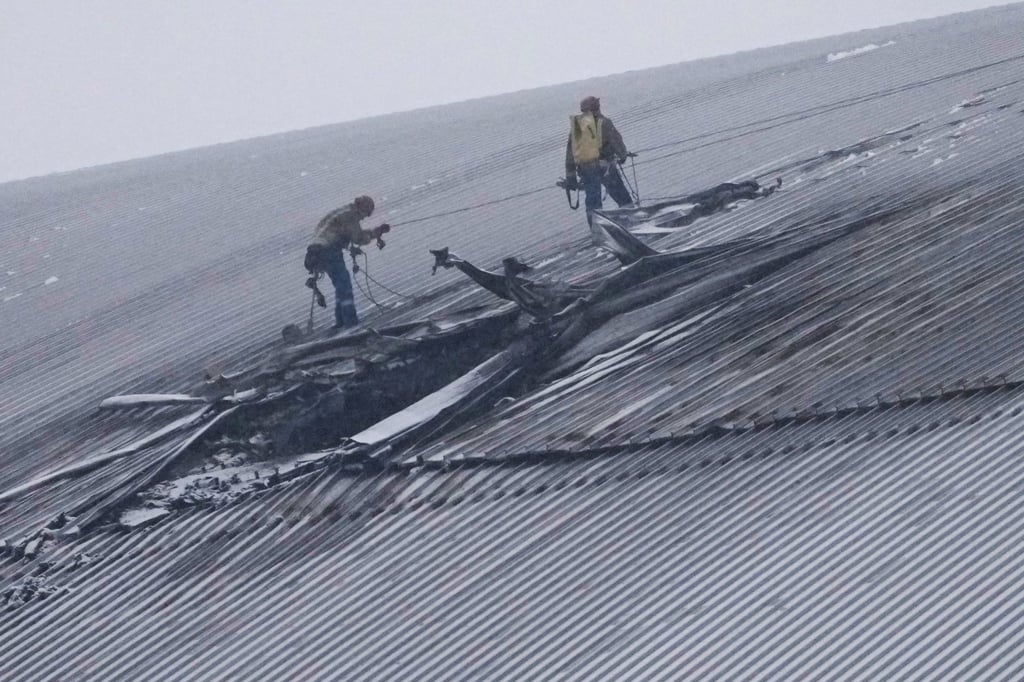 |
| Workers examine the damage to the roof of the New Safe Confinement structure, which was built to contain the radioactive remains of Reactor No. 4 at the Chernobyl nuclear power plant, following what Ukrainian officials said was a Russian drone attack in Chernobyl, Ukraine, on February 14 last year. Photo: AP |
The radioactive towns, villages and forests present as a conundrum to Ukrainian authorities knowing the land cannot be repopulated as a result of long-lived contamination. The issue of using the area however for some useful purpose is being considered, such as use as a storage area for nuclear waste, a test site for new reactors, a place for solar farm installations, and a disaster tourism destination; the last somewhat ghastly in its exploitation of boundless human curiosity about disasters, natural or human-enhanced.
New risks have emerged, however, as a result of the conflict, where scientists can no longer reach wells to measure groundwater radiation in fear of stepping on land mines. Firefighters are unable to extinguish wildfires that spread radiation through resulting smoke, since the land is littered with mines. The dangers inherent both in the active combat situation and the lurking threat of landmine explosions persuaded foreign scientists studying environmental radiation to flee.
The fragile situation was further endangered when a Russian drone flew into the huge steel shell enclosing an older rickety structure built over the ruined reactor, in February of 2025. Known as the sarcophagus, the older structure is close to collapsing entirely and when it does there will be another release of radiation. A hole was smashed in the $2.5-billion outer shell by the drone explosion, starting a fire within the New Safe Confinement shell which burned material that maintained the airtight seal. While no radiation escaped, the strike negated two decades of isolating the worst of Chernobyl's radiation.
Fortified against Russian attacks, Chernobyl remains a military site where tank traps, appearing like X's created from steel beams and coils of razor wire stretch over fields in the zone where soldiers patrol the overgrown ghost towns. The area commander cautioned that in comparison with destruction Russian forces inflict throughout Ukraine, an attack at Chernobyl could release more radiation that would be "on a completely different scale".
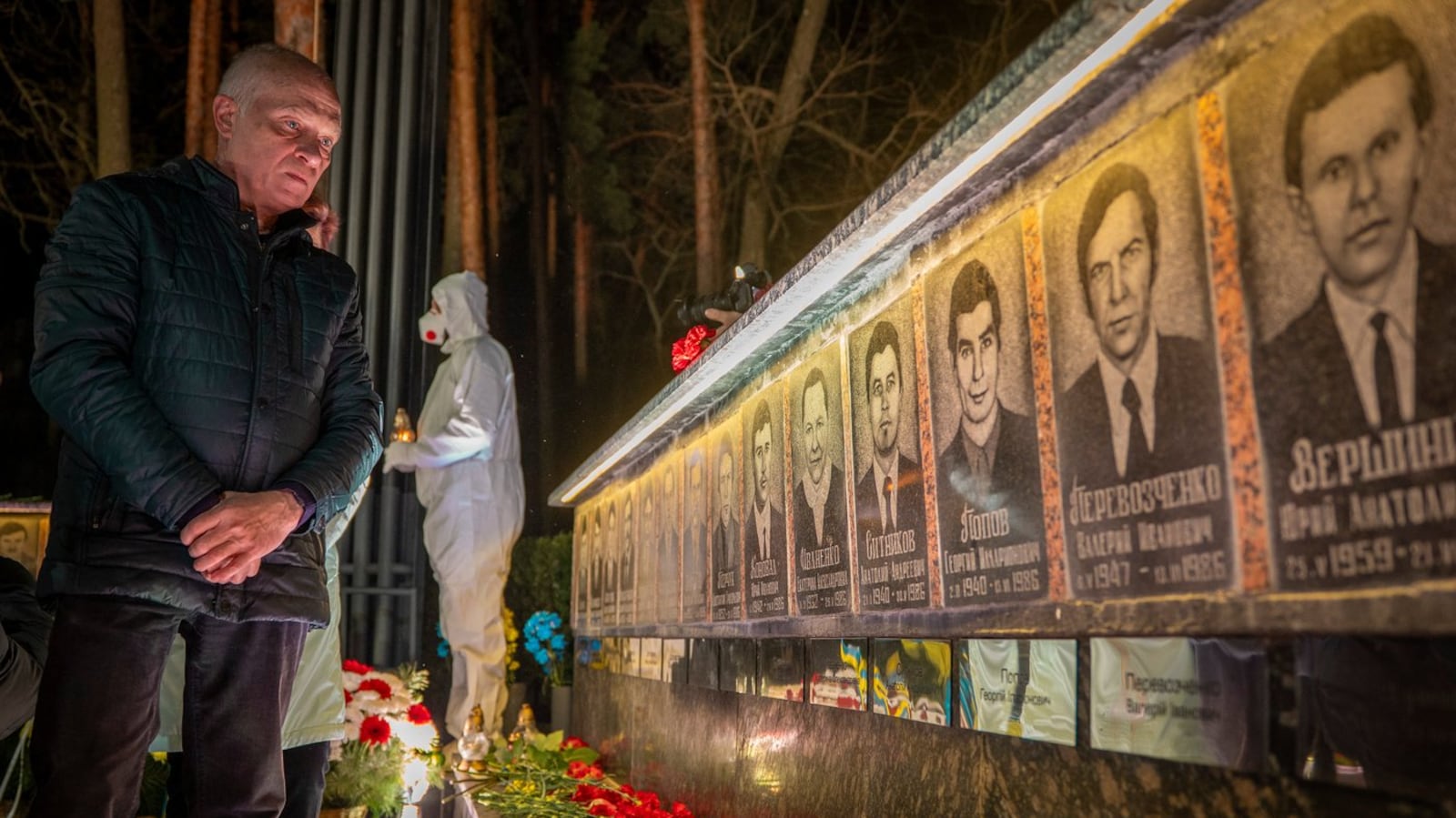 |
| A man looks at a memorial dedicated to firefighters and workers who died after the 1986 Chornobyl (Chernobyl) nuclear disaster, ahead of its 40th anniversary in Slavutych, Ukraine, Saturday, April 25, 2026. Chornobyl is the Ukrainian name for the city. (AP Photo/Dan Bashakov) |
Labels: Catastrophic Explosion, Chernobyl Nuclear Plant, Russian Invasion of Ukraine, Threats of Radioactive Emissions
posted by Pieface @ 8:23 PM


0 Comments:
Post a Comment
<< Home