Ruminations

Blog dedicated primarily to randomly selected news items; comments reflecting personal perceptions

Saturday, June 20, 2026

The Endless Flywheel of Nature's Designs

"[Advances made in modeling these tides over the last 15 years have enabled the study's authors to show that] the dissipation is lower than previously expected."
"A better understanding of tidal physics and the most advanced constraints we have on mass loss allow us to say that -- in the current state of knowledge -- Earth could move away from the Sun, contrary to what was predicted before."
Stephane Mathis, astrophysicist, Paris-Saclay centre, France 
 
"Earth's fate depends on a delicate balance between these two effects [increased size of sun's gravitational force pulling Earth closer to the Sun, compounded by oceanic tidal energy pushing the Moon further from Earth]."
"If tidal interactions predominate, Earth is engulfed by the sun. If the sun's mass loss predominates, Earth escapes into an orbit larger than the radius of its star." 
Mats Esseldeurs, astrophysicist, University of Leuven, Belgium 
A new lease of life: Our planet may escape a fatal spiral into the exploding fireball of the Sun
A new lease of life: Our planet may escape a fatal spiral into the exploding fireball of the Sun. Phys.Org
 
Up to the present time, and until the publication of a study published in the journal Astronomy & Astrophysics, of which Mats Esseldeurs was lead author, it was thought among astrophysicists that Earth's distant fate into the far future would be its absorption into the sun and thus complete annihilation. An almost-similar fate that has obliterated many stars in the firmament of the heavens over millions of years, as their stars became giants, then red dwarfs and then black holes vacuuming all that surrounded them into the nothingness of their depths. 
 
As huge as our sun is in comparison to the planets in its orbit, its size does not qualify it in that direction. It will ultimately, in the space of five billion years, become a white dwarf, a fireball of a dying star which it was assumed would consume Earth in its quest for energy to sustain itself before expiring. First the Sun must burn through all the hydrogen in its core, following which two immense expansion phases occur; becoming a red giant, and then an AGB star when it has spent all its helium.
 
An Asymptotic Giant Branch (AGB) star is a late stage in the evolution of low-to-intermediate mass stars (about 0.8 to 8 times the mass of the Sun). It represents the final bloated phase of a star's life before it sheds its outer layers and collapses into a dense white dwarf.
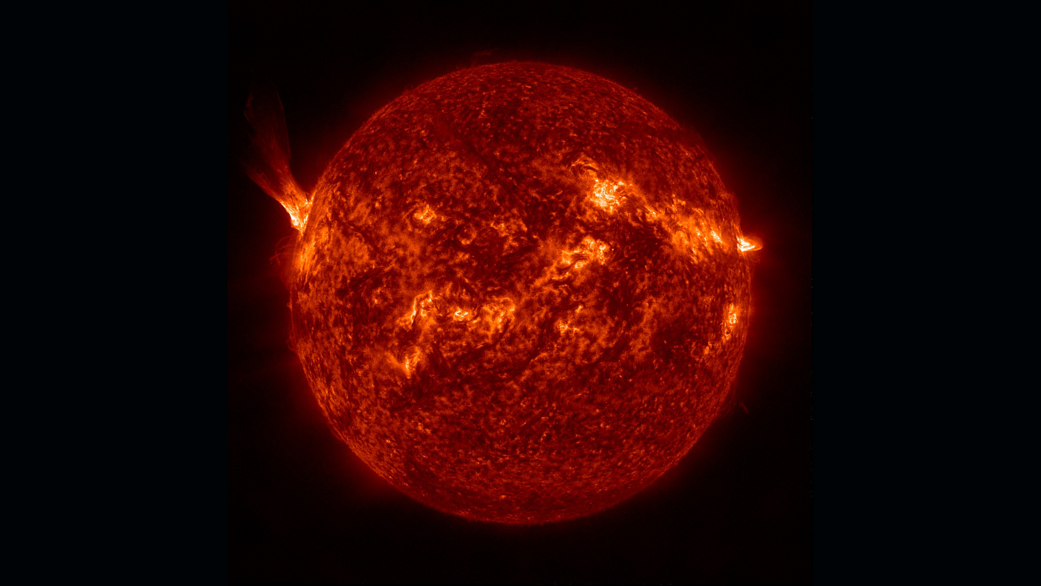
 
https://www.nasa.gov/wp-content/uploads/2023/03/apr2015-rec.png
Will the Sun become a black hole? No, it's too small for that! The Sun would need to be about 20 times more massive to end its life as a black hole.   NASA
 
As the Sun expands there will be significant effects seen on Earth as the Sun's increasing gravitational forces pull the Earth toward it. This force creates the push and pull of ocean tides on the Earth, energy from which dissipates at the ocean bottoms, which in turn slows Earth's rotation, while gradually moving the Moon further from Earth.  Intense tidal waves stir within the Sun as it expands and its blistering surface moves closer to Earth. It is when those tides dissipate that Earth would be pulled into the Sun's dying embrace.  
 
On the other hand, due to stellar wind, the growing Sun will also lose much of its mass, pushing planet Earth further distant. The new calculations reached by the authors of the newly-published study, places the initial hypothesis of the Earth being swallowed by the dying Sun in question. These are calculations reliant on relatively simple descriptions of tidal dissipation within giant stars. 
 
The study's authors took advantage of advances in modelling tides over the last 15 years to demonstrate "the dissipation is lower than previously expected", as explained by Dr. Mathis of the CEA Paris-Saclay centre. Mars is also affected by escaping, like Earth a death spiral into the Sun, according to the new modelling. Mercury and Venus, closest to the Sun, are less fortunate. Their fate will be that the expanding fireball will inexorably swallow them both. 
 
Of course, nature's plans can be inscrutable, and even while scientists feel they have achieved a fuller understanding of her formulated designs and the unfolding of the universe as it continues to age into eternity, new discoveries will emerge that will add layers on to what has already been surmised, hypothesized, synthesized and 'proven'. None of us, regardless, need spend sleepless nights concerned over how our lives will change as these forces of nature unfold, other than to marvel at the wonders of a universe that is vast and for the most part unknowable. 
 
Sunrise from Earth's horizon.
A view of the sunrise from Earth's horizon.    Zelch Csaba/Pexels


Labels: , , , ,

Wednesday, July 26, 2023

Astronomical Geological Anomaly

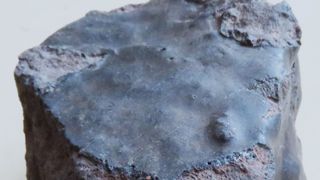
"[While the chemical composition of the 656-gram rock suggests a terrestrial origin, the presence of a] fusion crust [caused by a fiery trip through the atmosphere points to it having arrived from space]."
"[Certain isotopes in the meteorite] point to a very short [10,000-year] but significant exposure to galactic cosmic rays, and preclude that NWA 13188 is a man-made 'fake' meteorite."
Geophysicist Jerome Gattacceca, French National Centre for Scientific Research
a dark black rock
The Northwest Africa 13188 meteorite found in the Sahara desert in Morocco a few years ago. (Image credit: Albert Jambon)

A meteorite discovered a few years ago in the Sahara desert has been revealed by scientists studying it that the space rock startlingly appears to have originated on Earth itself. Their careful studies have led to the conclusion that this is a boomerang meteorite. It became such when a small asteroid hit Earth a few thousand years ago, disturbing terrestrial rocks with sufficient physical force to propel them into space. One of these pieces of rock, now catalogued and named Northwest Africa 13188 (NWA13188) has been orbiting Earth for millennia until it fell back to the Sahara.

And while this explanation, informed as it is geologically and astronomically, is intuitively speculative in nature, the fact is this unusual specimen was discovered by a meteorite hunter in 2018 and subsequently sold to a French collector, Albert Jambon. "I purchased this one just because it was odd. Nobody knows what this stone is really worth", he explained.
 
The hypothesis of the mysterious 'boomerang' meteorite was formally presented at an international geochemistry conference that took place in Lyon, France, by geophysicist Jerome Gattacceca. His and his colleagues' hypothesis has been called into question by other geologists who find it concerning that an asteroid sufficiently large to knock rocks into space has left no trace of its impact with Earth. There appear to be no known craters large enough and young enough in space-time to qualify for identification as to the source of the mystery. 

Dr. Gattacceca feels that a huge volcanic eruption might also have been the source of sufficient power to violently blast a rock into orbit, and so he plans to conduct more tests on NWA 13188 to accurately assess its age and devote a more investigative approach to realize a reliable amount of time it could have spent circuiting in space. Should it be proven that this is indeed a boomerang meteorite it would qualify as the first of its kind.

There was another confirmed sample of a meteorite from Earth, discovered in 1971 when the crew of Apollo 14 brought back a rock from the moon containing a small fragment of Earth which had been knocked awry by a collision with an asteroid four billion years ago which landed on the moon. It only took a few million additional years to be uncovered by another impact 26 million years ago.

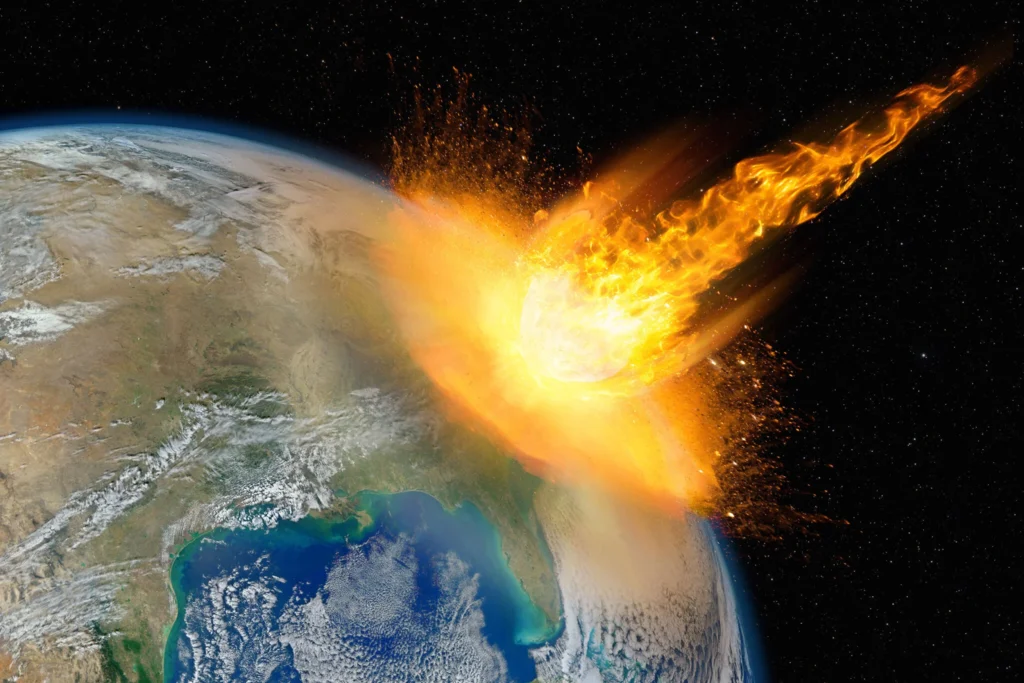
The fall of an asteroid to Earth in the artist’s image. Source: Dzika Mowka/iStock/NASA

Labels: , , , ,

Sunday, May 15, 2022

Nudging An Asteroid's Trajectory

"[Although some asteroids, like 2008 TZ3 are described as dangerous, according to space.com, that designation references] complex calculation related to size [larger than 150 metres] and the distance at which the object approaches Earth, among other factors."
1,600-Feet Asteroid, Bigger Than Most Buildings, Heading Towards Earth
Asteroid 388945 will pass us from a distance of about 2.5 million miles away

Planet Earth has been hit by asteroids in the past. Some of those impacts have been historically monumental. Asteroids, rocky pieces of space junk hurtle through outer space at amazing speeds. Like planets these space rocks orbit the sun with a predictable schedule. Greater numbers of asteroids have been detected, of late, attributable to more technologically advanced detection of improved upgraded telescopes. 

Telescopes whose function is to probe outer space for the presence of previously unidentified objects, meteors and asteroids among them. Their detection and study are considered to represent prudence in the first line of defence against potential threats of catastrophic impacts. NASA has assembled a list of potentially harmful asteroids it tracks to keep tabs on.

Its records affirm that for the present no threats exist to Earth from any such impact resulting from years of search, with the assurance that chances of impact are seen to be statistically improbable. Should there arise an asteroid threat, one of sufficient size and approaching close enough in its trajectory to Earth to predict a possible crash, there are several solutions to deploy in defensive technologies by NASA.
 
 
NASA developed a planetary defence spacecraft whose function is to crash into an asteroid at a velocity as extreme as its own, aiming to redirect it away from Earth; in the development of the Double Asteroid Redirection Test (DART). Still, the thought is, there is no reason for complacency and vigilance must never be dropped.

May 16 was the expectation date that a half-kilometre-wide rock, known as 388945 (2008 TZ3) travelling at the incredible speed of 37,400 kilometres an hour, is set to make its closest approach to Earth. At its closest approach, according to Live Science, its speed is 30 times faster than that of sound.

What astrophysicists speak of as 'close' in space terms still is 5.6 million kilometres distant from Earth, and as such, bears no cause for alarm. 2008 TZ3 passes Earth every few years in its orbit around the sun. Its appearance this year is to be the closest such pass until May of 2163.
 
NASA Asteroid 388945 (2008 TZ3) Empire State Building Earth
NASA has confirmed that asteroid 388945 (2008 TZ3), which is larger than the Empire State Building in New York City, is hurtling towards Earth. Thankfully, this 1600-foot space rock is expected to pass 3.5-million miles away, but should still be considered a threat. It’s set to make a close approach at 5:18pm ET on May 16th at a speed of just over 18,000 miles per hour   TECHEBLOG


Labels: , , , , ,

Monday, May 18, 2020

Micro-Earth, Biosphere 2 -- The Ultimate Haven

"We were in quarantine for two years. Or we put the rest of the world in quarantine for two years."
"Any time there was a special occasion of drink or food, all the conflict [among the eight people who volunteered to live within the confines of Biosphere 2 for two years] drained away. No one wanted to spoil it."
"Whatever food and drink really makes people happy in quarantine should be pursued. This isn't fun unless we can have feasts and parties and do home brewing [under quarantine from COVID-19]."
"Wherever you are, you are supported, and you are living, because we have a healthy Earth biosphere. Fall in love with every bit of it. The plant on the windowsill, the tree on the corner. We have to understand that every breath of air that we take, every drop of water, every bit of food is produced by our biosphere."
"That's the awareness we need to come out of this pandemic. We're all connected. It's showing us the downside of it. But we need to recognize the flip side. Think of this amazing biosphere that's given us birth."
"Biosphere 2 was so far ahead of its time that it offered an understandable way of getting around what a biosphere was. We weren't making a model of planet Earth, thank you very much. It was a little slice."
"It totally transformed me, and everyone else who was in there. I'm still digesting it. The incredible bodily connection that all of us felt with that living system, to where it was unthinkable that we would harm it in any way. The mindfulness with which we took care of the biome. The tender loving care that we took, and the visceral sense that we were connected was also part of the human dimension."
"That knowledge and that love went from my brain, my mind, to my body. To where my body got it. My bodily understanding that I was connected to that world."
On one level being alone with seven people was like being in an encounter group, or group therapy, for two years. I got to see ways I related to other people that I didn't like. I had to change who I was."
Mark Nelson, 77, former 'Biospherian'
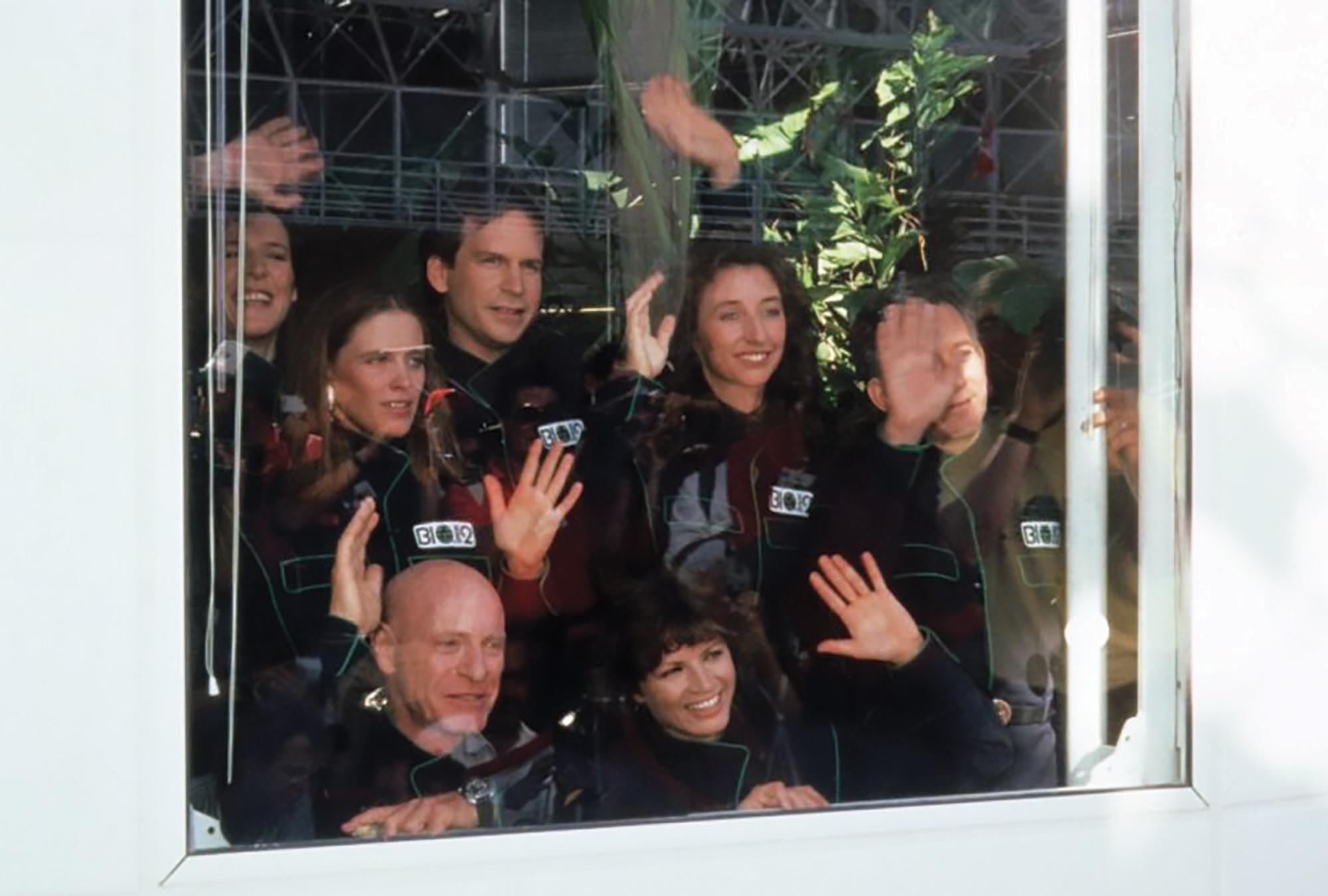
Biosphere 2, Mark Nelson, 1991

"Leonardo da Vinci talked about flying machines. Centuries later the Wright brothers built one. Biosphere 2 may prove to be the Kitty Hawk of biospheric life-support systems."
"Then again it may prove to be one of those airplanes everybody sees in the movies and laughs at that had 16 wings flapping at the same time."
Biosphere 2 patron Ed Bass, 1991

It was an imaginative, forward-looking experiment. A costly one, to invest in the needed infrastructure, to develop a system that was as true to the Earth's atmosphere and support of living creatures and vegetation as possible, to allow for self-isolation in a grand experiment where a group of eight people intended to see whether they might succeed at being self-sufficient, as stewards of a miniature Earth, drawing from its resources whatever they needed to sustain life, not only for themselves but for the creatures living alongside them, from insects to birds, mammals to vegetation.

It was quite an ad hoc experiment. The inhabitants of Biosphere 2 who named themselves 'Biospherians', were five Americans, two Brits and a Belgian, comprising four of each gender, included among them a botanist, a marine biologist and a physician. The very same professions, in fact, that sea-voyaging geographical exploratory missions of the past setting out to discover new continents and other inhabited locations worldwide with different cultures and levels of civilization generally brought along, in humanity's search to know the world they lived within, through the ages.


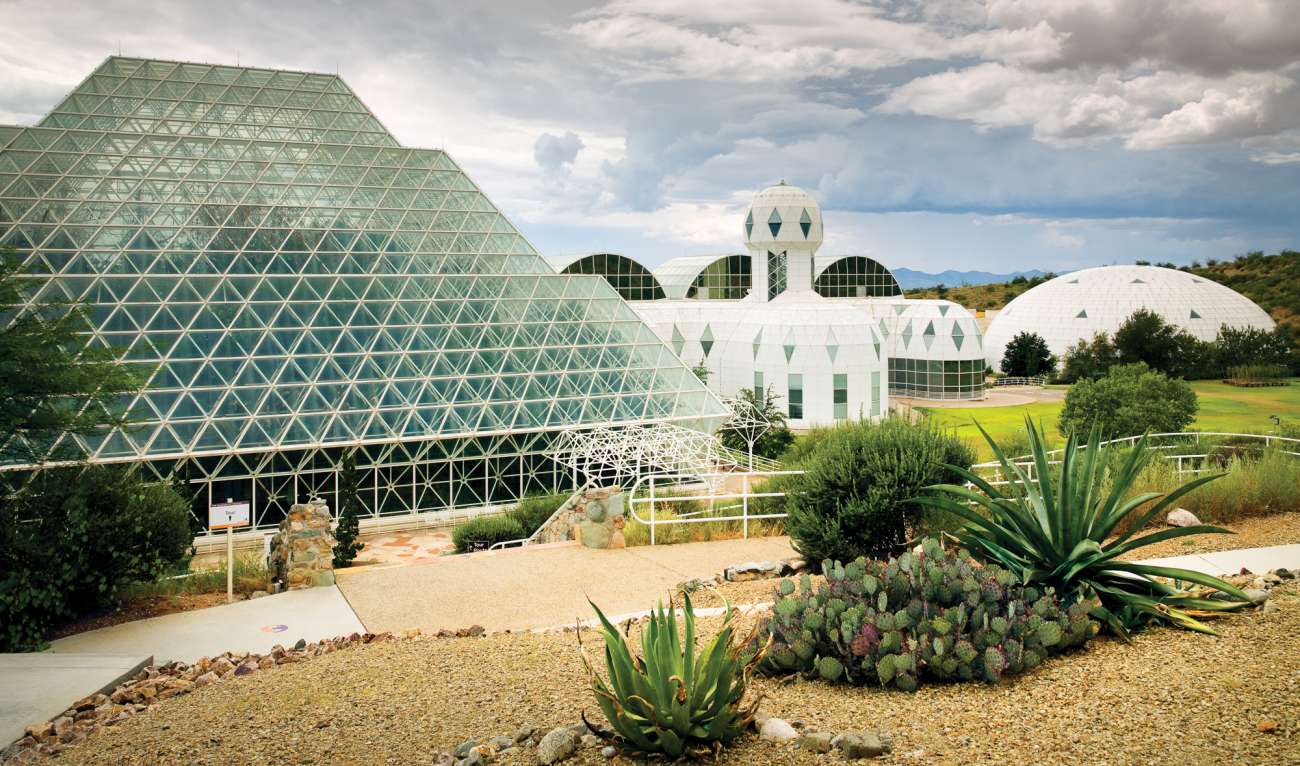
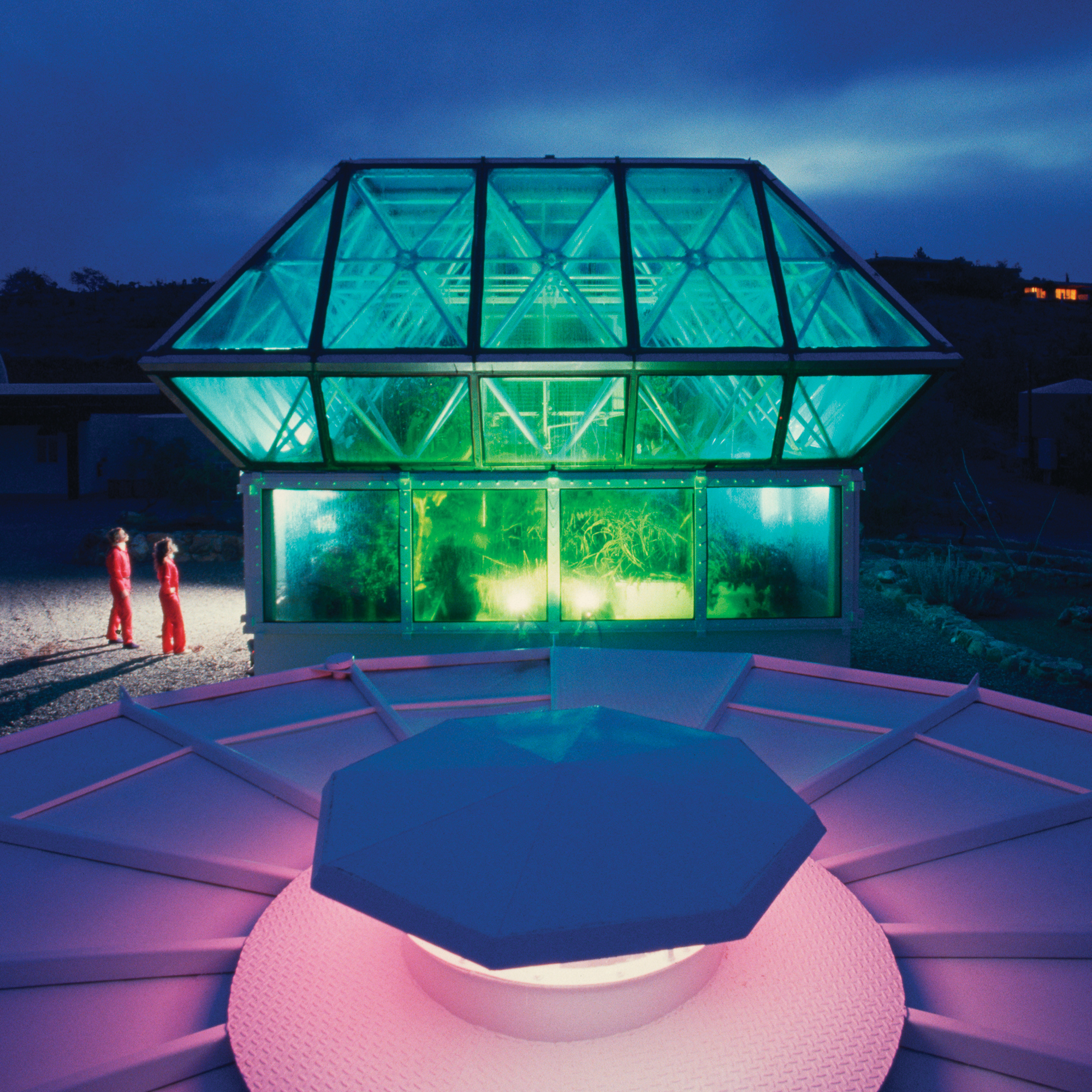
In cloistering themselves and shutting themselves away from the outside world, their adventure in living was meant to instruct the participants on how to manage lives separated from all that was familiar as they re-acquainted themselves with the natural world at a level none had ever before experienced and developed sustainable techniques. Biosphere 2 was planned and created to enable the eight people within to creatively live independently. The complex into which they had sequestered themselves was of an immense size, purpose-built through the 1980s in the Arizona desert..

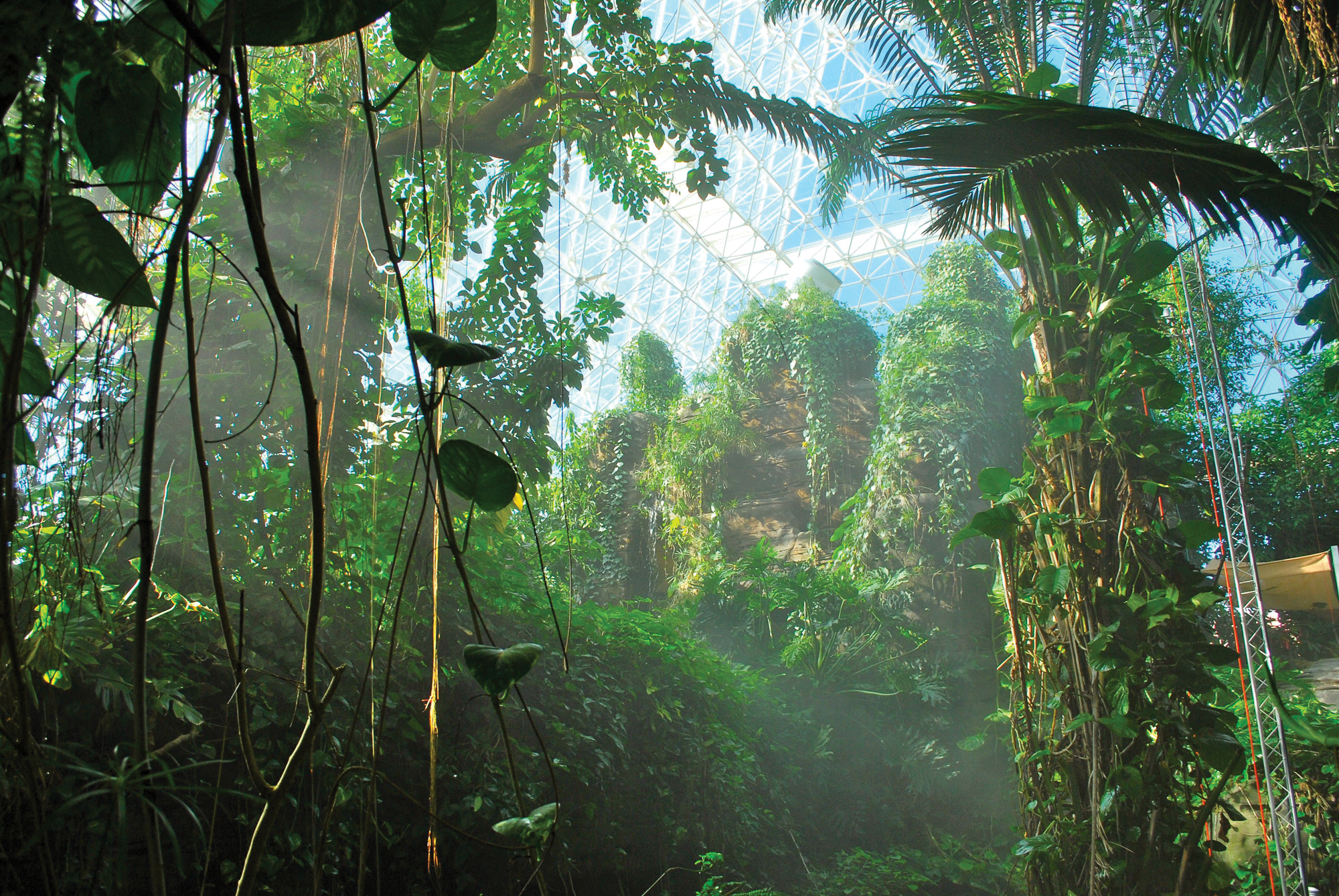
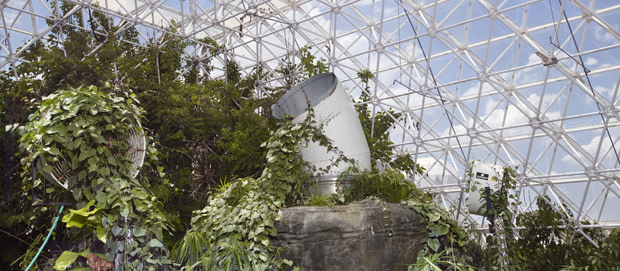
The Biosphere had an ocean with coral reefs, a miniature rainforest, a desert, and a wide range and plenitude of flora and fauna, living among the eight humans. One of whom badly injured herself which mandated she be withdrawn from the closed atmosphere to undergo surgery on her hand. Once her injury was resolved, she returned to the Biosphere. Among a few controversial revelations was that the 'all-natural system', of the breathing, living atmosphere meant to sustain life 'naturally' through its micro eco-system, was the presence of a carbon dioxide scrubber to ensure fresh air could be pumped in to avoid potential hypoxia.

As Mark Nelson wrote for publication in a Dartmouth College journal, as a former Dartmouth alumni, the group grew all their food, raising and slaughtering livestock. They had a laboratory, they were busy maintaining equipment and had their personal living quarters. Everyone was required to work from three to four hours daily, five days a week, to help produce the food they depended on for nutritious health. With no agricultural background among any of them, they were spurred by the reality that if they didn't produce they wouldn't eat.


And eat they did, learning to produce 80 various crops, from rice to yams, peanuts, sorghum, millet, beets, wheat, carrots, peppers, bananas, figs, tomatoes, kale, eggplant, onions, papaya, beans, sweet and white potatoes, squash and herbs. Biosphere 2 was host to 3,000 species of plants and animals.
Crops were grown with biological controls, and organic matter was recycled for composting. And lessons were learned; the cockroaches they hosted meant to recycle organic matter grew exponentially in numbers and began threatening the crops. A situation seen in ants, as well.

Bees and hummingbirds, two of the most delightful animals, and reliable pollinators eventually failed to survive the atmosphere. And eventually the atmosphere itself failed in its purpose to sustain life when oxygen thinned out necessitating the opening of the sealed domes so fresh air could be circulated and replenished. Despite inconveniences and downright emergencies where the inhabitants of Biosphere 2 had little option but to temporarily abandon the airtight sanctity of the domes, they persevered and lived for the appointed two years, isolated and self-sufficient.

Mr. Nelson himself now lives and works on a working farm, serving as an ecology research centre and retreat in New Mexico, called Synergia Ranch, a group he first joined after graduation from Dartmouth College in 1968.

biosphere1
Biosphere 2's 91-foot-tall rain forest contains more than 150 plant species and now provides scientists a test ground for ecosystem experiments. Douglas Adesko

Labels: , , , ,

Friday, February 01, 2019

Advertising In Space

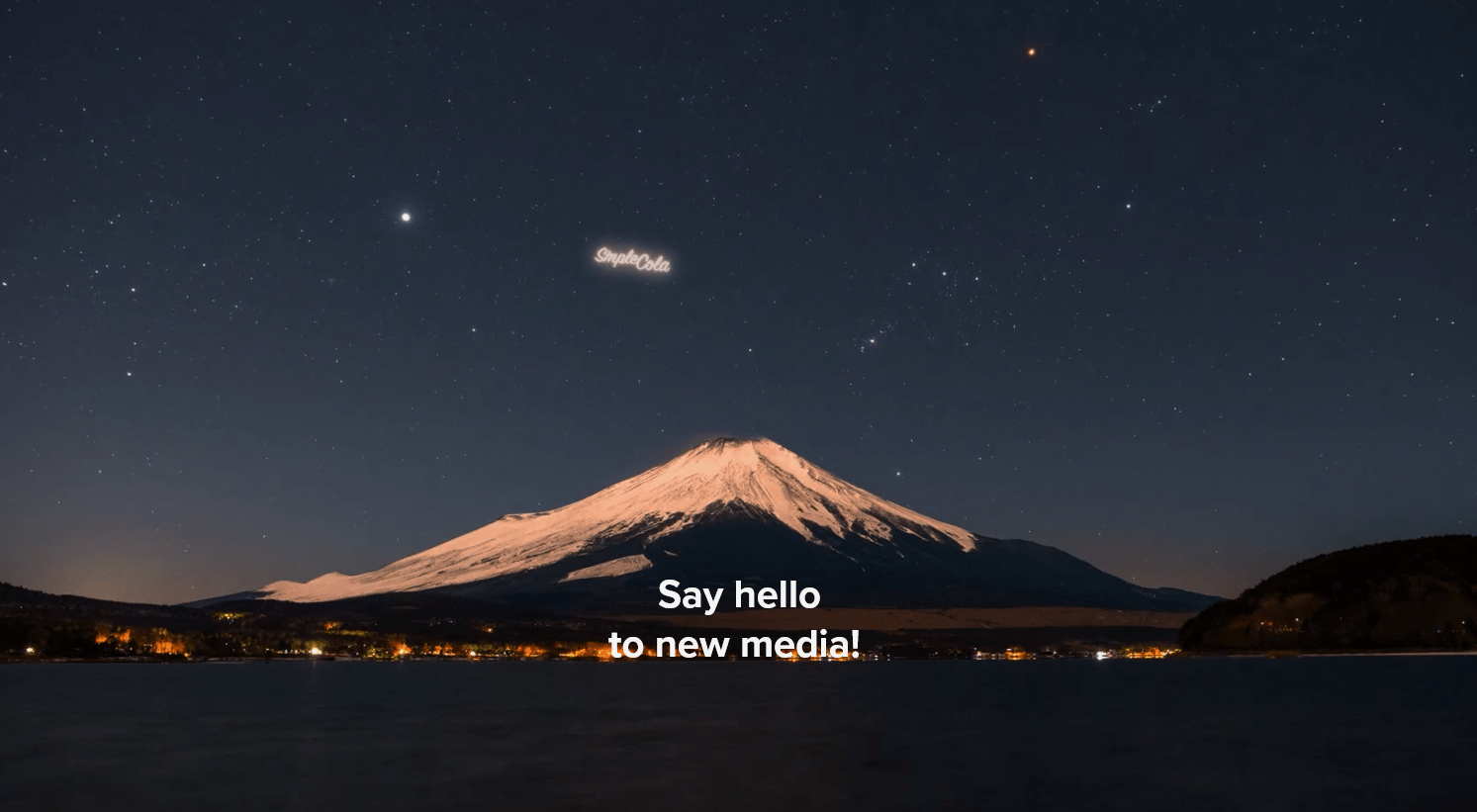
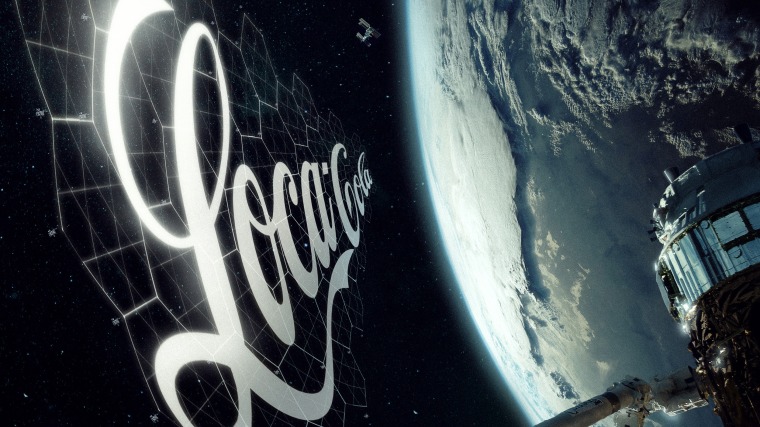
A screen capture from StartRocket's promotional video for their Orbital Display. Image Credit: StartRocket.
Universe Today -- space and astronomy news
"New ages demand new gods."
"It was the first time somebody made entertainment in space ... and advertising is part of entertainment."
"People hate me because they think in two years the whole sky will be covered in advertising."
Vlad Sitnikov, CEO, StartRocket, Russian start-up

"It might be a good starting point to re-examine the whole nature of regulation of space activity."
"We know that the use of outer space for positioning nuclear weapons is prohibited, but there is no such prohibition on the placing of giant billboards [in space]."
Christopher Newman, professor of space law, Northumbria University, Britain

"Advertising in space seems to be simply a wasteful and expensive way of ruining the view of the night sky."
"Light pollution on the ground makes it difficult enough already to see the sky -- the stars and the Milky Way -- from many locations, and advertising in space is a way of destroying that beautiful vista from the remaining unsullied sites."
Robert Massey, deputy executive director, Britain's Royal Astronomical Society
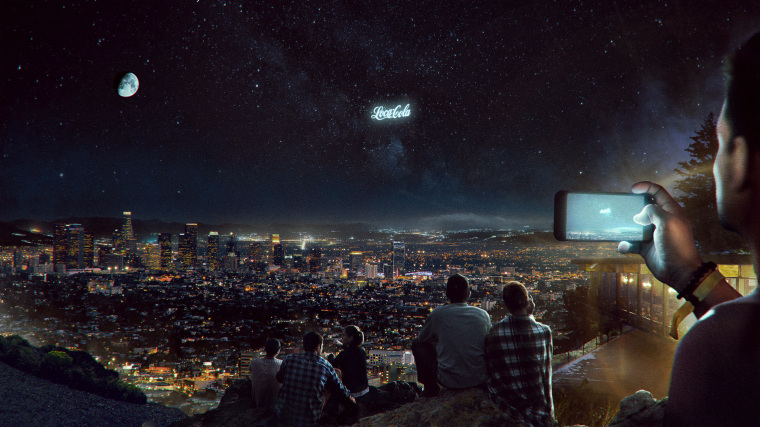
Image: A Russian startup, StartRocket, plans massive billboards to beam advertisements to Earth.
StartRocket's space-based ads would be visible only at night but could be seen from just about anywhere on Earth.   StartRocket

Yet another intrusion into the night sky. Who in their right mind would look forward to gazing upward at night to search the sky for identifiable stars and constellations, revelling in the majesty of the view  and then shockingly coming across the logo of a soft drink manufacturer or a fast-food conglomeration, moving sedately along the Milky Way. Transforming the magical to the pedestrian in one fell swoop. That is, should StartRocket have its way in plans to place billboards in space.

The plan is to develop a system whereby hundreds of tiny satellites can be manipulated to form a massive commercial display visible from Earth. This represents the latest of ventures following musing about asteroid mining and space hotels, all visualized as what the future holds in mining space for its commercial potential. Astronomers have reacted to the proposal unleashed in mid-January with predictable alarm.

And the question is now raised whether it is high time that some universal standards be put in place by global agreement to shelter space from such intrusions. Regulations to be agreed upon and observed that would constrain any such future exploitation of space beyond the mess humankind has already made to transform it into a giant garbage dump of dead satellites and other human-responsible space debris.

The brilliant hypothesis that space could be used to advantage advertising, assembling clients who wouldn't mind paying a hefty invoice for the privilege of their messages reaching around the world came to advertising expert Vlad Sitnikov in the wake of the rocket propulsion company Rocket Lab launching a disco ball named Humanity Star into orbit, which remained visible to the human eye for a period of months.
Image: A Russian startup, StartRocket, plans massive billboards to beam advertisements to Earth.
A Russian startup, StartRocket, plans massive billboards to beam advertisements to Earth.   StartRocket

StartRocket, confident of its ability to blueprint a suitable technical plan, has teamed with experts from a Moscow private university, Skoltech where the team plans to place 200 tiny satellites -- CubeSats -- at an altitude of some 500 kilometres in the lower orbit of Earth by 2021. Each satellite equipped with a sun-reflecting sail would be designed to fly in close companionship with one another to create pixels of a gigantic screen to be switched on and off in displaying words or logos.

The estimated investment for production is expected to exceed $150-million. On the other hand it would cost about $200,000 for clients to contract for eight hours of advertising. A promotional video was released in early January and since then thousands of calls have come in from abroad to StartRocket, including a rough dozen from potential clients; while many other messages reflect the opinions of people opposed to the idea.

Each display would appear the size of a half moon, visible for six minutes at a time, from anywhere in the world. On the other  hand, to derive the most potential from the advertising, the plan is to target large population bases where light pollution from cities is  high to begin with. Dusk or dawn being the preferred times for display, when people tend to be about in the streets, according to Mr. Sitnikov, in the interests of the bottom line.

The 1967 Outer Space Treaty drafted during the Cold War, focuses on peace and exploration, mentioning nothing about advertising. So, from a legal standpoint, there doesn't appear to be much that can be done about the plan to invade the inner ring of Earth's atmosphere as things stand, save an immediate and concentrated campaign on the part of astronomers and lawmakers to ensure that this is an idea quickly nipped in the satellite bud.
A screen capture from a promotional video on StartRocket's website. Image Credit: StartRocket.
A screen capture from a promotional video on StartRocket’s website. Image Credit: StartRocket.


"Launching art projects like this with no commercial, scientific, or national security value seems unwise…Space is getting increasingly crowded. There are over 20,000 objects with orbits in the official public catalog maintained by the U.S. Air Force."
"Less than 10 percent of those objects are active satellites—the rest are dead satellites, old rocket bodies and parts of spacecraft."
University of Michigan astronomy professor Patrick Seitzer

Labels: , , , ,

Friday, January 25, 2019

The Mysteriously Movable North Pole

"It's only going to cause trouble for people who use compasses to navigate around. Even then most of them are used to making corrections. The old navigators would be a bit wise to this."
"It doesn't tell you there's anything weird happening, it's a natural process."
"Decade to decade you get variations as you might in the weather day to day in the atmosphere. If one gets a little stronger, than the others it pulls the magnetic field in that direction."
Louis Moresi, geophysicist, University of Melbourne

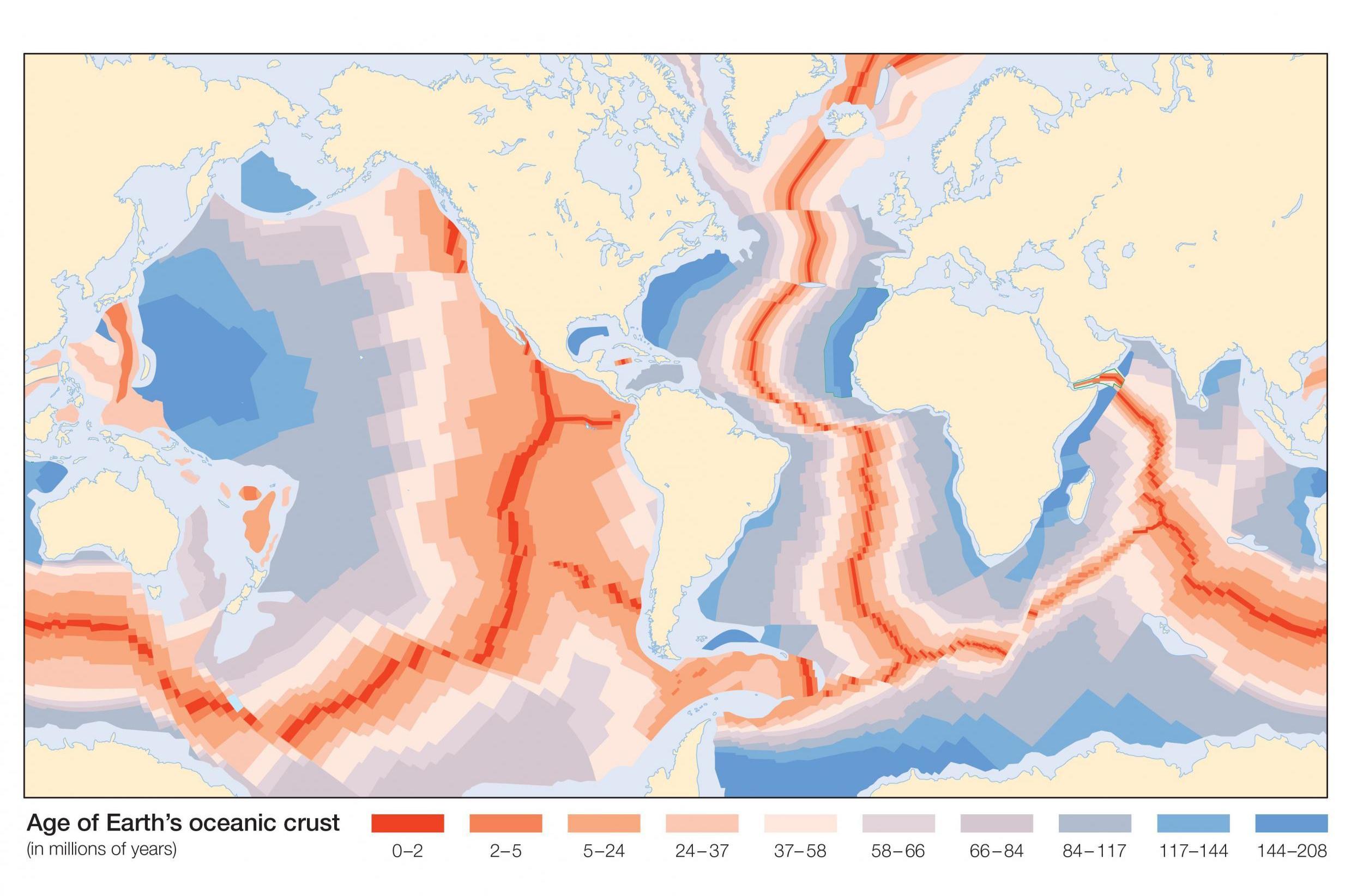
"The oldest ocean crust is a couple of hundred million years old — it gets destroyed by plate tectonics so we don't have older crust — but there's hundreds of reversals recorded in that ocean crust."
"There's no correlation with extinctions, but our society today is really heavily dependent on satellites and electronic devices."
"[We really don't know when or how fast a pole flip would or could happen.] People speculate all the time about the field reversing and there's some very nice analyses out there but the fact is we're dealing with incomplete information. We just don't know if it's going to reverse."
Andrew Roberts, paleogeologist, Australian National University

"People get excited when it appears to speed up or slow down, but it's unlikely we're seeing anything that's part of a more substantial swing."
"Even if you switch the Earth's field off, or you visit planets where there is no current field generation, you still see magnetic fields because rocks will carry remnant magnetisation."
"[And there's a rich history of pole shifts and continental drift written into Australia's ancient rocks.] If you look at rocks created at different times in Australia the direction of remnant magnetisation changes." 
"When you go to the regions of Australia that have magnetite deposits you get very strong anomalies [that distort the local magnetic field]."
"If you walked there with a compass, your compass would not give you the direction you would normally expect."
"In Australia, the Earth's field is typically about 50,000 nanoteslas. There's maybe a 15 nanotesla variation through what we call a quiet day."
Clive Foss, senior geoscientist, CSIRO (Commonwealth Scientific and Industrial Research Organisation)
North magnetic pole and geomagnetic pole shifts 1900 - 2015
 Close to 3,200 kilometres within the Earth lies the liquid iron constituting the core of the Earth, generating its magnetic field, and there a jet has formed and it has been raging like a veritable storm at sea, roiling the molten iron under the Arctic. What is termed a 'geological gust' has shifted the Earth's magnetic North Pole toward Siberia, and it continues to do so, at a rate of an estimated 40 kilometres annually.

This alteration of the pole was reported in the science journal Nature. The new location of the North Pole is meaningful to those attempting to navigate accurately at very high latitudes. The thing of it is, we are no longer as dependent on compasses to determine where the needle points, since the advent of satellites beaming their messages more accurately in a more timely manner.

Usually, it falls to the U.S. National Oceanic and Atmospheric Administration to publish updates to the World Magnetic Model used by cellphone GPS systems and military navigators to orient themselves. Half of their staff, however, is on furlough until the partial U.S. government shut-down is concluded and all U.S. government offices return to normal operation.

In a fallback of necessity to navigational old models a discrepancy is obvious, one that increases its inaccuracy day by day. Why at this time the geomagnetic commotion is occurring is not yet known, though scientists acknowledge the movement of molten iron in the Earth's interior generates a magnetic field, one that fluctuates in accordance to the behaviour of flows.
Illustration showing how the Earth's molten outer core creates a magnetic field

That being so, the planet's magnetic poles are known not to align precisely with geographic poles (located at the end points of the Earth's rotational axis), and it is well accepted that the location of the poles can and do change with no warning. Earth's magnetic field has even been known to flip, where the South Pole has located in the Arctic and the North Pole opposite, according to records of ancient magnetism found in million- and billion-year-old rock samples.

A hundred and fifty years ago, James Clark Ross of the British Royal Navy found the North Pole in the Canadian Arctic during his search for the North West passage. During the Cold War an American expedition located the pole 400 kilometres to the northwest. The pole has moved 965 kilometres since 1990, crossing the International Date Line into the Eastern Hemisphere last year, while the South Pole has remained relatively stable.

These shifts require the World Magnetic Model to be updated every five years; the next one had been scheduled to take place in the year 2020.Suddenly strange signals were received through the network of magnetometers and satellites tracking the magnetic field, as the North Pole was accelerating in movement unpredictably to the point where the 2015 version of the World Magnetic Model became oudated and navigation tools reliant on magnetic fields for orientation were drifting off target.

According to research from geophysicist Phil Livermore of University of Leeds, the location of the pole is controlled by two magnetic fields, one under northern Canada and another below Siberia. Dr. Livermore reported the detection of a jet of liquid iron in 2017, appearing to be weakening the Canadian magnetic field. "It's very hard to know what's going on because it's going on 3,000 kilometres beneath our feet. And there's solid rock in the way", observed Dr. Livermore.

Illustration of the Earth's magnetosphere and composition


Labels: , , , , ,

Monday, January 14, 2019

Exotic Subterranean Life On Earth

"Exploring the deep subsurface is akin to exploring the Amazon rainforest. There is life everywhere, and everywhere there's an awe-inspiring abundance of unexpected and unusual organisms."
"Molecular studies raise the likelihood that microbial dark matter is much more diverse than what we currently know it to be, and the deepest branching lineages challenge the three-domain concept introduced by Carl Woese in 1977. Perhaps we are approaching a nexus where the earliest possible branching patterns might be accessible through deep life investigation."
Mitch Sogin, Marine Biological Laboratory Woods Hole, USA

"Ten years ago, we knew far less about the physiologies of the bacteria and microbes that dominate the subsurface biosphere. Today, we know that, in many places, they invest most of their energy to simply maintaining their existence and little into growth, which is a fascinating way to live."
"Today too, we know that subsurface life is common. Ten years ago, we had sampled only a few sites - the kinds of places we'd expect to find life. Now, thanks to ultra-deep sampling, we know we can find them pretty much everywhere, albeit the sampling has obviously reached only an infinitesimally tiny part of the deep biosphere."
Karen Lloyd, University of Tennessee at Knoxville, USA
An unidentified nematode, found in the Kopanang gold mine in South Africa, lives nearly a mile below the surface.
Anunidentified nematode, found in a gold mine in South Africa, lives nearly 1.5 kilometers below the surface. Gaetan Borgonie, Extreme Life Isyensya, Belgium

"Our studies of deep biosphere microbes have produced much new knowledge, but also a realization and far greater appreciation of how much we have yet to learn about subsurface life."
"For example, scientists do not yet know all the ways in which deep subsurface life affects surface life and vice versa. And, for now, we can only marvel at the nature of the metabolisms that allow life to survive under the extremely impoverished and forbidding conditions for life in deep Earth."
Rick Colwell, Oregon State University, USA

"Discoveries regarding the nature and extent of the deep microbial biosphere are among the crowning achievements of the Deep Carbon Observatory. Deep life researchers have opened our eyes to remarkable vistas - emerging views of life that we never knew existed."
Robert Hazen, Senior Staff Scientist, Geophysical Laboratory, Carnegie Institution for Science, and DCO Executive Director
In search of life under the sea floor   EOS
New discoveries of life forms not on Earth but in Earth are being unearthed as it were with surprising conclusions. Biologists decades ago would never have believed that life might exist without sunlight, without oxygen, without moderating temperatures, without protection from the sheer weight of the mass of the Earth. It is known now with a thoroughness perhaps never before imagined that the internal deep subsurface chemistry of this planet supports life such as microbes dwelling deep within the Earth.

Scientists read into their presence a tantalizing hint of comparison with our own common ancestors which were surface dwellers at a time when Earth's early chemistry before abundant oxygen was available billions of years ago were similarly challenged in a deficit of life conditions, in a similarity to the deep subsurface biosphere now known to exist and thrive; leading to the hypothesis that quite possibly life on earth began deep within the Earth, filtering its way to the surface eventually.

The mysterious creatures such as Geogemma barossii which lives deep within our world in water furiously boiling at 120 degrees, an organism that nature adapted to live at extreme heat. This microbe is one of many that thrive in a massive subterranean habitat teeming with life forms. In a ten-year period, science has progressed in its investigation of subterranean life on our planet as investigators seeking to make sense of hidden habitats came together under the auspices of the Deep Carbon Observatory.

Remotely operated underwater vehicles, collection tubes, high-tech drills, DNA technology and computer modelling have all aided researchers as they explore volcanoes, diamond mines, deep-sea hot springs, underwater mud volcanoes and all manner of extreme geological sites underneath oceans and continents; in so doing, turning the world upside-down in terms of the vast proliferation of life forms.
Deep Carbon Observatory

Consider this: an estimated 200 to 600 octillion (octillion: 1 followed by 27 zeroes) microbes live under the world's continents with even greater numbers thriving beneath the floor of the seas -- all of which weigh the equivalent of some 200 million blue whales; a bulk weight scale far greater than the 7.5 billion humans would comprise. The sheer diversity of these subterranean creatures challenges the diversity of surface life even as most underground organisms have yet to be discovered, much less characterized.

Buried beneath deep within sediments or the sulfuric crust in the seafloor, or encased within granite, basalt, sandstone or clay beneath continents, microbial communities vary; some fungi and multicellular organisms resembling insects and worms exist deep underground. Some are scavengers who thrive on photosynthesis leftovers from the surface, buried for up to hundreds of millions of years.

There are microbes that breathe uranium, expelling waste expressed as tiny crystals. If nutrient availability becomes diminished, microbes become dormant, with subsurface microbes reproducing only once every 30 years; in various instances it can take tens to thousands of years to replace an old population with a new one, where the chemistry in the deep subsurface supports life.

Some researchers hypothesize the possibility that what occurs in the subsurface might reflect life elsewhere in the solar system; Mars or Europa: "Could there be a deep biosphere on these other worlds?" muses Robert Hazen, mineralogist at George Mason University in Virginia, and director of the observatory. Until such time as such a possibility is explicated by new discoveries what has been seen to date is "providing us with a vivid new way of thinking about 'what is life'?"

Flatiron Institute

Labels: , , , ,

Saturday, January 05, 2019

Plate Tectonics and the Origins of Life on Earth

"If there wasn't a way of recycling material between mantle and crust [of the evolving Earth], all these elements that are crucial to life, like carbon, nitrogen, phosphorus and oxygen, would get tied up in rocks and stay there."
Aubrey Zerkle, geochemist, University of St.Andrews, Scotland

"Think about what drives evolution. It's isolation and competition. You need to break continents and continental shelves apart, and separate one ocean from another, for speciation to occur."
Robert Stern, geoscientist, University of Texas, Dallas

"The prevailing view is that Earth started to exhibit behaviors that look like plate tectonics 2.5 to 3 billion years ago."
Michael Brown, geologist, University of Maryland
A cross section of the Earth, showing the exterior crust, the molten mantle beneath it and the core at the center of the planet. Image credit: NASA/JPL-Université Paris Diderot – Institut de Physique du Globe de Paris

Plate Tectonics is the supposition that the outer shell of Planet Earth is broken into pieces, or plates that glide over a belt of hot, weak rock; in some areas rising from the underlying mantle and in others plunging back into the mantle; a geological consruct that describes the structure and behavior of the Earth: mountains and ocean canyons, earthquakes and volcanoes, inclusive of the composition of the air we breathe sustaining life.

It was only in the mid-20th Century that the theory of "continental drift" became generally accepted when evidence was unearthed of a 'subterranean engine' directing continental deviations. It was at that time that geologists determined Earth's outer layer to be broken into eight or nine large pieces along with five or six smaller segments resulting in a mixture of relatively thin, dense oceanic plates riding low while thicker, lighter continental plates bobbed above.

Aerial photo showing a river of lava flowing through the land.
Lava from Hawaii’s Kilauea volcano has destroyed dozens of homes in the past month. The volcano is the result of the same deep-mantle hot spot that formed the Hawaiian island chain.  USGS

Melting rock from the underlying mantle rises up at large fissures on the ocean floor, steadily increasing the oceanic plates while at other fracture points in the crust, oceanic plates dive back inside or alternately, in the process of subducting become absorbed into the hot belly of the mantle.

Jun Korenaga, a geophysicist at Yale University and others of his colleagues contend that plate tectonics was initiated directly after the crust of the Earth solidified. "That is when the conditions would have been easiest for plate tectonics to get started", he asserts. Most of the water on Earth would at that point be on the surface, little having found its way into the mantle.

Photo of a diver between two tectonic plates in Silfra. reykjavik. Iceland
The Silfra fissure in Iceland forms part of the boundary between the North American and the Eurasian tectonic plates. The two plates drift about 2 centimeters farther apart every year.  Photo: Charlie Jung

Heat convecting up through the mantle, exerting a stronger force on dry rocks than on lubricated rocks occurred at the same time as surface water would ease the process whereby hot, twisting rocks beneath cracked the surface lid apart a process which Dr. Korenaga feels represents the key in starting the subduction engine in its mighty transformative action.

This theory is not, however, generally accepted by all geophysicists in the field, by any means. Basically, three camps exist, all sparring over when the entire movable plate system began; whether it is as ancient as the planet; roughly 4.5 billion years old; or perhaps merely one billion years or some other, younger, starting point?

The question is, basically, what was it that caused the shell to crack apart to begin with. And from there it follows that the second key question to be answered is how the recycling of the crust of the Earth then began. A link between plate tectonics and the evolution of complex life appears tantalizingly connected.

The hypothesis has been raised that continental collisions and crashing mountains could very well have unearthed crucial nutrients at specific moments of biological inventiveness in nature's great scheme of creation. A process that loosened the vital chemical ingredients, enabling them to ferment together in a stew creating the basic elements of primal lifeforms.
oceanic-crust.jpg
Robert Stern argues that plate tectonics, on the other hand, is a natural occurrence in Earth's evolution of a mere billion years in age, perhaps less; that Earth's first 3.5 billion years had a "single lid" serving as an outer shell, a crust riddled with volcanoes and mountains but no moving plates. And then there is the group of geologists who make do with a middle ground decoupling plate tectonics from the origins of life on Earth.

Scientists consider plate tectonics vital to the sustained evolution of primordial life where evidence of the earliest single-celled organisms date back over 3.6-billion years. As the theory goes, the activity of plate tectonics maintained a constant supply of water shuttling between mantle and crust instead of gradually evaporating from the surface.

A process that blocked dangerous buildup of greenhouse gases through subducting the excess carbon underground. The process disturbed mountains and pulverized rocks, loosening essential minerals and nutrients such as phosphorus, oxygen and nitrogen to be used in nature's laboratory petri dish production of life.

Plate tectonics may have helped facilitate the development of life on Earth. Image credit: NASA.

Labels: , , ,

Monday, June 25, 2018

Defending Earth

"This plan is an outline not only to enhance the hunt for hazardous asteroids, but also to better predict their chances of being an impact threat well into the future and the potential effects that it could have on Earth."
"[Protecting Earth from incoming asteroids will be a huge job, no astronauts would be involved.] That's something relegated to the movies — it makes a good movie, but we do not see in our studies any technique that would require the involvement of astronauts. [NASA's proposed asteroid-deflection techniques] would all be done by robotic spacecraft."
"[The agency's Double Asteroid Redirection Test [DART], to be launched in 2021, will be] our first technology demonstration of the kinetic impact technique to deflect an asteroid."
NASA's planetary defense officer, Lindley Johnson

"[One focus of the DART goal is to increase international cooperation to better prepare the rest of the world for the possibility of an asteroid strike — under the leadership of the United States.]"
"This kind of cooperation is really important  It's a global hazard that we all face together, and the best way to approach and address that hazard is cooperatively."
Aaron Miles, senior policy adviser, White House Office of Science and Technology Policy
This Is NASA's New Plan to Detect and Destroy Asteroids Before They Hit Earth
Artist's illustration of a large asteroid headed for Earth. Credit: ESA
A report from the National Science and Technology Council in the United States outlined a pressing need to improve vigilance by the international community dedicated to preserving Planet Earth's geological integrity and the safety of all living creatures, through international programs in coordination with the United States in detecting the presence of and danger posed by asteroids and other space objects speeding toward Earth, recognizing that a collision with a large rock-metal-ice object hurtling toward the planet could result in utter catastrophe.

During Earth's formative years tens of millions of years ago such collisions did occur when for example a 200-kilometre-wide crater was discovered, all that remained of the results of such an ancient collision that wiped out three-fourths of the vegetation and animal species then existing on the planet. The crater's remnants were recognized on the Yucatan Peninsula, and the Gulf of Mexico, a wide swathe of utter destruction.

The knowledge that Earth is vulnerable at any given time to other collisions which might occur have been fortified by some that have. As, for example in 2013's event when a 20-metre asteroid appeared suddenly over the sky in Chelyabinsk, Russia, exploding and damaging thousands of buildings in the thermal blast, causing widespread injuries. In 1908 a much larger asteroid exploded over Tunguska, Russia leaving 2,000 square kilometres of forest devastated.

The report, published in Science, pointed out that were such an asteroid to explode over a far more vulnerable, populated area such as New York City, the fallout would be enormous, the death toll unspeakably dramatic. NASA has catalogued no fewer than 18,310 space objects of sizes from minuscule to alarmingly huge. Just over 800 of those space objects are 140 metres or larger. Should a space rock happen to suddenly appear  and an estimate made of its strike time; anywhere from days to weeks in advance, current space technology offers no solutions for stopping or altering its trajectory.

The National Science and Technology Council report speaks of the urgent need to improve asteroid detection, its tracking and the potential for deflection. Its participating partners are NASA, federal emergency, the military, the White House and other similar U.S. national authorities. Scientists, according to NASA's planetary defence officer, have discovered 95 percent of near-Earth objects measuring one kilometre or larger, continuing to search for the remaining 5 percent and smaller objects still capable of inflicting damage on Earth.

The most difficult to detect are rocks that have passed the sun and are on their way out of the solar system, approaching from the day side, while ground telescopes are known to detect asteroids speeding into the inner solar system, approaching from the night side of Earth; the former is how the Chelyabinsk asteroid suddenly appeared. The nightmare scenario of a Tunguska-sized asteroid hitting New York City equates to millions of people dying.

Even with all resources put to work, headed by the American initiative and joined by international partners with every reason to be as concerned as the U.S., solutions will take years of planning, design, construction and implementation before it could be said an effective defence can be mounted. It would take years for any effort to turn away a threatening asteroid; a number of years to build a spacecraft, another few years for it to reach its target. A minimum ten years' advance notice of a feared approach of a killer asteroid is what Dr. Johnson envisions.

The mission could be comprised of a design to smash the asteroid or comet with a fast-moving robotic spacecraft to alter the path of the threat. Even to launch a nuclear device to superheat the surface of the asteroid, to remove sufficient material to make for a swerving diversion, thus bypassing its initial target Earth. It all sounds dramatically science-fiction-like, but then so does the prospect of our home, Earth, or parts thereof being blown to smithereens by some gigantic space object approaching and colliding  and destroying it and us.

Smoke trail in sky
This image of a vapor trail was captured about 125 miles (200 kilometers) from the Chelyabinsk meteor event, about one minute after the house-sized asteroid entered Earth’s atmosphere.
Credits: Alex Alishevskikh

Labels: , , , ,

 
()() Follow @rheytah Tweet