Ruminations

Blog dedicated primarily to randomly selected news items; comments reflecting personal perceptions

Saturday, June 20, 2026

The Endless Flywheel of Nature's Designs

"[Advances made in modeling these tides over the last 15 years have enabled the study's authors to show that] the dissipation is lower than previously expected."
"A better understanding of tidal physics and the most advanced constraints we have on mass loss allow us to say that -- in the current state of knowledge -- Earth could move away from the Sun, contrary to what was predicted before."
Stephane Mathis, astrophysicist, Paris-Saclay centre, France 
 
"Earth's fate depends on a delicate balance between these two effects [increased size of sun's gravitational force pulling Earth closer to the Sun, compounded by oceanic tidal energy pushing the Moon further from Earth]."
"If tidal interactions predominate, Earth is engulfed by the sun. If the sun's mass loss predominates, Earth escapes into an orbit larger than the radius of its star." 
Mats Esseldeurs, astrophysicist, University of Leuven, Belgium 
A new lease of life: Our planet may escape a fatal spiral into the exploding fireball of the Sun
A new lease of life: Our planet may escape a fatal spiral into the exploding fireball of the Sun. Phys.Org
 
Up to the present time, and until the publication of a study published in the journal Astronomy & Astrophysics, of which Mats Esseldeurs was lead author, it was thought among astrophysicists that Earth's distant fate into the far future would be its absorption into the sun and thus complete annihilation. An almost-similar fate that has obliterated many stars in the firmament of the heavens over millions of years, as their stars became giants, then red dwarfs and then black holes vacuuming all that surrounded them into the nothingness of their depths. 
 
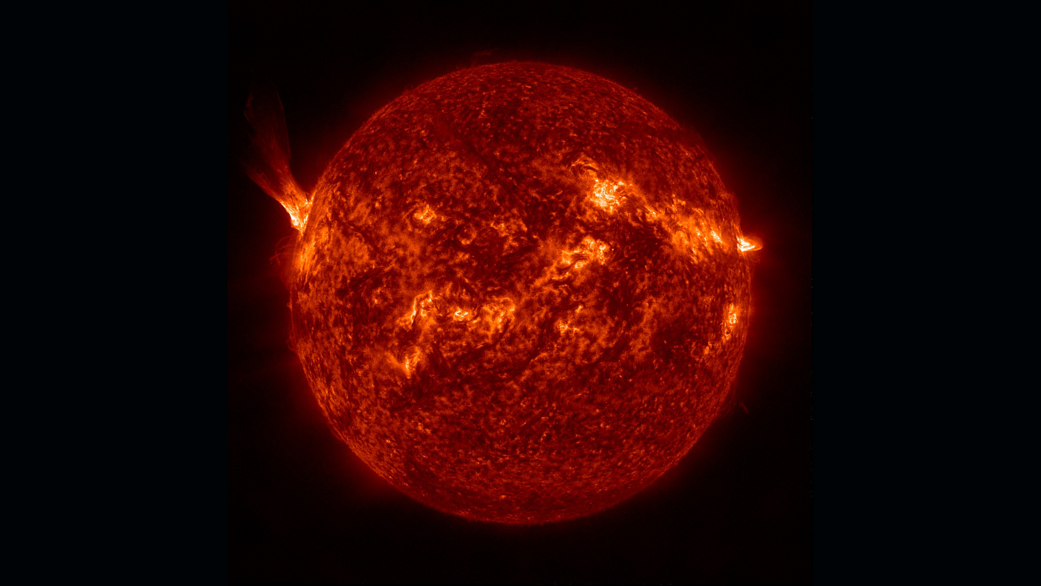
As huge as our sun is in comparison to the planets in its orbit, its size does not qualify it in that direction. It will ultimately, in the space of five billion years, become a white dwarf, a fireball of a dying star which it was assumed would consume Earth in its quest for energy to sustain itself before expiring. First the Sun must burn through all the hydrogen in its core, following which two immense expansion phases occur; becoming a red giant, and then an AGB star when it has spent all its helium.
 
An Asymptotic Giant Branch (AGB) star is a late stage in the evolution of low-to-intermediate mass stars (about 0.8 to 8 times the mass of the Sun). It represents the final bloated phase of a star's life before it sheds its outer layers and collapses into a dense white dwarf.
 
https://www.nasa.gov/wp-content/uploads/2023/03/apr2015-rec.png
Will the Sun become a black hole? No, it's too small for that! The Sun would need to be about 20 times more massive to end its life as a black hole.   NASA
 
As the Sun expands there will be significant effects seen on Earth as the Sun's increasing gravitational forces pull the Earth toward it. This force creates the push and pull of ocean tides on the Earth, energy from which dissipates at the ocean bottoms, which in turn slows Earth's rotation, while gradually moving the Moon further from Earth.  Intense tidal waves stir within the Sun as it expands and its blistering surface moves closer to Earth. It is when those tides dissipate that Earth would be pulled into the Sun's dying embrace.  
 
On the other hand, due to stellar wind, the growing Sun will also lose much of its mass, pushing planet Earth further distant. The new calculations reached by the authors of the newly-published study, places the initial hypothesis of the Earth being swallowed by the dying Sun in question. These are calculations reliant on relatively simple descriptions of tidal dissipation within giant stars. 
 
The study's authors took advantage of advances in modelling tides over the last 15 years to demonstrate "the dissipation is lower than previously expected", as explained by Dr. Mathis of the CEA Paris-Saclay centre. Mars is also affected by escaping, like Earth a death spiral into the Sun, according to the new modelling. Mercury and Venus, closest to the Sun, are less fortunate. Their fate will be that the expanding fireball will inexorably swallow them both. 
 
Of course, nature's plans can be inscrutable, and even while scientists feel they have achieved a fuller understanding of her formulated designs and the unfolding of the universe as it continues to age into eternity, new discoveries will emerge that will add layers on to what has already been surmised, hypothesized, synthesized and 'proven'. None of us, regardless, need spend sleepless nights concerned over how our lives will change as these forces of nature unfold, other than to marvel at the wonders of a universe that is vast and for the most part unknowable. 
 
Sunrise from Earth's horizon.
A view of the sunrise from Earth's horizon.    Zelch Csaba/Pexels


Labels: , , , ,

Wednesday, June 28, 2023

Here Comes the Sun!

"The sun would appear green if your eyes could handle looking at it."
"Basically, when you look at the sun, it has enough of all the different colours in it and it's so bright that everybody's eyes are firing like crazy and saying, 'It's too bright for me to tell you what colour it is'."
"That's why the sun looks white to us."
"Essentially, it's a green star that looks white because it's too bright, and it can also appear yellow, orange or red because of how our atmosphere works."
"The sun is at its mid-life, and it still has quite a lot of years before it changes colours. It still hasn't dimmed out one bit."
"When astronomers say colour, they really mean temperature. But to anyone in the public, colour just means the colour you see and how you make sense of the world."
W. Dean Pesnell, project scientist, Solar Dynamic Observatory, NASA 

"We think of perception and vision as being really straightforward, with this idea of 'I have my eyes and see'. And, actually, it's not like that at all. It's influenced by where you grow up, when you grow up and who you grow up around."
"When you're a kid, you don't necessarily pay that much attention to these deep philosophical questions about the nature of colour and light in the way you might start to when you're sitting in your office looking out the window on a sunny day, so perhaps you just override your memory with the learned association of 'yellow equals sun', which you leaned on heavily as a child."
"This is just another neat example of how life paints colour."
Alice Skelton, researcher of developmental colour science, University of Sussex, Britain
The sun
Do you know what color the sun really is? solarsystem.nasa.gov
 
While children in Japan might colour a circle red to represent the sun, in alignment with their national flag [Land of the Rising Sun], those in North American have a tendency to sketch a yellow circle. Adults are now debating the colour of the star at the centre of our solar system, some of whom feel it has changed hues since the time of their childhood. Weeks back, writer Jacqui Deevoy tweeted her opinion that the round yellow sun of her childhood had turned white and looks wonky. Her post amassed 6 million views.

Some of those had responses with people either agreeing with Deevoy's observation or those who claimed the sun had always appeared white. And as far as science is concerned, it's neither -- while being a bit of both. The sun from its 150 million kilometre distance generally appears a white spot in the sky, while the yellow tint perceived by some people is related to how light is scattered. Molecules in the air redirect sunlight's blue and violet wavelengths, and this directs more yellow and red to meet our eyes.

Sunlight passes through a thicker atmosphere as day transforms into night, so more molecules scatter its blue hues and lead to displays of oranges and reds at sunset. The sun's hue is really light bouncing off surfaces. With stars, colour equals temperature; the hotter a star, the more blue light it gives off. Cooler stars appear red. The sun at its core has a temperature topping 15 million degrees Celsius; "somewhere in the middle, in this weird space where we can't perceive its colour", observed Dr. Pesnell. In the distant future the sun is expected to change hues.
 
sun_photo.jpeg

The sun appears different depending on who’s looking. From left, NASA’s NuSTAR sees high-energy X-rays; the Japanese Aerospace Exploration Agency’s Hinode mission sees lower energy X-rays; and NASA’s Solar Dynamics Observatory sees ultraviolet light. NASA/JPL-Caltech/JAXA

The source of all the light and heat that makes flowers bloom, birds sing and people smile emanates as a result of the conversion of hydrogen to helium taking place deep inside the sun's core. The hydrogen gas will -- in a vast stretch of time run out. The sun will enlarge exponentially and take on a deep red shade then ingest all the planets surrounding it and finally it will glow bright blue for a while, and then dim to such a low temperature its colour will become imperceptible ... but no one will be around by then to perceive it.

That colossal event won't take place for at least four billion to five billion years into the future. The sun has some people convinced it has become whiter, but this is connected with the brain's perception more than with astrophysics, according to Dr. Pesnell. Perception itself differs from person to person. Colour, in its most physical sense is what people see when a wave length enters the eye and specialized cells send signals to the brain which translates waves into the colours we see. Everyone may be receiving the same information, but individual life experiences and backgrounds dictate what we make of it.

In the Arctic Circle for example, where some children are born during its long periods of darkness and others experience prolonged sunlight, colour looks different, depending on those life-beginning circumstances. As adults, research shows time of birth influences abilities to distinguish different shades. Language and culture may also play a role, with some not having a specific word to differentiate between blue and green, as an example. Dr. Skelton points out that people's upbringing and how they learn to associate colours with objects can affect perception.

An image of the Earth and the Sun from space. The Sun is extremely bright saturating the camera but it is white

The Sun from space... the color should be obvious. Image credit: NASA

Labels: , , , , ,

Saturday, August 26, 2017

The Sunshine Vitamin

"This sun-phobic atmosphere has been promoted for so long. But the abstinence recommendation of not being exposed to one direct ray of sunlight for your entire life defies good logic."
"There is good evidence that the lower the latitude that you live [in the Northern Hemisphere], the lower your risk for high blood pressure, having a heart attack, multiple sclerosis, Type I diabetes, infectious diseases, cognitive dysfunction, and the list goes on."
"You essentially [your body] make no vitamin D before 9 a.m. and after 4 p.m. or 5 p.m., even if  you're at the equator with the sun shining brightly."
"Its just like everything else in life. You have to do it [exposure to the sun's rays] in moderation. And you need to understand the consequences of what you're doing."
Dr. Michael Holick, endocrinologist, Boston University Medical Center


For decades medical authorities have been warning people to stay out of the sun; have no direct sun contact, use Vitamin D supplements to obtain the requisite daily Vitamin D. At one time people were regularly exposed to direct sunlight throughout the course of their daily lives. The Industrial Revolution had the increasing effect of producing soot and smog and before long city landscapes were clouded with particulate matter to the extent that little sunlight penetrated. Children began presenting with rickets, and doctors across the Western world realized that lack of sun had warped growing bones.

The curative powers of the sun and of fresh air were noted by the ancients. The father of medicine, Hippocrates, treated various ailments with a regimen of direct sun exposure. In the late 19th Century, sunshine was prescribed as a treatment for tuberculosis, among other diseases. More latterly, the risk of skin cancer has led the medical community to warn people of the risks inherent in direct, prolonged exposure to the sun. But the key here is 'prolonged' exposure, not limited exposure. Any kind of exposure, however brief, was decried as too risky.

But although Vitamin D has been industrially added as a vital supplement to all manner of foods, most notably dairy products, research reveals that there are a myriad of benefits derived from direct sun exposure. Chemical changes occur when photons in sun penetration of the skin  takes place. The sun influences the creation of nitric oxide, causing blood vessels to relax, lowering blood pressure. Skin cells stimulated by UV radiation produce other hormones to modulate the immune system, and to produce beta-endorphin, making us feel good in sunlight.

Dr. Holick, specializing in vitamin D, sees the value in supplementation, but he also stresses that sun exposure is a requirement for optimum health outcomes. He explains that avoiding the sun may raise risk of other diseases like breast cancer, heart disease and colon cancer. His book, The UV Advantage: The Medical Breakthrough That Shows How to Harness the Power of the Sun for Your Health, recommends people receive five to ten minutes of direct exposure to the sun at least two to three times weekly.

He is a professor of medicine, physiology and biophysics at Boston University. And he also acts as the director of the Heliotherapy, Light, and Skin Research Center at the medical centre of the university. Many of his colleagues, long accustomed to warning patients off sun exposure under the fear that even minute exposure can damage DNA are yet to accept Dr. Holick's arguments fully.

A study out of the UK where light-skinned people were exposed to simulated sunlight produced an interesting effect. "There was some DNA damage, but what was remarkable was that at the end of the study, it looked like there were mechanisms at play to help correct the DNA damage", Dr. Holick pointed out.

Two studies from the Journal of the National Cancer Institute reported that those with daily sun exposure experienced a lower risk of non-Hodgkins' lymphoma. As well, survival rates were increased for patients with early-stage melanoma.

Even while the sun is associated with damage to the epidermis, small doses in exposure appear to effectively heal skin problems, as Dr. Bobby Buka, a dermatologist in New York points out. Inflammatory skin conditions like psoriasis, eczema and acne can be seen to improve when people are exposed to UV radiation for limited periods of time.


Labels: , , , , ,

 
()() Follow @rheytah Tweet