Ruminations

Blog dedicated primarily to randomly selected news items; comments reflecting personal perceptions

Saturday, June 20, 2026

The Endless Flywheel of Nature's Designs

"[Advances made in modeling these tides over the last 15 years have enabled the study's authors to show that] the dissipation is lower than previously expected."
"A better understanding of tidal physics and the most advanced constraints we have on mass loss allow us to say that -- in the current state of knowledge -- Earth could move away from the Sun, contrary to what was predicted before."
Stephane Mathis, astrophysicist, Paris-Saclay centre, France 
 
"Earth's fate depends on a delicate balance between these two effects [increased size of sun's gravitational force pulling Earth closer to the Sun, compounded by oceanic tidal energy pushing the Moon further from Earth]."
"If tidal interactions predominate, Earth is engulfed by the sun. If the sun's mass loss predominates, Earth escapes into an orbit larger than the radius of its star." 
Mats Esseldeurs, astrophysicist, University of Leuven, Belgium 
A new lease of life: Our planet may escape a fatal spiral into the exploding fireball of the Sun
A new lease of life: Our planet may escape a fatal spiral into the exploding fireball of the Sun. Phys.Org
 
Up to the present time, and until the publication of a study published in the journal Astronomy & Astrophysics, of which Mats Esseldeurs was lead author, it was thought among astrophysicists that Earth's distant fate into the far future would be its absorption into the sun and thus complete annihilation. An almost-similar fate that has obliterated many stars in the firmament of the heavens over millions of years, as their stars became giants, then red dwarfs and then black holes vacuuming all that surrounded them into the nothingness of their depths. 
 
As huge as our sun is in comparison to the planets in its orbit, its size does not qualify it in that direction. It will ultimately, in the space of five billion years, become a white dwarf, a fireball of a dying star which it was assumed would consume Earth in its quest for energy to sustain itself before expiring. First the Sun must burn through all the hydrogen in its core, following which two immense expansion phases occur; becoming a red giant, and then an AGB star when it has spent all its helium.
 
An Asymptotic Giant Branch (AGB) star is a late stage in the evolution of low-to-intermediate mass stars (about 0.8 to 8 times the mass of the Sun). It represents the final bloated phase of a star's life before it sheds its outer layers and collapses into a dense white dwarf.
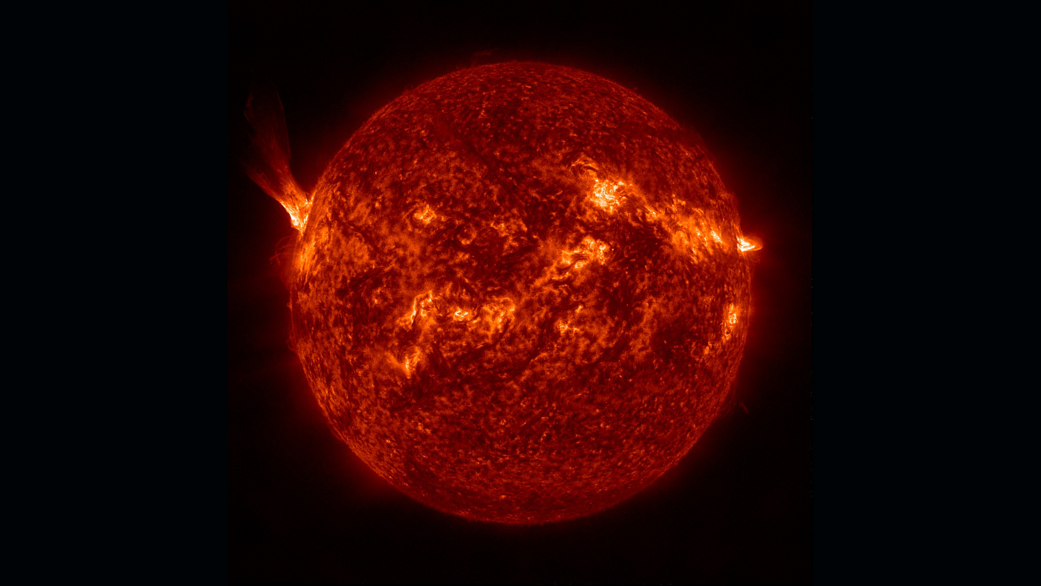
 
https://www.nasa.gov/wp-content/uploads/2023/03/apr2015-rec.png
Will the Sun become a black hole? No, it's too small for that! The Sun would need to be about 20 times more massive to end its life as a black hole.   NASA
 
As the Sun expands there will be significant effects seen on Earth as the Sun's increasing gravitational forces pull the Earth toward it. This force creates the push and pull of ocean tides on the Earth, energy from which dissipates at the ocean bottoms, which in turn slows Earth's rotation, while gradually moving the Moon further from Earth.  Intense tidal waves stir within the Sun as it expands and its blistering surface moves closer to Earth. It is when those tides dissipate that Earth would be pulled into the Sun's dying embrace.  
 
On the other hand, due to stellar wind, the growing Sun will also lose much of its mass, pushing planet Earth further distant. The new calculations reached by the authors of the newly-published study, places the initial hypothesis of the Earth being swallowed by the dying Sun in question. These are calculations reliant on relatively simple descriptions of tidal dissipation within giant stars. 
 
The study's authors took advantage of advances in modelling tides over the last 15 years to demonstrate "the dissipation is lower than previously expected", as explained by Dr. Mathis of the CEA Paris-Saclay centre. Mars is also affected by escaping, like Earth a death spiral into the Sun, according to the new modelling. Mercury and Venus, closest to the Sun, are less fortunate. Their fate will be that the expanding fireball will inexorably swallow them both. 
 
Of course, nature's plans can be inscrutable, and even while scientists feel they have achieved a fuller understanding of her formulated designs and the unfolding of the universe as it continues to age into eternity, new discoveries will emerge that will add layers on to what has already been surmised, hypothesized, synthesized and 'proven'. None of us, regardless, need spend sleepless nights concerned over how our lives will change as these forces of nature unfold, other than to marvel at the wonders of a universe that is vast and for the most part unknowable. 
 
Sunrise from Earth's horizon.
A view of the sunrise from Earth's horizon.    Zelch Csaba/Pexels


Labels: , , , ,

Wednesday, April 06, 2022

Hello! Anyone There?

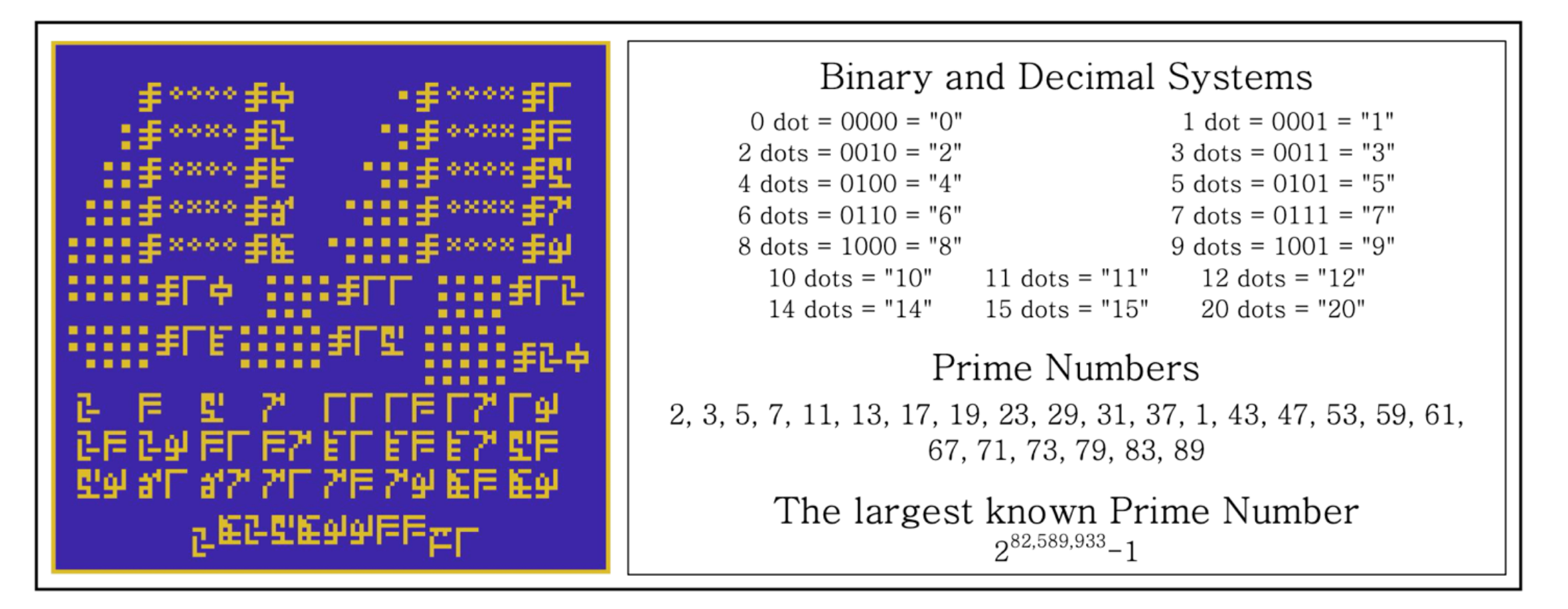
"[The Beacon in the Galaxy is not the first message created to be sent into space; it] contains more information about basic mathematics and science [than its predecessor, Arecibo]."
"The main part of this BITG Message contains a new set of graphical information in the form of images and special 'alphabets' to represent numbers, elements, DNA, land, ocean, and human, etc., starting by an artificial header and footer that consists of prime numbers."
Matthew Chong, physics/math student, Cambridge University
Binary and decimal systems.
A sample from a new message intended to be sent toward potential intelligent extraterrestrials in the galaxy. Credit: “A Beacon in the Galaxy: Updated Arecibo Message for Potential FAST and SETI Projects,” by Jonathan H. Jiang et al. Preprint posted online March 4, 2022 (CC BY-NC-SA 4.0)
"If aliens visit us, the outcome would be much as when Columbus landed in America, which didn't turn out well for the Native Americans."
"[Even if a signal is received from Gliese 832c, an exoplanet that may possibly be habitable], we should be wary of answering back."
Stephen Hawking, British physicist extaordinaire (deceased)
Humanity reaches out to whatever/whoever elevated life form may exist on a planet somewhere in the universe. Science refuses to believe that in the vastness of the universe, and the uncountable array of galaxies, stars and planets only the Milky Way's Planet Earth brought forth the organic life that developed the animals that inhabit the planet, including homo sapiens. Radio telescopes have been attempting for decades to pick up even the faintest signals of life elsewhere in the universe, to no avail.

Now a new initiative, the latest in a long series of outreaches to any intelligent beings assumed to have the capacity to receive and analyze and interpret a message from Earth, has been updated, the radio message to be sent into the cosmos, essentially pinpointing Earth's location to aid an interested intelligence in understanding precisely where this planet is located in the geography of the universe. 

The BITG message is comprised of 13 portions consisting of approximately 204,000 effective binary digits; 25,500 bytes in total. The goal of the scientists involved is to start a dialogue with ETI (extraterrestrial intelligence) "no matter how far in the future that might occur". Should intelligent life exist elsewhere in the universe as astrophysicists believe, it could potentially receive a radio message as a guide to finding Earth.

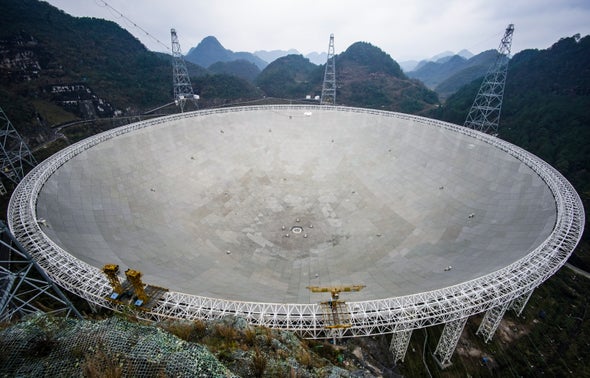
Jonathan Jiang, the lead on the project, a scientist at NASA's Jet Propulsion Laboratory, elaborated that a group of cosmic landmarks are meant to be conveyed as an assist to indicate Earth's position within the Milky Way Galaxy. The intention is for the Five-hundred meter Aperture Spherical Radio Telescope in China and the SETI Institute's Allen Telescope Array in northern California to transmit the message.
 
 General view of the Five-hundred-meter Aperture Spherical radio Telescope (FAST) in Pingtang County, Qiannan Buyei and Miao Autonomous Prefecture, Guizhou Province of China. The 500-meter aperture spherical radio telescope (FAST), also known as China's 'Sky Eye', will open to global scientific community from March 31. (Photo by Li Jin/VCG via Getty Images)

Labels: , , , , , , ,

Thursday, July 29, 2021

Settling The Science of General Relativity

Researchers observed bright flares of X-ray emissions, produced as gas falls into a supermassive black hole. The flares echoed off of the gas falling into the black hole, and as the flares were subsiding, short flashes of X-rays were seen – corresponding to the reflection of the flares from the far side of the disk, bent around the black hole by its strong gravitational field. (Image credit: Dan Wilkins)
"Fifty years ago, when astrophysicists started speculating about how the magnetic field might behave close to a black hole, they had no idea that one day we might have the techniques to observe this directly and see Einstein's general theory of relativity in action."
Professor Roger Blandford,  Luke Blossom Professor, School of Humanities and Sciences, Stanford professor of physics and SLAC professor of particle physics and astrophysics

"Any light that goes into that black hole doesn’t come out, so we shouldn’t be able to see anything that’s behind the black hole."
"The reason we can see that is because that black hole is warping space, bending light and twisting magnetic fields around itself."
"This magnetic field getting tied up and then snapping close to the black hole heats everything around it and produces these high energy electrons that then go on to produce the X-rays."
"I've been building theoretical predictions of how these echoes appear to us for a few years. I'd already seen them in the theory I've been developing, so once I saw them in the telescope observations, I could figure out the connection."
"It's [Wide Field Imager detector] got a much bigger mirror than we've ever had on an X-ray telescope and it's going to let us get higher resolution looks in much shorter observation times. So, the picture we are starting to get from the data at the moment is going to become much clearer with these new observatories."
Dan Wilkins,  research scientist, Kavli Institute for Particle Astrophysics and Cosmology, Stanford and SLAC National Accelerator Laboratory
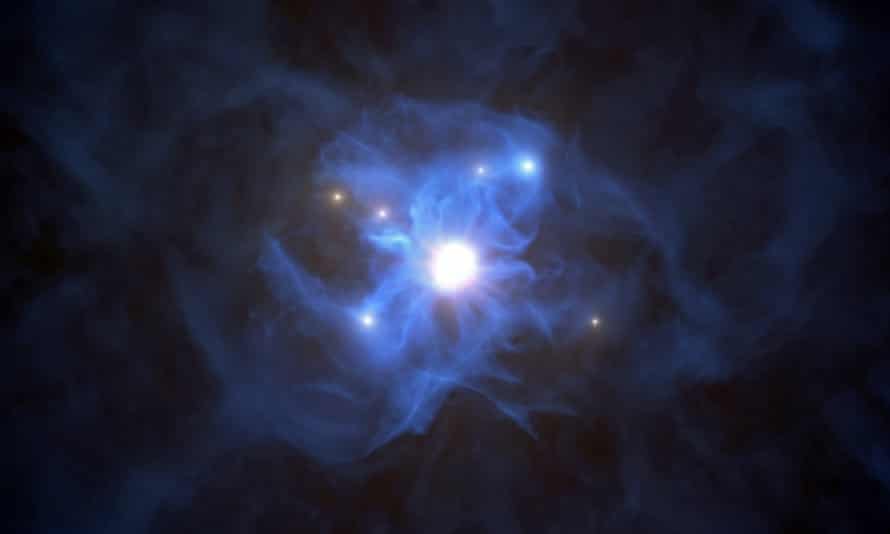
An artist’s impression of a supermassive black hole.
An artist’s impression of a supermassive black hole. Photograph: ESO/L Calçada/EPA

Predicted in 1915, Albert Einstein's theory of general relativity has undergone many challenges to its accuracy but in the final analysis there has been no question that his theory has been upheld time and again. And now, yet again irrefutable proof of that theory has emerged with the detection of light being emitted from the back end of a black hole. His prediction was that the gravitational pull of black holes warp the fabric of space to such a degree that they twist magnetic fields and bend light.
 
It should be possible, he predicted, to witness the emergence of light waves as they eject from the far side of black holes resulting from the distorted magnetic fields that act as a mirror. The theory, while accepted by experts in the field, remained untested. The phenomenon was never directly observed. Now, however, given modern telescopes and the development of technologies to produce sensitive instruments, the spectacle was indeed witnessed.
 
The result of which is that an international team of researchers made use of X-ray telescopes in their study of a massive black hole some 800 million light years distance from Earth, located at the centre of a distant galaxy. The expected and frequently observed black hole hallmarks were seen but now researchers also were able to detect light in the form of X-rays being emitted by the far side of the black hole under scrutiny.
 
An astrophysicist at Stanford University, Dan Wilkins was in the process of studying the mechanics of a black hole ripping atoms and electrons apart which subsequently produces X-rays. Inspecting the accumulated data, he expected and saw X-rays spewed directly toward Earth from the black hole's core. Then he also saw shortly following this, unexpected echoes which he identified as X-rays flung out in the opposite direction to Earth, reflected by the black hole's mangled magnetic field.
 
That finding described in a release published in the journal Nature proved again, in supporting Einstein's theory of general relativity, how correct a theory Albert Einstein gifted to science. This celestial giant's immense gravitational pull, ingesting everything and anything in its near vicinity into its great maw was assumed to be insatiable in appetite, its interior a dense mysterious darkness emitting no light. 
 
Now an international team of researchers, with the use of X-ray telescopes revealed that light is indeed emitted as X-rays, in the opposite direction to which the black star swallows all it surveys. 
 
An orange ring with twisted stripes.
Credit: CCO Public Domain


Labels: , , , , ,

 
()() Follow @rheytah Tweet