Ruminations

Blog dedicated primarily to randomly selected news items; comments reflecting personal perceptions

Tuesday, July 04, 2023

If You Go Out In The Woods Today

"We can now count and track when these illnesses are occurring, map it for a risk map and be able to inform the public when these diseases become more prevalent."
"It's absolutely expected that we'll have greater incidence over the next several years because this is a known wave of infections that we've seen migrate up the coastline of northeast North America and anticipate them affecting Ontarians."
"It is simply from the ability of these ticks, that are now able to survive our winters and stay and breed over their two-year life cycle."
"We've seen them migrate from the mid-eastern United States and now that wave of migration we've seen go through Connecticut and New York and these diseases are following in the footsteps of Lyme disease and we anticipate that we'll have more cases of these."
Ontario Chief Medical Officer of Health Dr. Kieran Moore 
Three types of tick-borne illness in addition to the well-known Lyme disease threat have been identified in Ontario, with an expected growth in the incidence of these diseases in the near future. Health-care providers, in view of the seriousness of the anticipated dangers to people's health, are now expected to recognize a new regulation requiring them to report cases of anaplasmosis, babesiosis and Powassan virus to their local medical officers of health.

So far, anecdotal reports and publications addressing the issue of the three illnesses being discovered in recent years in Ontario represent the need to begin their formal tracking. There has been a rise over the past twenty years in the incidence of Lyme disease, now that ticks, and in particular black-legged ticks are capable of surviving Ontario's still-harsh winters. Waves of anaplasmosis, babesiosis and Powassan virus have been seen in the United States, giving Ontario's chief medical officer of health ample reason to expect the same to begin occurring in the province.

Bacteria able to enter the human bloodstream through a tick bite causes anaplasmosis which causes fever and chills, but is also able to suppress bone marrow and the creation of white and red blood cells, as well as platelets. Ticks transmit intracellular parasites with babesiosis, which invade a person's red blood cells and burst them so that people can present with anemia, fever and chills, similar to malaria.
 
A black and white photo of a little boy.
Lincoln Byers had the first recorded case of Powassan virus in 1958. He died of complications from the virus at the age of five. (Submitted by Sue Cossar)

With Powassan virus, most infections are asymptomatic, yet some people can experience fever, headache, nausea, vomiting, weakness or aches and pains. At a later date following an acute phase and a period of remission, an infected person may become confused, have loss of coordination, difficulty speaking, paralysis, seizures or coma. Lincoln Byers was five years old when he died of complications from what is now known as Powassan virus, a tick-borne illness which can lead to infection of the brain (encephalitis) or the membranes around the brain and spinal cord (meningitis) in severe cases.

No specific treatment exists for Powassan virus disease, according to the Centers for Disease Control; patients' symptoms are managed, instead. Anaplasmosis and babesiosis can be treated with antibiotics for cases that are symptomatic. 
"Approximately 50 per cent of people who survive severe disease have long-term health problems, such as recurring headaches, loss of muscle mass and strength, and memory problems."
Associate Chief Medical Officer of Health Dr. Michelle Murti
A picture of a tick with a brown body and black legs.
Photo provided by the U.S. Centers for Disease Control and Prevention (CDC) shows a black-legged tick, which is also known as a deer tick. (AP via CDC/The Canadian Press)

Labels: , , , , ,

Friday, July 23, 2021

Beware Blacklegged Ticks ... Transmitting Lyme Disease and Anaplasmosis

"There has been a rise in cases. Anecdotally, my colleagues and I are seeing a larger number than in past years."
"This is the first year I can remember that we have seen multiple cases in a relatively short period of time."
"They both [Lyme disease and Anaplasmosis] make people feel pretty dreadful."
Dr.Gerald Evans, infectious disease specialist, Kingston Health Sciences Centre, Queen's University
what is Anaplasmosis
  • Although cases of anaplasmosis can occur during any month of the year, the majority of cases reported to the CDC have an illness onset during the summer months and a peak in cases typically occurs in June and July.
  • This period is the season for nymphal blacklegged ticks. Nymphal blacklegged ticks bite people and can spread the pathogen.
  • A second, smaller peak occurs in October and November when adult blacklegged ticks are most active.
Health officials in upper New York State are seeing a spike in cases of anaplasmosis; from early July cases had quadrupled from a year earlier in Warren County, New York, not far from the Canadian border. Authorities caution this to be yet another reason for precautions to avoid tick bites. For Lyme disease transmission ticks generally must be attached to human skin for over 24 hours to transmit the pathogen, but evidence exists that faster transmission of anaplasmosis takes place, with no telltale rash left, as occurs with Lyme disease.
 
pet human Anaplasmosis
Facty Health
 
The poppy-seed-size and slightly larger ticks are difficult to notice, making it imperative that when people are in wooded areas where wildlife abound, particularly mice and deer, that they carefully scrutinize themselves and their pets after exposure, to detect the presence of these tiny creatures and to take careful steps to extract them, particularly the head, from adhesion to the skin. 

Lyme disease has a more gradual, subtle presence, generally starting with a rash in a bullseye shape. Following symptoms are inclusive of joint and muscle aches, fatigue, headache and low fever. Later stages of Lyme can lead to cardiac and neurological problems. Anaplasmosis, on the other hand, usually causes fever, chills, severe headache, nausea, vomiting and muscle aches. An enlarged liver and spleen as well as low white-blood-cell and platelet counts can also result.
 
symptoms of Anaplasmosis
Facty Health
 
Anaplasmosis is rarer than Lyme disease, and can be treated with doxycycline, the antibiotic prescribed for treatment of Lyme. Warmer winter seasons have encouraged a rise in the presence of bacterium Borrelia burgdorferi in ticks carrying Lyme disease but those same ticks are also vectors of the bacterium carrying anaplasmosis. The result is increased numbers of anaplasmosis are being seen among the public.

The bactrerium Anaplasma phagocytophilum is transferred by tick bite to cause anaplasmosis in people and livestock. And now it is arriving in Ontario with researchers reporting the first known human case in 2018, acquired from a blacklegged tick, whereas the first cases reported in the United States go back to 1994, in Minnesota and Wisconsin. Doctors had seen the disease in people who had travelled to the U.S. where cases were fairly common, but never before acquired in Ontario.

Now, despite the fact that borders between the two countries have been closed to travel during the global pandemic, and few Canadians are travelling to the United States, cases among Ontarians have arisen indicating that they were acquired through tick bites near home. Recent research from the University of Ottawa found one in three blacklegged ticks tested positive for Lyme disease.

Anaplasmosis prevention
Facty Health

In roughly one percent of cases of this tick-borne illness, it can be fatal, according to the U.S. Centres for Disease Control. Those over age 60 and people who fail to get treatment  quickly are most at risk for severe outcomes. The best possible course of ideal action is, of course, avoidance. Wearing clothing that covers the skin, and vigilance to the presence of ticks on return from an outdoor hike in a forested area.
 
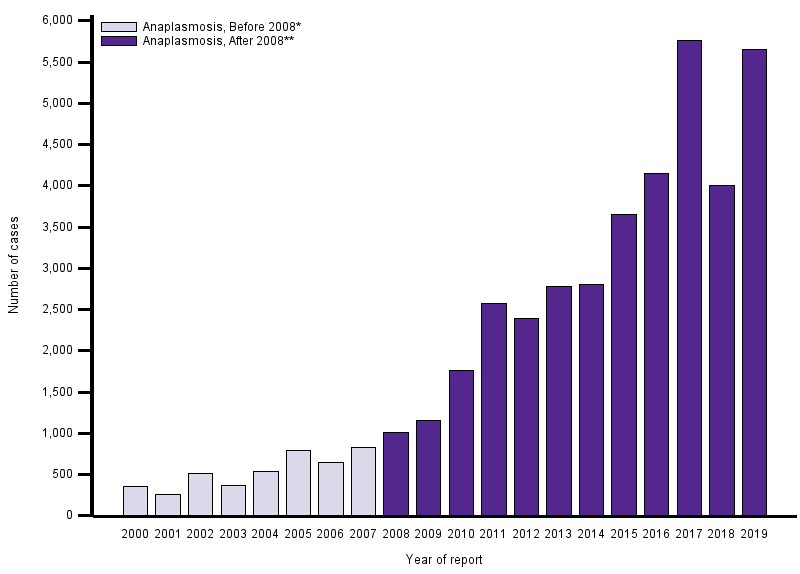
The graph displays the number of human cases of anaplasmosis reported to CDC annually from 2000 through 2018.  See table below for data.


Labels: , ,

 
()() Follow @rheytah Tweet