Ruminations

Blog dedicated primarily to randomly selected news items; comments reflecting personal perceptions

Wednesday, June 17, 2026

The Increasingly Vulnerable Place of Jewish-Canadians Within Canada

"The findings suggest that condemnation alone has not been enough."
"While many leaders have denounced antisemitism since October 7, the survey shows that a significant minority of Canadians still believe that events in the Middle East justify negative attitudes toward Jewish Canadians."
"It [new poll results] suggests that public education should not only focus on people who hold openly antisemitic views, but also on the much larger group that may not recognize when criticism about Israel becomes rhetoric that targets Jews and that presents a threat to Jewish Canadians' sense of safety and belonging." 
Jack Jedwab, president, Association for Canadian Studies  
https://smartcdn.gprod.postmedia.digital/nationalpost/wp-content/uploads/2026/06/na0617-antisemitismPoll-French-English-BH-W.jpg?quality=90&strip=all&w=564&type=webp&sig=LYBIF17bcWT6MPTd4_zdHg
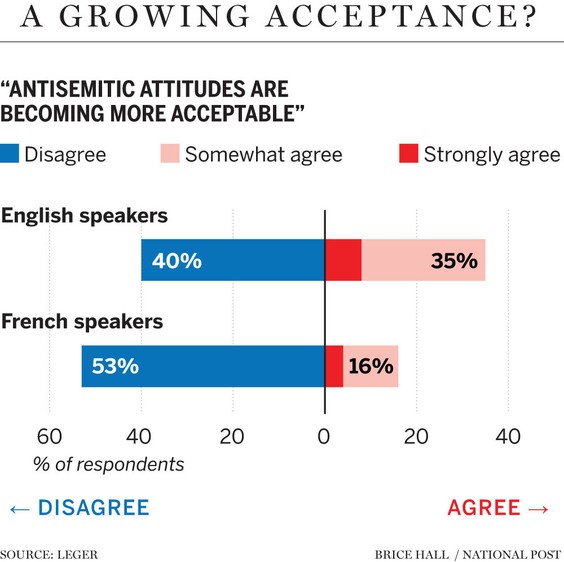
 According to a newly-released Leger survey, almost a third of Canadians believe that anti-Jewish attitudes have become more acceptable. The highest level of agreement to that observation was among university students (37 percent), though altogether 31 percent of those questioned held that view. Among men (38 percent agreed) and (35 percent) held that view, ages 18  to 34. The survey found that among English speakers 35 percent agreed that antisemitism is now more socially acceptable, while among francophones that number was 16 percent.
 
"Israel's military actions in Gaza justify negative attitudes toward Jewish people in Canada", struck a chord with just over a fifth of respondents (22 percent), as opposed to the almost half (49 percent) who disagreed. Once again those aged 18 to 34 (26 percent) and men (29 percent) led the way in agreement with the statement. Of those Canadians surveyed, some one-sixth (17 percent) agreed they now have more negative emotions toward Jews since the October 7 terrorist attacks in southern Israel, though a majority (62 percent) disagreed.
 
Women's opinion at (68 percent), college students (66 percent) and Canadians past age 55 (69 percent), were likelier to disagree even as those who were part of the survey and born outside Canada were likelier to agree (24 percent), than those respondents who were Canadian-born (16 percent)
 
For the statement whether "Jews in Canada are responsible for the actions of the Israeli government", nine percent of all respondents, plus eight percent of those born in Canada were in agreement, even as twice the number of those born outside the country (15 percent) agreed. 73 percent of respondents born in Canada and 62 percent of those born elsewhere, were in disagreement with the statement.  
 
https://thehub.ca/wp-content/uploads/2026/06/Fig4_SummaryofStatementds_graph_v2-1.jpg
Over a third of respondents (39 percent) found agreement that calls for Israel to cease to exist are antisemitic, though slightly over a quarter (28 percent) disagreed -- with younger Canadians aged 18 to 34 being less likely (34 percent) than those over 55 years of age (47 percent) to agree over the antisemitic nature of such sentiments.
 
As for the question posed to English speakers and francophones -- 39 percent versus 40 percent revealed little difference between the groups. The variance between those born in Canada at (39 percent) and those born abroad (41 percent), also revealed minimal differences. 
 
Interestingly, slightly over a third of respondents (39 percent) were of the opinion that Prime Minister Mark Carney "should publicly condemn calls for Israel to cease to exist as a state", as opposed to just under a quarter (24 percent) disagreeing. The survey was conducted between June 5 and 7, questioning a total of 1,518 respondents.  
"The importance of the minority who don't think it is antisemitic to say that Israel should cease to exist as a state is very worrisome and I think speaks to some nefarious motivation on the one hand and a fair degree of confusion on the other and in either there is an important degree of unlearning that is needed."
"That, along with the share of the group that is uncertain about the issue, points to a glaring misunderstanding about where antisemitism begins."
"It reveals that many Canadians are unclear about the distinction between criticism of Israeli government policy and rhetoric that denies Jewish self-determination altogether."
Jack Jedwab, Association for Canadian Studies 
https://smartcdn.gprod.postmedia.digital/nationalpost/wp-content/uploads/2026/06/na0617-antisemitismPoll-collectiveBlame-BH-W.jpg?quality=90&strip=all&w=564&type=webp&sig=0cneekcvnXM8Pvx_jQNxNA


Labels: , , , ,

Saturday, March 21, 2026

Iranian Sponsored Social Media Propaganda

"You've got one end of the spectrum that's at zero and you've got that other group that's disproportionately probably more and more susceptible to following direction from influencers on selected social media, which is probably what this is attributable to."
"Medium to long term, there may be some unlearning that needs to be done amongst persons that are adopting such positions that clearly are not well informed if they think the majority of Iranians are  supporting the Iranian regime. That's incorrect." 
Jack Jedwab, President and CEO, Association for Canadian Studies
 
"[Scores of fake online accounts that were] coming from Iranians inside Iran linked to the regime and fuelling the campus protests at McGill [University, Montreal]."
"A massive, funded, co-ordinated and organized [effort by Iran designed to influence public opinion and government policy]."
Canadian investigative journalist Nagar Mojahedi
 
"As the Israel-Hamas war broke out on October 7, 2023, Iran immediately surged support to Hamas with its now well-honed technique of combining targeted hacks with influence operations amplified on social media, what we refer to as cyber-enabled influence operations."
"By late October, nearly all of Iran's influence and major cyber actors focused on Israel in an increasingly targeted, coordinated, and destructive manner, making for a seemingly boundless 'all-hands-on-deck' campaign against Israel."
Microsoft Threat Analysis team
https://smartcdn.gprod.postmedia.digital/nationalpost/wp-content/uploads/2026/03/pjt-al-quds-protest-2-_302056778.jpg?quality=90&strip=all&w=564&h=423&type=webp&sig=jWe-YR15_Pe5-36V14giPg
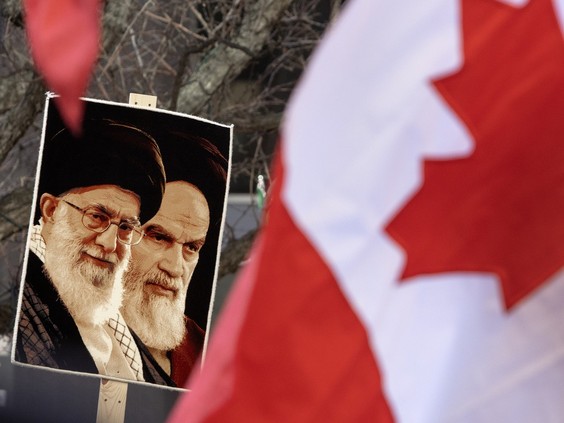
While most prefer neutrality in the Iran war, many in the Gen Z cohort think Canada should support the Iranian regime, according a new poll. Photo by Peter J Thompson/National Post
 
A  new Leger poll highlights that a significant portion of Canada's youngest adults subscribe to the belief that Canada should be supporting the Iranian regime in defence against the U.S. and Israel's aerial onslaught against the Islamic Republic. One-fifth (20 percent) of respondents between the ages of 18 to 24 felt that Ottawa should 'politically support' the Iranian regime's leadership. Among that age cohort only eight percent think the United States, Israel and other allied nations in the three-week-old war should receive Canada's backing. 
 
In contrast, results for older Canadians are the reverse to the youth contingent. Among Canadians aged 45 to 54, three percent support the Iranian regime; among the age group 55 to 64, one percent, and zero percent among Canadians aged 65 and older. A quarter of these older Canadian groups feel that Canada should be in support of its historic allies; at the rate of 23, 25 and 26 percent respectively.
 
The Islamic Republic of Iran's Revolutionary Guard Corps has been listed on the Canadian government terrorist list for the past two years. Jack Jedwab, whose group commissioned the poll, felt that the response by young Canadians reflected the fact of misinformation that has been disseminated by malign foreign interests among the gen Z cohort -- among whom 32 percent believe that Iranian-Canadians do not support the U.S.-Israel military actions against Islamic Republic of Iran. 
 
Despite the demonstrations by Iranian-Canadians celebrating in support of the U.S.-Israeli actions in Iran on the streets of Canada in jubilation that this may see the end of that violently repressive regime, over half of all respondents said they don't know.
 
Across all age groups, half of the poll's respondents felt that Canada should remain neutral in the escalating conflict, while one-fifth said they don't know are aren't certain. "It's a combination also of our own sort of self-evaluation or assessment of ourselves as the nation that is seeking or desires peaceful solutions and outcomes", was Mr. Jedwab's interpretation of the poll results, highlighting a November 2024 ASC poll finding that Canadians are 92 percent for peace with all nations, yet still felt that war could not be avoided even if one side stood down.
 
"Things are going to be more complex than that. I think some of that thinking underlies part of the neutrality view." In his view, Mr. Jedwab stated it appears that the Liberal government is attempting to balance neutrality with some Canadians' expectation that Canada should aid its allies. "That's a challenging position to take and we'll see what types of pressure are exerted in the coming days and weeks on the part of the U.S. and its allies for middle powers like Canada to become engaged, and assist those who prefer greater disengagement to better understand what the stakes are." 
 
The youth cohort, Mr. Jedwab observed, is especially drawn by anti-Trump sentiment, despite the fact that the IRGC is a terrorist entity, and the Islamic Republic itself is universally acknowledged to be a regime that encourages and supports and funds terrorist groups like Hezbollah, Hamas and the Yemeni Houthis, as well as Iraqi Shiite terror groups. 
 
"That is not something that can be taken lightly at all in trying to see one's way clearer in this war."
"It's something one needs to consider carefully in terms of drawing conclusions about where Canada should stand on this." 
 
https://smartcdn.gprod.postmedia.digital/nationalpost/wp-content/uploads/2026/03/2266076087_302058531.jpg?quality=90&strip=all&w=564&type=webp&sig=beKR2WUKNRK5SKyeRmxwKg
Al-Quds Day protesters, right, were met with a sizeable counter protest near the U.S. Consulate in Toronto, Ontario, on March 14, 2026. Photo by GEOFF ROBINS /AFP via Getty Images
 
"In late 2024, Meta -- the company that owns and operates Facebook, Instagram, and WhatsApp -- shut down a sophisticated Iranian influence operation run by the dictatorship's Islamic Revolutionary Guard."
"Meta's Threat Disruption Center revealed that Iran, aided and abetted by Hezbollah, was running multiple fake accounts across Meta's platforms as well as on TikTok, X, and others."
"Iran-supported Hezbollah created fake sites and purchased thousands of dollars of advertising on Facebook and Instagram."
Warren Kinsella, The Hidden Hand: The Information War and the Rise of Antisemitic Propaganda 

Labels: , , , ,

Saturday, July 06, 2024

Holocaust Denialism, Skepticism in Canada

"The increase in agreement that 'the Holocaust is exaggerated' from 5 to 9% in the space of just a few months may be regarded by some as modest but it is indicative of a worrisome trend, especially amongst millennials."
"It raises serious questions as to how and by whom such skepticism about the Holocaust is being driven."
"[This] is all the more troubling given the increased opportunities for Gen Zrs and Millennials to readily find the facts through schools, museums, books and film."
"It suggests that the increasing tendency to acquire information via the internet/social media platforms and to how and by whom it gets interpreted is contributing to rising misinformation."
Jack Jedwab, president, Association for Canadian Studies
https://www.ctvnews.ca/content/dam/ctvnews/en/images/2022/1/25/auschwitz-1-5753997-1643138468312.jpg
In this Jan. 27, 2020 file photo, writing reading in German "Work Sets You Free" is seen on the gate of the Auschwitz Nazi death camp in Oswiecim, Poland. (AP Photo/Markus Schreiber, file) ​

Holocaust skepticism is rising in Canada, most particularly among those who are in the young-age categories, as  highlighted by a newly published national poll, conduced by Leger for the Association for Canadian Studies, at the very time of rising antisemitism rates in the wake of the terrorist attack on Israel of October 7, followed by the Jewish State's unleashing of a war in Gaza to unseat the Hamas terrorist group which has threatened to repeat October 7's savagery and death toll until its goal of destroying Israel and annihilating Jews has been accomplished.
 
In a poll dated November 2018 it was found that 17 percent of Canadians believed fewer than six million Jews had perished during the Holocaust years, but by May of 2024 that number had risen to 24 percent. Pollsters found in February that five percent of Canadians believed the Holocaust to have been exaggerated, but by May that number had risen to nine percent; a view that more than doubled from four to 11 percent among those aged 45 to 54.
 
In the more recent poll between the ages of 25 and 34, Canadians were likely at 31 percent to doubt the numbers reflecting the Holocaust's official death toll. Slightly over one-fifth of those polled between the age of 35 and up held inaccurate views relating to the death toll of the Third Reich's 'Final Solution'. Snapchat and Telegram users were likeliest to hold inaccurate beliefs of the number of Jews that perished in the Holocaust. Among Telegram users close to 52 percent were convinced fewer than six million Jews were annihilated by the Nazi regime.
"I wouldn’t necessarily use the word denial as it doesn’t suggest that they think the Holocaust didn’t take place – though some of the group surely subscribe to that – it’s more that they minimize or trivialize the Holocaust, by questioning its scale and/or other aspects of it."
Jack Jedwab
Those who used the social media platform known as X were likeliest to accurately identify how many Jews died in the Holocaust, at nearly 67 percent, followed by LinkedIn users at 50 percent and 48 percent of YouTube users, along with 47 percent of TikTok and Facebook users, and 46 percent of Instagram who agreed that six million Jews had perished in the Holocaust. 
 
https://media-cldnry.s-nbcnews.com/image/upload/t_fit-1240w,f_auto,q_auto:best/newscms/2021_37/3198501/200123-auschwitz-mc-8473.JPG
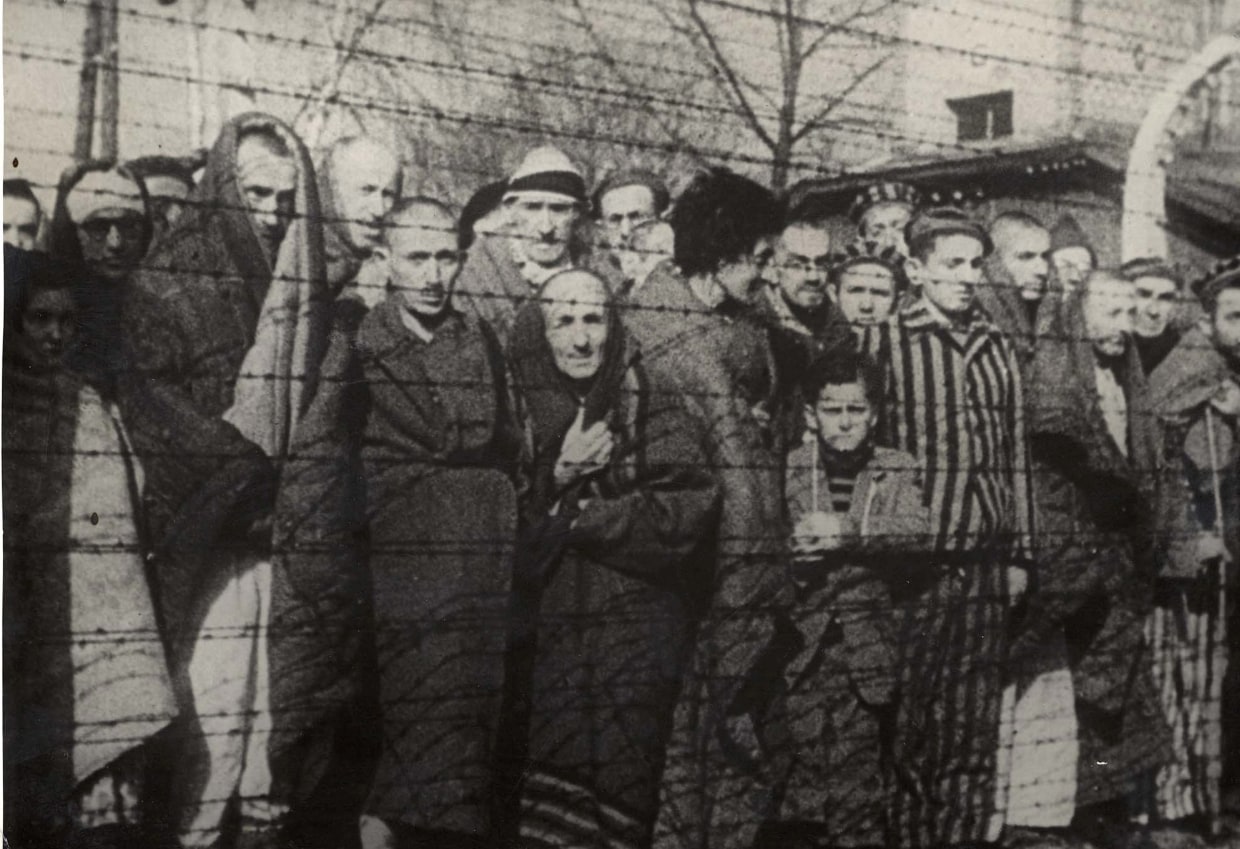
Holocaust survivors stand behind a barbed wire fence after the liberation of the Nazi German death camp Auschwitz-Birkenau in 1945 in Nazi-occupied Poland.Yad Vashem Archives / Reuters file
 
Of those poll respondents who believe numbers who died in the Holocaust has been exaggerated it was seen that they represent those most likely not to know what the correct death count amounted to. Among them, 26 percent believe that between one and three million Jews perished, while 50 percent of those who claim the Holocaust has not been exaggerated identified six million as the accurate number of Jews killed in the Holocaust. 

Of those holding "very negative" views of Jews, 36 percent believe the Holocaust has been exaggerated in comparison to 5 percent who believe it has been exaggerated, but hold "very positive" views of Jews generally. Of those with "very negative" views of Jews, 37 percent accurately identified the death toll, while 64 percent of respondents with "very positive" views knew the correct numbers.

Finally, those Canadians polled who had never had contact with anyone Jewish were likelier to believe the Holocaust to have been exaggerated, while 20 percent who claimed "never" to have interacted with anyone Jewish felt the Holocaust is exaggerated, while 94 percent who "often" interacted with Jews did not believe the exaggeration of the Holocaust.

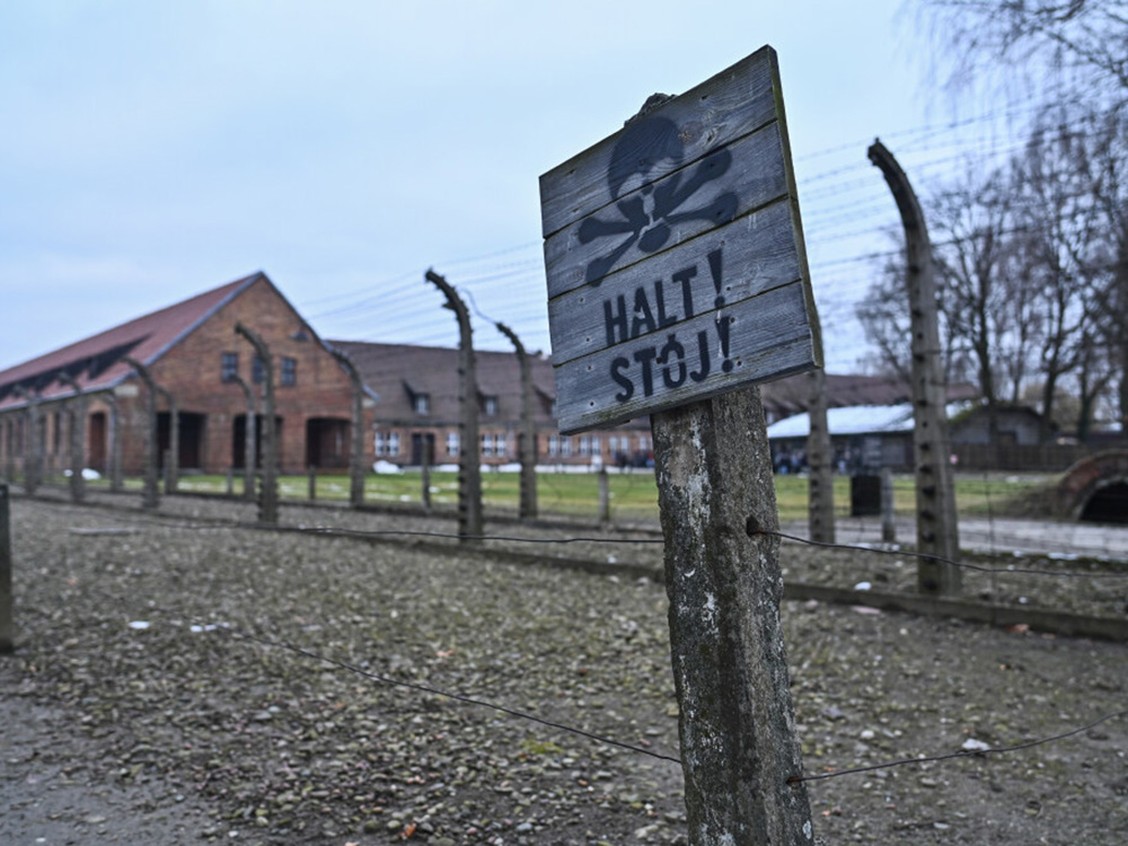
https://smartcdn.gprod.postmedia.digital/nationalpost/wp-content/uploads/2024/03/auschwitz.jpg?quality=90&strip=all&w=1128&h=846&type=webp&sig=P5QfBVMhUYJibqu9ur562A
"It is likely that the increase in Holocaust skepticism is attributable to some politically motivated influencers seeking to diminish or distort the Holocaust and/or describing it as one historic injustice amongst others."
"Skeptics were far more trusting of information when it goes viral and when the source has a large following. This suggests that there is a growing risk of exposure to misinformation and/or outright revisionism amongst what appear to be a rising number of skeptics."
Jack Jedwab, Association for Canadian Studies


Labels: , , , ,

 
()() Follow @rheytah Tweet