Ruminations

Blog dedicated primarily to randomly selected news items; comments reflecting personal perceptions

Wednesday, July 23, 2025

Canadian Immigration, Refugee and Migrant Intake

"While most observers attribute the persistent concern with the numbers of refugees to economic concerns and housing challenges, the survey looks at the extent to which Canadians trust immigrants and refugees and finds that amongst those Canadians who feel that there are too many immigrants, the level of trust in refugees is especially low."
"This may imply that concerns over domestic intergroup tensions may be a more important factor in concern with levels than has been previously acknowledged." 
Analysis of national Leger poll
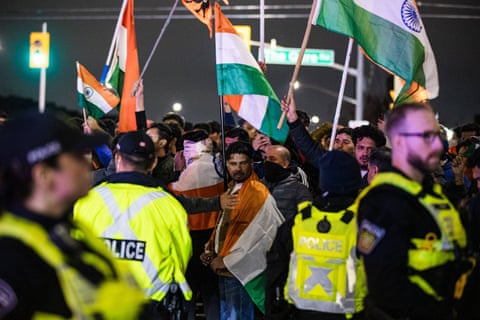
People gather and wave the Indian flag as police assemble in the foreground.
Protesters at the Hindu Sabha Mandir temple in Brampton, Ontario.  Photograph: Nick Lachance/Toronto Star/Getty Images
 
"Intergroup tensions", as for example Canadian Hindus versus Canadian Sikhs with their traditions of suspicion and distrust, acting out within Canada in viral events of dangerous dimensions, the two solitudes coming to blows, endangering the communities and bringing international attention to their divisions. It is, in fact, the communities' propensities to have among them cliques that also engage in illegal, criminal activities domestically in Canada. But above all, the ongoing agenda of the Khalistani Sikhs who agitate for a separate Sikh state to be divided from India's interior. Canada's worst terrorist assault was one committed by British Columbia Khalistanis who placed a bomb aboard Air India Flight 182 that killed all 329 people aboard, in 1982.
 
Canada has a population of Sri Lankans, among them members of the Tamil Tigers who in the past agitated for their own separatist state, committing violent crimes in Sri Lanka in support of their sovereign aspirations against the country's military and members of government. Canadian Sri Lankans belonging to the Tamil Tigers promulgated their violent terrorist propaganda, drawing Canada involuntarily into a debate roiling another country entirely, until the Tigers were delivered a crushing blow that devastated their numbers in Sri Lanka and put their designs to rest.
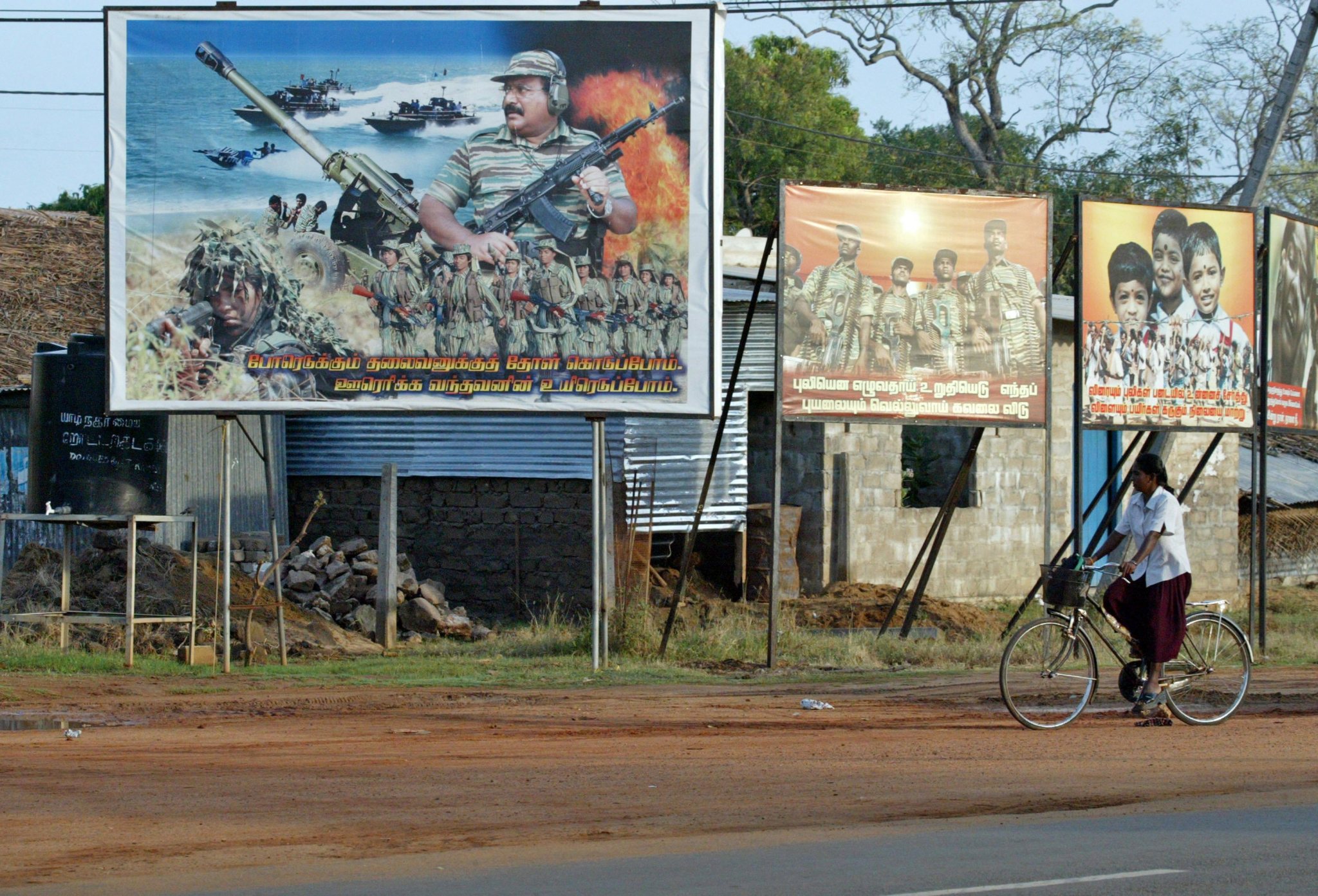
 
https://globalnews.ca/wp-content/uploads/2025/06/CP214269429.jpg?w=2048
Propaganda billboards in the region of Sri Lanka controlled by Liberation Tigers of Tamil Eelam, April 22, 2007. (AP Photo/Gemunu Amarasinghe)
 
But wait: the current Liberal government of prime minister Mark Carney elevated a former sympathizer of the Tigers, MP Gary Anandasangaree, to the important Cabinet post of Public Safety Minister. The Liberation Tigers of Tamil Eelam, along with the Tamil Tigers and World Tamil Movement, are listed terrorist groups in Canada. Minister Anandasangaree took the step of recusing  himself from anything to do with these two groups, as Public Safety Minister. But it was discovered, that as a Member of Parliament years previous, he had written a letter in support of a former Tamil Tiger facing deportation from Canada.
 
And nor to overlook the tens of thousands of Syrian refugees brought to Canada during Syria's 14-year sectarian civil war when former regime Shia-Alawite President Bashar al-Assad barrel- and chemical-bombed Syria's Sunni population killing an estimated third of a million Syrians; years that saw half the population of the country internally displaced, and millions more seeking haven abroad. These intake refugees along with a sizeable Palestinian-Canadian population and other Muslim groups in Canada totalling almost two million have made their presence known in ongoing street protests against Israel.
 
https://i.cbc.ca/1.7509131.1744564685!/cpImage/httpImage/image.jpg_gen/derivatives/16x9_1180/cda-israel-palestinians-20250412-ottawa-parliament-hill-april-2025.jpg?im=Resize%3D780
Pro-Palestinian protesters chant during a demonstration protesters are calling a "National March for Palestine" near Parliament Hill (Spencer Colby/The Canadian Press)
 
Since the 2023 October 7 incursion of thousands of Palestinian terrorists from Gaza into southern Israel who embarked on a sadistically savage rampage of rape, mutilation and mass murder, killing 1,200 Israelis and kidnapping another 250 children, women, elderly, foreign farm workers and a number of Israeli IDF members, leading to a military response by the IDF into Gaza to route out Hamas leaders and operatives, Muslim groups in Canada, led primarily by Palestinians living in Canada have harassed Canadian Jews, threatened their security, committed violent criminal acts and behaved in a manner inconsistent with Canadian values and justice. 
"We're trying o probe here whether Canadians do have security concerns that are also driving some of the reticence or hesitation about immigration right now. My conclusion is that that is the case."
"The point of the survey is, there is an issue that we need to pay attention to. If there is a security concern associated with migration right now, it requires some attention and a need to reassure Canadians that our government and the responsible departments are taking care of those issues, are paying attention to those issues if and when they arrive, or where and when they may arise."
"We're seeing the degree of trust expressed in refugees as especially low. And particularly amongst those people who think there are too may immigrants, the trust of refugees is low, lower than it is normally."
"Whether you're born in Canada or not born in Canada, or whether you're a minority or not, this issue around trust, and the perceptions around the global instability, is affecting our perspectives around migration." 
Jack Jedwab, president, chief executive, Association for Canadian Studies and the Metropolis Institute  
The new poll in question conducted nationally for the Association for Canadian Studies and the Metropolis Institute, found 62 percent of people polled feel Canada is accepting too many people, over double the number that expressed those sentiments  six year earlier. Only 20 percent disagreed, while 19 percent responded they  don't know. Canadians were asked if they think immigrants can be trusted, and the 52 percent of Canadians who said they can, saw 36 percent responding in the negative when the issue is that of refugees being trusted -- 20 percent adamant that immigrants cannot be trusted; 23 percent felt the same about refugees.
 
For the question whether there are too many people coming to Canada, among those who declare there are, 32 percent only, trust immigrants; 28 percent felt they cannot be trusted, and for refugees those numbers were 24 percent trusting; another 32 percent felt they cannot be trusted. And it is immigrants themselves that agree, by 57 percent, that too many immigrants are arriving to Canada, near matching the numbers of non-immigrant responders. Non-white people surveyed saw 61 percent agreeing there are too many immigrants in comparison to 58 percent of white people. 
"That polarization is not based on whether you are yourself an immigrant or you are a minority, it's not. It's transcending that. So the trust issue is a critical factor. It's just not defined by, as I said, your status as an immigrant or non-immigrant or as a minority. Those groups of people are making observations to the same extent across those markers of identity."
"It is important that we properly understand what the factors are underlying the reticence about immigration. So that's where the importance ... is in trying to establish what the concerns are, how significant those concerns are, where those concerns are coming from."
"And then, on that basis, to determine how best to address them rather than dismissing them."
Jack Jedwab 
https://i.ytimg.com/vi_webp/_BolmzWM9PE/maxresdefault.webp
The Canadian Citizenship Ceremony  -- Still from video
 

Labels: , , , , ,

Sunday, February 04, 2024

The Privacy Rights of Mass Murderers

"The report provides insight into Canada's shameful history of admitting many former Nazis and their collaborators to the country, almost all of whom lived out their lives in Canada undisturbed, without ever having to face justice."
Friends of Simon Wiesenthal Center
 
"The applicant's obligation is to satisfy the court that he is of good character. He is not required to satisfy the court that he, at no time in his past, committed an opprobrious act."
"[While I can appreciate the concern of Jewish Canadians relating to inaction on the presence of war criminals in Canada] it appears to me, on the other hand that it would be most ill-advised for the government to undertake this venture [removal of citizenship from war criminals]."
(Former) Justice Minister Pierre Elliott Trudeau (1967)
https://smartcdn.gprod.postmedia.digital/nationalpost/wp-content/uploads/2024/02/war-crimes-records-20240201.jpg?quality=90&strip=all&w=1128&h=846&type=webp&sig=z0Z1AVMjAqiUo3j43iQh0w
Canada distinguished itself for posterity during the years of the Second World War when it, along with the United States and most other Western nations declined an opportunity to save European Jews from extermination. It became well known that the Third Reich had established a priority program to rid the world of Jews, and it began the industrialized process of that institutional extermination with the Jews who had lived for centuries in WWII German-occupied Europe. When Germany in its early stages invited Jews to leave, there was no welcome extended to them elsewhere.
“Canada is where the Nazis are. Canada is the unknown haven for Nazis. Everybody knows about Argentina, but nobody knows about Canada.” 
War crimes investigator and private detective Steven Rambam. 1977
Canada's attitude at the time under Prime Minister William Lyon Mackenzie King was influenced by his immigration minister, a staunch antisemite, Frederick Blair, who opposed and strictly limited Jewish immigration to Canada was clear. Mackenzie King was pleased to agree. And so was born the legend: 'One is too many'. Post-war, German Nazis fled the record of their past performance under Hitler's rule, hastily leaving for South America in preference to standing trial for their crimes. Canada's quiet motto then might have been 'More would be fine'.

Canada became notorious for its laissez-faire attitude on admitting Nazi war criminals. Recently, a 40-year-old report was newly declassified -- revealing the manner in which Canada handled Nazi war criminals. Canadian bureaucrats, it seemed, understood at the time that politics, not legal positions drove decisions on the harbouring of war criminals. The case of one such criminal stood out as an example, one that former Prime Minister Pierre Trudeau was engaged with.

A decision was made in 1967 not to extradite a man who had been convicted in the Soviet Union of Nazi war crimes. The revocation of his citizenship and expelling him to the country which found him guilty in absentia failed to materialize, based on advice from Pierre Trudeau, then-minister justice, when the minister of external affairs asked for his advice relating to a man identified only as 'Subject F' in the documents.

The 1985 Commission of Inquiry on War Criminals in Canada in a version of historian Alti Rodal's report had deleted mention of Mr. Trudeau's involvement in the case until 15 additional pages from the report were released by the present Liberal government, pressed to do so by B'nai Brith Canada and other Jewish groups which had been requesting that be done for decades. B'nai Brith and the Simon Wiesenthal Center renewed the request following an incident in the House of Commons.

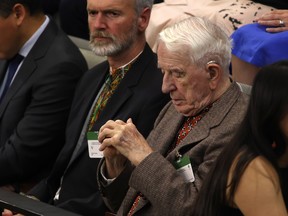
On that occasion, when  Ukrainian Prime Minister Volodymyr Zelenskyy was to address Parliament, a Ukrainian war veteran had been invited as a special guest to meet Zelenskyy. Parliamentarians recognized the man's presence with enthusiastic applause. Only later was it discovered to their shame and embarrassment, that the elderly Ukrainian had been one of many volunteers who fought for a Nazi Waffen SS unit in Ukraine. At a time when Ukraine viewed Russia, then an ally of the West, as the enemy and Germany as their saviour.
 
Yaroslav Hunka.
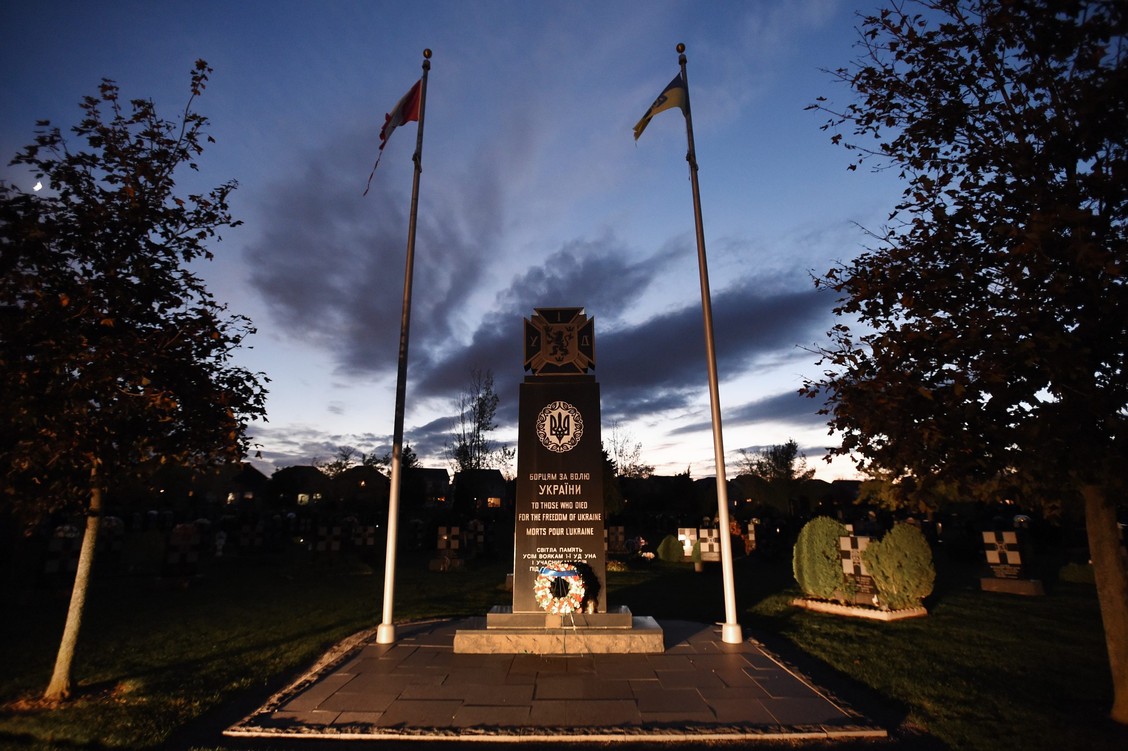
Prime Minister Justin Trudeau stated the release of additional documents was made on the decision to balance public interest with privacy. "I think people understand that this is both an important part of the historical record, but also one that has implications around privacy, around community". Unsaid is the reality that within the Canadian-Ukrainian community there are those who venerate the memory of Ukrainians who fought against the Soviets, preferring to cast their lot with Nazi Germany. That is seen in the controversy over the newly-completed, not-yet opened memorial to 'victims of Communism'.

Where names and groups are memorialized, some honoured within the Ukrainian community, but known to be Nazi collaborators; those whose voluntary inclusion in SS units, did not preclude them from murdering Jews and others whom the Third Reich targeted for extermination. The newly-released pages of the report show that the current prime minister's father Pierre Trudeau said Canada should not revoke Subject F's citizenship, when he was asked for his opinion in 1967.
 
https://smartcdn.gprod.postmedia.digital/nationalpost/wp-content/uploads/2023/09/0722_ed_farber2-scaled.jpg?quality=90&strip=all&w=1128&type=webp&sig=ZZ7GZqefn14Tp6yifuepWQ
This is a cenotaph at Oakville, Ont.’s St. Volodymyr Ukrainian Cemetery honouring the Galician Division, which it refers to as the First Ukrainian Division, Ukrainian National Army. It’s one of two monuments in Canada (the other one is in Edmonton) paying homage to a division of the Waffen-SS. Photo by Peter J. Thompson/National Post
 
There was no evidence, said Pierre Trudeau, that the citizenship court that handled Subject F's application ever asked about the crimes, nor was there evidence that he knowingly concealed that information. Both can certainly be inferred, however, since to reveal such information would have disqualified the subject's application. Nothing in the Citizenship Act required Subject F  to confess the evil deeds he was involved in, reiterated the elder Trudeau.

There are times when political devices are downright immoral, and this was one of those times. Historian Rodal characterized Trudeau's logic as "highly abstract and contrived", since Subject F had been accused of direct participation in the deaths of thousands of people. A naturalized Canadian, Subject F immigrated from Latvia, convicted in absentia by the Soviet Union in 1965, the case identifying him as the "captain of a firing squad which murdered, 5,128 Jews" in Latvia during the Second World War.

Publicly accusing a Canadian citizen, said Trudeau Sr., convicted in absentia in Russia would strike fear into the heart of any naturalized Canadian, that something they were involved with in their past could become a reason for the government to revoke their citizenship. In actual fact, falsely attesting on a citizenship application or failing to include evidence that can be incriminating is in and of itself grounds for revocation. With Pierre Trudeau's intervention, the government reached the conclusion it could do nothing respecting the allegations against Subject F.

However, soon afterward, lawyers at the Department of External Affairs expressed their displeasure with the decision in a memorandum, wanting to have it reviewed on the basis it was not made for legal reasons, but for political ones. The unredacted pages show that External Affairs believed that requests from Czechoslovakia and the Soviet Union to extradite four accused or convicted war criminals had been political, designed to embarrass Canada. Even so, they believed the four named were very likely "guilty of having committed atrocities".

https://canadiandimension.com/images/made/images/articles/_resized/1520px-Zaprzysi%C4%99%C5%BCenie_14._Dywizji_SS__Galizien__(2-1993)_800_568_90.jpg
Volunteers of the 14th Waffen Grenadier Division of the SS are sworn in, 1943. As many as 2,000 members of the unit arrived in Canada in the 1950s. Photo courtesy the National Digital Archives of Poland
"In purely legal terms, it is arguable that the government is free to commence revocation proceedings under the Citizenship Act, notwithstanding the Attorney General's opinion."
"It appears to us that the government's decision not to do so is a matter of policy rather than law."
"[Subject F stood out for having been] an ardent Nazi lackey, not only co-operating actively with the occupying German forces but actually serving their Jewish and Gypsy extermination squads." 
Canada's (then) External Affairs Department

Labels: , , ,

 
()() Follow @rheytah Tweet