Ruminations

Blog dedicated primarily to randomly selected news items; comments reflecting personal perceptions

Sunday, June 11, 2023

The Man Who Admired Kim Philby

A color photo of a blue and white identification card with “Department of State” and Mr. Hanssen’s name on it. Next to it is a F.B.I. business card with his name over the title “Special Agent, Unit Chief.”

"When authorities arrested Robert Hanssen, the FBI’s most high profile double agent had just one question for his colleagues: 'What took you so long'?"
"Hanssen, who was found dead this week in his cell in a Colorado supermax prison, was serving a life sentence, found guilty of spying for Moscow compensated to the tune of over $1.4M for over two decades."
"Hanssen’s case was dubbed 'possibly the worst intelligence disaster in US history' in a government report. He compromised over 50 FBI human sources (including several later executed), handed over thousands of classified documents and revealed top secret intelligence-gathering techniques as well as the US strategy for responding to nuclear conflict."
"Hanssen was a suburban father and ostensible patriot, who drove his six children around in old cars and was devoted to Opus Dei, a conservative movement within the Catholic Church."
Financial Times

"On February 18, 2001, Hanssen was arrested and charged with committing espionage on behalf of Russia and the former Soviet Union. Hanssen—using the alias 'Ramon Garcia' with his Russian handlers—had provided highly classified national security information to the Russians in exchange for more than $1.4 million in cash, bank funds, and diamonds."
"Hanssen’s espionage activities began in 1985. Since he held key counterintelligence positions, he had authorized access to classified information. He used encrypted communications, 'dead drops', and other clandestine methods to provide information to the KGB and its successor agency, the SVR. The information he delivered compromised numerous human sources, counterintelligence techniques, investigations, dozens of classified U.S. government documents, and technical operations of extraordinary importance and value."
Federal Bureau of Investigation website
FBI agent Robert Philip Hanssen may not have set out to betray  his country to a belligerent adversary, but it's certainly what he ended up doing. He became one of the most notorious spies linked with the FBI, reportedly inspired while a teen by Kim Philby, the infamous British intelligence officer who was revealed as a Russian double agent. Robert Hanssen had quite the career with the FBI, given trusted access to secret files which he chose to sell to Russia.
 
His work as a double agent for Moscow was without peer, undetected for 22 years. Divulging details respecting the American government's planned response to a nuclear attack and revealing the presence of a multimillion-dollar eavesdropping tunnel built by the FBI under the Soviet Embassy in Washington. For his troubles he earned a total of $1.4 million dollars. 
 
He evidently suffered no crisis of conscience by identifying KGB double-agents Valery Martynov and Sergei Motorin, both lured back to Moscow where they went on trial on charges of espionage and subsequently punished by being shot in the head. Aldrich Ames, another American mole, had also revealed their names to the Russians. General Dmitri Polyakov, a CIA informant who passed information to American intelligence since the early 1960s while rising to achieve the rank of Soviet army general, was betrayed by Hanssen as well.
 
The general was posted back to Moscow and sentenced to death in 1988 for treason. Hanssen's career as a double agent began in 1979, three years after joining the FBI, no doubt viewed as having special skills since he had studied Russian language at university. His wife, Bonnie Hanssen, made the discovery of his dealings with Russia, and he convinced her he was providing them with false information. In October 1985 he sent a letter to Viktor Cherkashin, then chief counterspy at the Soviet embassy, that he would provide classified information for $100,000.
 
With the use of aliases, he left 'Dead drops' for his handlers in suburban Virginia areas, refusing to meet Moscow agents face-to-face. Following the 1994 arrest of Aldrich Ames, a CIA agent spying for Russia, classified information continued to be leaked, leading the bureau to the realization there was another spy in their midst. Two decades later, a Russian intelligence officer gave the FBI a fingerprint left by Hanssen on one of the dropped garbage bags containing a tape recording of a call with an agent.

Hanssen was given an obscure FBI assignment with a small team working undercover to monitor him with a view to gathering evidence, in 2000. There were reportedly 300 agents working on the case, at the time of his arrest. When asked what had lead him to this double career, he responded it was "fear of being a failure and fear of not being able to provide for my family". Added to which he laid blame on the lax security of the FBI, amounting to "criminal negligence". 

Indicted on May 15, 2001, Hanssen pleaded guilty to 15 counts of espionage, to enable him to avoid he death penalty. He was sentenced to life in prison in 2002, without parole. The devout Catholic, father of six, frequented strip clubs. He secretly filmed pornographic videos of his wife. A respected member of his civilian community, anti-Communist, he found it in himself to betray his country, his family, his Church. Hanssen, now 79, was found Monday unresponsive, at a maximum-security facility in Florence, Colorado his journey in life over.
"He really wanted to catch spies. He was a James Bond fanatic, loved the movies. He could quote them chapter and verse. He wanted to be a spy. He was joining the FBI to do that — not to spy against the U.S., but to go in and hunt spies."
"He truly didn't respect Russia very much, at least not in his conversations with me. But he was able to use them very effectively to solve his other problems. One that he was angry at the FBI for not placing him in the position of authority and gravitas and respect that he believed he deserved. And two, he needed money. He was financially having problems and he needed money and you solve both those problems by becoming a spy." 
"At some point, spying and being the top spy for the Soviet Union, while within the FBI, became the thing that made him belong to something much bigger than himself. I think that at some point, even more than the money that became what was so important to him." 
Eric O'Neill, undercover FBI agent


Labels: , , , ,

Saturday, April 15, 2023

Making An Espionage Impression

"It is fairly commonplace for individuals of his age to have access to classified information,"
"Often people at his level are supporting senior leaders, and he might have a 'need to know' if he was prepping senior leaders or putting together briefing books," 
"It does raise questions about how we are training individuals on how to handle classified information. It's exposing gaps in the system that will be looked at … but there's also a level of trust that you place in these individuals, that they are there for the right reasons."
Alexandria Seymour, associate fellow, Technology and National Security Program, Center for a New American Security think tank

"It's part of this drive to get as much information as possible for analysts to use."
"And that drive means that you are potentially opening up access to information that could be leaked."
"To have greater restrictions on information means more of a move towards a traditional type of strict need-to-know principles."
Dan Lomas, senior lecturer in intelligence and security studies, Brunel University
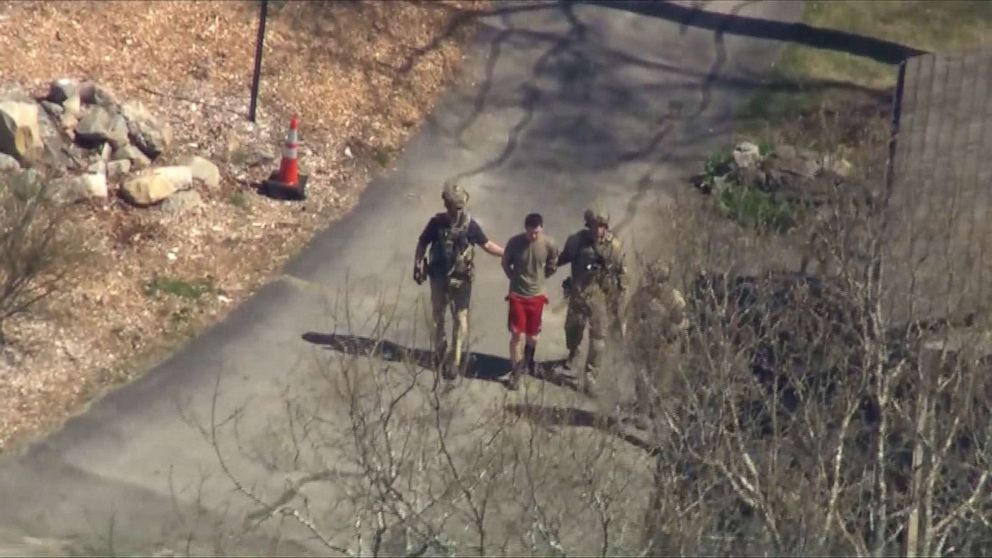
PHOTO: Suspected classified document leaker and U.S National Guardsman, Jack Teixeira, is taken into custody by FBI agents in North Dighton, Mass., April 13, 2023.
Suspected classified document leaker and U.S National Guardsman, Jack Teixeira, is taken into custody by FBI agents in North Dighton, Mass., April 13, 2023.  WCVB
"[I commend] the rapid action taken by law enforcement to investigate and respond to the recent dissemination of classified U.S. government documents."
"While we are still determining the validity of those documents, I have directed our military and intelligence community to take steps to further secure and limit distribution of sensitive information, and our national security team is closely coordinating with our partners and allies." 
U.S. President Joe Biden
This is the fourth time in recent decades that American high-security secret files have been accessed by trusted personnel with security credentials to have accessed files and documents not to be seen outside the confines of American intelligence, but which have been released to the scrutiny of the public at large at home and internationally. In most of these revelatory leaks those releasing secret files did so as a matter of personal principle in the belief that the public should be aware of what was happening behind the scenes. In this latest case, the release appears to have been effected by an emotionally immature man who sought attention and admiration from his peers.

The suspect in this latest release of secret American intelligence files, 21-year-old Jack Teixeira, comes from a military family, himself a member of the Massachusetts Air National Guards, now accused of having released to the public highly classified military documents. He was arrested and a day later appeared before a court to face charges under the Espionage Act, of having, though unauthorized, removed and retained classified and national defence information. Seemingly motivated by the irresistible urge to prove he had access to such documents.

The thoughtless act of a narcissist. Someone who wanted to be the centre of attention. And now he is up front and centre of attention. Perhaps not quite in the way he would have wished to be. He appeared to have begun his posting of document images, annoyed that other users of the clandestine social gamers' group he was part of failed to take his actions seriously in that they did not recognize the enormity of his transgression of the trust placed in him by his upgraded security assessment that enabled him access to the highly sensitive documents.

He had initially taken to typing out the documents he would post, but ended up with the feeling they weren't having the deeply admiring impression he meant them to. Which was when he reverted to photographing the documents themselves and posting those. And this went on for months; highly sensitive, secret military documents available for anyone to scrutinize in the international community. The Pentagon unaware of the situation until an investigation was undertaken and published by The New York Times.
 
Which sparked a weeklong criminal investigation into the public disclosure of government records, a breach exposing sensitive information on many issues, most notably, the war in Ukraine to the world at large. A capricious emotional pique upturning the nation's security and the trust of its international security partners. U.S. Magistrate Judge David Hennesy ordered Teixeira  to be held until a following hearing, when he appeared in court Friday for a brief proceeding. He is innocent until proven guilty, and is as yet only a 'suspect', but his future does not look bright.

A Defence Department official advised that as an information technology specialist responsible for military communications networks, the Guardsman now in prison would have held a high level of security clearance. The Pentagon is set to conduct a review of its "intelligence access, accountability and control procedures" with a view to preventing a similar such leak from re-occurring. It is believed by investigators that Teixeira led a private online chat group on the Discord channel platform. 

This is a social media platform people who play online games tend to gravitate to. The FBI took possession of billing records from Discord which helped investigators to identify Teixeira as a suspect. An FBI affidavit disclosed that an indioidual familiar with Teixerra's online posts informed investigators of a username linked to Teixeira posting classified information beginning in December. Teixera took home with him documents to photograph and post once he "had become concerned that he may be discovered making the transcriptions of text in the workplace".

His actions remained undetected until April 6, when the Pentagon was alerted by the first published story of the documents breach. In their investigation it was discovered that Teixeira had searched online for the word "leak" in an effort to find what his leaked documents were leading to. Which gave the FBI another clue regarding his involvement. The group of gamers linked to Teixeira held certain issues in common regard: gaming enthusiasts, devout Christians, gun-lovers, racism and antisemitism.

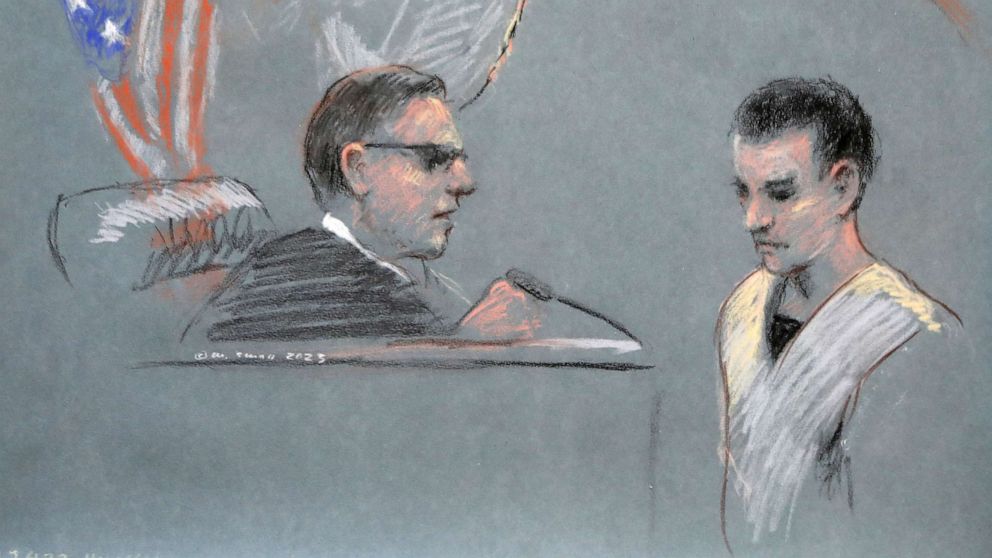
PHOTO: Jack Douglas Teixeira, a U.S. Air Force National Guard airman accused of leaking highly classified military intelligence records online, makes his initial appearance before a federal judge in Boston, on April 14, 2023, in a courtroom sketch.
Jack Douglas Teixeira, a U.S. Air Force National Guard airman accused of leaking highly classified military intelligence records online, makes his initial appearance before a federal judge in Boston, on April 14, 2023, in a courtroom sketch.
Margaret Small/Reuters

Labels: , , , , ,

 
()() Follow @rheytah Tweet