Yemen's Houthi Terrorists Emboldened
"The Houthis are not 'defending Gaza' or trying to 'stop a genocide'.""They are using the Gaza war as a pretext to consolidate their [brutal, autocratic] rule inside Yemen and to position themselves as a regional power."Middle East security expert Thomas Juneau"These strikes are in direct response to unprecedented Houthi attacks against international maritime vessels in the Red Sea, including the use of anti-ship ballistic missiles for the first time in history.""These attacks have endangered US. personnel, civilian mariners, and our partners; jeopardized trade, and threatened freedom of navigation."U.S. President Joe Biden
 |
| Military
forces from the U.S. and U.K. launched airstrikes on sites in Yemen, saying the strikes targeted areas that hosted radar,
missile and drone capabilities used by Iran-backed Houthi forces to
attack vessels in the Red Sea. CBCNews Still from video |
The Shia Houthis who govern half of impoverished Yemen, a Sunni-majority country, are a satellite proxy of the Islamic Republic of Iran, part of Iran's Shi'it axis of influence in its campaign to achieve greater prominence in the Middle East through alliances with Qatar, Lebanon (Hezbollah), Iraq and extending to Hamas in Gaza. Iran's IRGC speedboats have been harassing shipping in the Persian Gulf in much the same way as the Houthis are now doing and what Somali pirates were doing in the Gulf of Aden and around Somalia's coastal waters.
Iran's well-known penchant for proxy terrorism through its Shia militias as agents of chaos in the Middle East have now expanded to include working relationships with Russia, China and North Korea.
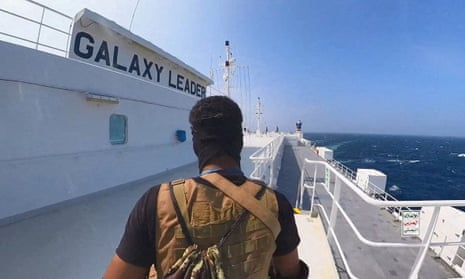
The Houthi-created blockages of navigation in international waters have caused great perturbation among the world's shipping lines -- where consumer goods travel back and forth from Asia to Europe and North America -- have been interrupted necessitating alternate routes around Africa creating complications in maritime shipping of lengthier travel times increasing expenses and creating shortages.
 |
| A Houthi military helicopter flies over the Galaxy Leader cargo ship in the Red Sea in this photo released on Nov. 20. (Houthi Military Media/Reuters) |
American and British missiles struck Houthi targets, after a course of diplomatic overtures failed to make any impression on the Houthi leadership. Weeks of warnings from Western officials that sustained Houthi drone and missile attacks on commercial and civilian vessels traversing the Red Sea would engender a military response of retaliatory strikes, should the attacks not cease, made no inroad, leading to strikes on Houthi radar installations, storage and launch sites for drones and missiles.
The issue of Yemen-based Houthi militia strikes at ships transiting the Red Sea began in the weeks that followed the Hamas terrorist attack against southern Israel on October 7, when 1,400 Israelis were slaughtered, 240 captured as hostages, taken back to Gaza, and countless Israeli girls and women were raped, tortured and murdered. At the time the Houthi claims were that their attacks on vessels were aimed solely at ships heading for or from Israel, or were Jewish-owned. It took no time before other vessels, including military ships were being targeted.
In a public address, U.S. President Biden explained the strikes' purpose was to demonstrate that the United States and its allies "will not tolerate" the ongoing Houthi attacks on the Red Sea -- impairing freedom of navigation on international waters -- that its and its allies missile strikes on Yemen Houthi targets were made only after efforts at diplomatic negotiations failed. In response, the Houthi military spokesman, Brig. Gen. Yahya Saree stated that the strikes "would not go unanswered or unpunished".
 |
| Yemeni demonstrators shout slogans during a protest in Sanaa on Friday that followed U.S. and British airstrikes across the country aimed at retaliating against Houthi forces. (Mohammed Huwais/AFP/Getty Images) |
According to U.S. Air Forces Central Command, the strikes were laser-focused on command and control nodes, munition depots, launching systems, production facilities and air defence radar systems, involving over 100 precision-guided munitions, inclusive of air-launched missiles and ship-and submarine-launched Tomahawk land attack missiles.
A later report from the United Kingdom Maritime Trade Operations overseeing Mideast waters, on Friday evening reported a new attack occurring off Yemen when a missile was fired toward a vessel 90 miles south-east of Aden, the ship being followed by three small vessels, a modus operandi pioneered by Iran's Islamic Republican Guard Corps, and faithfully followed by their latest proxy terrorist group.
 |
| Iranian-backed
Houthi forces based in Yemen have launched their biggest attack yet on a
vessel in the Red Sea. U.S. and British forces repelled the assault but
experts say the Houthis are becoming emboldened. Still from video, CBCNews |
Labels: Houthi Attacks on Marine Traffic, Houthi Terrorism, US and UK Military Responses
posted by Pieface @ 8:35 PM
0 comments


:format(webp)/cdn.vox-cdn.com/uploads/chorus_image/image/72985575/1804440745.0.jpg)

