Toronto 18 Muhammad Shareef Abdelhaleem : Full Parole Denied
"I'm an intimidating individual and I'm very loud. Everyone here will testify to that. I tend to express myself vocally and vociferously.""I'm a very loud person. I always cut people off, I vocally impose myself. These are things I have to work on.":I hope the board does not insist or base their decision on whether for the next 30 years of my life I will ever get angry -- of course I'll get angry. It's a human thing to be angry at certain things.""I'm being completely honest. You should appreciate the honesty."Muhammad Shareef Abdelhaleem, 46, charged and convicted of terrorism in 2011
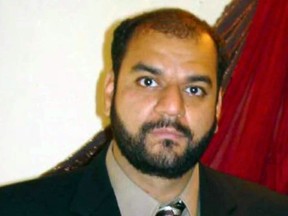 |
Abdelhaleem obviously thought his 'honesty' would be disarming, would gain him a measure of respect as he addressed the panel comprised of two parole board members in his customary loud, harsh voice. A man prone to outbursts of anger, aware of that, and 'working on it'. He has been on day parole in a halfway house in Montreal for over 14 months. In 2011 he was given a life sentence with no chance to seek parole for a decade. That's the Canadian justice system's version of imprisonment for a life sentence in recognition of a crite of high treason and intent to terrorize and indulge in mass murder.
He and the other 17 arrested when he was in 2006, members of a group named the 'Toronto 18' of which he was a major conspirator, planned to detonate powerful truck bombs at the Toronto Stock Exchange, at a Canadian military base, and at Canada's spy agency, the Canadian Security Intelligence Service. Along with additional plans to storm Parliament and behead the prime minister. Canada's very own, home-grown Islamist terrorists.
Before all this occurred, Abdelhaleem, the 'key architect' of the terrorism plot, was a high-paid computer engineer with a side-interest in day-trading as an investor. His commitment to Islamist jihad twinned with his passion for acquiring money. So why bomb the Toronto stock exchange, what would that have in common with a revenge jihad attack? He thought he could profit financially from the chaos that would ensue.
That was merely a secondary benefit, not his prime motivation, he assured the parole board. It was the political element that motivated him, wanting to bring the penalty of justice to those harming the interests of global Islam. He felt that after spending over a year on day parole, he should qualify for full parole to enable him to live a normal life.
More recently, with the Russian attack on Ukraine, he felt outraged that the West was opening wide to accepting Ukrainian refugees, valuing their lives over those of Syrian refugees. Ukrainians are not Muslim, Syrians are. Another discriminatory signal that Muslim lives are worthless. His mind failed to grasp the significance of an Islamic regime having been the cause of the death of hundreds of thousands of Muslims in Syria and his belief that Western democracies have the obligation to rescue Muslims from Muslim rule.
The fact that brutal sectarian violence, pitting two sects of the same faith against one another seems not to bother this man; only his perception that non-Muslim democracies have an obligation to rescue Muslims from their Muslim rulers. Managing to overlook the acceptance of refugee Afghans and Syrians that did take place, among others fleeing violence in Muslim countries. When he mentioned his anger over the issue to his anti-violent extremism counsellors they responded "maybe they're afraid of letting in terrorists" reminding him of his own plans to commit mass violence in Canada.
When a Board member asked Abdelhaleem his thoughts regarding the potential loss of life and damage to infrastructure his terror group planned to mount had the plot succeeded, his response was somewhat less than reassuring:
"There's no doubt that this would have been devastating to certain families should they have lost loved ones.""Somebody must have woken up the morning of my arrest, some worker in one of those buildings, and thought, 'Wait a minute, I could have died today'. It must have scared the living bejesus out of him. I can empathize with that.""But I don't get to the point of tears about it because at the end of the day it did not occur."
No, it did not come to fruition, but only because the terrorist plan in its wide scope and potential had been infiltrated and apprehended, not because the group hadn't intended to fully carry out their carefully planned atrocities. So does that sound like someone who fully appreciates the consequences of his intended actions? And in so doing feels the least bit of remorse? Strangely enough his parole officer and a halfway house advisor recommended his release on full parole.
Describing him as a 'conformist' meticulous with rules, polite and responsible. One who participates in deradicalization counselling, enrolled with the intention to begin college in the fall. Two restrictions were proposed by his parole officer; not to associate with anyone involved in crime or radicalized activity and to have no position of leadership in a spiritual or religious activity or group. The Parole Board reached their decision after several days of deep thought.
"It is difficult to believe and disturbing to think that he would accept a role in a plot that had the potential to cause significant amounts of death and destruction simply as a means to gain acceptance of a group of individuals."Correctional Service of Canada
The psychologist who worked with Abdelhaleem reached the professional conclusion that remorse was 'incomplete'. For his part, at the hearing, Abdelhaleem found the psychological report wanting. That the psychologist had a personal dislike for him because he tended to argue back when told he had a “parasitic” relationship with his family, who send him an allowance to help support him. "Venal and vindictive", was how the psychologist was labelled by Abdelhaleem. Neatly encapsulating precisely what his own personality obviously is.

"It was the opinion of the Board that the seriousness of your actions and their potentially devastating nature called for caution.""The Board concludes that you will present an undue risk to society and your release will not contribute to the protection of society by facilitating your reintegration into society as a law-abiding citizen on full parole.""After a few years of a hedonistic lifestyle including the use of alcohol, drugs and extravagant spending, you decided to reconnect with your faith [Islam]. You attended a mosque more assiduously. You eventually met radicalized people and engaged in activities that led to the current offences,""Several psychological risk assessments are included in your file, the most recent being from October 2020. In her report, the psychologist identifies narcissistic and obsessive-compulsive personality traits. She notes that you are vulnerable to substance abuse and have anxiety and depressive effects, but do not meet criteria for having a clear-cut problem.""Your family members support you in your social reintegration, and you maintain employment.""However, you are still struggling with adjustments to the community and work has to be done in developing skills to reach full autonomy. More specifically, you need to work in the areas of self-esteem, sense of belonging, fear of displeasing others, and a need for approval.""You do not demonstrate any radical thinking on any subjects, but you appear to be sensitive to injustice in the world.""You generally did well in incarceration and since your return to the community. You have shown your capacity to respect rules as well as your special conditions and have been able to work with your caseworkers in what appears to be an open and transparent manner. There is no doubt for the Board that you have made progress up to now."Parole Board of Canada
Labels: Full Parole Denied, Life Sentence, Muhammad Shareef Abdelhaleem, Terrorist Plot, Toronto 18
posted by Pieface @ 7:47 PM
0 comments


