Blog dedicated primarily to randomly selected news items; comments reflecting personal perceptions
Sunday, April 16, 2023
Mifepristone, an Essential Medicine
"Because mifepristone alone will not always complete the abortion, FDA mandates a two-step regimen; mifepristone to kill the unborn human, followed by misoprostol to induce cramping and contractions to expel the unborn human from the mother's womb."
Judge Matthew Kacsmaryk, Texas-based district court judge, April ruling
"Note that nowhere in the medical literature does it say that mifepristone 'halts nutrition, and ultimately starves the unborn human until death'."
Dr. Daniel Grossman, professor of obstetrics, gynecology and reproductive sciences, University of California, San Francisco
Reuters
"Any way that you can get mifepristone to a pregnant person who does not want to be pregnant is safe."
"The thing that I most fear is that people might read about what's happening in the U.S. and believe they don't have options here [in Canada]."
"We know, historically, that people sometimes take desperate measures or even feel that they can't continue their own life if they wouldn't have access to [abortion] care."
"We don't want people believing that what they're hearing in the United States is the case here."
"Canada is working with the science behind this. What's happening in the States is not reflecting scientific evidence."
Dr. Wendy Norman, researcher in sexual and reproductive medicine, University of British Columbia
"We should also be concerned about the expansiveness of tactics that people are using to rationalize their anti-abortion stance, so, discrediting the FDA."
"[Any argument that the drug shouldn't have been approved 20 years ago is] very limp."
"Over 202 studies have been done that say this is a safe and effective abortion pill."
Farrah Khan, executive director, Action Canada for Sexual Health and Rights
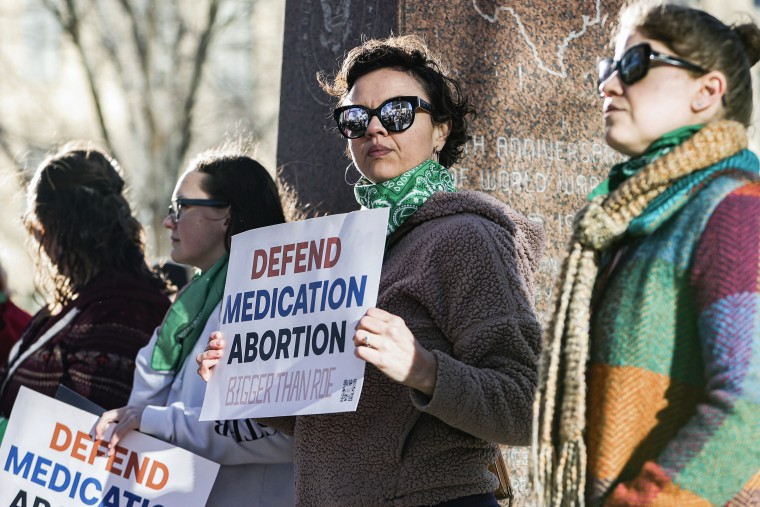
Protests in support of access to abortion medication.David Erickson / AP
There is concern among Canadian doctors that the uncertainties about abortion procedures as a necessary health alternative for women unwilling to carry a pregnancy to birth may cause problems in Canada, as a spillover from the situation now prevailing in the United States. Canada's largest, most active 'pro-life' group has expressed satisfaction that the furore over abortion rights in the United States may lead Canadian women to engage in 'kitchen table' discussions brings to mind the horrors of botched abortions when women died during primitive abortions on kitchen tables when medical abortions were closed to them.
Last June abortion rights in the United States was sent into a tailspin when the Supreme Court ruled on a challenge overturning Roe v.Wade and in the process the assurance of the federal constitutional right to abortion in the United States came to a thudding halt. Since then, a number of American states have banned abortions while others have instituted time limits during pregnancy. More latterly an appeals court ruled that mifepristone can remain on the market while imposing restrictions; halting the pill by mail order and its availability only through seven weeks of pregnancy as opposed to the Food and Drug Administration-approved ten weeks.
The drug has been on the market since it was approved by the FDA 23 years ago as a safe, reliable abortion pill. Health Canada authorized use of the drug in 2014 following one of the lengthiest drug approval processes on record, for the drug once known as RU-486. Some 87,495 abortions wee tallied in 2021 in Canada, according to the Canadian Institute for Health Information. Of those abortions, 40 percent were medical abortions with the use of mifepristone, the two-drug regimen sold under the brand name Mifegymiso.
A large study of abortions performed in Ontario found no surge of abortions followed, once restrictions on the use of Mifepristone were lifted as well as "no material changes" in the incidence of serious outcomes. The study concluded that serious adverse events occurred at 0.04 percent following mifepristone use. The abortion drugs are free of charge in every Canadian province and "primary care practitioners of all stripes" are able to prescribe it for use within the first nine weeks of pregnancy.
Mifepristone has been approved for use in abortions by every drug regulator in high-resources countries. It is listed as an essential medicine by the World Health Organization, which names it as a non-invasive and highly acceptable option to pregnant persons. "In order for anything to get on the [essential medicines] list", points out Dr Norman, "a high standard of safety must be proven". There are, however, side-effects and risks with the use of the abortion pills.
Painful cramps can ensue with their use and heavy bleeding, along with nausea, vomiting, diarrhea or dizziness. There is a warning on the product monograph that Mifegymiso can lead to serious bacterial infection, inclusive of rare cases of fatal septic shock. Over 5.6 million American women have made use of mifepristone in a pregnancy termination since its approval in 2000. There were 28 deaths attributed to the drug and reported to the FDA up to June of 2022; nine deaths associated with sepsis.
Canada saw 41 serious adverse reactions reported to Health Canada, one death of a 19-year-old included, from septic shock. There are understandable concerns from advocates for abortion choice that the American court rulings will result in misinformation and disinformation clouding the issues involved. That abortion is not safe, and that women regret their decisions will now be trumpeted by 'pro-life' groups is viewed as an inevitability.
"We don't expect them to heed our pleas, because our government bureaucracies are so ideological that they're willing to sacrifice the health of mothers and their pre-born children in the name of expanding abortion access."
"I think more realistically what we're hoping for is kitchen-table conversations about the harm of chemical abortion."
"I can't tell you how many stories I've read of women who've fainted, who've been vomiting, who've lost so much blood ... there are so many women out there who have had these experiences who probably haven't talked about them because they recognize this is something that is controversial, perhaps they feel ashamed."
"Our hope is that the news from the United States prompts these women to start talking to their family members, their friends, about their own experiences, so we can talk about how crazy it is that not only does the pill present these risks, but Canada has got rid of some of the few safeguards they had in place."
Jose Luetke, director of education and advocacy, Campaign for Life
Protesters stand outside the U.S. courthouse ahead of a lawsuit over the abortion medication mifepristone in March. Photograph: Michael Cuviello, Amarillo Globe-News
"Abandonments are happening everywhere, but people are not aware of it because it's not happening in their backyard."
"We can all agree a baby should be placed in my box and not in a dumpster to die."
"When a woman is given options, she will choose what's best for her. And if that means that in her moment of crisis she chooses a baby box, we should all support her in her decision."
Monica Kelsey, founder, "Safe Haven" Baby Drop Boxes
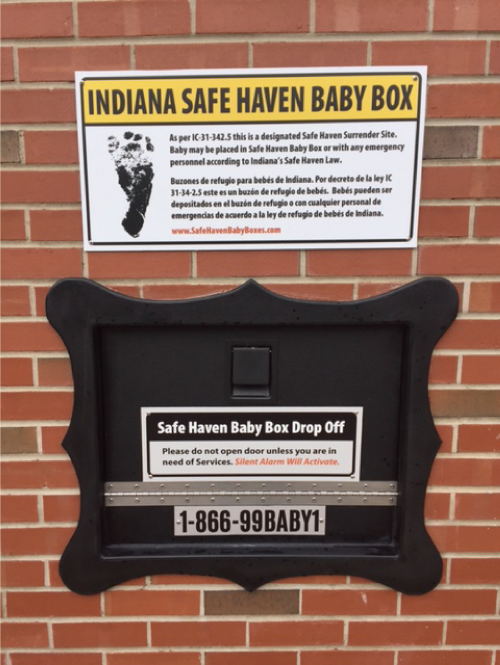
Safe Haven Baby Box
Unwanted babies born to girls and women who have no intention of raising and nurturing them for whatever reason, who are placed in areas where they will be seen and rescued, have taken place since time immemorial. Houses of worship were often places where babies and infants were left abandoned to chance. Infanticide was always another option. With the greater availability of medical interventions to interrupt a pregnancy those abandonments were significantly lessened.
As a means of disposing of the unwanted burden by a woman who was raped, or one already raising too many children, or coping with poverty or any number of other reasons, abandonment of babies since the U.S. Supreme Court abandoned the right of women to seek safe medical abortions, giving the green light to states who seek to enact tougher laws restricting abortions or going to the extreme of making them illegal, are certain to be on the increase.
In 1999 after infants were discovered in garbage bins, safe haven legislation known as the "Baby Moses" law, was passed in Texas, a state which strictly forbids abortion under the law. Aborting a fetus doesn't fly in Texas, but abandoning babies in garbage bins as a solution doesn't, either. Enabling a woman under duress, desperate enough to consign a baby to death, to have an alternative disposal route by leaving a baby in a box, is considered a humane option. As a solution to an untenable choice, it is.
Now that Roe vs Wade has been overturned, the inevitable uptick in abandoned babies has resulted in the humanely compassionate promotion of adoption as an alternative to abortion. Leaving an unwanted baby into a drop-off bin resembles a disposal method commonly used in small-town communities in the 19th century. Such boxes can now be found at disparate public places from fire stations and hospitals to other sites where staff have received training in handling abandoned babies.
This completely anonymous solution to a difficult and heart-wrenching problem has seen over a dozen states pass laws to permit the use of drop boxes. Most of the 100 drop boxes currently in use in the United States are in Indiana where the movement began when Monica Kelsey, who discovered she had herself been abandoned mere hours after birth, felt a compassionate obligation to help both mothers and babies with a solution to an age-old dilemma.
A box installed at a fire station in Carmel, California received three babies this year following its disuse for the previous three years. Three more babies were left at boxes elsewhere in the state over the summer. Indiana last week became the first state to approve abortion restrictions in the wake of the Supreme Court ruling overturning Roe vs Wade.
Safe haven laws protecting mothers who surrender their babies have been passed in all 50 states. The Safe Haven movement promotes awareness of safe haven laws. Their hotline latterly has received over 8,000 calls from across the United States. Over 100 babies have been left with them, 21 of them surrendered through the safe haven boxes.
"The inescapable conclusion is that a right to an abortion is not deeply rooted in the nation's history and traditions."
U.S. Supreme Court Justice Samuel Alito
"If this decision holds, it's really quite a radical decision. I hope there are not enough votes for it [in the Supreme Court]."
"I believe that a woman's right to choose is fundamental. Roe has been the law of the land for almost fifty years, and basic fairness and the stability of our law demand that it not be overturned."
U.S. President Joe Biden
"[The leaked document was] authentic [while not representing the] final position [of the court. The leak represented a] singular and egregious breach [of trust that will be investigated]."
"To the extent this betrayal of the confidences of the court was intended to undermine the integrity of our operations, it will not succeed. The work of the court will not be affected in any way."
U.S. Supreme Court Chief Justice John Roberts
May 3rd 2022 Demonstration outside the Supreme Court Photo: AP
It is truly the most societally polarizing of issues; nothing separates people as dramatically as disagreement on the basic issue of ending a pregnancy. There were once socially accepted solutions that pleased the conservative-minded and which were supported by a kind of social fiat; women had to carry pregnancies through to completion, give birth and surrender their babies for adoption.
This was a patriarchal society's solution for the disposition of an unwanted child, a reflection of religion's part to play in its dictation that women are meant to bear children and must on no account seek to end a pregnancy before its full term and the birth of a child. The very fact that women were held to a male-dominated discipline that punished them for their biological gift of child bearing was taken for granted. Women may have chafed against the social ownership of their bodies and the biological function they were endowed with, but acceptance was general for they had no other options.
\Those who made attempts to destroy their pregnancies through forbidden means of interference with nature's blueprint would be punished if discovered, and many others paid the ultimate price of their defiance of religious and social ritual expectations of female subordination to church and hearth. And then came the social phenomena of Women's Liberation that roiled North America, and eventually the rest of the world.
When women stood up and demanded to be recognized as having authority over the disposition of their own bodies, not society at large. When demands that abortion rights be respected; that women's human rights entitled them to decide when and if they would carry a pregnancy, not society or circumstances. It was an epic struggle, the church damning the impertinence of women and governments loathe to surrender their authority by acquiescence.
Gradually, the issue was recognized as a right owed women and abortion rights was accepted, but for a minority of men and women who abhor the very idea of legalized abortion, convinced it was little different than state-authorized murder. Which made a compelling argument for the procedure to take place in the first semester before the foetus became or came close to viability; to survive outside the womb.
"It would mean every other decision relating to the notion of privacy is thrown into question. It goes far beyond the concerns of whether or not there is the right to choose."
"It goes to other basic rights, all the decisions related to your private life, who you marry, whether or not you decide to conceive a child. It's a fundamental shift in American jurisprudence."
"I'm not willing to leave that to the whims of local areas. It will fall on voters to elect pro-choice officials this November."
U.S. President Joe Birden
The division between those supporting a woman's right to choose whether she would carry a pregnancy to term, or decide to end the pregnancy prematurely has been fairly well accepted by society at large. At the same time the issue simmers beneath the surface of civil society, with ample numbers of groups dedicated to outlawing abortion and mandating once again the criminalization of abortion. Yet most recently 69 percent of Americans feel that abortion rights should not be overturned, opposed to 29 percent claiming the need to do so.
In the United States, the division between social Democrats and Republications has become strained with the emergence of partisanship over social mores widening dramatically in the past decade. Nowhere is that strain more evident than in the issue of legal abortion being overturned. The divisions so stark that the executive branch of government, now held by Democrats, sees fit to challenge the independence of the nation's Supreme Court, to which a previous administration had appointed hard-right candidates, forming a majority.
In a true liberal-democracy the state judiciary stands above politics, theoretically. And the executive branch does not interfere much less question the legal authority of the judicial branch. In the same token, justices are held to the concept of neutrality on issues they deal with, for it is justice that must prevail, not the conviction of personal emotions/opinions. Here also, the Supreme Court justices in the majority seek to rule on overturning a social issue supported by the majority of the people.
Demonstrators protest outside of the U.S. Supreme Court, Tuesday, May 3, 2022, in Washington, D.C. Jacquelyn Martin/AP
"Is a brave clerk [at the Supreme Court] taking this unprecedented step of leaking a draft opinion to warn the country whats coming, in a last ditch Hail Mary attempt to see if the public response might cause the court to reconsider?'
Brian Fallon, press secretary to Hillary Clinton in 2016
"As a former Supreme Court clerk, I can tell you there are very few people in the entire building who had access to the opinion."