Targeting Ukraine's Railway Infrastructure
"[The attacks are] very cruel [and] deliberate when everyone expects de-escalation steps.""[Ukraine had intelligence] about preparations by the Russians of new ballistic missile strikes. We need the means to take out all this Russian evil. We are expecting relevant decisions.""A horrific Russian attack on Dnipro train station. The Russians used a drone to attack a platform where a regular commuter train and a regular passenger train were standing.""How many such terrorist attacks has Russia carried out on our people after lifting sanctions on some Russian oligarchs and energy companies instead of de-escalating."Ukrainian President Volodymyr Zelenskyy"It was hell. The train stopped at night somewhere in central Ukraine. I don’t even know the name of the town. Half asleep, I just heard the conductor say ‘evacuation’. We took only our personal belongings and valuables with us. It was raining outside. Thank you to the conductors for handing out blankets.""That’s how we held out for two hours. While kamikaze drones were buzzing overhead, we crawled under a goods wagon. The last carriage in the train was full of children. They were being taken back from hospital. They were crying in their sleep. I thought I’d ended up in some sort of horror film. But no, this is our life."Ukrainian journalist Tetiana Zaiets
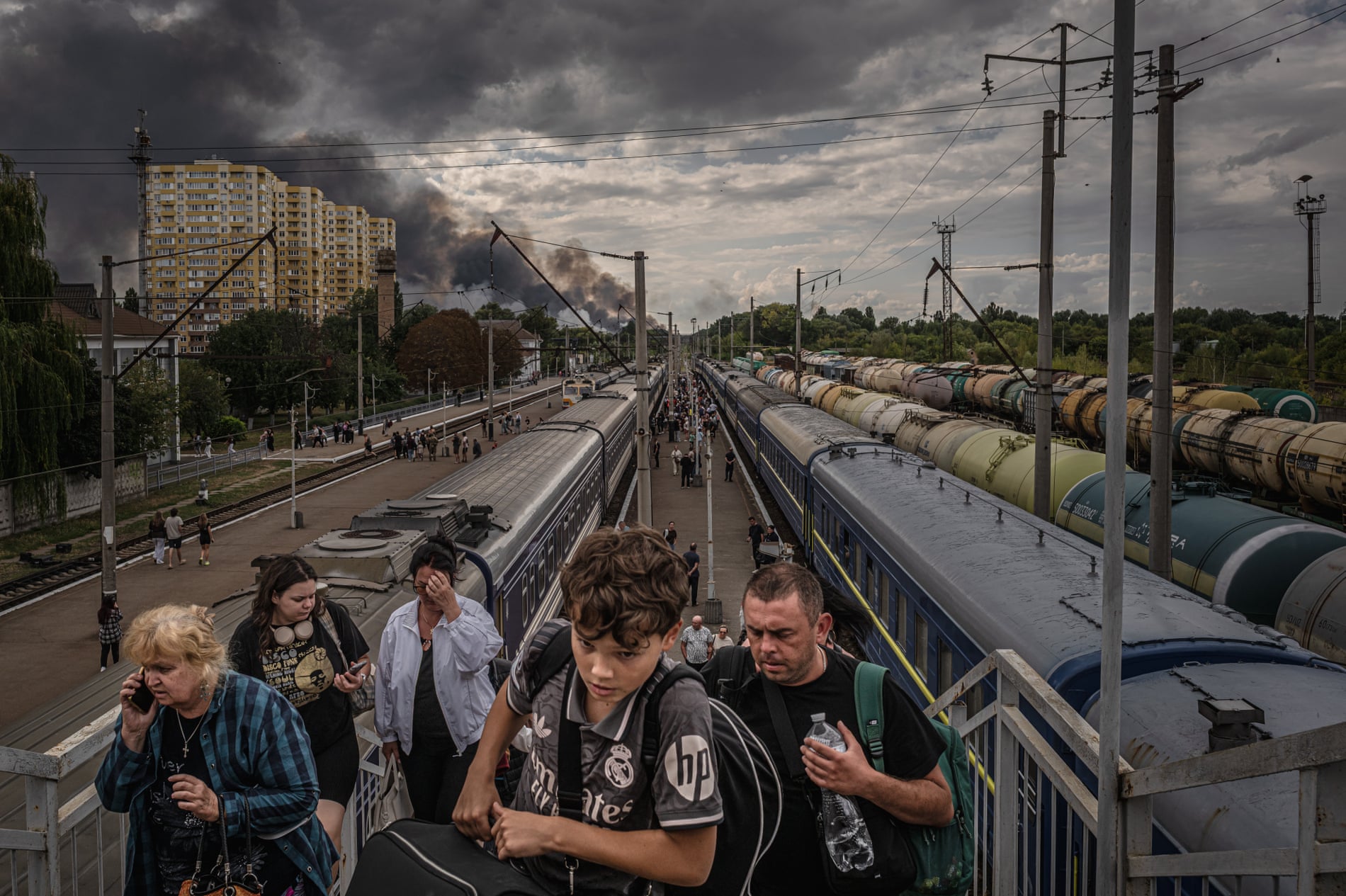 |
| Boryspil, in the Kyiv region. Trains were evacuated and travellers stranded during Russia’s days-long air assault on Kyiv |
"The enemy has chosen our passenger services as a target", commented Oleg Golovashchenko, head, state operator passenger company, Ukrainian Railways. Drone attacks have forced Ukraine to institute a safety process, now routine, of evacuating trains when danger of a drone attack seems imminent. Passenger trains are typically paused for as long as it takes for the danger to pass. Passengers are escorted off the trains to ensure they will not become trapped in any that are struck by explosives.
These massive and increasingly frequent attacks on trains, train stations and railway infrastructure have made any kind of journey potentially dangerous undertakings. Mass transit use in Ukraine is an absolute necessity for any number of reasons, from short trips to and from a place of employment, to longer business trips between cities, and trips for family reunification, brief or prolonged. There are no longer trips taken casually with the impulse for a trouble-free, pleasant outing.
 |
| Emergency employees work at a railway station hit by a Russian drone strike, amid Russia's attack on Ukraine, in Dnipro, Ukraine, on Thursday. (Reuters) |
Ukraine's skies have for years been closed to passenger flights; the only planes are those of the Ukrainian military or those of the Russian military's 'special military operation' in the beleaguered country's airspace. Train travel is the only option in a country where suddenly missiles and drones erupt on missions of destruction of civilian infrastructure, not excluding schools, hospitals, shopping centers, apartment blocks. There are no international rules of warfare protecting civilian enclaves that Moscow respects.
Reliance on trains in Ukraine has become a mainstay of travel, from short trips to lengthy travel plans. Through 2026 alone, Russian aerial attacks targeting rail lines have resulted in damage to 4,856 railway facilities, among which are 380 locomotives out of commission and 146 carriages destroyed, according to Ukrainian Railways. At least 50 railway personnel have lost their lives. Those attacks have made it compulsory that when attacks appear imminent, trains must pause and passengers evacuated.
Daily, there are one hundred to two hundred evacuations, resulting in widespread delays lasting hour after hour across the country. Some 30 kilometres from the Russian border, trains chugging to and from the north-eastern terminus stop frequently in response to attack threats on the Kharkiv-Kyiv route, Ukraine's largest, most populous cities.
 |
| A Ukrainian railway carriage that was attacked by a Russian drone on Jan. 27, 2026, is displayed at the Kyiv central train station on Feb. 23, 2026. | Henry Nicholls/AFP via Getty Images |
Departing Kharkiv overnight, passengers making sleep preparations are given warning their rest could be rudely interrupted through the necessity of an emergency evacuation. "We brought them aboard the train, we must get them to their destination alive", explains 50-year-old train attendant Mykola Kryvenko. Mere hours into the journey the night-time silence in the carriage is disturbed when the sound of hurried footsteps break out and there are compartment door knocks. "Evacuation, evacuation", the rudely awakened passengers hear the train attendant's call. The sounds of nearby Russian drones clear drowsy heads.
The platform swiftly fills with people intently aware of sounds in the sky. Attendants urge passengers to place some distance between themselves and the emptied carriages, as the sounds of approaching drones increase in volume. Suddenly the sky is lit with explosions in the near distance, and passengers pick up a running pace to separate from the train while others quietly edge further and then further again from direct proximity to the stilled train.
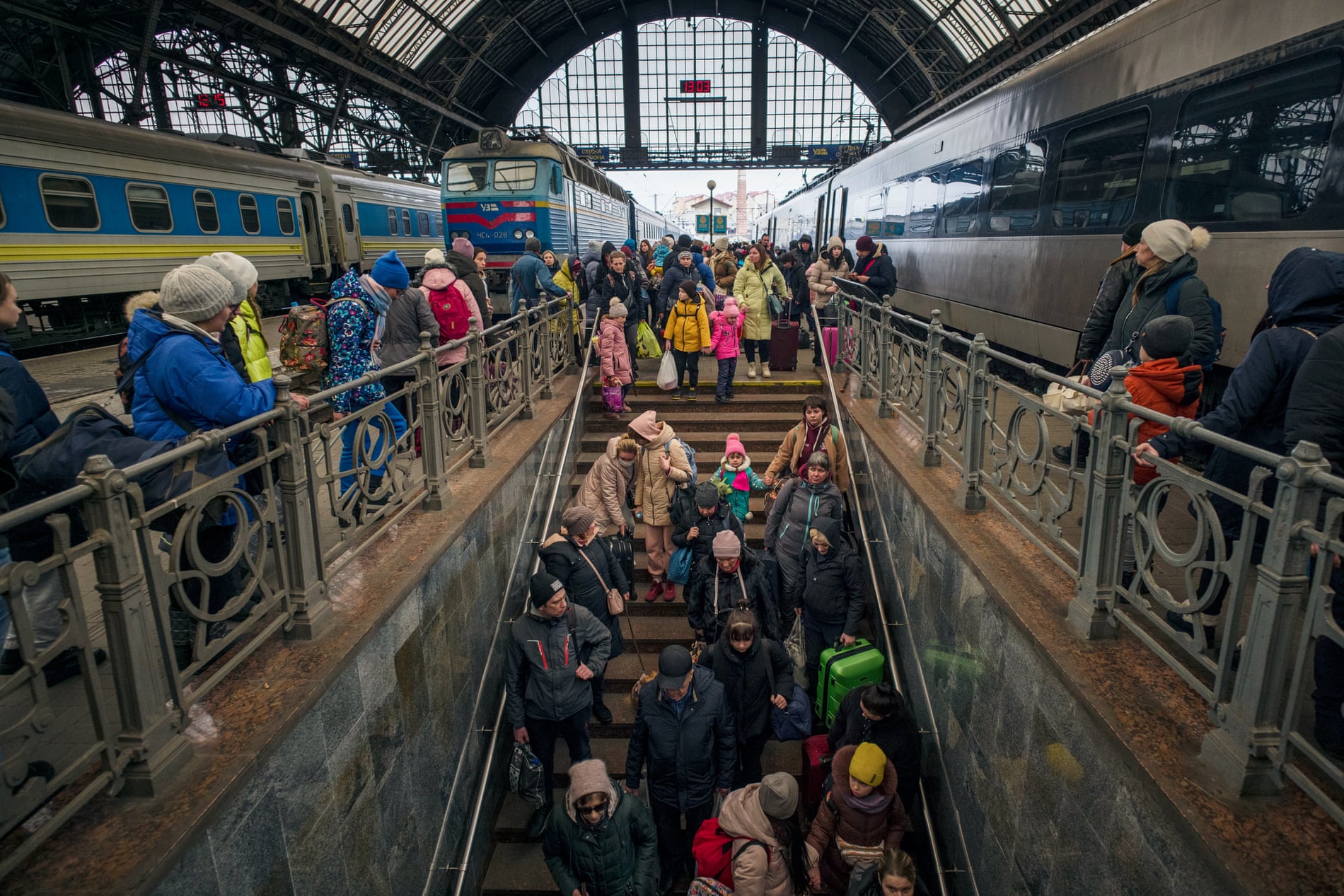 |
| Refugees arriving in Lviv on evacuation trains from Kharkiv and Kryvy Rih make their way through the train station. Photograph: Jelle Krings |
Once the sounds of explosions fade and danger seems to have passed, the passengers soon re-embark when the crew announces an all-clear, and the journey continues. But Ukraine's winter is approaching and uppermost in mind is the fear that this winter will be harsh and train travel will become even more fraught with danger. Should potential disruptions take place to electricity, water and heating resulting from Russian attacks on energy infrastructure intensify, the near future is one of anxious apprehension.
Frequent train pauses and the evacuations that accompany them will become all the more difficult with the onset of freezing temperatures, snowfall and deadly interruptions. Plans are underway at Ukrainian Railways to allow passengers to remain on board paused trains at preventative stops. Golovashcenko, head of the passenger company, adds that blankets and heating pads will be on hand with the new preparations to ensure that people keep warm in harsh winter conditions
 |
| Pixabay.com via Defence24 |
Labels: Domestic Military Assaults, Russian Invasion of Ukraine, Russian War Crimes, Targeting Passenger Transports
posted by Pieface @ 7:41 PM
0 comments