Ruminations

Blog dedicated primarily to randomly selected news items; comments reflecting personal perceptions

Tuesday, April 28, 2026

Staggering Death Toll in Sudanese Conflict

"This grim and chastening anniversary marks another year when the world has failed to meet the test of Sudan."
"Sudan is an atrocities laboratory: sieges, denial of food, weaponized sexual violence."
Tom Fletcher, emergency relief coordinator, United Nations 
 
"He [young man who came to the morgue] was looking for his father and his uncle for over a year. When he came to us, he found out they had both been shot dead in the street in the early weeks of the war. It broke him, he collapsed and cried for a long time." 
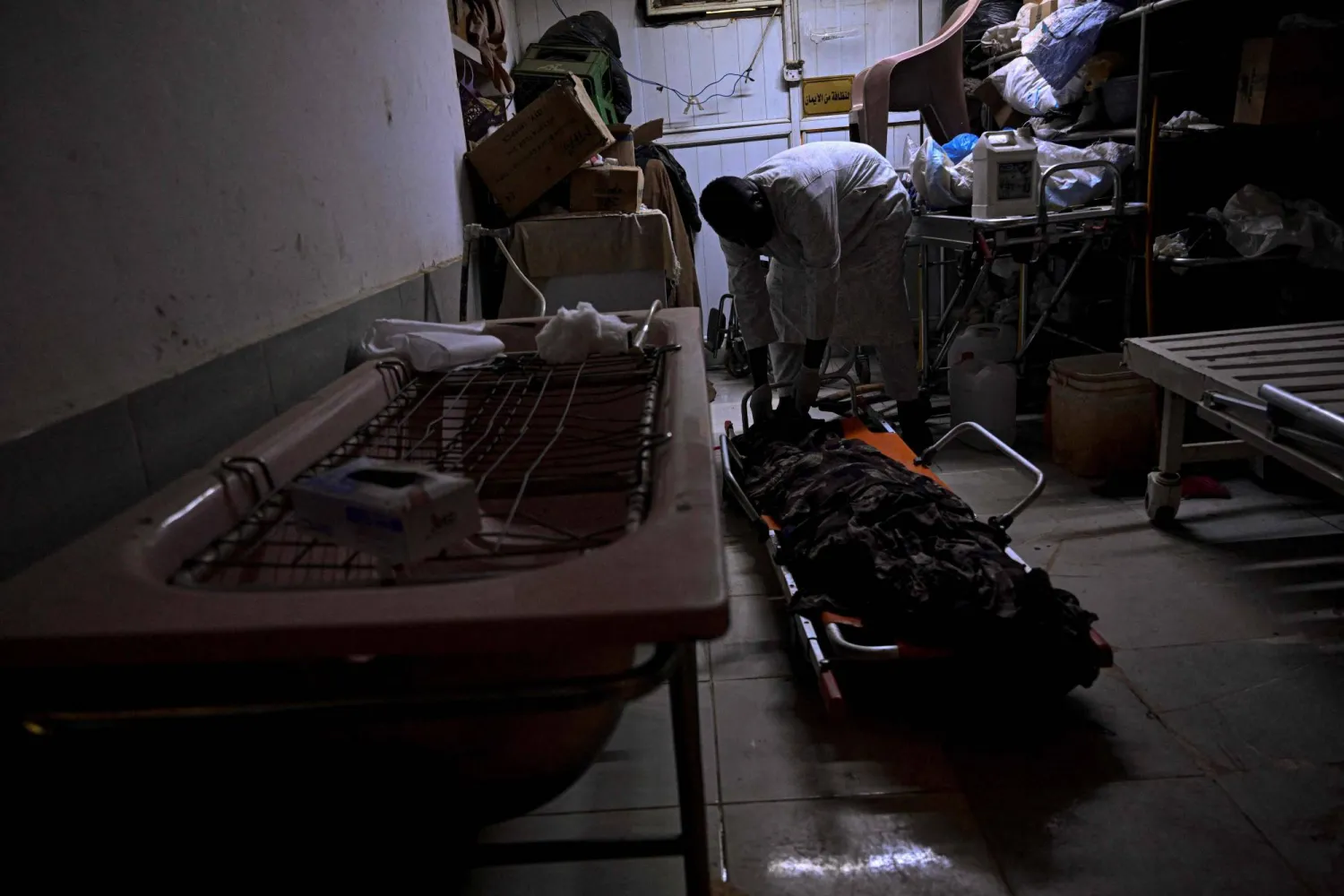
"We photograph every body. We check if there's anything in their pockets to help us identify them, and we mark the spot where we buried them."
Ali Gebbai, mortician, makeshift morgue, Khartoum 
 
"[Khartoum has turned into an open-air morgue]. That leaves a mark on society, it destroys human dignity and it normalizes death."  
"The safest place to keep the DNA samples is buried separately in the ground, and marked clearly. Or we'll exhume the bodies again later."  
Hisham Zein al-Abdeen, head of forensic medicine, Sudan's health ministry
https://static.srpcdigital.com/styles/1037xauto/public/2026-04/1512816.jpeg.webp
This photo taken on April 18, 2026 shows Sudanese Ali Gebbai, a volunteer responsible for handling burial procedures for unidentified bodies in the capital, Khartoum, examines one of the unidentified corpses at the mortuary of Omdurman's Al-Nao Educational Hospital. (AFP)
 
 The war in Sudan has now officially passed its three-year anniversary, since the Sudanese military and he paramilitary Rapid Support Forces opposed one another, bringing the nation to a war that shows no sign of abating, with an estimated 200,000 Sudanese having been killed thus far. This conflict represents a poster of the world's largest humanitarian crisis. A conference in Berlin on April 15 to raise aid funds and call attention to the conflict, doesn't appear to have made much of a global impact on news reportage.
 
Entering its fourth year, widespread displacement, violence and hunger has burdened the population with no end in sight, while the world's attention remains fixed on Russia's invasion of Ukraine, the Israeli response in Gaza to Palestinian terrorism, and more latterly the joint U.S.-Israel aerial bombardment of the Islamic Republic of Iran, with the closure of the Strait of Hormuz taking world headlines. 
 
Even so, the Iran conflict which has impacted rising fuel and fertilizer prices throughout the globe, has also compounded the severe food crisis experienced in Sudan. The Norwegian Refugee Council's latest report stated that the violence had "systematically eroded Sudan's food system -- field by field, road by road, market by market -- producing mass hunger."  
 
https://english.ahram.org.eg/Media/News/2026/4/28/41_2026-639130104759319724-931.jpg
Photo: Southern Sudan city of Rabak after a drone strike hit several vehicles belonging to the Joint Forces, including some carrying weapons and ammunition, which caught fire. AP
 
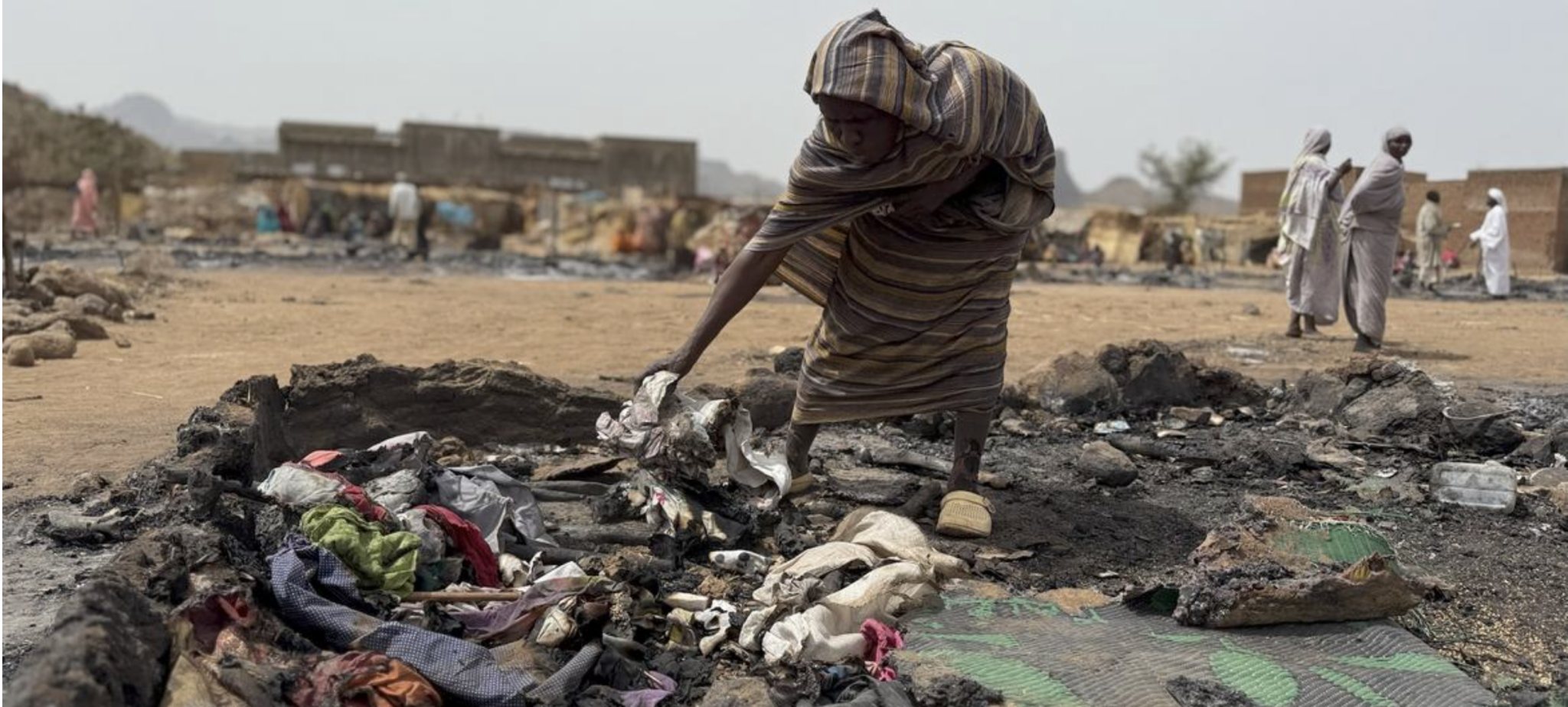
The fierce fighting between the two antagonists -- both of which have been accused of vicious human rights violations, preying on helpless civilian populations -- have forced 14 million people from their homes. Arable fields  have been left untended as farmers abandon their growing crops in the face of danger from land mines and cross-fire from faceoffs by the two opponents. While harsh conditions for farming lead to a steep rise in food prices, incomes have declined and malnutrition stalks the land. 
 
Sudan's 50 million population is starved of food with over 10 million people suffering severe and extreme levels of food insecurity, while some 20 million more are confronted by shortages of basic foodstuffs in a  wartime economy. Millions of people sustain themselves with one meal daily in the two areas hardest hit by the conflict -- North Darfur and South Kordofan. According to the Norwegian Refugee Council report, desperately hungry people are left with little option but to eat foliage and animal feed for survival.   
 
https://assets.cfr.org/images/t_gct_w1200/v1765908261/globalconflicttracker/Sudan_03/Sudan_03.jpg?_i=AA
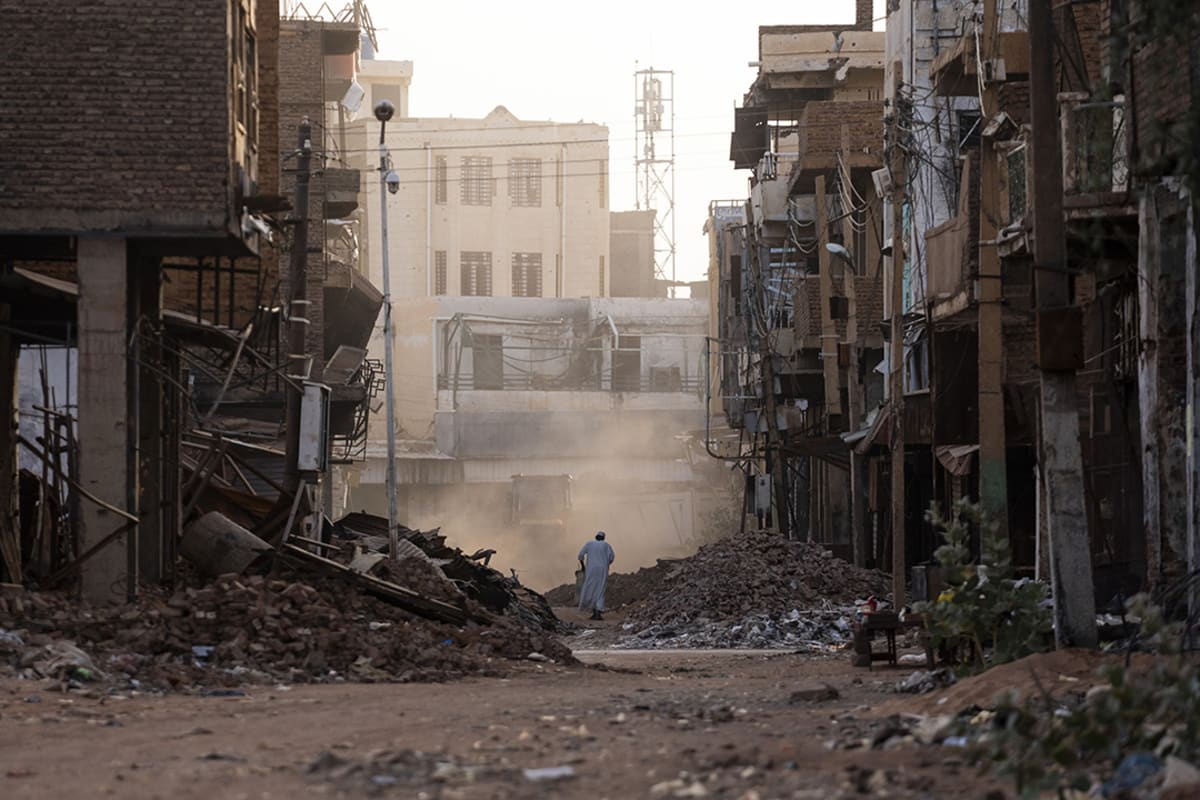
 Destroyed section of Omduran, Sudan, AP
 
The ongoing crisis in Sudan is considered by aid agencies to represent the world's most critical, based on hunger and displacement. "Hunger and violence are reinforcing each other in a vicious cycle of desperation", stated deputy executive director Carl Skau, of the World Food Program.
 
Gold production and trade enables the warring competitors to finance their war with the abundant natural resources in gold that lie in deposits across the country. The conflict is also being supported by foreign powers supplying weapons to both sides. Sudan's economy has been destroyed, its health system collapsed 
 
Widespread violence against women is rife, most Sudanese children are without educational opportunities, and tens of thousands of children have died in this war. The civilian death toll is put at over 22,000 by the Sudanese health ministry, but some estimates see that number swell as  high as 400,000. 
 
https://healthpolicy-watch.news/wp-content/uploads/2026/04/Screenshot-2026-04-15-at-18.02.19-2048x924.png
As donors gather in Berlin, tens of millions in Sudan face famine, genocide and displacement   Health Policy Watch


Labels: , , , , ,

Wednesday, October 29, 2025

War Crimes in Civil War-Ravaged Sudan

 
"[I am] deeply alarmed [by reports of civilian casualties and forced displacement from El-Fasher]."
"With fighters pushing further into the city and escape routes cut off, hundreds of thousands of civilians are trapped and terrified — shelled, starving and without access to food, health care or safety."
"[There is a dire need for an] immediate ceasefire [throughout the region]."
"[The UN has life-saving supplies ready, but due to the intensified attacks in the region, it has made it impossible for workers to get aid in]."
"Safe, rapid and unimpeded humanitarian access must be allowed to reach all civilians in need."
Tom Fletcher, emergency relief co-ordinator, United Nations
 
"Our liberation of [El Fasher] is the liberation of Sudan, all the way to Port Sudan...."
"We are coming and we are coming heavy." 
"The new Sudan goes forward, the old Sudan gets destroyed."
RSF second-in-command Abdelrahim Dagalo 
 
"[The Rapid Support Forces [RSF] committed heinous crimes against innocent civilians in the city of El-Fasher, where more than 2,000 unarmed citizens were executed and killed on October 26 and 27, most of them women, children and the elderly."
Joint Forces, allies of the Sudanese military  
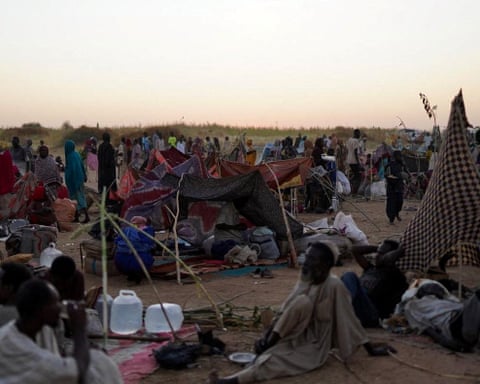
People sitting at a camp for displaced families who fled from al-Fashir to Tawila, North Darfur, Sudan.
Camp for displaced families who fled from al-Fashir to Tawila, North Darfur, Sudan. Photograph: Mohammed Jamal/Reuters
 
Sudanese army chief General Abdel Fattah al Burham stated his forces had withdrawn from El-Fasher "to a safer location". In so doing, he acknowledged that his defense operations had lost the battle for the strategic city, leaving the Rapid Support Forces now in full control of all of Darfur. Even so, he made a pledge to continue to fight "until this land is purified". Despite which, analysts conclude that Sudan has now been partitioned along an east-west axis. The RSF has set up a parallel government from a territory that will prove extremely difficult for the military to extract them. 
 
This is a bloody civil war, with the RSF, formerly in partnership with the Sudanese army, since April of 2023 challenging the Sudanese government for total control of Darfur. Formerly known as the Janjaweed, horsed Arab militia in conjunction with the previous government of Omar al-Bashir who was found by the ICC to have been guilty of war crimes in Darfur, the power struggle between the two forces led to their violent separation and the challenge that followed. Since then, over 150,000 people have been killed, with over 14 million displaced in the fighting.  
"The shelling was so intense on Saturday that we had no choice but to flee El-Fashir."
"Along the way, the RSF filmed us and we were beaten and insulted - and they stole what we had on the journey."
"A number of people were captured and ransoms were demanded for their release. Some of those who were taken were later executed."
"During the journey, many people were arrested, and we suffered greatly from hunger and thirst."
Displaced Darfurian  
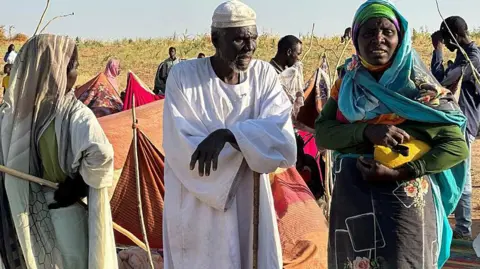
AFP/Getty Images A crowd of people including an elderly man in white leaning on a walking stick and a woman wearing a blue headscarf are pictured after arriving in Tawila, Sudan - October 2025.
People arriving in Tawila have been describing the extreme violence they faced as they fled el-Fasher. AFP/Getty Images
 
 Ethnically-motivated atrocities in the western Sudanese city of El-Fasher have been reported since it fell to the paramilitary Rapid Support Forces, concluding the years-long siege that made life an utter misery for those city dwellers who were unable to flee, with the city surrounded by RSF forces. Over 18 months of siege warfare had created fear and threats of starvation for those forced to remain in the city, trapping 260,000 people without external aid being able to reach them. 
 
The Rapid Support Forces now has control over every state capital in the sprawling Darfur region comprised of mostly non-Arab, Black farming communities. NGOs, along with local groups had given warning that mass atrocities would be triggered by El-Fasher's fall to the RSF and those predictions are ringing true. Open-source intelligence and satellite imagery have confirmed the dire state of affairs now reigning for the residents of the city. 
 
According to Volker Turk, UN rights chief, there is a growing risk of "ethnically motivated violations and atrocities", as his office was "receiving multiple, alarming reports that the Rapid Support Forces are carrying out atrocities, including summary executions". According to pro-democracy activists, El-Fasher residents endured "the worst forms of violence and ethnic cleansing" since control of the area was claimed by the RSF.
 
A fighter known for executing civilians in RSF-controlled areas was shown in a video released by local activists shooting a group of unarmed civilians seated on the ground. They were killed at point-blank range. As many as 15,000 civilians from non-Arab groups in the West Darfur capital of El Geneina have been reported to be killed by the paramilitaries, with their track record of atrocities. The Sudanese army itself has also been accused of war crimes.
 
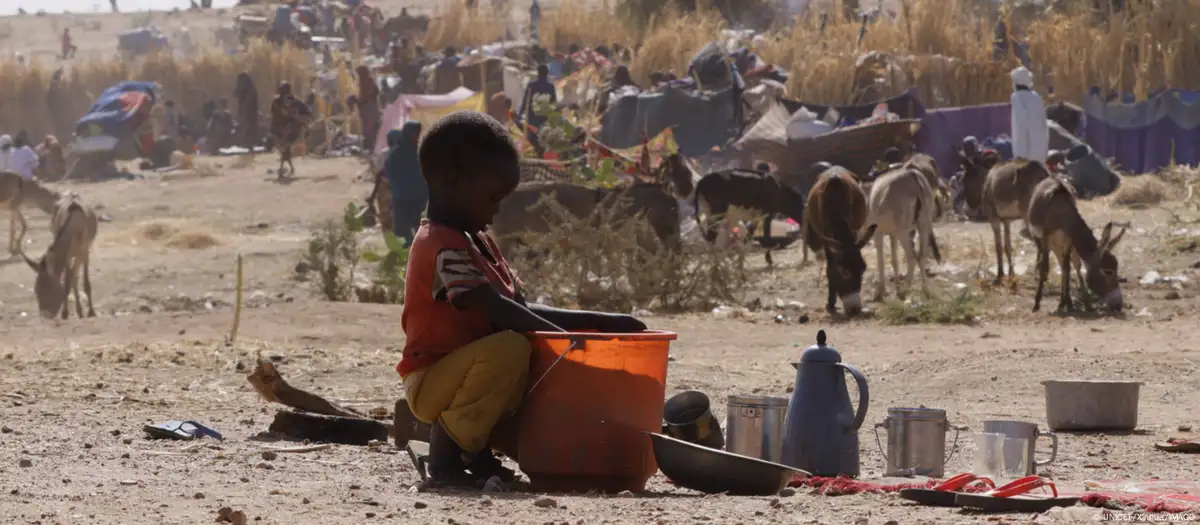
https://static.dw.com/image/74510523_1004.webp
The paramilitary RSF Forces have taken over el-Fasher prompting fears of the lives of thousands of civilians   Image: UNICEF/Xinhua/IMAGO
 
 El-Fasher was considered to represent one of he grimmest places in war-torn Sudan -- thanks to a war labelled by the UN as among the world's worst humanitarian crises. Located outside the city, displacement camps were declared to be in famine. Within El-Fasher, the quarter-million population in desperation turned to eating animal feed to stay alive.  
"[The city] appears to be in a systematic and intentional process of ethnic cleansing of Fur, Zaghawa, and Berti indigenous non-Arab communities through forced displacement and summary execution."
"[This includes what appears to be] door-to-door clearance operations."
Yale University Humanitarian Research Lab 
 
 
"[The crisis is] the final stage of the Darfur genocide."
"I have seen videos of ditches and trenches entirely full of friends, neighbours and family members’ bodies."
"There have been reports of entire families hanging from trees."
Emi Mahmoud, Darfur Internally Displaced People Network  


Labels: , , , ,

Sunday, April 30, 2023

Another Sudanese Conflict

"This is a huge country, very diverse ... I think it will be a nightmare for the world."
"This is not a war between an army and small rebellion."
"It is almost like two armies – well trained and well armed." 
Former Sudanese Prime Minister Abdalla Hamdok
 
"[There was a recently noticeable change in the sides' attitudes; they appeared more open to negotiations, and were saying they would accept] some form of talks".
"The word 'negotiations' or 'talks' was not there in their discourse in the first week or so."
U.N. special representative in Sudan, Volker Perthes 

"I'm afraid that one day I'm asleep and I wake up to a bomb falling on my house."
"That's my deepest fear right now. That's all that I think of. That's why I can't sleep at night."
Khalid, resident of Khartoum

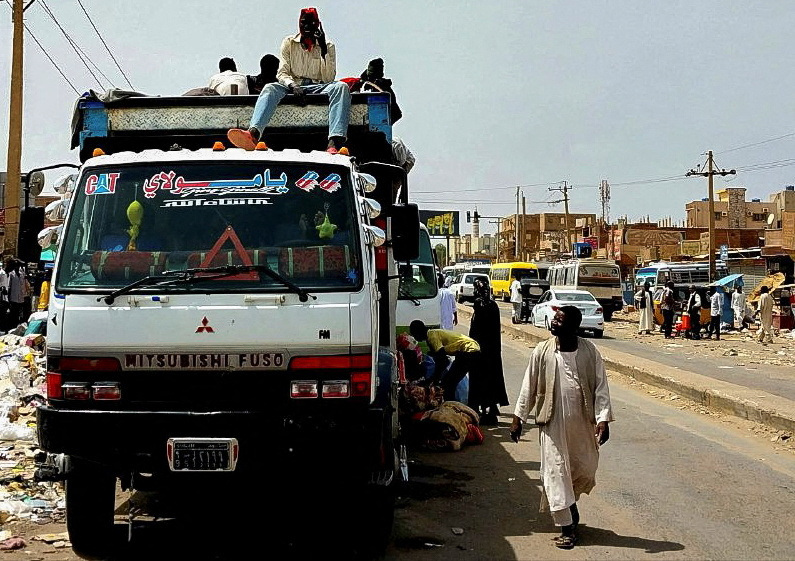
People gather to ride trucks to flee outside Khartoum, in South Khartoum locality
People gather to ride a truck to flee outside Khartoum, during clashes between the paramilitary Rapid Support Forces and the army, in Khartoum, Sudan April 28, 2023. REUTERS/ Stringer

"The current fighting has forced us to stop almost all of our activities in West Darfur."
"We are incredibly worried about the impact this violence is having on people who have already lived through waves of violence in the previous years."
Sylvain Perron, MSF’s deputy operations manager for Sudan
In 2003 there was wholesale carnage in the area of Darfur, an African farming community. There were disagreements between the Arab pastoralists and the farmers of Darfur. The Muslim-majority Arab-led government of the day under president Omar al-Bashir unleashed a no-holds-barred conflict on the farming communities of ethnic minorities, with military helicopters dropping bombs and the Janjaweed Arab mounted militias attacking the largely helpless farming communities who fled in terror.
 
Horrendous war crimes were committed and al-Bashir was found guilty along with his top general of war crimes and crimes against humanity.  An estimated 300,000 people were slaughtered, and millions were left homeless.

At the present time, Sudan's military had a shared custody of the country with the leader of the Rapid Support Forces militia which had grown out of the Janjaweed. Both General Abdel-Fattah Burhan who leads the Sudanese military and General Mohammed Hamdan Dagalo leader of the Rapid Support Forces (RSF) ended their temporary power sharing arrangement over the issue of elections for a civilian government promised after the previous one had been deposed.
 
Their disagreement turned into a violent power struggle with the third largest African country on the continent now engaged in a war that has killed hundreds of its people, wounded many thousands and caused the migration of over 75,000 people seeking haven from the conflict elsewhere in neighbouring countries, while foreign governments have taken emergency measures to evacuate their citizens to safety out of the country.
 
A number of temporary truces and ceasefires have come and gone, with other African and Arab nations, the UN and US acting as mediators between the adversaries in efforts to persuade them to reach an agreement and cease hostilities. The capital Khartoum has become a war zone. The truces are tentative and quickly breached, while in the interim tens of thousands flee elsewhere for safety. Evacuations by land, sea and air have come to an abrupt standstill, as the violence continues and escalates.
 
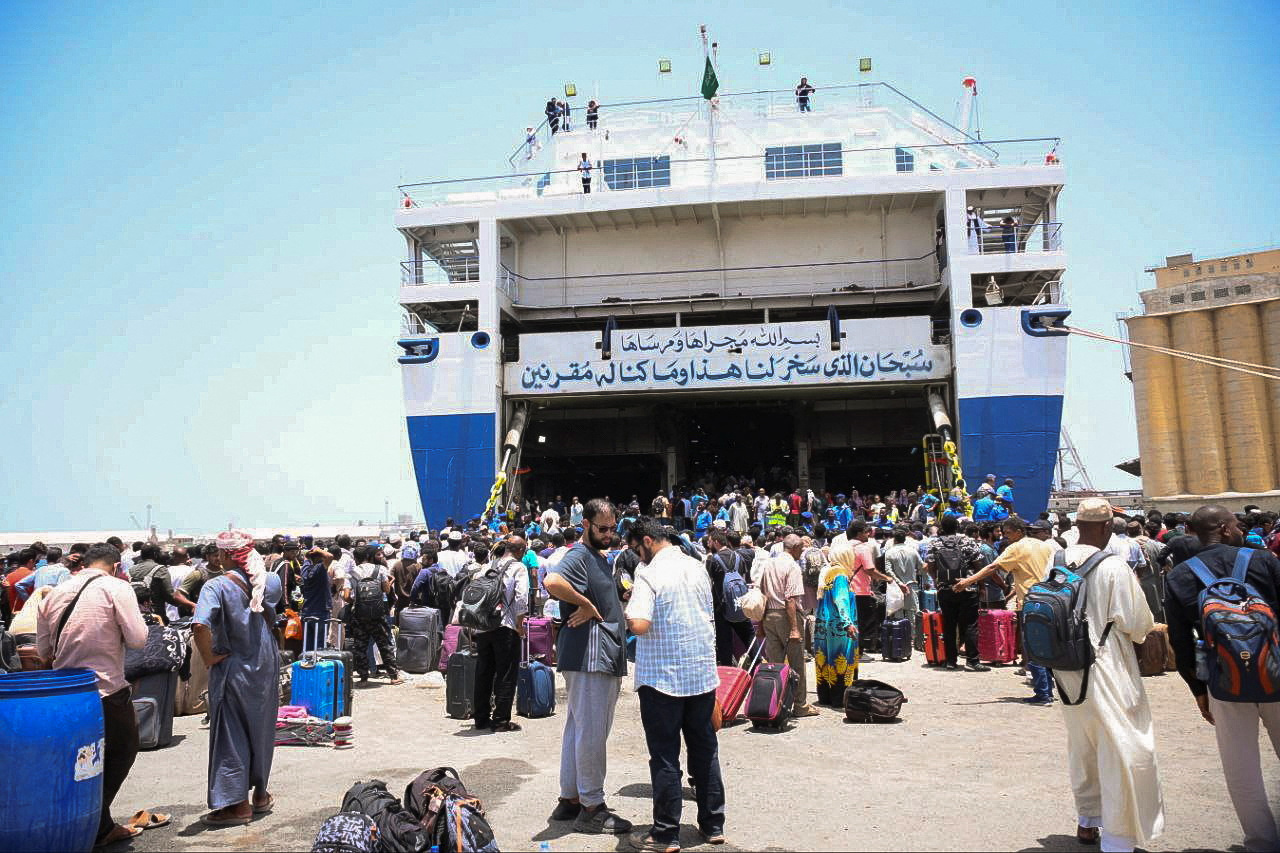
European, Asian and African nationals prepare to board a ship to Saudi Arabia, at Port Sudan
European, Asian and African nationals prepare to board a ship to Saudi Arabia, at Port Sudan, Sudan April 28, 2023. REUTERS/Ibrahim Mohammed Ishak
 
The military's warplanes bombed the RSF in upscale neighbourhoods in Khartoum on Friday while classes were reported as well around the headquarters of the military, the Republican Palace and the area close to the Khartoum international airport. Since the conflict erupted on April 15, these are areas that have become flashpoints. In Khartoum's sister city Omdurman, explosions have been noted as well.

In Khartoum, medical workers report that medical personnel have been abducted by the RSF to treat their wounded fighters. A voice note was shared on a chat group for Sudanese health care workers giving warning to wear civilian clothing, not medical uniforms, and to conceal any identification that would list their profession, should RSF fighters stop them on the street.

A Sudanese-American infectious disease physician at the University of Nebraska, working with community health leaders in Sudan shared the stories of five doctors she knows who were taken from the streets of Khartoum by the RSF since the fighting began. One of the abducted doctors forcibly taken to an unknown location described seeing dozens of wounded fighters, a stockpile of medical supplies and two other kidnapped doctors working on the fighters.

His days there were spent treating fighters with gunshot wounds, burns and other injuries, before they were finally released. Neither the military nor the militia have been able to strike a conclusive blow against the other to this point. World powers struggle to convince them to set aside the violence. An East African nation bloc has arranged an initiative for the two sides to hold talks, promoted by the African Union, the United States, the United Arab Emirates, Saudi Arabia and the United Nations.
 
While denying that he has an ambitions to attain power for himself, General Burhan insists that General Dagalo "wants to rule Sudan, seize its resources and magnify his wealth". He has ruled out speaking and engaging in negotiations with Dagalo while accusing him of orchestrating a rebellion against the state.

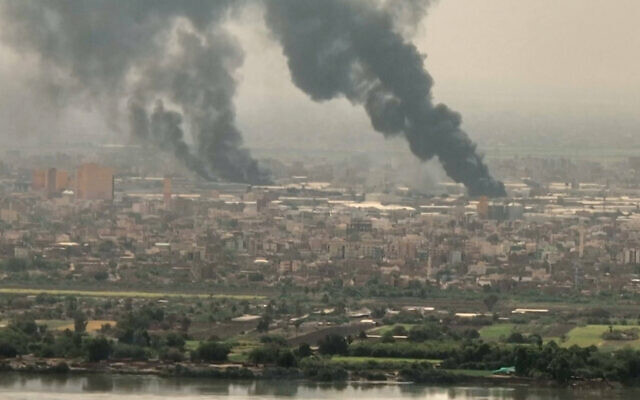
This image grab taken from AFPTV video footage on April 28, 2023, shows an aerial view of black smoke rising over Khartoum. (AFPTV/AFP)

Labels: , , , ,

 
()() Follow @rheytah Tweet