Ruminations

Blog dedicated primarily to randomly selected news items; comments reflecting personal perceptions

Thursday, January 20, 2022

Vaccine Passports -- The Debate
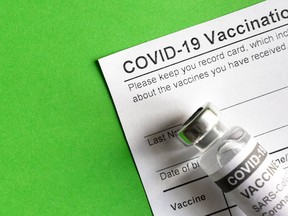
vaccine passports
"Given the reduced/no effectiveness of two doses, depending when the last dose was, there is a risk of these people having an infection, perhaps unknowingly, and transmitting to someone else in such a setting [places restricted to those with vaccine 'passports'."
"[The vaccinated are much likelier to have mild illness], So they may be more likely to be out and about, despite being infected. By excluding all the unvaccinated people from these places, we are in essence keeping them safer from the vaccinated people, who may be asymptomatically or pre-symptomatically infected with     COVID, but still able to transmit, especially when everyone is unmasked."
"If we drop the vaccine passports, the unvaccinated are going to go into those spaces. Right now, they may be living the life of a hermit, and have managed to stay safe that way. But if we get rid of vaccine certificates, they're like sitting ducks."
Dr.Jeff Kwong, epidemiologist, senior scientist, ICES (Institute for Clinical Evaluative Sciences)
"But the passports? They may be a good stick, but I'm not sure how effective they are for slowing transmission."
"We've seen it affecting families, splitting families apart. [Once vaccines became polarized], all reason went out the window."
Professor emeritus David Streiner, psychologist, McMaster University

"Because it makes people think that they are in a safe space [vaccine certificates may be harmful]; they were, pre-Omicron, but no longer."
"Vaccine certificates may prove valuable again at some point, but the two main purposes -- motivating people to get vaccinated and protecting people by keeping spaces confined to those at low likelihood of infection -- are clearly no longer relevant."
Dr.Andrew Morris, infectious diseases specialist, Toronto

"In the fall, when people were talking about implementing mandates, and some of my colleagues who were unvaccinated were facing termination, I thought to myself, what, exactly, is the risk reduction gained by terminating unvaccinated health-care workers."
"And that just led to a broader exploration for the actual numbers behind that."
"We were in these in-between phases of the waves. Obviously now infection risks are rising. It's a totally different situation."
"But I think we should think very carefully about whether or not, in a pluralistic democracy, we are sure that the benefits we may extract from [vaccine mandates and passports] outweigh the harm of creating a class of citizens who are not allowed to fully participate in society."
"We are starting to look at our fellow citizens in a way that they are not equal citizens to us, because they have made decisions that we don't agree with. And I think that's a very dangerous thing to do."
Aaron Prosser, psychiatry resident, McMaster University
Ontario had previously indicated that requiring proof of vaccines in settings such as restaurants, bars and cinemas would no longer be required after Jan.17, but a senior official said the government is taking that end date off the table. (Evan Mitsui/CBC)
 
This is a debate on reducing the risk of transmission of COVID-19. The debate over vaccines is long past. Their well acknowledged capacity to prevent severe disease, hospitalization and death in vulnerable adults is no longer open to debate. The value of the COVID vaccines has been proven time and again; not a 'cure' but a means to prevent a worse-scenario response to the incursion of a predatory pathogen that has cut a wide swath through the world's population in illness and in a massive death count globally.
 
A new study produced in Canada explores whether vaccines reduce transmission risk. And according to the study results they do. For a limited time frame. Two doses, the world now knows, are not likely to protect against infections by a virus that is highly contagious as Omicron has proven to be. Six months following the second dose "it kind of wanes down to, like, zero", stated Dr. Kwong, lead author of the study.
 
Updated data examined by his team indicated effectiveness against infection can recover following a third dose with an mRNA vaccine to about 60 percent. A higher rate of protection, he agrees, "but still not great", certainly not as high as had been the case with the previous, Delta strain. Based on two objectives; prevention of transmission, and keeping people out of hospitals and alive, the concept of vaccine passports gained recognition and became an important part of the anti-COVID arsenal.
 
Vaccines proved their usefulness in diminishing the worst-borne-out threats of COVID, but it was soon realized that they don't stop transmission and infections; all the more so with particularly wildly contagious Omicron. An observation that led to questions over whether passports remain relevant, and why the controversial issue hasn't been more fully addressed by the governments mandating their use. 
 
Making life a little more difficult for people who decline the shots, passports were seen as a method of encouraging vaccine uptake; no vaccination, no entry to settings such as gyms, theatres, restaurants, sports events or liquor and cannabis stores. Once Quebec expanded its vaccine certification scheme to cannabis and liquor stores the number of first-dose bookings quadrupled.
 
It is Dr.Kwong's contention that vaccine passports serve to protect the unvaccinated, at this juncture. His views are not universally shared; many health professionals feel the coercive use of passports to try to force the unvaccinated to comply divides people, creating adversaries out of the vaccinated and the vaccine-hesitant or -defiant. The question of the percentage in the population required to achieve 'herd immunity' with COVID goes answered as yet -- and how many people need to be excluded to result in prevention of one transmission?

"I think we're in this stage of producing fatigue about it: Okay, I've got my two shots, my booster. Enough already. Let me go on with my life", observed Dr.Streiner, professor in the department of psychiatry and behavioural neuroscience, McMaster University. The risk of public pushback concerns him. Dr.Streiner's study estimated in the pre-Omicron era, at least 1,000 unvaccinated people would be needed to be excluded in prevention of one SARS-CoV-2 transmission in most settings.

New data envisages a surge in daily hospitalizations in coming weeks amidst signs the Omicron wave may be peaking,  just as it appears to be doing in Britain and the United States. The variant may be running out of people to infect, according to The Associated Press. "It's going to come down as fast as it went up", commented Dr.Ali Mokdad, University of Washington scientist.


Labels: , , , ,

Wednesday, September 30, 2020

Public Mood on COVID-19 Vaccine Resistance

"We've had discussions at the task force, we've had presentations by experts in this area, about vaccine hesitancy. It's not the extreme anti-vaxxers we're talking about -- it's people who I think quite reasonably will have an 'I'll wait a little bit and see what my friends say', kind of thing." 
"And I would say, in a word, this comes down to trust. A lot of people have been concerned because it [vaccine trials] seems to be going so fast."
"The honest answer is, we don't know [what vaccine uptake numbers should be to achieve herd immunity]. Obviously, the higher the number, the better."
"It would be unwise to say, 'Gee there won't be any side effects'. We don't know that. We just don't know the answer to that question until we do the Phase III  trials."
"[But] one has to remember we're in the middle of a pandemic. So you have to weigh -- we all have to weigh -- the risks of taking a vaccine against the risk of getting COVID."
"[And unlike in the U.S.], there is no evidence whatsoever of political interference, or any other kind of compromising, on safety. So I think we're quite lucky in this country that we can trust our regulator."
"Public health is all about transparency communication, earning the public's trust. This [eventual vaccine] will not necessarily be a magic bullet. It'll be part of the public health armamentarium; wearing a mask, washing our hands, keep a distance, and the vaccine."
"We will eventually get rid of this virus. But it won't happen the day after you are immunized."
Dr.Alan Bernstein, COVID-19 vaccine task force Canada
"[While most vaccine safety scares aren't supported by scientific evidence], without substantial global investment in active vaccine safety surveillance, continuous monitoring of public perceptions and development of rapid and flexible communication strategies, there is a risk of SARS-CoV-2 vaccine never reaching their potential due to a continued inability to quickly and effectively respond to public vaccine safety concerns, real or otherwise."
Institute for Vaccine Safety, Johns Hopkins Bloomberg School of Public Health
Research assistant Jae-Heon Kim conducts research on a vaccine for the novel coronavirus at a laboratory in San Diego, California, March 17, 2020, photo by Bing Guan/Reuters

Research assistant Jae-Heon Kim conducts research on a vaccine for the novel coronavirus at a laboratory in San Diego, California, March 17, 2020   Photo by Bing Guan/Reuters

The World Economic Forum had contracted with Ipsos to conduct a survey, released in August, of 20,000 adults from 27 countries, which found that 74 percent of the polled would opt for an inoculation against COVID, but 37 percent only agreed strongly, while 37 percent somewhat agreed. In most countries, the pollsters reported, the agreeable group vastly outnumbered the group choosing to disagree. Last year, the World Health Organization identified vaccine hesitancy as one of the top ten global health threats.
 
Critics contend that U.S.President Donald Trump has politicized the issue of COVID-19 vaccines, and in so doing has seriously undermined public confidence. He has stated that his administration may -- or may not -- approve more stringent FDA standards linked to emergency authorization of a COVID vaccine. "Because when you have Pfizer, Johnson and Johnson, Moderna, these great companies, coming up with the vaccines and they've done testing and everything else ... why would they have to be adding great length to the process?", Mr.Trump has mused. 

A number of the front-runner candidates for vaccines are RNA-based vaccines, using specific parts f the SARS-CoV-2 virus genetic code meant to trigger an immune response. This is an entirely different process. Normally to develop a new vaccine it will take a decade and more. And in the current situation with the global pandemic, researchers and pharmaceutical labs are attempting to do the research, the trials, due diligence in one year; collapsing ten into one.  Even so, emphasizes Dr.Bernstein, president and CEO of the global research organization CIFAR, there are no short-cuts being taken.
 
Credit...Audra Melton for The New York Times
Physicist Neil Johnson of George Washington University has been tracking online vaccine conversations through 100 million Facebook users, noting that pre-COVID the "undecided" were becoming more tangled up with hard-core anti-vaxxers, a trend that has strengthened since March. That the science keeps shifting, and evolving appears to be part of the problem in public perception. Questions such as whether or not COVID is airborne, what the size is of a particle, a droplet; "Should you be six feet away, should it be three feet, should it be 2,000?", queries Dr.Johnson. "It's not wrong, it just looks like science doesn't know."

And Dr.Johnson identifies safety, need, big-pharma conspiracies and does-science-actually-know-what-it's-doing, as the major impact appearing among the "not-sures". "But we also see it -- and I think this is even more scary -- in the yeses, the ones that say 'they would get a vaccine', who then inside are thinking, 'yeah, but I wouldn't be first in line. I'm going to wait until my whole street, everybody I know has it, and if they're still standing a few months later, I'll get one."

Question: What happens if you have the flu shot at the same time as the first COVID shot? What happens if I've had antibodies already established in me and I have the vaccine, is that bad? "These are the things occurring to them." It's not yet clear which strategy will be the most effective among the dozens of vaccines now being tested in humans, though the best vaccines are those most clearly mimicking a natural infection; avoiding making the person sick, even killing them.

Even a partially effective vaccine in the 60- to 70-percent range would produce an important impact; on the other hand the less effective the vaccine turns out, the greater the number of people required to be vaccinated to achieve herd immunity. Another unknown: how long vaccine-induced immunity may be good for; months? a year? longer? What is anticipated is that the vaccines would be more effective in the young and the healthy, and far less so among the health-impaired and the elderly.
"[The choice whether to be vaccinated is one most people won't have to face for months], if not a year or more. The supply just won't be there for the general public."
"[Despite the prospect of a potentially fearsome fall and winter surge of COVID, and the potential that vaccines] can liberate everyone from the constraints on liberty [represented by lockdowns and quarantining, there are some people who will say] count me out."
"They don't trust vaccines or they don't trust the government to provide a safe one."
Arthur Caplan, founding head, division of medical ethics, NYU School of Medicine
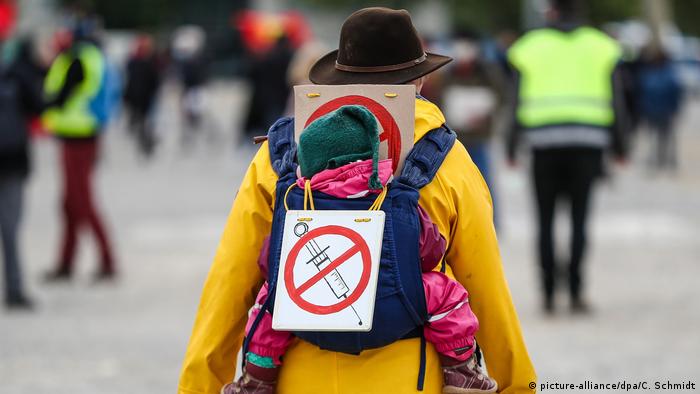
A man carrying a small child on his back, with an anti-vaccine sign

Labels: , ,

 
()() Follow @rheytah Tweet