Canadian Justice -- Canted to Serve the Interests of Indigenous Exceptionalism
"The appellant [who was 20 at the time] thought he could hear Mr. Stone yelling at his mother. Thinking that she was in danger, he rushed to the scene of the accident.""On arrival, he spoke to his mother and then confronted Mr. Stone who was hurrying toward his mother, having just come from a store where he had purchased cigarettes for her.""Although Ms. Davis tried to stop her son, he walked briskly toward Mr. Stone and punched him in t he middle of his forehead, causing him to fall to the ground unconscious."Partial text of British Columbia Court of Appeal decision"The specific question to be addressed in this case is whether Mr. Davis, as an Indigenous offender, should be sentenced differently from the way a non-Indigenous offender would be sentenced for an aggravated assault of this nature. In my view, the answer to that question must be 'yes'.""Significant weight should be placed on the lessened moral culpability of the offender given his circumstances as an Indigenous person.""Mr. Davis has been incarcerated since November 2024. By operation of law, the time served in custody will be counted as part of the 24-month conditional sentence order. The remainder of the first 18 months of the conditional sentence is to be served under house arrest.""[While the sentencing judge] was alive to the importance of Gladue factors, he found these factors had a 'lesser impact', in part of Mr. Davis's 'success in life' as demonstrated by the fact that he had graduated from high school, was employed, had no negative peer associations, no addiction issues, and no criminal history.""Reports filed at sentencing confirmed that his father abused his mother and sexually abused his cousin.""Mr. Davis's circumstances provide the necessary context for understanding his actions on the day of the offence.""[While it isn't] necessary to establish a direct causal link between systemic and background factors and the offence at issue, Mr. Davis's circumstances provide the necessary context for understanding his actions on the day of the offence."Justice Lauri Ann Fenlon, B.C. Court of Appeal majority decision
 |
| The B.C. Appeal Court has sentenced an Indigenous offender to house arrest instead of jail for an unprovoked attack that left his victim permanently injured, citing the goal of reducing the disproportionate number of Indigenous offenders in Canadian jails. Photo by Corgarashu /Fotolia |
The Gladue principle referred to is the generously forgiving infantalization of Indigenous Canadians who are held, due to environmental circumstances beyond their control, to be less capable than any other Canadian citizens in controlling their emotional, criminal impulses. Indigenous Canadians have the misfortune of being over-represented as a criminal class incarcerated for committing crimes in Canada. Canada's criminal justice system maintains that this is the result of colonization, of European settlers foisting their standards of civil behaviour on native Canadians.
That the colonial mentality was dismissive of the humanity of the Indigenous peoples who were found to be inhabiting North America at the time of European arrivals searching for prospective new territory for settlement. Considering themselves superior to the 'savages' they found throughout North America, a paternalistic attitude prevailed which made an effort at times to respect Native culture and values while at the same time maligning them. The establishment of Residential Schools for Indigenous children to receive the kind of formal education that would prepare theme for life in urban centres was meant to help them integrate and to be exposed to basic life skills alongside literacy and numeracy.
Those educational establishments were condemned in later years as a prime symbol of European arrogance, exposing Indigenous children to sub-par conditions injurious to their sense of pride, culture and heritage. Quite bypassing the fact that most children did receive a useful education, enabling them to go on to pursue further avenues of higher education in situations not entirely unlike the boarding schools that the elite in the United Kingdom sent their children to, where some children there too suffered ill treatment yet because it was the prevailing system of the monied class, managed to prevail toward normal adulthood.
In Canada, the Gladue principle prevails in the sentencing of Aboriginal Canadians, whereby lesser sentences are given to criminal offenders, taking their cue from the concept of a state where vulnerable children were raised in underdeveloped circumstances which hampered their sense of right and wrong. In fact, in Aboriginal communities there tends to be gender-based violence in excess of what prevails elsewhere. Minor criminal activities are common and many within the Native communities struggle to find their place within society. Alcohol addiction, illegal drug activity, and neglect of children's needs are rife.
That Indigenous Canadians have faced blatant discrimination is undeniable. That they are generally considered to be less capable at endeavours to shape a decent life for themselves outside of gangs and prostitution is a problem within the community. Yet among them have arisen those who pursued an education that would prepare them for pursuit of the professions of politics, law, education, medicine, mercantilism and academia, just as those from other walks of life have achieved.
In the face of which the failure to hold violence committed by Canadian citizens of Indigenous background remains an anomaly whereby they are held to inferior standards than that of other Canadians. In the case of Isaac Harrison Davis, found guilty of aggravated assault against another young man whom he believed to be abusing his mother, applying the Gladue principle which should long since have been retired from Canadian law, fails to do justice to his victim. Davis's mother happened to have been in a car accident while on the phone with her son; the other drive was Andrew Stone.
When Davis rushed to the scene of the accident, he confronted Mr. Stone and without warning struck him a blow severe enough that Mr. Stone fell unconscious, vomiting and bleeding, never having been given an opportunity to speak or to defend himself. His skull was fractured in the blow. Multiple surgeries followed. He was three weeks in a coma, paralyzed for two weeks. The result of which he suffered from speech aphasia, memory loss and cognitive deficiencies. He now must take speech therapy, and requires the use of a hearing aid.
A member of the K'omoks First Nation, Mr. Davis had originally been sentenced to 21 months in prison, reflecting the fact that he had caused another man a severe brain injury. The Court of Appeal for British Columbia has now ruled that having failed to give due consideration to the Gladue principles; the sentencing judge, Justice Paul Riley, having taken into consideration the normalcy of his having completed high school, secure employment and no record of criminal activity; the original sentence was set aside.
Despite that Justice Paul Riley had concluded that the 21-month jail term approached the low end of the sentencing range, taking into account the effect of Gladue principles on the degree of moral culpability by the offender; for he had considered when he originally sentenced Mr. Davis, all the other mitigating circumstances. The reversal of this judge's carefully considered opinion leading to the sentence, represents a miscarriage of Canadian justice.
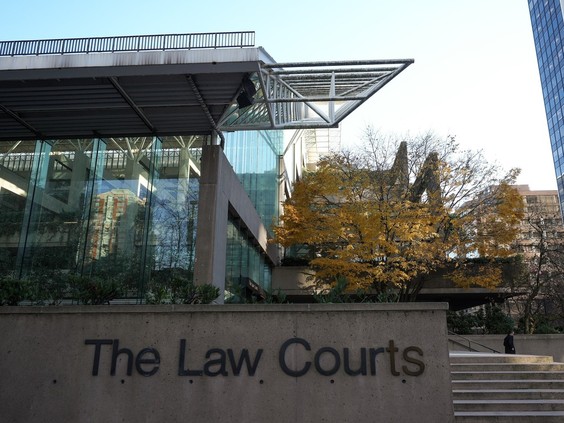 |
| B.C.'s top court has set aside a 21-month jail sentence handed down last fall to Isaac Harrison Davis, a member of the K'ómoks First Nation, for punching another man, fracturing his skull and causing a severe brain injury. Photo by DARRYL DYCK /THE CANADIAN PRESS |
Labels: Canadian Justice, Gladue Provisions, Indigenous Sentences, Injustice, Violent Attack
posted by Pieface @ 7:47 PM
0 comments


