Ruminations

Blog dedicated primarily to randomly selected news items; comments reflecting personal perceptions

Monday, September 20, 2021

An Explosive Spectacular

"When we saw the column of smoke, we thought it could not be real, but it kept growing and we knew we had to get out of there."
"You leave, but you are also looking back because you want to see what will happen."
"Nobody knows how the lava flows will descend, but our plot and lots of houses in the area could be in the way."
Carlota Martín, family agricultural plot, Todoque, downhill from eruption site
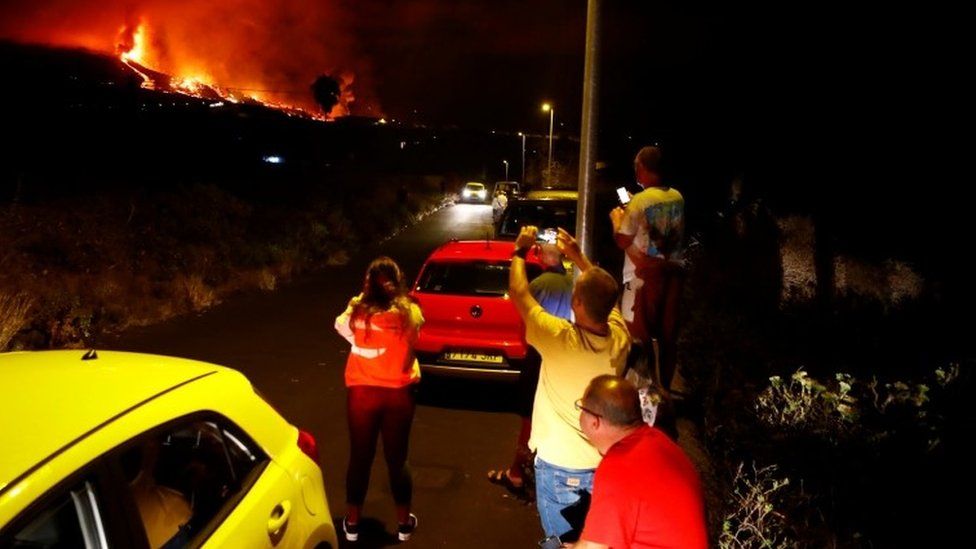
Residents watch lava following the eruption of a volcano in the Cumbre Vieja national park at El Paso, on the Canary Island of La Palma
A 2km (1.2 mile) wide exclusion zone has been set up around the lava flow as it moves down the hillside   Reuters
 
Presaging the Volcanic Eruption: "Instituto Geográfico Nacional (IGN) and Instituto Volcanológico de Canarias (INVOLCAN) reported that a seismic swarm beneath Cumbre Vieja at the S part of La Palma began at 1618 on 11 September and was likely associated with a magmatic intrusion. The swarm intensified in number of events and magnitude, and by 1600 on 12 September a total of 315 earthquakes had been recorded and ranged 8-13 km in depth. The largest event was a M 2.8 (on the Mb_lg scale). On 13 September a scientific committee comprised of representatives from multiple agencies and institutions raised the Alert Level to Yellow (the second lowest level on a four-color scale) for the municipalities of El Paso, Los Llanos de Aridane, Mazo, and Fuencaliente de la Palma. By 0800 on 14 September 2,935 earthquakes had been detected. Larger events were felt by residents during 13-14 September; the largest earthquake was a M 3.9, recorded at 0600 on 14 September. Overall, the events were becoming shallower (8-10 km) and hypocenters migrated slightly to the W. GPS and tiltmeter networks showed deformation totaling 1.5 cm centered over the clusters of epicenters."
Smithsonian Institution National Museum of Natural History Global Volcanism Program
"The island is open. If your hotel is affected, we will find you another one."
"We can make the most of this opportunity. For the many tourists who want to enjoy what nature has brought to La Palma, they can do so in the coming weeks and months."
Spain's Tourism Minister, Reyes Maroto
 
"But now the most amazing thing, which I've never experienced, is that the noise coming from the volcano, it sounds like... 20 fighter jets taking off and it's extremely loud, it's amazing,"
Jonas Perez, local tour guide
 
"I fear further big eruption of the volcano. It's like 200 metres altitude of fire, and then a big river of lava that is going closer and closer to the coast."
"I saw how many houses were covered by lava, and families crying."
"We didn't expect this to happen now. I was walking near the volcano when it explode[d]. I didn't expect it. This is amazing."
Sergio Sarti, island resident 
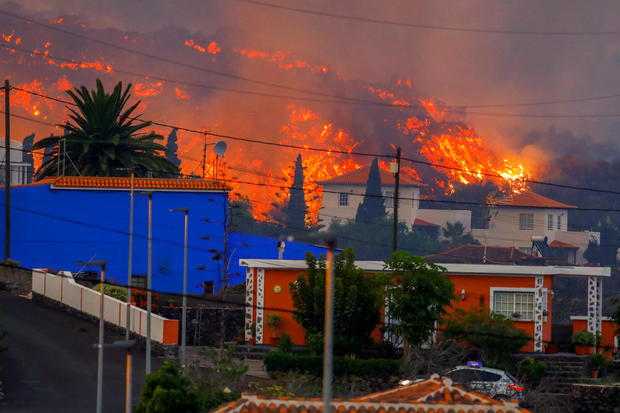
Lava flows behind houses following the eruption of a volcano in Spain
Lava flows behind houses following the eruption of a volcano in the Cumbre Vieja national park at Los Llanos de Aridane, on the Canary Island of La Palma, September 20, 2021. BORJA SUAREZ/REUTERS

Vacationing tourists were witness to quite the spectacle of nature with the eruption of a volcano in the Spanish Canary Islands. Some were only too anxious to be flown out and away from potential danger others were happy to view the fires blazing in the sky, the red-hot trails of lava inexorably wending their way down the volcano, into hillside towns on their way to the sea. That Spain's tourism minister saw fit to hawk the eruption as a tourist draw would surely not sit well with the thousands of residents who had to be evacuated, most particularly those who have lost their homes.
 
Nothing could possibly survive the lava's encroaching passage as it rolled downhill with no earthly power capable of stopping it. As a mayor of La Palma observed, nothing escaped its path, and there was nothing left as it passed. "The lava left absolutely nothing in its path," local mayor Sergio Rodriguez told Spanish broadcaster TVE, and nor would residents be returning to their homes any time soon ... which is to say those homes that escaped the lava's path.
"When the volcano erupted today, I was scared. For journalists it is something spectacular, for us it is a tragedy. I think the lava has reached some relatives' houses."
"I was five years old when the volcano last erupted [in 1971]. You never get over a volcanic eruption."
Isabel Fuentes, 55, local resident
Authorities lost no time evacuating the infirm and some farm animals from villages on a wooded slope, anticipating the eruption which blew at 3:15 p.m. in the sparsely populated Cabeza de Vaca area. When two hours passed, lava rolling down the hillside from five fissures that had been torn into the hillside, the evacuation of four villages was ordered. Nighttime video footage showed fiery fountains of lava blazing hundreds of metres into the sky, leading to incandescent orange rivers of molten rock creepng downhill.

The fiery lava tore raw open gashes into forests and farmland, ravishing everything in their path, spreading and engulfing all in before them, as they neared lower ground. A single stream of lava, several hundred metres in length and tens of metres width-wise, crossed a highway, then began to engulf houses scattered in El Paso. Spain's Civil Guardia helped to evacuate between five and ten thousand people. 
 
"In no circumstances go near the lava flow. If there is volcanic ash, stay in your houses", residents were cautioned by municipal authorities.


Smoke billows as lava flows next to houses on La Palma, part of the Canary Islands. (Borja Suarez/Reuters)


Labels: , , , ,

Monday, February 18, 2019

Hawaii's Kilauea Eruption Timeline


"[This eruption was] truly unprecedented in the modern record."
"Everybody’s chewing on all the great data collected from this eruption."
"That will go on for years and years."
Christina Neal, head scientist, U.S. Geological Survey’s Hawaiian Volcano Observatory, Big Island 

"There’s no reason why we should have expected there would be hydrothermal activity that would be alive within the first 100 days. This is actually life here!"
"[The discovery suggests] how volcanism can give rise to the chemical energy that can drive primitive microbial organisms and flower a whole ecosystem."
"[Studying how hydrothermal life forms near volcanoes that aren’t along tectonic boundaries on Earth could reveal a lot about other celestial bodies]. This is a better analog of what we expect to them to be like [but] it is what’s least studied."
Chris German, geologist, Woods Hole Oceanographic Institution, Falmouth, Mass. 

"[The findings were highly valuable for the monitoring of Kilauea]: Having very high resolution ground deformation measurements before, during and after eruption is exceptional, and will help us to understand how magma behaves in shallow settings better—and in the Kilauea plumbing system in particular."
Pete Rowley, volcanologist, University of Hull, United Kingdom
Kilauea Volcano
Lava from a Kilauea volcano fissure advances up a residential street in Leilani Estates, on Hawaii's Big Island, on May 27. Mario Tama/Getty Images
On April 30 of 2018 the collapse of the Pu'u 'O'o crater atop Kilauea volcano on Hawaii surprised geology scientists and vulcanologists all over the world as the eruption continued for months, producing the equivalent of 320,000 Olympic-size swimming pools of lava transforming the landscape and in the process destroying 700 homes. A detailed timeline of the volcano's destructive eruption, the worst in recorded history, has been published by the Geological Survey's Hawaiian Volcano Observatory.

The data coming out of that publication has enabled vulcanologists to gain a deep understanding of the most hazardous volcano in America. Further investigation may help uncover mysteries of similar volcanoes located world-wide. One of several active volcanoes on Hawaii, Kilauea has been erupting continuously since 1983. The new eruption sequence initiated and seen in May saw two focal points; one, a flank area known as the lower east rift zone where the surface of the volcano is splitting, and the second, to the west, at the Helema'uma'u crater at Kilauea's summit.

A working hypothesis is that a breakdown of a subterranean barrier allowed magma to flow toward the lower east rift zone, coinciding with the April collapse of the Pu'u 'O'o crater. The lava lake representing a persistent pool of bubbling lava within the crater began to drain from the summit of Halema'uma'u, cracks appearing in the rift zone. The following day, May 3, the flow of lava began, necessitating an evacuation of thousands of residents.

A magnitude 6.9 temblor saw increased seismic activity at the summit on May 4, under the volcano's southern flank, the largest in over 40 years, likely a result of magma pushing against the southern section of the volcano, causing a fault to slip. On May 15 and 17 major summit explosions were recorded, producing plumes 3,700 and 9,150 metres in height, activity once thought to be driven by groundwater reacting with draining magma. According to Dr. Neal, however, new data suggests escaping magmatic gas accounted for the explosions.

June 24 saw fissures appearing in the rift zone and rivers of lava flowing up to 100 cubic meters per second, carrying deeper magma -- since old, stagnant magma had already erupted. The deeper magma was more fluid and packed with dissolved gasses, all erupting at 1200 degrees Celsius, leading to incredibly high fountains of lava emerging from some fissures, up to 80 meters in height. The largest freshwater lake on Hawaii vaporized in 90 minutes, on June 2, and by July hot updrafts contributed to pyrocumulus clouds.

A suffocating vog was produced by sulfur dioxide emissions intermixed with water vapor. As lava met the Pacific Ocean a laze, a mixture of hydrochloric acid, glass particles and steam was produced. Suddenly, on August 4, volcanic activity declined but not before a great area of the island was covered with lava. By the time the Hawaii Volcanoes National Park opened again on September 22 35.5 square kilometers had been layered over by lava and 500 meters of vertical collapse had occurred at the summit.
Kilauea lava flows
 Kilauea’s eruption last summer, its largest in 200 years, gave scientists a front-row seat to the volcanic processes that power the planet. In this image from August 5, lava heated to 1000° Celsius pours into the Pacific Ocean, sending a mixture of volcanic gases and evaporated seawater into the air.

Labels: ,

 
()() Follow @rheytah Tweet