Ruminations

Blog dedicated primarily to randomly selected news items; comments reflecting personal perceptions

Friday, August 18, 2023

Wildfire Evacuations, North West Territories
https://ichef.bbci.co.uk/news/976/cpsprodpb/12EDE/production/_130843577_gettyimages-1607843205.jpg.webp
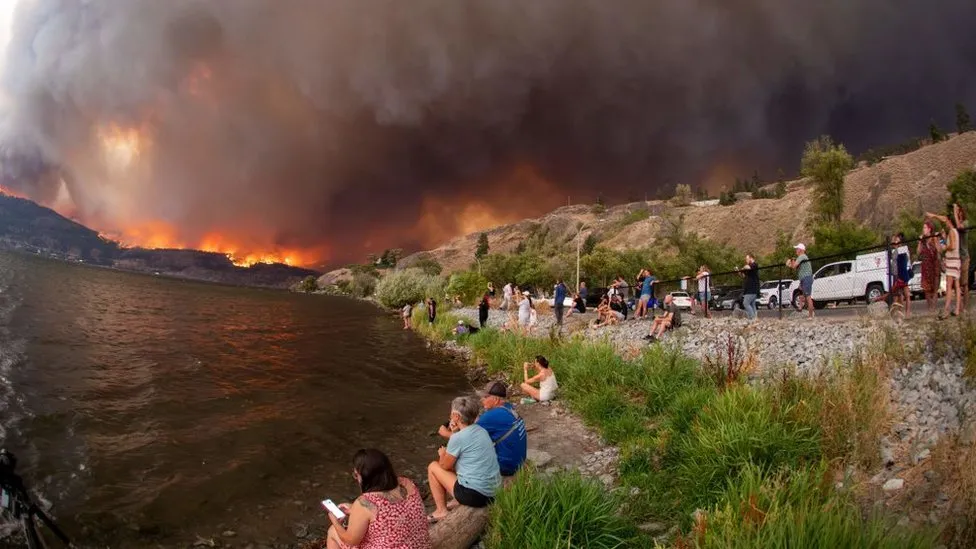
One Kelowna resident told the BBC the fires came over the mountainside like an 'ominous cloud of destruction'   Getty Images

"It is safe for residents who have a vehicle and are able to drive to start evacuating now."
"If there are smoky conditions, residents evacuating by highway will be escorted from Yellowknife through the active fire zone."
North West Territories government
 
"It's going to be tough to get this done, there's no doubt, but folks are co-operating, folks are staying calm."
"People are doing the right thing."
N.W.T. fire information officer Mike Westwick
 
"I'm really anxious, and I'm scared. I'm emotional."
"God, just so many emotions, I don't even know where to begin. I'm in shock."
"I don't know what I'm coming home to or if I'm coming home. There's just so much unknowns here."
Angela Canning, Yellowknife N.W.T. resident 

"We're all in this together, but individually we choose how to react."
"We will get through this. Now, more than ever, is the time to ask for help if you need it, and to work together."
"We're all tired of the word unprecedented, yet there is no other way to describe this situation in the Northwest Territories. The country is watching, and our neighbours are keeping us in their thoughts and prayers."
N.W.T. Premier Caroline Cochrane
https://i.cbc.ca/1.6940304.1692362769!/fileImage/httpImage/image.jpg_gen/derivatives/4x3_1180/canada-wildfires.jpg
Yellowknife residents have been ordered to leave the Northwest Territories capital by noon Friday due to wildfires. Twenty-two flights are scheduled to evacuate about 1,800 Yellowknifers today, with others leaving by vehicle on Highway 3. Sgt. Avery Parle updates a crowd waiting to register for an evacuation flight on Thursday. (Jennifer Gauthier/Reuters)
 
Yellowknife, the capital of North West Territories with its population of 20,000, along with nearby communities of Ndilo and Dettah has been given an evacuation order from the territorial government which views residents along Ingraham Trail, in Dettah, Kam Lake, Grace Lake and the Engle Business District to be at highest risk of approaching wildfires, and should make emergency arrangements to leave as soon as possible; Wednesday was recommended.

Residents of Yellowknife and neighbouring communities were given a little more time, ordered to leave Friday noon, and advised that reception centres for Yellowknife evacuees were set at noon Thursday to open in three communities in Alberta. Travel by road was deemed safe. Air evacuations were to be utilized for those people at higher risk; those who are immunocomprised, those who have no other options by which to leave.

Evacuees from Yellowknife unable to find their own accommodation would be provided with support in three communities in the neighbouring province of Alberta, while the N.W.T. government searches out additional potential emergency hosts for the evacuees. The closest of the reception centres is more than a thousand kilometres distant by road from the N.W.T. capital.
https://i.cbc.ca/1.6940300.1692362457!/fileImage/httpImage/image.jpg_gen/derivatives/4x3_1180/canada-wildfires.jpg
A helicopter carrying a water bucket passes a sign that reads Forest Fire Smoke as wildfires approach Yellowknife. To protect the city, municipal and contractors have been using heavy equipment to build fire breaks 100-metres wide. They have also deployed 20 kilometres of pipe and pumps that can provide between 500 and 1,000 gallons of water a minute from local water sources. (Jennifer Gauthier/Reuters)
 
A main gas station along the highway south of Yellowknife arranged for additional fuel, sufficient to supply thousands of wildfire evacuees. Since the evacuation order was issued, lines at the pumps have grown increasingly. The city of Calgary stated it can provide accommodation for 5,000 evacuees; one reception centre has been prepared at the Calgary airport, prepared to receive five evacuation flights.

In Yellowknife transit, trucked water and sewer services along with residential garbage collection were suspended, while the intensive care unit at Yellowknife's hospital was set to close, reflecting the health authority's reduction in its services. Some services at the Stanton Territorial Hospital, including long-term care, are expected to be closed in the next 24 hours.

While thousands of Yellowknife residents are in road convoys, other stood with packed bags at the airport in snaking lines waiting for the opportunity to leave as wildfires approached. Wildfire fighting crews are fully engaged in battling some of the over 200 blazes that forced thousands to  retreat to evacuation centres throughout Alberta. 

Up to yesterday, the evacuation  has been orderly and safe, the fire about 16 kilometres from the northern outskirts of Yellowknife. The evacuation order was made at that point, to ensure an orderly exit while the fire was still at a distance.

https://i.cbc.ca/1.6940434.1692373006!/fileImage/httpImage/image.JPG_gen/derivatives/16x9_780/canada-wildfires.JPG
Residents of Yellowknife wait to register for evacuation on Thursday as wildfires threaten the Northwest Territories capital. (Jennifer Gauthier/Reuters)

Labels: , , ,

Friday, July 07, 2023

Canada's Famed and Beautiful Forests Aflame

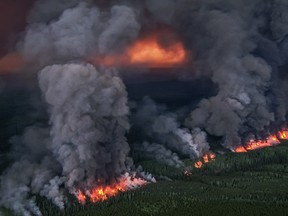
The Donnie Creek wildfire.
The Donnie Creek wildfire in northeastern B.C. Photo by B.C. Wildfire Service
"[Typically, fires larger than 1,000 hectares in Canada last around three weeks on average, while fires larger than 10,000 hectares can burn for approximately 40 days on average."
"Some active fires have been burning for several weeks already."
Mohammad Reza Alizadeh, post-doctoral associate MIT, researcher, bioresource engineering, McGill University
 
"[This] could be happening probably for the rest of our lives or until the forest burns out, and it will be seasonal. We are going to see more fires every summer."
"Now it's pushing all the way through October into November and even in Alberta, which is a really cold place, they've had wildfires in the middle of the winter because it's been so dry and there's been so little snow."
"You could have a hot muffler on an ATV or a car or a Jeep. You could have a careless person with fireworks. You could have a campfire that wasn't put out properly or that threw some sparks."
"The conditions in 2015 that precipitated the Fort McMurray fire were nearly identical to the conditions we're seeing all across Northern Canada right now, which are record-breaking high temperatures in the 30-degrees-Celsius range and rock-bottom relative humidity. The forest fuels -- the leaves, the sticks, the soil, the grass -- are very, very dry and so they catch on fire, not like a wet leaf or a piece of moss, but like a piece of newspaper."
John Vaillant, author, Fire Weather: The Making of a Beast (2016 Fort McMurray wildfires)
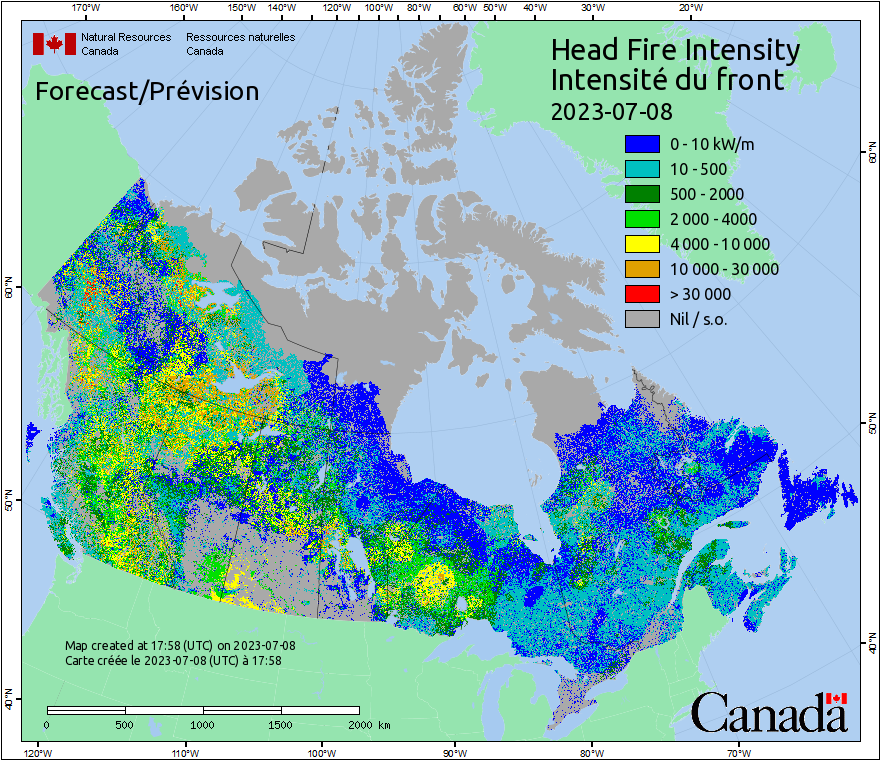
Head Fire Intensity
 
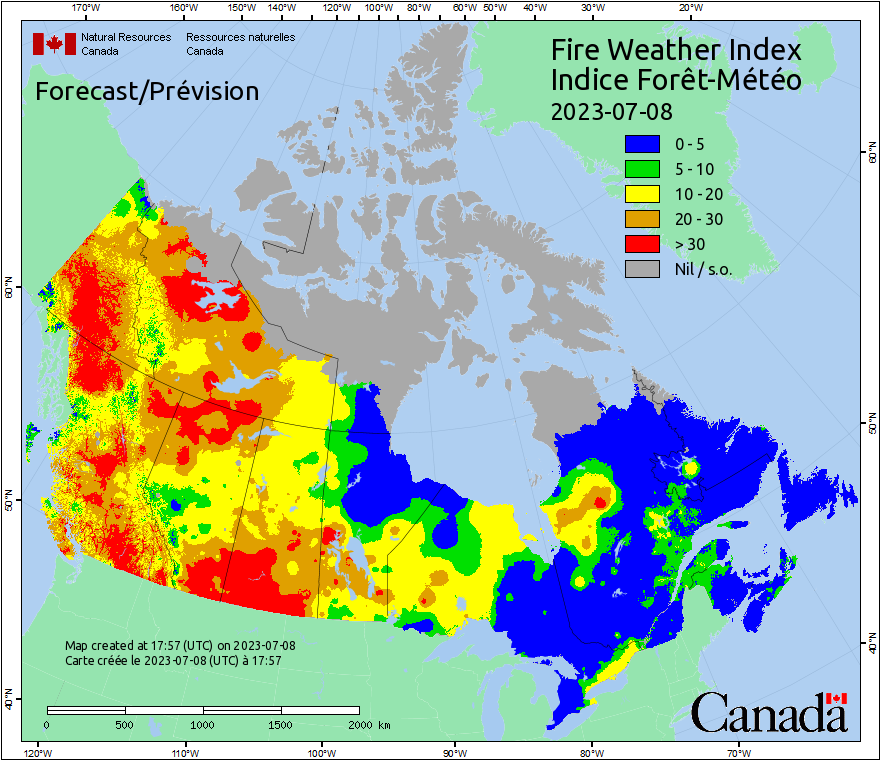
From coast to coast this lamentably unusual year, intense wildfires spread throughout the breadth and depth of the second largest national geographical land mass on Earth. "The risk of forest fires is going to remain very high", director general Michael Norton with the Canadian Forestry Service stated recently. From British Columbia in the West to the Atlantic provinces in the East of the country, Natural Resources Canada speaks of unprecedented wildfires. 
 
Wildfires in Canada's world-precious forests that act as a global carbon sink, have produced huge plumes of smoke, wind-driven far and wide. The intense fires have produced intense acridity affecting air quality from drifting particulate matter in province after province, with shifting winds taking them far abroad to the United States and even to Europe. Total area burned by wildfires in one season by June 27 surpassed the historical record.
 
The 2023 wildfire season is far from over, with 8.8 million hectares so far having been burned as opposed to the previous record of 7.6 million hectares through the entire 1989 season. By July 5 there were 3,412 fires so far this season; while the 10-year average stood at 2,751 fires per season. In 2023, 639 of those fires remain active, 351 of that total in the "out of control" category. 

The evacuation rate has been equally remarkable, with an estimated 155,856 people having been forced from their homes across 132 evacuation orders throughout the country. Historically, Canada's wildfire season runs from April through September, with most activity taking place in July and August. This year's intense fire season began in May and could remain at an intense level until season's end.  El Nino's expected onset could make wildfire conditions even worse.
 
A firefighter in a red jumpsuit with soot on his face stands in smoke near a burning fire in a training exercise.
A recruit works to contain and put out a fire near Merritt, B.C., during a training exercise. Though hard hats and other gear are standard for wildfire fighters, respiratory protection is not. (Ben Nelms/CBC)
 
For the maintenance of ecosystems, wildfires are considered to be a natural phenomenon essential to remove dead vegetation. Some fires are started by humans, but lightning remains the most common wildfire trigger. Close to three in four fires were confirmed this season to have been started by lightning, but hot weather conditions make forests more flammable, making it likelier a fire could result from human activity.
"You're often in smoke. Even on a small initial attack, you're usually breathing smoke."
"When you're 22 and doing it, you don't think about it. But once you get over 30 and you start feeling the burn, it creeps up on you. That I might have to think about this down the road."
"Waking up with a kind of smoke hangover in the morning. When that smoke settles, you're breathing it in all night and you'll wake up with that wheeze and that headache." 
"You're in the forest. You're taking branches to the face. You're wet. You're sweaty. You're hot. And you're out there doing 16-hour days and then you wear something when you're sleeping in your tent at night? Probably not. It's just I don't know if they can really design something for wildland fire."
Ian Sachs, 13-year veteran firefighter, British Columbia
"Unfortunately, there isn't a great standard presently for firefighters that have to work in dynamic fire situations, in wildland and wildland urban interface settings in other places across the globe." 
"There's no real mandatory requirements for proper respiratory protection that filters out carbon monoxide, volatile organic compounds, and these fine particulates that we know are associated to the diseases that are killing firefighters."
"We unfortunately bury too many firefighters because of the diseases they acquire from exposures on the fire ground. We can't put the genie back in the bottle when those exposures happen."
Neil McMillan, director of science and research, Occupational Health, Safety and Medicine Division, IAFF (International Association of Fire Fighters)
In certain areas, high temperatures produce lightning-initiated wildfires because the environment becomes more dry, prompting lightning to trigger and spread fires. Heat causes evaporation from trees foliage and grass, making them increasingly flammable. John Vaillant, an expert on wildfires, points out that 21st century fires are characterized by abnormally hot and fast flames that firefighters find it exceedingly difficult to combat. 
"Over the past seven years, everybody who has been in one of these new severe 21st century fires -- firefighters and civilians alike -- have just been astonished by how fast the flames move across the landscape."
 
Firefighters in red jumpsuits with hoses spray at blackened ground to put out hot spots from a fire. They are surrounded by smoke.
Firefighters with the B.C. Wildfire Service put out hot spots on the McKay Creek wildfire north of Lillooet in 2021. (B.C. Wildfire Service)
 
Government agencies have mobilized 3,790 provincial firefighters along with Canadian Armed Forces personnel helping with airlifts and firefighting action. Equipment is mobilized between provinces by the Canadian Interagency Forest Fire Centre, supporting air evacuations, while evacuees have been hosted by municipalities.

International support has aided Canada in dealing with the wildfires in recognition that this wildfire season has stretched and challenged Canada's firefighting capacity. The number of international firefighters has totalled 3,258 that Canada has called upon, coming from six continents and eleven countries to give assistance over the season's course. 1,754 international firefighters are currently helping in the fight against wildfires in Canada.

There are signed agreements between Canada for firefighting assistance from Australia, Costa Rica, Mexico, New Zealand, South Africa, the United States and Portugal. And they have all responded to Canada's appeal for international help.

Fire Weather Index
 
"Even without the fire, the smoke is already extraordinarily dangerous for their health [older adults, children with asthma, those with breathing and heart conditions]. And you can't even see."
"These fires, the way the smoke billows out of these fires, it turns day into night. You need your headlights on in the middle of the day and you can't even see anyway because the smoke is so thick."
John Vaillant, author of Fire Weather: The Making of a Beast 

Labels: , , ,

Monday, September 20, 2021

An Explosive Spectacular

"When we saw the column of smoke, we thought it could not be real, but it kept growing and we knew we had to get out of there."
"You leave, but you are also looking back because you want to see what will happen."
"Nobody knows how the lava flows will descend, but our plot and lots of houses in the area could be in the way."
Carlota Martín, family agricultural plot, Todoque, downhill from eruption site
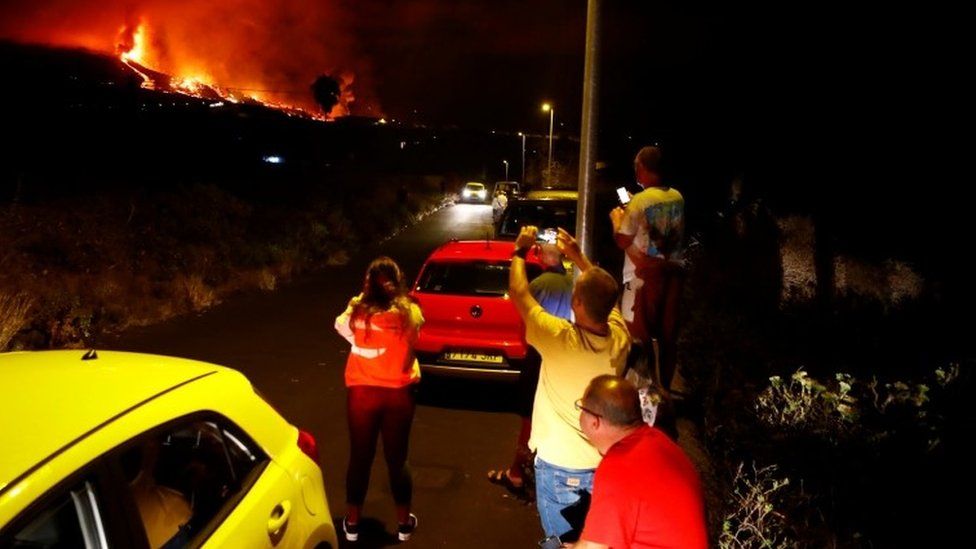
Residents watch lava following the eruption of a volcano in the Cumbre Vieja national park at El Paso, on the Canary Island of La Palma
A 2km (1.2 mile) wide exclusion zone has been set up around the lava flow as it moves down the hillside   Reuters
 
Presaging the Volcanic Eruption: "Instituto Geográfico Nacional (IGN) and Instituto Volcanológico de Canarias (INVOLCAN) reported that a seismic swarm beneath Cumbre Vieja at the S part of La Palma began at 1618 on 11 September and was likely associated with a magmatic intrusion. The swarm intensified in number of events and magnitude, and by 1600 on 12 September a total of 315 earthquakes had been recorded and ranged 8-13 km in depth. The largest event was a M 2.8 (on the Mb_lg scale). On 13 September a scientific committee comprised of representatives from multiple agencies and institutions raised the Alert Level to Yellow (the second lowest level on a four-color scale) for the municipalities of El Paso, Los Llanos de Aridane, Mazo, and Fuencaliente de la Palma. By 0800 on 14 September 2,935 earthquakes had been detected. Larger events were felt by residents during 13-14 September; the largest earthquake was a M 3.9, recorded at 0600 on 14 September. Overall, the events were becoming shallower (8-10 km) and hypocenters migrated slightly to the W. GPS and tiltmeter networks showed deformation totaling 1.5 cm centered over the clusters of epicenters."
Smithsonian Institution National Museum of Natural History Global Volcanism Program
"The island is open. If your hotel is affected, we will find you another one."
"We can make the most of this opportunity. For the many tourists who want to enjoy what nature has brought to La Palma, they can do so in the coming weeks and months."
Spain's Tourism Minister, Reyes Maroto
 
"But now the most amazing thing, which I've never experienced, is that the noise coming from the volcano, it sounds like... 20 fighter jets taking off and it's extremely loud, it's amazing,"
Jonas Perez, local tour guide
 
"I fear further big eruption of the volcano. It's like 200 metres altitude of fire, and then a big river of lava that is going closer and closer to the coast."
"I saw how many houses were covered by lava, and families crying."
"We didn't expect this to happen now. I was walking near the volcano when it explode[d]. I didn't expect it. This is amazing."
Sergio Sarti, island resident 
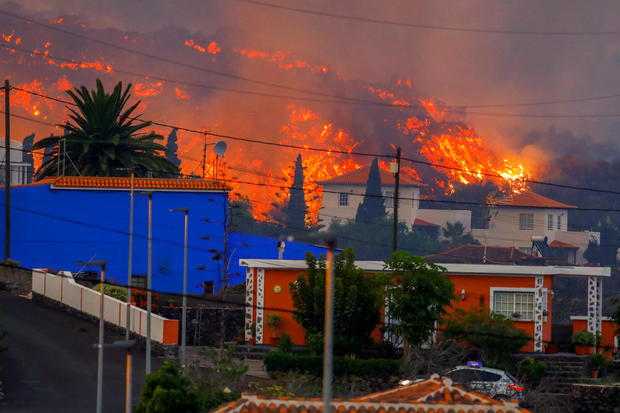
Lava flows behind houses following the eruption of a volcano in Spain
Lava flows behind houses following the eruption of a volcano in the Cumbre Vieja national park at Los Llanos de Aridane, on the Canary Island of La Palma, September 20, 2021. BORJA SUAREZ/REUTERS

Vacationing tourists were witness to quite the spectacle of nature with the eruption of a volcano in the Spanish Canary Islands. Some were only too anxious to be flown out and away from potential danger others were happy to view the fires blazing in the sky, the red-hot trails of lava inexorably wending their way down the volcano, into hillside towns on their way to the sea. That Spain's tourism minister saw fit to hawk the eruption as a tourist draw would surely not sit well with the thousands of residents who had to be evacuated, most particularly those who have lost their homes.
 
Nothing could possibly survive the lava's encroaching passage as it rolled downhill with no earthly power capable of stopping it. As a mayor of La Palma observed, nothing escaped its path, and there was nothing left as it passed. "The lava left absolutely nothing in its path," local mayor Sergio Rodriguez told Spanish broadcaster TVE, and nor would residents be returning to their homes any time soon ... which is to say those homes that escaped the lava's path.
"When the volcano erupted today, I was scared. For journalists it is something spectacular, for us it is a tragedy. I think the lava has reached some relatives' houses."
"I was five years old when the volcano last erupted [in 1971]. You never get over a volcanic eruption."
Isabel Fuentes, 55, local resident
Authorities lost no time evacuating the infirm and some farm animals from villages on a wooded slope, anticipating the eruption which blew at 3:15 p.m. in the sparsely populated Cabeza de Vaca area. When two hours passed, lava rolling down the hillside from five fissures that had been torn into the hillside, the evacuation of four villages was ordered. Nighttime video footage showed fiery fountains of lava blazing hundreds of metres into the sky, leading to incandescent orange rivers of molten rock creepng downhill.

The fiery lava tore raw open gashes into forests and farmland, ravishing everything in their path, spreading and engulfing all in before them, as they neared lower ground. A single stream of lava, several hundred metres in length and tens of metres width-wise, crossed a highway, then began to engulf houses scattered in El Paso. Spain's Civil Guardia helped to evacuate between five and ten thousand people. 
 
"In no circumstances go near the lava flow. If there is volcanic ash, stay in your houses", residents were cautioned by municipal authorities.


Smoke billows as lava flows next to houses on La Palma, part of the Canary Islands. (Borja Suarez/Reuters)


Labels: , , , ,

 
()() Follow @rheytah Tweet