Ruminations

Blog dedicated primarily to randomly selected news items; comments reflecting personal perceptions

Thursday, June 05, 2025

Canada's Gross Mismanagement Under Trudeau Liberals : OECD

"Rapid population growth has exacerbated previous housing affordability challenges. Housing supply should keep pace with immigration targets."
"The skill composition of recent immigration, which included many students and temporary workers, has also likely reduced average labour productivity."
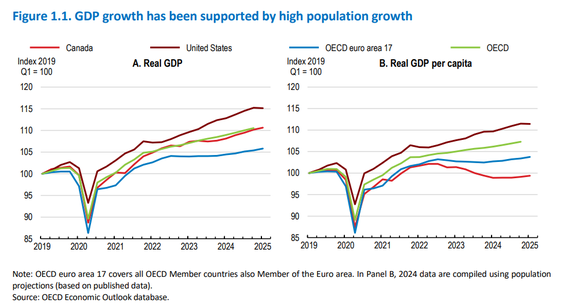
"[Canada's] GDP per capita growth has lagged in recent years, particularly compared to its close neighbour, the United States."
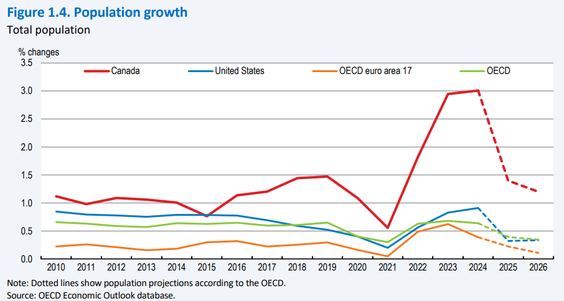
"Canada's population grew rapidly, by 3.0 percent in 2023 and 2.5 percent in 2024. This is much faster than in other OECD countries such as the United States or countries in Europe." 
Organisation for Economic Co-operation and Development (OECD) 
https://i.cbc.ca/1.7550745.1748957910!/fileImage/httpImage/image.JPG_gen/derivatives/16x9_1180/usa-trump-tariffs-canada.JPG?im=Resize%3D780
A Canadian flag is shown near the GM Oshawa assembly plant in Oshawa, Ont. (Carlos Osorio/Reuters)
 
A group of 38 countries representing the developed world, the OECD conducts a comprehensive "economic survey" of each of its members, produced by economists from within the OECD every two years, presenting the completed survey to the member-country for its edification. In the latest issue of its survey for Canada, the report was anything but flattering to the way in which the Canadian government under the Liberal Party under the leadership of its former prime minister Justin Trudeau had governed the country. Under that leadership productivity suffered; openly excess immigration resulted in a crippling of the country's universal health care system, and its unaffordable housing stock, all the while doing its utmost to conceal from the Canadian public the state of economic growth in Canada.
 
The most recent survey presented to Canada placed a particular focus on housing, goods affordability and worker productivity, areas where the  country now ranks with the developing world's most laggardly. Record high immigration was singled out for its effect on worsening the problems. Canada, warns the OECD, has accepted millions of new immigrant workers into its labour force, lacking comparable increases in "productivity-enhancing investment". The stagnant economy that has resulted relates to workers in Canada receiving an increasingly short share of the economic pie in total.
 
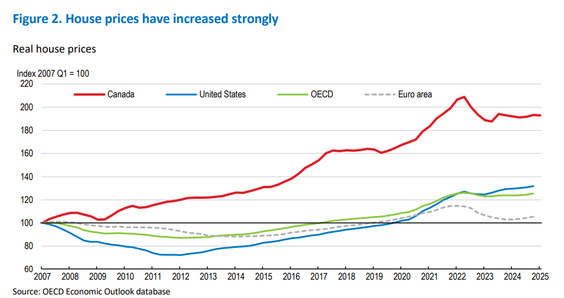
Canada's previous immigration intake system prioritized high-skilled immigrants in professions such as medicine and engineering. In contrast, migration flows now are mostly comprised of low-skilled workers. Statistics have indicated that Canada has become an outlier on housing affordability, placing in the OECD's most recent tally of "price to income" ratio the regrettable situation that identifies Canadian housing to be the highest of all member states other than Portugal. 
 https://smartcdn.gprod.postmedia.digital/nationalpost/wp-content/uploads/2025/06/OECD2.png?quality=90&strip=all&w=564&type=webp&sig=PdIy5cUuZRlUsnRwG28YCQ
 
In OECD rankings of gross-domestic-product growth per capita, Canada has been identified as one of the worst performers over the past ten years that correlate with the governance of the Trudeau Liberals. For comparison, GDP growth per capita from 2014 to 2022 was close to three times higher than Canada's in the United States, at 1.7 percent. A note of optimism appeared in the report in its summary with the declaration that Canada's economy is "resilient", endowed with "robust public finances".
 
Canada's immigrant intake represented a million newcomers absorbed annually. In 2022 the Canadian population was about 38.5 million; three years later it stands at 41.6 million, increased by over three million, judged to be some six times faster than its peers in the OECD where in 2023 the average OECD country grew by 0.5 percent, in comparison.  The report confirms as well a phenomenon Canadian analysts have warned of since 2023: that Canada has been in a "per capita" recession for several years.
 
https://smartcdn.gprod.postmedia.digital/nationalpost/wp-content/uploads/2025/06/Screenshot-2025-06-03-023321.png?quality=90&strip=all&w=564&type=webp&sig=S3iGMGaFatEQojCdVa08-w
This worked out to about one million newcomers entering Canada each year. At the beginning of 2022, the Canadian population stood at about 38.5 million. Now, it’s at 41.6 million, an increase of more than three million.
 
While the injection of three million people appeared to increase GDP, given their impact on the economy paying rent, buying groceries and thus contributing to the amount of money circulating within the economy, on an individual basis the reality is that the average Canadian's wealth and purchasing power has been notably dropping. When ranked by "real GDP per capita", Canada's economic performance falls behind dramatically. The subtitle of the report aptly reads: "GDP growth has been supported by high population growth".  
"Inflationary pressures from higher tariffs will require a more cautious approach to lowering interest rates."
"Increased government spending, particularly on housing affordability and new social programs, has recently worsened the general government balance, although it had previously been in surplus." Organisation for Economic Co-operation and Development 
 https://smartcdn.gprod.postmedia.digital/nationalpost/wp-content/uploads/2025/06/OECD3.png?quality=90&strip=all&w=564&type=webp&sig=_B2YulCp7VEocKgR66TLzQ


Labels: , , , , , ,

Thursday, December 31, 2020

How're We Doing?

"Most people had assumed there would be a trade-off between health and the economy; that if you imposed restrictions to limit the virus's spread and keep deaths down, your economy would be hurt -- and the tougher the restrictions the worse for the economy."
"But not so. Countries that imposed restrictions early and severely, keeping deaths per million low, also had a low decline in GDP."
"By contrast, countries that applied restrictions haphazardly, letting deaths reach high levels while hoping to protect jobs, had among the biggest declines in GDP."
"It turns out the best economic policy was successful aggressive action to limit COVID's spread."
George Fallis, professor emeritus, economics and social science, York University, Toronto

Sweden had decided on the advice of their chief medical officer of health, not to impose  restrictions on its population, hazarding the belief that Swedes would behave sensibly, following basic guidelines of a level of social distancing and protective hygiene. Swedes for the most part, acted accordingly, and voluntarily limited activities while they went about their normal lives and trusted that their government's reliance in their population's good sense would lead to a better outcome than that of their neighbours who had gone in the opposite direction; lockdowns.
 
eople walk near a trash can with a sign reading
People walk near a trash can with a sign reading “The danger is not over — Keep your distance” in Uppsala, Sweden, in October. Photo by TT News Agency/Claudio Bresciani via Retuers files
The lack of formal restrictions in Sweden led to a large number of deaths early on, and the situation        failed to improve as time wore on. Swedish politicians were determined to forge ahead with no restrictions on trade and business; the idea was to proceed as normal; perhaps not taking into account in their deliberations that with their largest trading partners -- their neighbouring states -- closed down, the faltering economy that hit their neighbours would also impact on them. In the end, they gained nothing and lost more lives than did their neighbours.
 
High-income advanced economies with reliable health-care systems represented by 20 OECD countries came out of their ordeal with the global pandemic with mixed results. Using Canada as an example, its government faltered in initial decision-making, fluctuating between cautious instructions to its population, to eventual lockdown after downplaying the emerging seriousness of the SARS-CoV-2 virus that causes COVID-19. The federal government's attitude toward securing its borders was lax, it denied the usefulness of mask-wearing, instead championing testing, tracing and isolating.
 
Pedestrians in downtown Toronto during the start of the city's second lockdown in November.
But even these practices were poorly executed in comparison to the take-up rate of their counterpart nations in other OECD countries. One thing all countries had in common, however, despite their modern, technically advanced economies and excellent health-care systems, was unpreparedness. Along with a critical lack of PPE and other related hospital-medical equipment. This, despite more than ample warning that just such a threat as a global pandemic hovered on the near horizon. This, despite that SARS-1 had proven itself to be a deadly virus the world handled poorly, offering a lesson in the necessity of proactive preparation.
 
The first entry of the novel coronavirus took the world by surprise as it swept through the globe following its initial emergence in Wuhan, China. Which Beijing initially played down, giving inadequate and incorrect information to the WHO, delaying the declaration of a pandemic. The world looked on, fascinated and disbelieving as China then took draconian measures to cope with a dread new virus with the intention of isolating the infection and stopping its spread. Despite which COVID appeared to experience little trouble escaping the boundaries set up to contain it as it spread virulently.
 
When the winter of 2020 merged into spring, it began to appear as though much of the world had succeeded in controlling the spread of COVID, and restrictions that were imposed were relaxed while the number of cases dwindled and a sense of optimism prevailed. Until the Northern Hemisphere entered fall, then winter and the fearsome second wave of infection re-entered. Monetary stimulus, support for businesses and workers were activated by governments even as GDP shrank and the death count rose. 

Some countries had moved expeditiously and severely to limit the first wave while others struggled to contain that huge entry of infections, with mixed results. South Korea as an example experienced a mere 4.4 percent decline in GDP, with eight deaths per million population, while the U.K. took a 21.8 percent decline in GDP, and suffered 595 deaths per million. It was soon realized that those countries with the largest GDP decline experienced a larger bounceback with the mid-year decline of COVID infections.

Austria Denmark, Finland, Germany, South Korea, New Zealand, Norway and Switzerland experienced a smallish decline in GDP and a lower death rate per million, while Belgium, Italy, Spain and the United Kingdom were hit much harder in both metrics. On the other hand other countries came off better in one metric and worse on another; France, Ireland,Netherlands, Japan, Sweden and the United States. Among these countries many committed errors in judgement, now facing a larger second wave of cases.

European countries -- in particular those that performed poorly during the first wave and lockdowns, have faced distinctly high daily death rates due to COVID-19. Severe lockdowns were re-instituted by early November and in some countries daily deaths are on the decline, while others remain struggling with ongoing high death counts. Austria, Belgium and Switzerland's death rates have been horrifically high. But it is in the United States where throughout the nine months of the coronavirus onslaught its spread was never brought under control, resulting in ongoing daily death rise surpassing levels seen in the first wave.

Those countries that realized partial successes in controlling the coronavirus are continuing to perform well at present, including South Korea, Japan, Norway, Finland and Denmark, where death rates have been kept at a relatively low rate. Australia and New Zealand are stand-outs for their success in avoiding a second wave entirely. What has been proven to be highly successful is a protocol of strict lockdowns maintained until low levels of cases are realized, then held there with tighter border controls. Testing-tracing-isolation regimes on a large scale has become a tool of necessity.


Labels: , , , , , , ,

 
()() Follow @rheytah Tweet