Female Indigenous Victims of Male Violence
"[The IJB's findings reflect] important systemic problems [that impact the outcomes of cases involving female Indigenous victims].""If police don't see the life [of Indigenous girls and women] as being as important ... how does that affect how they collect the evidence that goes before the prosecutor? Or a prosecutor says, 'I'll take a guilty plea to manslaughter so we don't have to clog up the courts with three months' or two months' worth of trial time.""We Indigenous women, for the most part, live in the margins -- in the shadows. Our lives just simply aren't as valuable as other people's lives."Lawyer Marion Buller, former judge, elder, Mistawasis Nehiyawak First Nation
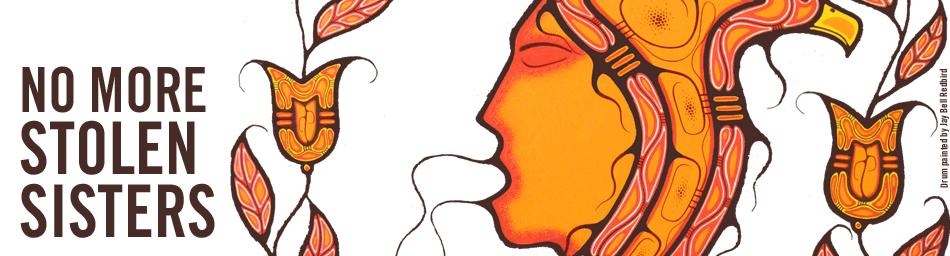
According to the Investigative Journalism Bureau [out of University of Toronto], Indigenous women and girls are killed far more frequently than other women in Canada by their intimate partners, perpetrators of murder, yet they are all too frequently convicted of lesser offences than murderers of non-Indigenous women. In their research the IJB concluded that in virtually all instances of the deaths of Indigenous women, the victim was familiar with her killer.
There were 1,329 identified cases where women and girls died under suspicious circumstances in Canada between the years 2019 and 2025. Of that total, 25 percent -- 340 victims -- were Indigenous. Of those, 46 percent concluded in court with a finding of manslaughter (lack of intent to kill); the most common outcome in Indigenous female homicides. The single most common outcome in the deaths of Indigenous females is deemed to be manslaughter with its lesser criminal penalties.
 |
On the other hand, of the 384 court cases involving non-Indigenous victims 24 percent concluded with a verdict of manslaughter. Second-degree murder, the outcome in 137 or 36% of cases was the most common conclusion which carries a minimum sentence of ten years, while manslaughter comes with no minimum sentence in the absence of a firearm.
"When you look systemically ... lives and their health and their safety are not valued as highly. It is something that should cause further inquiry", noted Michael Spratt, Ottawa criminal defence lawyer. Several unusual characteristics were revealed by the IJB analysis in the manner in which the Canadian justice system manages meting out justice in cases of Indigenous female deaths. First-degree murder which carries a mandatory life-sentence represents the most serious charge in the country's justice system.
Yet a mere 25 percent of the accused in the deaths of Indigenous women and girls were charged with first-degree murder. In contrast, first-degree murder charges were laid in instances of non-Indigenous female victims, at the rate of 37 percent. Further, 64 percent of cases in the killing of an Indigenous woman conclude with a plea bargain, in comparison to 57 percent of non-Indigenous victims.
A plea bargain results in 64 percent of cases when an Indigenous woman is killed, in comparison to 57 percent with a non-Indigenous victim. Reasons? The Indigenous community is over-represented in the Canadian justice system, far exceeding their share of the population, both as victims and as perpetrators, affirms Statistics Canada. This over-representation has led to the justice system creating a special category for Indigenous offenders, one that takes into account their status as Indigenous people who have suffered discrimination, poverty, disproportionate lack of schooling and troubled childhoods.
A Jordan principle is applied that takes all these issues into account, citing as well the circumstances of Residential Schools in operation for a century, where children were separated from their families to be taught a curriculum that deliberately sought to introduce students to the Western European way of life, muting their Indigenous roots, culture and language in favour of the children adapting to general life in Canada. Out of these schools came students who could aspire to higher education and life in the professions. At a cost of root self-identification.
The courts and the entire criminal justice system adjusted to treating Indigenous offenders more lightly than criminal cases involving non-Indigenous, and that extended to cases of serious criminal offences like murder. "[Perpetrators] know they're not going to get anything (punishment for ill deeds). And the reason is that the justice institution has failed us", states Ann Maje Raider, executive director, Liard Aboriginal Women's Society, Yukon, responding to a perception of greater leniency around the deaths of Indigenous women exacerbating the problem.
IJB's database illustrates that almost all -- some 97 percent -- of female Indigenous victims were killed by someone they knew. Although the figure is 90 percent for non-Indigenous victims, their killers are treated to a harsher, more appropriate penalty for their crimes. Available histories of accused in Indigenous crimes revealed that 94 percent were red flagged for previous arrests and convictions, contact with child services or significant mental health problems.
Remote areas such as reserves see restraining orders ineffective in maintaining a separation between victim and perpetrator. As a result, Indigenous women and girls face unusual and difficult challenges to self-protection from violence. Access to resources and shelters is limited or non-existent. The risk of community response when women and girls speak up about their fears and the violent abuse they are exposed to risks alienation from a disapproving community.
Indigenous women speak up, complaining about their vulnerability and faulting a justice system that too often fails them. They can carry signs that read "Where Are My Sisters", as they did in 2023, during the International Day of Action Search the Landfills for missing and murdered Indigenous women, but there are no organized protests by these women placing the blame on their 'Brothers' from within the Aboriginal community who prey on them, nor do they campaign for the responsibility of their communities to protect them.
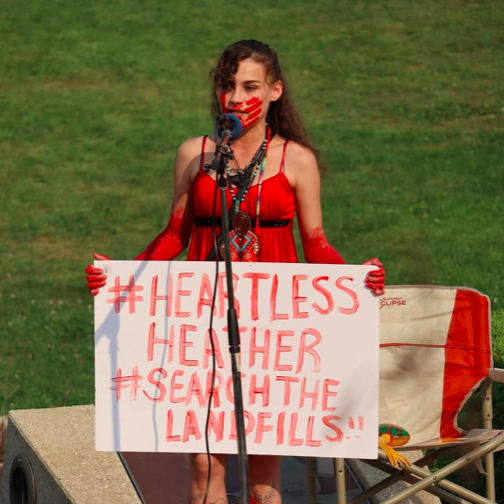 |
| Summer 2023: Winnipeg’s Cambria Harris addresses a rally calling for the Manitoba government to walk back its refusal to search two local landfills for the remains of her mother, Morgan Harris, and two other Indigenous women allegedly murdered by a serial killer. (Photo credit: Melissa Robinson) |
Labels: Aboriginal Reserves, Criminal Justice System, Indigenous Female Murders, Light Sentences for Male Murder of Female Victims, Remote Indigenous Communities
posted by Pieface @ 8:05 PM


0 Comments:
Post a Comment
<< Home