Ruminations

Blog dedicated primarily to randomly selected news items; comments reflecting personal perceptions

Sunday, February 15, 2026

New Zealand's Dilemma

"It's difficult to see what more could've been done. [Tarrant] is an unreliable witness and his narrative should be treated with caution."
"Pleading guilty to charges where his guilt is certain can't be seen to be irrational."
N.Z. Crown lawyer Barnaby Hawes 

"I very distinctly remember that I left court after the sentencing thinking 'Right, the trauma chapter is now closed, time to heal, time to focus on your own mental well-being', but then it pops up again and again,"
"It will be just an image [on-screen image of the mass murderer] that I am looking at, because he means absolutely nothing to me at this stage."
"I suspect one of his main motivations to do this is to open up traumas again and I won't let him succeed in doing that - he just wants his limelight and to be relevant again."
"He took the right of life of my brother and 50 others, and then we're going to sit through now and talk about the legal arguments of his right to appeal."
"When you place those two together, they are morally not comparable."
Aya al-Umari, who lost her older brother Hussein in the attack on Al Noor mosque  
Three police officers stand in front of the court
Extraordinary arrangements are in place in Wellington as a convicted terrorist addresses the country's Court of Appeal. (ABC News: Che Chorley)

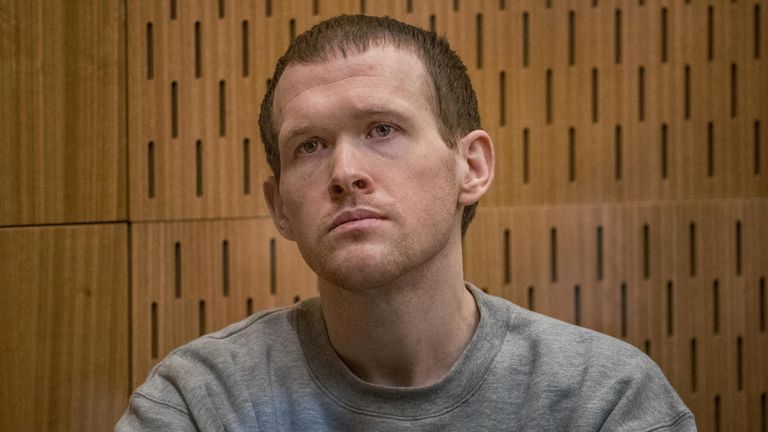
Brenton Tarrant in court in 2020. Pic: Reuters
Brenton Tarrant, 35
"I did not have the mindframe or mental health required to be making informed decisions at that time."
"I think the issue is, did I really know what I wanted to do or what would be a good idea?"
"No, I didn't actually ... I was making choices, but they were not choices made ‍voluntarily and they were not choices made rationally due to the [prison] conditions."
Brenton Tarrant, white supremacist, New Zealand mass murderer  
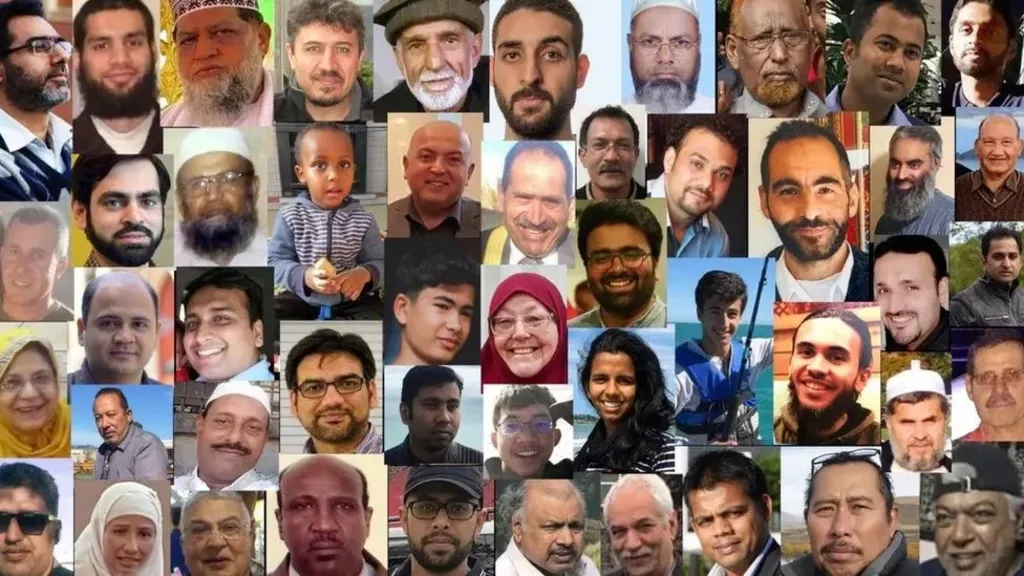
Originally from Australia, the self-professed white nationalist of 35,went to New Zealand for an express purpose in 2019. He planned to acquire weapons and to attack mosques for the purpose of killing as many Muslims as he could manage. And he succeeded to a monstrous degree, taking the lives of 51 people at two mosques, including those of children, women, the elderly and an assortment of other New Zealand Muslims, some there to study or to pursue professions, others having arrived as refugees to settle in a place of haven where they thought they would be safe from violence.
 
At the time of his attacks of the two mosques in Christchurch, he livestreamed the massacre as it was ongoing, filmed his face as he proceeded to mow down people at prayer, leaving overwhelming evidence of his guilt. "Keeping this case alive is a source of immense distress" to the victims of the atrocity, pointed out Crown lawyer Madeleine Laracy. "It doesn't allow them to heal."
 
Serving life with no chance of parole, Tarrant is appealing his sentence earned by his cold-blooded, planned and prosecuted murder of 51 people, claiming that it was not his intention to plead guilty, having done so was "irrational", but circumstances induced him to do so by solitary and austere prison conditions. In response to his move to have a retrial, and despite that experts ruled Tarrant was fit to enter pleas, Crown lawyers opposed his appeal, given no evidence existed or claims he was seriously mentally ill.
 
Lawyers on either side, those who supported and those opposing his sentence appeal, studiously skirted making mention of his white supremacist views, the topic avoided during the week-long hearing where no mention was made of the hate motivating Tarrant's crimes that he cited as reason for committing the massacres.
 
New Zealand's courts were fully engaged in suppressing the racism that led Brenton Tarrant to commit mass murder. He had made reference to other massacres committed by perpetrators of mass murder that he admired and in fact emulated, before  his own horrendous attack. A legal ban was instituted on his racist manifesto as well as the video he livestreamed at the time of the shooting. 
 
In deciding to recant his guilty pleas, a three-judge panel in Wellington at the Court of Appeal hard final arguments by Crown lawyers opposed to the application to have his admissions to charges of terrorism, murder and attempted murder in 2020 discarded. Should he be allowed to revoke his guilty pleas, the case would return for a full trial in court.
 
The appeal bid was revealed before nine reporters, nine lawyers, a few court staff and an empty public gallery, with the intention of the court seeking to limit public exposure to Tarrant, his views and his motivation; no one permitted to view the evidence as the appeal bid unfolded. The incarcerant's image was not visible in the courtroom other than when he gave evidence while he watched the proceedings by video conference from Auckland Prison. 
"What happened in New Zealand, it was unprecedented and at every point we've had to create new methods to deal with the situation."
"We're learning as we go." 
"You do need to have some kind of objective transparency, where the person who is accused can be seen and some of what they are saying can be heard," he said.
"But at the same time, you've got to make sure that the platform they're given is not hijacked for other purposes."
Waikato University professor of law Alexander Gillespie  
https://ichef.bbci.co.uk/news/1024/cpsprodpb/412e/live/4cc2fa00-0341-11f1-b5e2-dd58fc65f0f6.jpg.webp
 New Zealand mosque assaults victims BCC
 

Labels: , , , , ,

Friday, December 09, 2022

The Vaccine=Disaffected

"[The baby's parents believed there were] spike proteins in the blood of people who have been vaccinated and that these proteins were causing unexpected deaths relating to transfusions. In Baby W''s best interests [the court will take temporary custody."
Judgement, Justice Ian Gault
 
"[The New Zealand Health Service decisions are] always made with the best interests of the child in mind." 
"We acknowledge the decision made by the court, following our application in relation to the baby's surgery and recognize this is a difficult situation for all involved."
Dr. Mike Shepherd, Auckland's interim director of the New Zealand Health Service 
Anti-vax demonstrators supporting mother and father of a four-month-old baby that urgently needs a heart operation demonstrate outside the High Court in Auckland, New Zealand, Tuesday.
Anti-vax demonstrators support the mother and father of a 4-month-old baby outside the High Court in Auckland, New Zealand.   AP

The parents of a six-month-old baby boy, referred to as "Baby W" in court, have refused to allow doctors to operate on their child unless a needed blood transfusion could be guaranteed to come from an unvaccinated source. Cole Reeves, the baby's father, stated that he and the baby's mother, Samantha Savage, refused to permit their child to receive "any blood other than blood that did not contain the Pfizer vaccine, mRNA, the spike protein or any other associated contaminants".

They firmly believed that spike proteins circulating in the blood of those who had been inoculated with mRNA vaccines such as the Pfizer0BioNTech or Moderna vaccines were "causing unexpected deaths related to transfusions", conveying this information to health-care workers at Starship hospital in Auckland where their baby son is being treated.

Baby W was diagnosed with a congenital heart defect requiring surgery for him to survive the condition. He remains in urgent need of an operation, and "every day that the operation is delayed his heart is under strain", noted the court order, citing one of his doctors' explanations. The New Zealand High Court took official custody of the baby to circumvent the parents' demand, preventing doctors from performing the child's life-saving surgery.

Doctors at the hospital responded to the parents' demand explaining that making use of blood donated from outside normal channels was "impractical" for the situation. Performing the surgery without donated blood was "not an available option". An explanation that failed to satisfy the parents. And since the surgery's urgent nature to preserve the child's life was paramount despite the parents' ongoing objections, Judge Ian Gault ruled that "in Baby W's best interests" the court would take temporary custody of the baby until surgery took place.

Until the baby recovers from surgery and no later than the end of January, the child would remain under the court guardianship. The needed surgery is estimated to require 48 hours to bring to completion. Under the court ruling two doctors were appointed as Baby W's legal representatives to enable consent to surgery. The baby's parents were appointed for "all other purposes" as his legal representatives in the interim. 

The parents had been "distressed? on an earlier occasion in October when they discovered during a medical procedure that the child had received blood. In future, an alternative was requested by them, since they refused to have their child receive "any blood other than blood that did not contain the mRNA spikes"  
 
Late, the distressed parents appeared on Infowars, a podcast that notorious conspiracy theorist Alex Jones hosted. He was recently held liable in a court action for misinformation denying the 2012 mass murder at a Sandy Hook school in Newtown, Connecticut.


Labels: , , , ,

Tuesday, October 05, 2021

Confronting Delta in New Zealand

"At the moment, it's not totally beyond hope that New Zealand could control its new cluster, but the odds are against it"
"In a very short space of time, they could be trying to slow the spread and flatten the curve just as Britain was more than a year ago."
"All power to New Zealand for keeping deaths so low, but the issue is that if your policy fails and you haven't got anything else in place, it will be as bad as if you had let it rip right from the start. New Zealand could find all the sacrifices of the past year wasted if they do not get their population immunized quickly enough."
Paul Hunter, professor of health protection, University of East Anglia

"The government is realizing it can't go another year without opening up, but it can't do that without a high level of vaccination and societal license."
"It's a lot easier to lock down than to open up."
"Meanwhile, the tech sector is crying out for high quality labour that can't get into the country, and the hospitality sector is crying out for imported labour. These sectors are hurting and they can't take advantage of New Zealand's position."
Sir Peter Gluckman, former chief scientific adviser, director of the Koi tu Centre for Informed Studies, New Zealand

"Early on in the outbreak, New Zealand was a great example of how you could deal with the virus through lockdowns and social distancing."
"We have to accept that now we've moved on from that. It's incredibly difficult to secure your borders forever, and the only thing New Zealand is left with is vaccination, otherwise they are pretty much fighting a losing battle because you are always going to have the virus knocking on your door."
Professor Jonathan Ball, expert on emerging viruses, University of Nottingham
Wellington, New Zealand, during lockdown last week.
Credit...Hagen Hopkins/Getty Images
New Zealand, as of a number of countries able to defend themselves from the onslaught of the SARS-CoV-2 virus that causes COVID-19, because like them, it represented a castle with a watery moat surrounding it for defence purposes, cloistered itself from the potential of infection from outsiders, with closed borders. There was no emphasis on inoculating its population against the infectious virus, only keeping it at bay, until presumably, it would 'give up' and 'go away'. But it never did, and was highly unlikely to do so, in its ongoing revisiting of previously successful countries suddenly assailed by a more virulent strain of what they had previously evaded.

So few New Zealanders have been vaccinated against COVID, an estimated 80 percent, not inoculated, are now vulnerable to the hugely infectious Delta strain doing its geographic rounds and successfully leaving an island nation suddenly finding itself confronting the variant. There is no demographic which had been naturally exposed to COVID with useful antibodies against re-infection, much less the greater numbers susceptible to infection, never vaccinated. The island has become a proverbial sitting duck.

Scientific circles now look in on the dilemma facing the country with the plunging popularity of its Prime Minister, Jacinda Ardern, now on the horns of a predictable dilemma. So confident in locking away the island from outside infection it was thought by the country's medical authorities that there would be no need to inoculate the public against a virus whose presence would be receding. Only, of course, that's not what happened; the virus has come roaring back in a more infectious variant.

Ardern saw no help for it but to once again re-impose another lockdown; no longer is New Zealand     COVID-free. Not that it has yet been completely overrun with cases, they're still in low numbers albeit rapidly advancing. Yet on the other hand, to remain in isolation is to ensure that its declining economy has nowhere else to go but down, and yet further down, its surpluses enjoyed in the years before COVID now a dim memory.

In its favour still, is that it is an island with natural protection afforded by surrounding seas, that it is  relatively sparsely populated, that a start has been made on inoculation, with confidence that by the end of December the majority of New Zealanders will have been vaccinated. The concern remains, however, that despite its tiny death toll resulting from the past year-and-a-half's protective measures the future may reveal some unexpected turns with deaths in the thousands reflecting its over-reliance on isolation and lack of focus on vaccination.

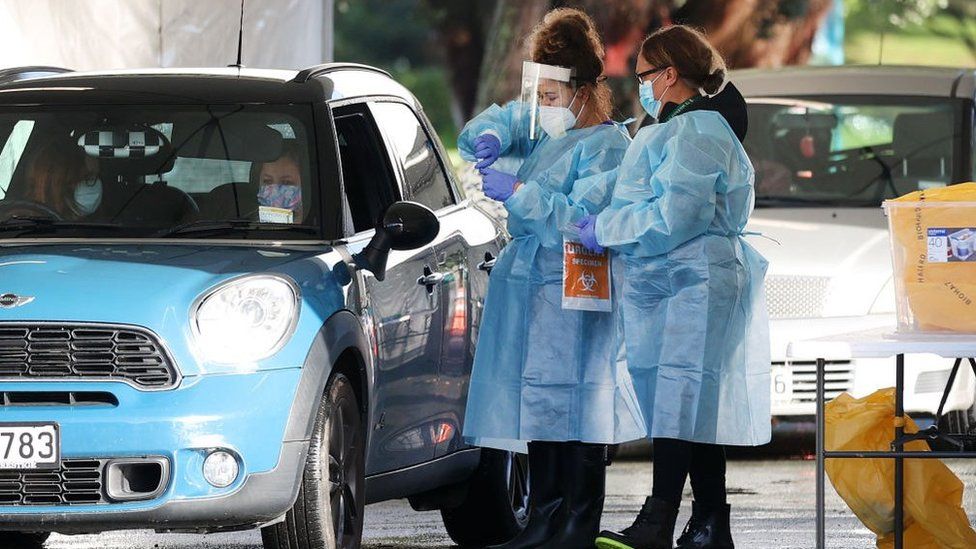
Testing at a car park in Auckland
New Zealand is grappling with increasing COVID infections   Getty Images

Labels: , , , , ,

Wednesday, March 18, 2015

The Trans-Pacific Partnership (TPP)

"This year, Canada contributed $500-million to the replenishment of the Gavi Vaccine Alliance's fund. Canada is also one of the leading donors to the Global Fund to Fight AIDs, Tuberculosis and Malaria, which has provided antiretroviral therapy to over six million people living with HIV in developing countries."
Stephen Cornish, executive director, Doctors Without Borders Canada

"Now, thanks to a retroactive examination of the usefulness condition -- established in 2010 by the Canadian Federal Court of Appeals -- a patent must meet heightened requirements for usefulness. "
"...This look[s] like industrial policy for Canadian generic drug producers who now can receive the unpatented formula at no cost once the patent is revoked [due to the 'Promise Doctrine' where patents under Canadian law must perform the action they promise to do]."
"...Innovative pharmaceutical companies suffered more than $1.1-billion in lost sales from the premature termination of patents in Canada."
Michelle Wein, trade policy analyst, Information Technology and Innovation Foundation, Washington

"The U.S. should drop its demand in the Trans-Pacific Partnership talks that its trading partners respect a rule giving the American pharmaceutical industry 12 years of exclusive rights to its patents. Even Europe allows shorter time spans."
Caroline Freund, The Japan Times


 TPP Member Fact Sheets

Ah, Hawaii, a lovely place to visit, particularly by those who live in northern climates. It's one of Barack Obama's favourite getaways, nostalgic for the past, isn't it? And it is there that closed door negotiations have been taking place in a hotel where representatives of a dozen countries are working on hammering out a collective trade agreement that will impact the lives of an estimated 800 million people, representing 40 percent of the global economy.


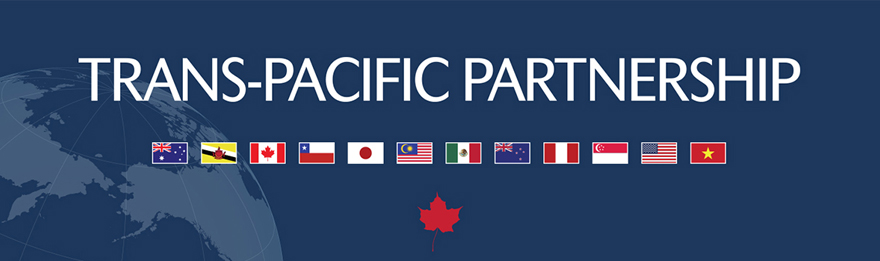
Image above: From (http://hawaiiindependent.net/story/whats-in-the-leaked-tpp-chapter).

Ten Pacific Rim countries as well as the United States and now Canada are in negotiations for a final agreement to consolidate the collective trade agreement known as the Trans-Pacific Partnership (TPP).  The partnership members also include, Australia, Mexico, New Zealand, Japan, Peru, Chile, Malaysia, Singapore, Vietnam and Brunei Darussalam. And all of these countries are anticipating that this partnership will be of immense export-trade value to them all.

The issues under discussion range from government procurement, investment, intellectual property, services, dispute settlement, goods, trade and environment, all the way to the really contentious issue of governments providing subsidies to protected industries in for example, agricultural production or manufactured goods. Take, for example, the U.S. where President Obama wishes Congress to grant him authority to fasttrack the TPP on his own initiative.

Something like his personal decision as chief of the executive branch of government in the U.S. to decide to veto the XL pipeline, reflecting his personal distaste for Canada's "dirty oil", his decision paying homage to many of those who brought him to public office at the highest level; to name but one constituency: environmentalists. Of course electing a president of the United States is a costly affair and there were also others instrumental in funding his presidency campaign.

One of the critical issues at stake in the TPP agreement being worked on coming courtesy of leaks from the TPP draft text is that some governments are angling to dismantle public-health safeguards reflecting international law, to extend the time limits permitting brand-name medicines' protection under patent. The effect of such extensions would result in monopolistic protection, ensuring that generic drug manufacturers must wait longer to produce less expensive versions of the patent-protected medicines.

The cost of immunizing a child with World Health Organization recommended vaccines has grown 6,700% since 2001, according to Doctors Without Borders. Stricter intellectual property rules the TPP is negotiating are guaranteed to further limit competition by maintaining artificially high prices, thus keeping these life-saving vaccines out of reach of those who most need them. Generic competition levels the price-field, ensuring all who need these drugs a better opportunity to obtain them.

Donor-supported global health institutions along with Doctors Without Borders have a heavy reliance on affordable, quality generic medicines to enable them to  fulfill 85% of their programming for health-provision initiatives. Proposals by the United States and a few other countries in the TPP could limit the effectiveness of these humanitarian organizations' programs, diverting resources from patient care where it is most needed.

Drug expenditures in Canada have been steadily growing in the last 25 years, consuming an ever-greater portion of tax dollars in health care. Prescription drug costs have doubled from the mid-1980s to 2012. Canada and other countries are actively opposing some of the most potentially harmful provisions in the TPP agreement.

A petition at www.msf.ca/tpp calling on Canada to resist pressure and stand up against the U.S. move to prolong patent monopolies for years, has resulted in over 32,000 signatures. It would be most unfortunate if the Trans-Pacific Partnership agreement resulted in passage of the move by the United States to protect its pharmaceutical industries' bottom line. The long-term harmful impact on people who rely on less expensive, reliable versions of drugs they need to continue life, would be immeasurable.

This would deleteriously impact affordable health care in all the countries affected. And it would restrict access to medicines for millions of people in developing countries. Pharmaceutical companies, with such patent extension would be enabled to charge higher prices for longer periods of time, restricting access to affordable generic medicines. Those who can least afford to pay will be penalized disproportionately, but at the government level public health care will also be impacted.

The pharmaceutical lobby and their resourceful forward-thinking in helping to elect a president who will aid their bottom line places in question the character and independent thought to benefit an international populace and not a broad spectrum of name-drug manufacturers speaking volumes about the values and priorities of those in positions of power.


Labels: , , , , , , , ,

 
()() Follow @rheytah Tweet