Women in Afghanistan--Striving and Surviving
"Our mothers used to tell us that they worked hard so our future would be better and more peaceful.""Our future did not become better or more peaceful.""Now we tell our own children the same thing, but I don't think that will happen."Fariba Noori, acting head Afghanistan's Women's Chamber of Commerce and Industry
 |
| A woman working in a saffron company, Herat province, western Afghanistan, May 2023. Photo: UN Women/Sayed Habib Bidell |
Over ten thousand Afghan women have secured business licenses, according to the Afghanistan Chamber of commerce and Industry, in the country where the ruling Taliban government has imposed the world's strictest restrictions on girls and women. Those same women and girls have been faced with the existential necessity of fending for themselves and some manage do just that by starting their own businesses which must comply with government rules.
Women's enterprise in seeking out ways that can help them avoid starvation and feed their families, do so within the most incongruously infelicitous political/social/religious atmosphere almost anywhere on the globe under totalitarian Islamist governance. Girls may not attend school beyond the equivalent of a primary education; where once young woman in Afghanistan flocked to universities, this administration has locked them out. Women who once strode the streets of the country's cities with confidence employed in responsible positions, are now constrained by edict to remain in their homes.
 |
| Women-led businesses are the largest employer of women in the private sector. The company Kandahar Treasure is one of them. Photo: Kandahar Treasure |
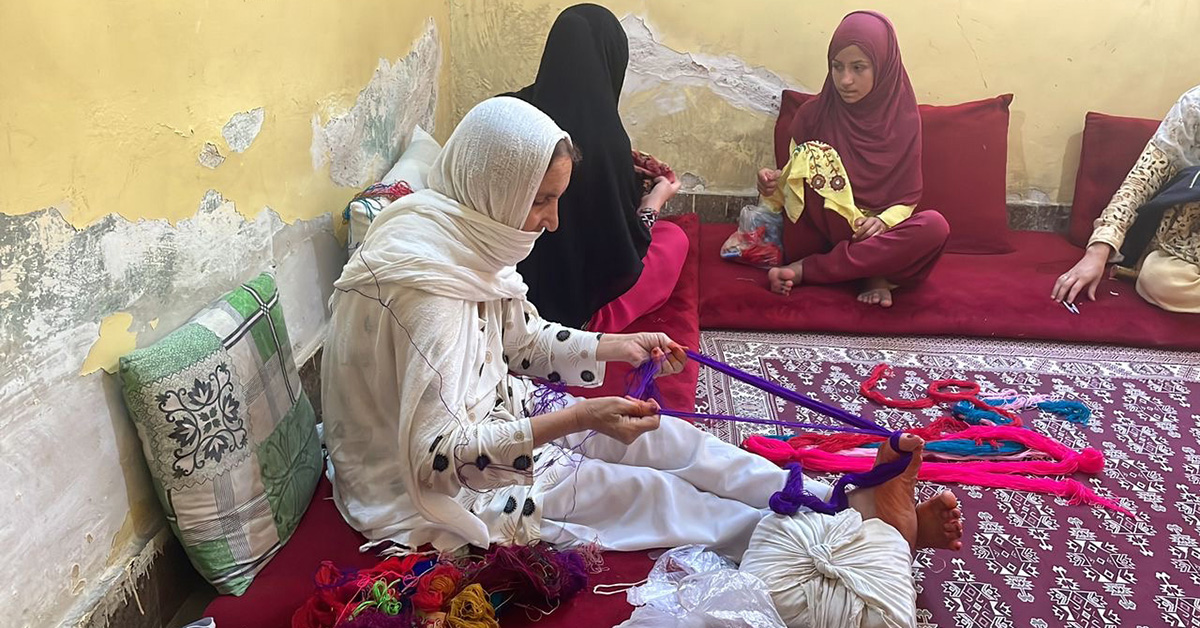
Once they were lawyers, engineers, university professors, medical practitioners in women's only hospitals, now they must seek no higher than to become of necessity carpet weavers, cosmeticians or vocational trainers -- for the Taliban government has closed them off from working at government jobs or for nonprofits. They may no longer operate beauty salons, study midwifery or nursing, speak with male clients, suppliers or banking officials.
Fewer than 7 percent of Afghan women had employment in 2024, according to the United Nations Development Program, in a country that restricts its women from working outside their homes other than female-restricted places where men cannot enter. One of the last and only methods by which Afghan women can employ themselves gainfully in support of their households is through entrepreneurship, within the confines of the government's strict guidelines.
There are examples of success on a modest, life-saving scale emerging in an unhealthy economy. One such takes place in a warehouse in Mazar-i-Sharif where 60 women knot, trim and weave rugs for their employer, 19-year-old Nasira Azazi. Barred from studying beyond grade six, she was 14 when the Taliban returned to power.
"I fell into depression. Here, there are at least more topics to discuss, more motivation to get the job done", she explained of the business she launched with financial support from the U.N. Development Program. Her business now employees about 450 female workers located in two workshops as well as at their own homes. The business by necessity has become a family affair.
She is reliant on her two brothers for the designs of the rugs her business produces, along with the marketing, while her father runs one of the workshops. Management, human resources, finances are Ms. Azizi's responsibility. She is limited in her public activities, since she cannot herself do business with male clients. Women themselves must rely on male family members to conduct business on their behalf.
 |
| Ghoncha Karimi, Photo Kiana Hayeri, The New York Times |
Ghoncha Karimi, a 39-year-old beekeeper, occasionally outfits herself like a man in her travels outside Herat to tend to her apiaries on the city's outskirts. She has 50 beehives and the honey she is able to produce and sell contributes greatly to her family's income. When the Taliban, in 2023 made it clear she could no longer receive male clients in her shop, her sales were diminished. When she objected to these constraints to a Taliban official she was imprisoned for 20 days' punishment.
According to Samullah Ibrahimi of the Afghan Ministry of Work and Social Affairs, women are encouraged to pursue vocational training programs, with the women expected to respect "the principles of the country". He referred to a "committee for economic empowerment" that had provided work for 26 Afghan women in 2026, out of a population in Afghanistan of close to 45 million people.
 |
| An Afghan woman entrepreneur displaying her products at the Oman expo, supported by UN Women, January 2025. Photo: UN Women |
Labels: Afghanistan, Female Entrepreneurship, Female Repression, Girls Denied Education, Taliban Rule, Women Forbidden from Interaction With Men
posted by Pieface @ 7:56 PM


0 Comments:
Post a Comment
<< Home