Neolithic Age Ingenuity and Engineering
Neolithic Age Ingenuity and Engineering
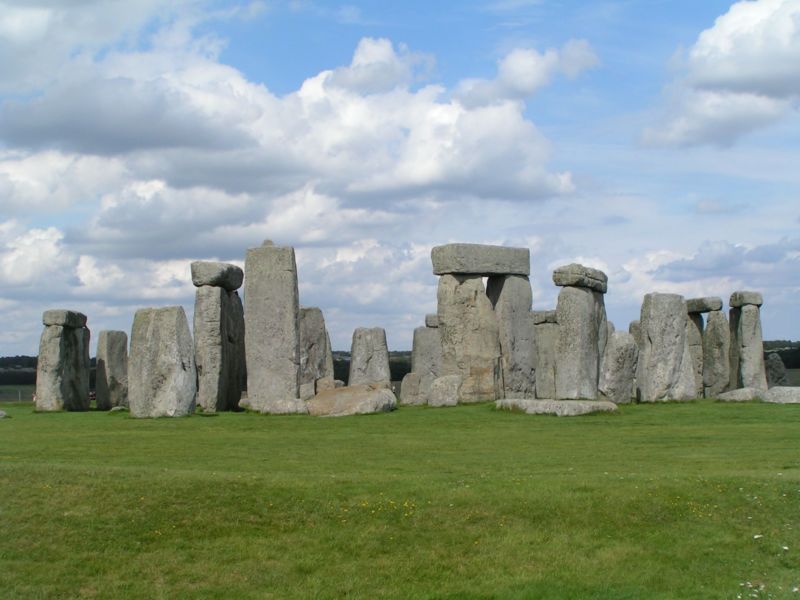
"The sarsen stones make up the iconic outer circle and central trilithon [two vertical stones supporting a horizontal stone] horseshoe at Stonehenge. They are enormous.""How they were moved to the site is still really the subject of speculation.""It has been really exciting to harness 21st-century science to understand the Neolithic past, and finally answer a question that archeologists have been debating for centuries."David Nash, geomorphologist, University of Brighton"The bluestones, we've known, come from mid-west Wales and they were easy to source because there are inclusions and quartz which you can match to the outcrop. The large stones are pretty uniform and just look like a big block, so it's difficult to interrogate them and find where they are from.""There are no sarsens of this size left in the downs, that's why it's been such a mystery and some people have suggested they come from elsewhere as you get outcrops in other places where you have chalk land, like Devon and Kent.""The west wood was overlooked because it's under ancient woodland and a lot of sarsens were removed in the 19th century for road stones, particularly in Swindon, but there are still sarsens buried in among the tees. To be able to pinpoint the area that Stonehenge's builders used to source their materials around 2500 BC is a real thrill.""We can now say, when sourcing the sarsens, the overriding objective was size -- they wanted the biggest, most substantial stones they could find and it made sense to get them from as nearby as possible.""This is in stark contrast to the source of the bluestones, where something quite different -- a sacred connection to these mountains perhaps -- was at play."Susan Greaney, historian, archaeologist with a specialization in British prehistory, Cardiff University
 |
| Stonehenge |
Before
there were the monumentally imposing great cathedrals of Europe, there
was Stonehenge. An ancient circle of massive stone formations
dominating a landscape, where sun worship as a Druid temple of sorts
spoke to an ancient belief in the divine. Humankind seems always to have
had a need of faith, faith in an unknown powerful force imagined as a
divine intelligence which created all that exists. The sun was the
manifestation of that life-giving, life-sustaining source. One of the
Egyptian dynasties was also that of sun-worship when Akhenaten reigned
and named the sun Aten.
The building of the
ancient Pyramids presented a conundrum just as Stonehenge has done; how
massive stone blocks could have been moved to particular sites to
construct gargantuan edifices of worship and burial in preparation for
the afterlife. Stonehenge's megalithic bluestones were known to have
been hauled 225 kilometres from Wales' Preseli Mountains to their
destination on Salisbury Plain. A laborious effort of both brute
strength and engineering; presumably with the use of log rollers to
convey the massive stones over a demanding geology.
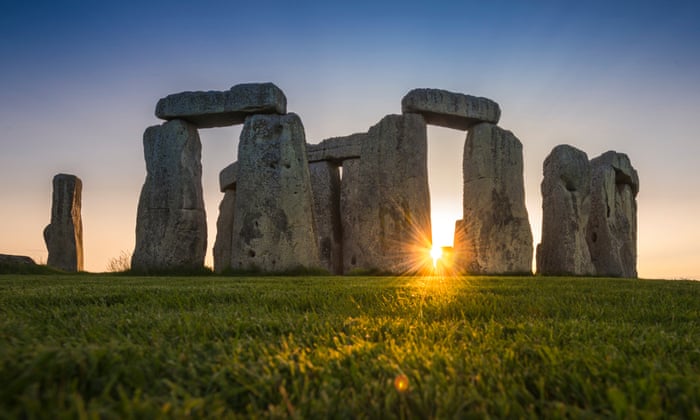 |
| Sunset at Stonehenge. Photograph: A Pattenden |
A
mystery appears to have been cleared with the newfound knowledge that
the 52 pale-grey sandstone megaliths known as sarsens originated in the
West Woods of the Marlborough Downs, a mere 25 kilometres in comparison
distance, north of Stonehenge. Not far from the Neolithic monument site
at Avebury. It took the combined work of archaeologists from English
Heritage and the University of Sheffield to solve this centuries-old
conundrum of human effort in a divine mission of devotion overcoming
massive physical effort and distance difficulty to achieve the goal.
A
core sample that had been drilled during repair work undertaken in the
1950s involving the "Stone 58" had been taken as a memento to the United
States, with permission, by a man who had worked for the company
involved in the conservation work when the sarsen core sample was
extracted and metal rods inserted to stabilize a cracked megalith. The
souvenir moved with this man when he emigrated to the U.S. and was
eventually returned to Britain to enable research.
When
fragments of the sample were analyzed, researchers were able to
establish the geochemical fingerprint of the sarsen which it was taken
from, which matched sandstone at West Woods. Most of the sarsens weigh
about 20 tonnes, with some as heavy as 30 tonnes; the largest is 30 feet
in length. It is hazarded that the Preseli stones were selected for
ritualistic purposes while the sarsens were chosen for size, according
to archeological logic. Moving such 30 tonne stones would have
represented an impossibly difficult prospect.
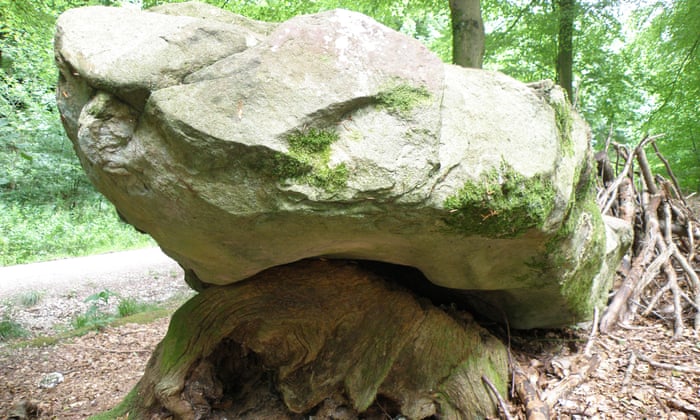 |
| A large sarsen stone at West Woods, the probable source of most of the sarsens used to construct Stonehenge. Photograph: Katy A Whitaker |
Labels: Ancient Habitation, Archaeology, Britain
posted by Pieface @ 8:17 PM
0 comments