To Boost or Not to Boost?
"But overstating evidence of waning immunity for the general population has already had important ramifications, including affecting vaccine confidence.""Most importantly, the long-term effects of boosters on reducing infection transmission and hospital admissions remains unknown."U.S.-British researchers, British Medical Association Journal
 |
"Israel is becoming everybody's crystal ball, because they were so early -- they got out before anybody with really aggressive vaccination programs.""The rest of us can watch what happens in Israel, to try to figure out what's going to happen locally. And what's happening in Israel now is, we are seeing, breakthrough infections.""The immune system does stop pumping out tonnes of antibodies [once the reaction to the vaccines subsides]. And it's the level of antibodies that are probably keeping you from getting infected.""Even though you might get infected, you're not as sick, and you're probably not going to spread.""We may all need a third shot at some point. I don't see it like a six-month thing, or every year, but honestly, no one really knows.""It's still a wait-and-see. And will everyone need one? Maybe people under 30 won't need them, maybe people under 40 won't need them. Maybe everyone over 60 should get one every year.""I don't think there's going to be a one-size-fits-all on boosters."Rodney Russell, professor of immunology and virology, Memorial University, Newfoundland
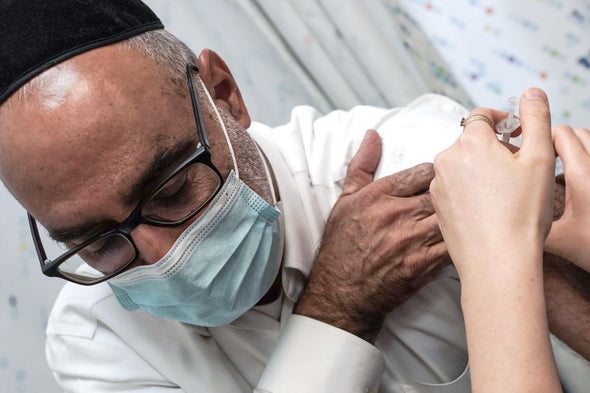 |
| A man in Jerusalem receives a third dose of the Pfizer COVID vaccine in August 2021. Israel has been offering booster shots to all citizens 50 and above. Credit: Nir Alon Alamy |
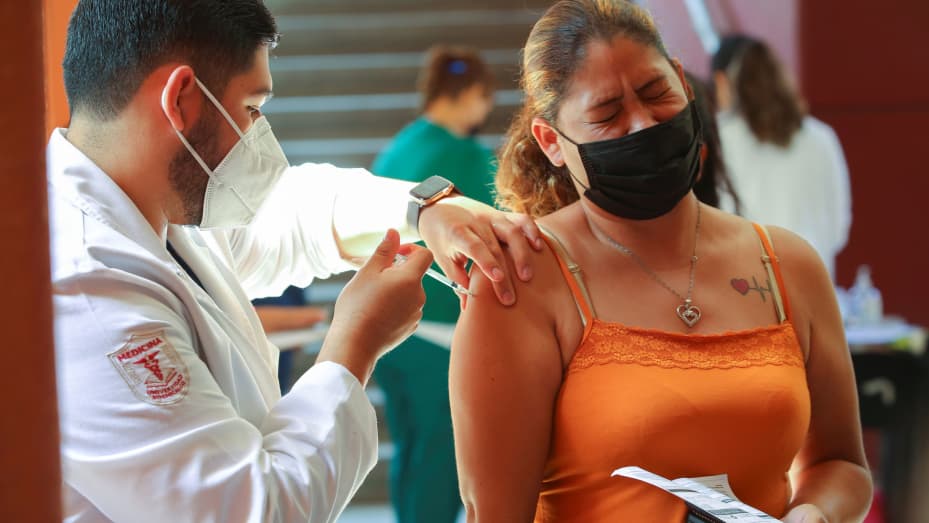
The debate over the potential need for a third 'booster' shot of COVID vaccine is driven by news and expectations surrounding the durability of the two-dose vaccine; how long antibody reaction lasts. Evidence is steadily emerging of a "modest waning"; some researchers now warn that seven months following the two-dose Pfizer or Moderna vaccines, antibodies decline precipitously, requiring a third dose to bring antibodies back up to reliability levels in defending against the SARS-CoV-2 virus.
According to an editorial in the British Medical Association Journal, a third dose presents as prudent as a preventive for the elderly and people with compromised immune systems, both categories which have a tendency not to mount an immune response as robust as younger and non-health-impaired individuals. Boosters for a select group inclusive of residents of long-term care and seniors living in congregate settings who are at high risk of exposure and serious illness from COVID has been recommended by Canada's National Advisory Committee on Immunization.
As the first country globally to make boosters available to its whole population, Israel has the eyes of the world fixed on its outcomes. A booster rollout is being seen as well now in the United States. There are some who feel acceptance of the need for booster shots may have the effect of undermining public confidence in the vaccines, that anti-vaxxers may take advantage of the issue as evidence the vaccines have failed to reach their promise.
In the United Kingdom third doses are deployed for Britons over age 50, administered six months following a second dose of either Pfizer or AstraZeneca's COVID vaccine. A decision on boosters is imminent by the European Medicines Agency for the general population, according to Reuters. Israel is now seeing protests against the prospect of endless boosters. Yet a million-people study in Israel of those aged 60 and over who received two doses of Pfizer's vaccine found the rate of confirmed infection to be 11 times lower in the boosted as opposed to the non-boosted group.
Moreover those who received booster shots aged 60 and over, were found with higher blood levels of antibodies and the rate of severe illness for this group was lower by a factor of close to 20. A natural infection or vaccination sees antibodies typically peak two weeks later, eventually beginning to fall off. Memory B cells rapidly churn out antibodies should someone be re-exposed to SARS-CoV-2 and memory T cells act similarly, potentially lasting for a decade or longer, kicking in swiftly after re-exposure "quicker than the first time, and you'll have antibodies made within days", explained
Dr.Russell.
Dr.Russell.
Hypothetically a booster may produce greater numbers of longer-lasting memory cells, an unproven expectation, points out the BMJ editorial. And even though a third dose tweaks the antibody level to increase, eventually it too will begin to wane. Unknown is whether an increased risk of myocarditis or other rare reaction after a booster dose could arise. But data out of Israel where over three million people were vaccinated with a third COVID shot, indicate fewer side effects such as fatigue, weakness and pain in the injection site after a third dose as compared to the second.
Labels: Booster Shot, COVID-19, Israel, Vaccine Breakthroughs
posted by Pieface @ 7:31 PM
0 comments