Ruminations

Blog dedicated primarily to randomly selected news items; comments reflecting personal perceptions

Friday, August 30, 2019

Clarifying C-Sections Connecting With Autism

"Our study does not provide irrefutable proof that C-sections cause psychiatric disorders. Association is not causation."
"However, we believe that the study provides information that may help parents [and] doctors to make informed decisions about how they want their births to be."
"C-section is often recommended by obstetricians if the mother has diseases such as diabetes, hypertension, etc. Some of the diseases might already have an effect on a child’s brain development when he or she is still in the womb. [A combination of factors may contribute to the risk, so] it would therefore be wrong to demonize C-sections. C-sections should continue to be used when medically necessary." 
"Researchers should continue [to] investigate what are the underlying causes of the observed associations." 
Tianyang Zhang, researcher, Karolinska Institute, Sweden, study lead author
"Public health concerns have been raised because access to medically indicated cesarean delivery may be difficult in low-resource settings and unnecessary cesarean deliveries may be performed in high-resource setting."
Research team, study, published in JAMA Network Open
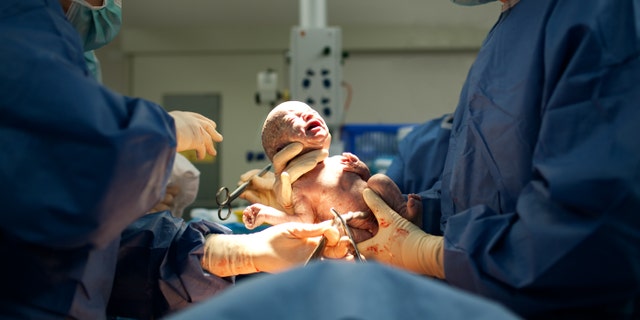
A mother holds the foot of her newborn baby on July 7, 2018 at the hospital in Nantes, western France. (Photo by LOIC VENANCE / AFP)        (Photo credit should read LOIC VENANCE/AFP/Getty Images)
It’s important to understand why there may be a link between cesareans and some disorders, especially as C-section rates have risen in recent years, say the researchers.  (Loic Venance/Getty Images)

"The impact of this is not going to be great because the increase is still pretty low."
"It’s not very dramatic. It’s statistically significant but from the population standpoint, the risk is not huge. And it absolutely does not prove that cesarean section is causing autism or ADHD."
"The risk factors that lead to a C-section may also be risk factors that lead to autism or ADHD."
Dr. Pankhuree Vandana, pediatric psychiatrist, Nationwide Children’s Hospital, Columbus, Ohio

"This study is certainly interesting and begs further prospective research be undertaken to try and answer the question of whether delivery by caesarean section increases the burden of mental health issues in children."
"Before undergoing any treatment, particularly elective treatment, it is important that doctors make patients aware of the options they have and their potential risks and benefits."
"Ultimately, this study does not answer this question, but merely comes up with the correct recommendation that 'further research is required'."
University of Queensland obstetrics researcher Gino Pecoraro
The link might be due to other factors such as the mother’s age or weight. Christian Bowen
A research team involving scientists from the Karolinska Institute in Sweden along with a number of Australian researchers undertook to examine 60 studies incorporating a total of 20.6 million births, finding that children delivered by caesarean section are a third likelier to develop autism than children born normally through the birth canal. The analysis also found that those children delivered by C-section were as well a sixth more likely to develop ADHD (attention deficit hyperactive disorder). The results of the study saw publication in JAMA Network Open.

As far as experts in the field are concerned, it remains  unclear why risks associated with C-sections appear to be so elevated, irrespective of whether the C-section was planned or undertaken as a result of a medical emergency. However, there is a possibility that factors such as a mother being older, or a baby at risk of premature birth could conceivably impact with such consequences and may also explain the higher risk of developmental disorders

Scientists also throw in the possibility that post-birth exposure to antibiotics could play a part as well. Professor Jeffrey Keelan, deputy director of the women and infants research foundation, University of Western Australia, found the study "interesting and well-performed", but failed to sufficiently adjust for a host of factors that could explicate the additional risk -- while other scientists felt the findings to be "significantly flawed", in that some of the studies included in the analysis reflected extremely high autism rates.

It is estimated that in the United Kingdom alone, around one percent of the population could be on the autism spectrum, reflecting the fact that Britain hosts some of the highest rates of births by caesarean section in Western Europe, with 26.2 percent delivery by C-section currently, in comparison to 19.7 percent performed in 2000. Experts link the rise in C-sections to the increasing age of mothers-to-be, along with the rise of obesity levels.
"The need for a caesarean is often caused by problems that could influence brain function, such as a poorly functioning placenta. It is highly unlikely the caesarean delivery itself is causal in these mental health conditions, from our current understanding of brain physiology and the effects of a caesarean."
"Women should not be alarmed by the need for a caesarean, which is often performed to reduce risk to their baby."
Dr. Andrew Shennan, professor of obstetrics, King's College London

"A number of underlying factors ... were not accounted for [in the study]. Therefore the findings of this paper do not show that caesarean birth leads to autism and ADHD."
"Women who have a caesarean birth should be reassured that it is a safe procedure. In many cases, a caesarean birth can be a life-saving intervention."
Dr. Pat O'Brien, consultant obstetrician, spokesman, Royal College of Obstetricians and Gynaecologists
 Kids delivered by c-section are a third more likely to develop autism, a study has found
Kids delivered by c-section are a third more likely to develop autism, a study has found     Credit: Getty - Contributor
"We know, for example, that caesarean sections are more common for pregnant women who are obese and older, and who have a history of immune conditions such as asthma."
"All of these factors have also been linked with an increased chance of having a child with autism, and it is entirely possible – and some would argue, probable – that it is more likely these factors underlie the relationship between caesarean section and neurodevelopmental disorders."
Dr. Andrew Whitehouse, Bennett Chair of Autism, University of Western Australia

Labels: , , , ,

Tuesday, July 30, 2019

C-Section Party-Time, Brazil

The Washington Post

"It's cultural. Brazilians want to plan for everything. They don't want to hit traffic on the way to the
 hospital."
"They want to get their nails done, get a wax, to play it like an event."
Marcia da Costa, director, Sao Luiz Hospital, Sao Paulo

"We saw that we had to re-evaluate these percentages and make sure that birth decisions were being geared toward the health of the mother and  the child, and not for convenience."
"Here we had the opposite statistics [to the WHO estimate that ten percent of births require a C-section."
Rodrigo Agular, director, National Supplementary Health Agency, Brazil

"C-sections today are much safer than they were thirty years ago."
"Things are changing. Women are in the job market. Couples are trying to schedule a moment when the family can get together."
"[Caesarean sections fit some lifestyles]."
Olimpio de Moraes Filho, president, Brazilian Federation of Obstetrics and Gynecology

"The mom has just given birth, she is learning to breastfeed, she doesn't want to entertain at home."
"So while she's getting ready for the birth, we are getting ready to host."
Paula Ascar Baracat, co-founder, Estudio Matre

"It [a natural birth] doesn't fit with our lifestyle. I'm a doctor, and my husband is, too. We have a very planned life and had to take vacation for the baby to be born."
"I love it [her hospital room, decorated in blue and white balloons, refrigerator stocked with rum-barrel-aged beer, her luxury suite lined with succulent plants, parting gifts for the 80 guests she expects]. To be surrounded by the people you love [as you give birth by C-section], people who saw you grow up, is extraordinary."
Bruna Viera, 32, Albert Einstein Maternity Hospital, Sao Paulo
image

Albert Einstein must be chuckling at yet another manifestation of human absurdity. True, he was absorbed with abstract, abstruse suppositions relating to physics, the cosmos, but his dry, amused comments on humanity and and peoples' proclivity toward extremes and the absurd were beyond entertaining, infused with wisdom and tolerance. Childbirth, the most natural experience a woman can have, the process nature designed females to undergo in the interests of natural increase of any population, is fairly straightforward.

In this busy-busy, distracted modern world of ours, patience is at a premium. People want things they anticipate to occur when they want them to; natural processes be damned. When a woman is in labour in hospital, her gynecologist is likely a very busy man, and he will, if it hasn't already happened on its own, break a woman's waters to speed labour and delivery. Women have taken to a more extreme level of management, opting for Caesarean Section over natural delivery in a bid to 'save time'.

Women appear increasingly in North America to look upon a C-section delivery as convenient and desirable. Gone are the days when such invasive surgery was looked upon with dread, a misfortune, a procedure undertaken to save a baby's life because a natural delivery was unfeasible, the baby's position in the uterus awkward and dangerous, delivery potentially hazardous. Instead of delivering vaginally, as nature has intended, a surgeon slits open a woman's abdomen and uterus to extract the fetus.

C-sections are 'legitimate' in the sense of being medically required in but ten percent of pregnancies. They are more expensive procedures to undertake than natural childbirth. At one time, the chance of death through C-section for both mother and child loomed dangerously; that danger has been dramatically reduced with modern techniques and well-equipped hospitals. Even so, hemorrhage and infection is more likely to occur in an elective Caesarean than as a result of a natural birth process.

C-sections are linked to higher rates of respiratory distress, diabetes and the potential for high-blood-pressure for babies delivered by C-section. When the choice is made for a premature C-section related to some event that corresponds in time with the event, and the procedure is carried through prematurely in the fetal development stage, the chance of respiratory problems for the baby and prolonged hospital stays for mothers and babies is more likely.

The government of Brazil does not view the new cultural normalcy around C-sections in a positive light, the Health Ministry attempts to reduce the Caesarean "epidemic" by persuasion if possible, through legislation if not, with the government banning medically unnecessary C-sections in 2015, before 39 weeks' gestation. In the past, Brazil's public health system saw the health community lacking resources to monitor women through hours of labour.

In those situations C-section meant medical staff could monitor mothers for a shorter time period. At private hospitals, mothers began to favour C-sections. At private hospitals it has become routine for a pregnant woman in labour to have her hair and makeup looked after in her hospital room. About $500 as a daily fee allows a family to rent the presidential suite, with living room and bathroom to accommodate guests, along with a balcony and mini-bar.

A frosted window looking into the operating room at the Albert Einstein Maternity Hospital turns transparent during surgery, so guests may view the drama inherent in the moment of birth. Clients of businesses specializing in C-section parties taking place in private hospitals pay up to $10,000 for floral arrangements, guest books, monogrammed sheets, personalized water bottles, and silver-plated guest favours.

Mothers in Brazil have been opting to schedule their child’s birth rather than wait for it to occur naturally so much that the Health Ministry was forced to step in to try an quell the “epidemic."
Mothers in Brazil have been opting to schedule their child’s birth rather than wait for it to occur naturally so much that the Health Ministry was forced to step in to try an quell the “epidemic." (iStock)

Director of the maternity ward at Einstein Hospital in 2015 conferenced with doctors, doulas, midwives, feminist activists and government officials in a discussion of possible methods that could result in an increase in the number of natural births at private hospitals in Brazil. The Appropriate Birth Project was launched in a partnership with 35 hospitals pledged to prioritize natural births over C-section deliveries.

They began by offering the same luxuries and party favours to natural births deliveries as is done with C-sections. Five new natural-birth centres with private showers and tubs were opened at the Einstein hospital. At Sao Luiz, those opting for natural births may select colours of lighting arrangements with their in-room whirlpool bathtubs. Ceiling Fairy lights can be blue or red, reflecting patient mood, with all rooms equipped with MP3 players patients can load with personal playlists.

In four years, the rate of natural births at Einstein increased close to 50 percent from 18 percent. Now, over 200 hospitals have adopted the same program.
"The changes have to be concurrent for everyone: women, their families, their workplace, doctors, nurses."
"When the husband comes in and says, 'I'm working, I need to know the date of the birth' -- it's about learning to plan for the unplannable."
Linus Pauling Fascina, director, maternity ward, Einstein Hospital
Baby party at hospital with balloons
iStock

Labels: , , , ,

 
()() Follow @rheytah Tweet