Ruminations

Blog dedicated primarily to randomly selected news items; comments reflecting personal perceptions

Saturday, January 29, 2022

All-Purpose COVID Vaccine Courtesy of U.S. Army

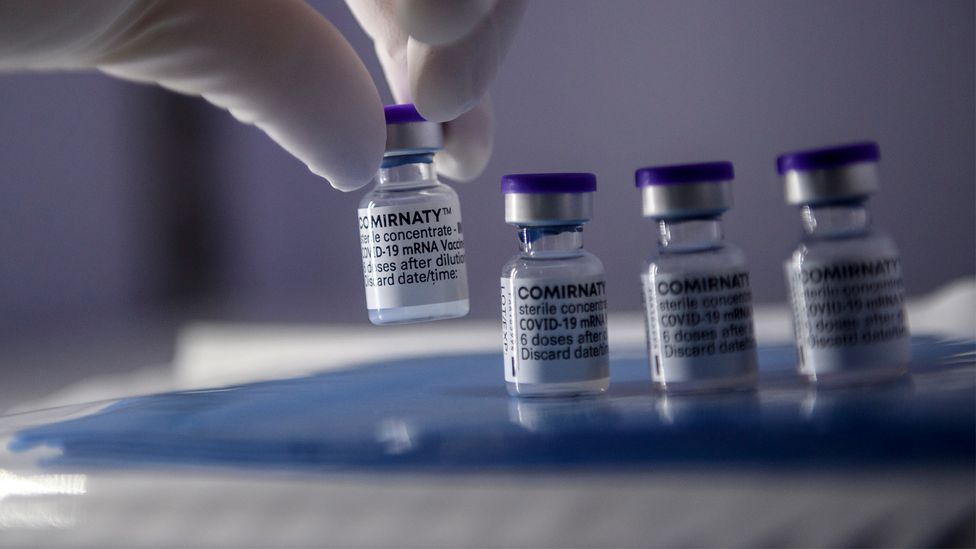
A vial of SpFN, the Army's vaccine against coronavirus variants, is shown.
WRAIR’s COVID-19 vaccine.
U.S. Army photo by Mike Walters
"Walter Reed’s Spike Ferritin Nanoparticle COVID-19 vaccine, or SpFN, completed animal trials earlier this year with positive results. Phase 1 of human trials, wrapped up this month, again with positive results that are undergoing final review,
"We're testing our vaccine against all the different variants, including Omicron."
"We want to wait for those clinical data to be able to kind of make the full public announcements, but so far everything has been moving along exactly as we had hoped."
"With Omicron, there's no way really to escape this virus. You're not going to be able to avoid it. So I think pretty soon either the whole world will be vaccinated or have been infected."
"We need to evaluate it in the real-world setting and try to understand how does the vaccine perform in much larger numbers of individuals who have already been vaccinated with something else initially…or already been sick"   Dr. Kayvon Modjarrad, director of Walter Reed’s infectious diseases branch
DefenseOne.com
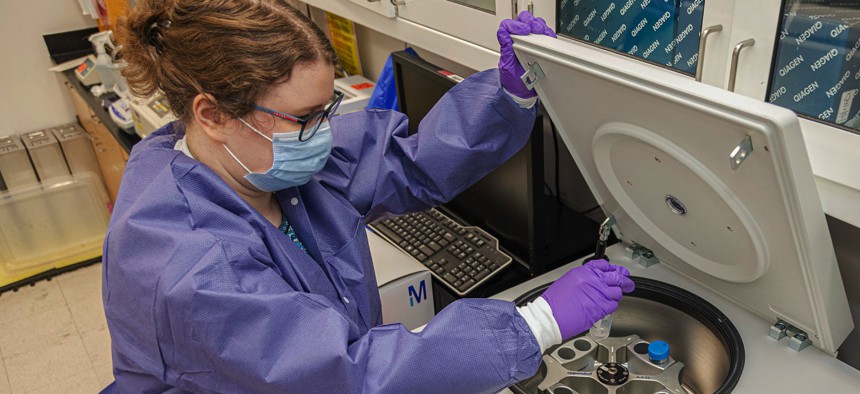
A scientist with the Emerging Infectious Disease branch of the Walter Reed Army Institute of Research conducts studies to find a vaccine for COVID-19 in July 2020.
A scientist with the Emerging Infectious Disease branch of the Walter Reed Army Institute of Research conducts studies to find a vaccine for COVID-19 in July 2020. Shawn Fury, Army

In development for the past two years, a vaccine has been brought to Stage 1 trial at the Walter Reed National Military Medical Center in Maryland, the product of Army scientists. Pre-human trials were conducted on monkeys with promising results. The vaccine is now in its first human trial, being tested for safety on human volunteers.
"Since September of 2020 there have been five SARS-CV-2 variants of concern -- Alpha, Beta, Gamma, Delta and now the current, Omicron."
"So, obviously, innovative approaches are needed [to counter COVID and its many emerging mutations]."
"I don't want anyone to think that pan-coronovirus vaccines are literally around the corner in a month or two."
Dr.Anthony Fauci, head, National Institute of Allergy and Infectious Diseases
$43 million in research grants has been issued by the National Institute of Allergy and Infectious Diseases, to a varied number of academic institutions in a bid to help develop a pan-coronavirus vaccine. The emergence of COVID-19 was not the first time a coronavirus came along to surprise the scientific community, posing a dangerous threat to public health.
 
When SARS emerged in 2002 in China, it spread rapidly around the globe, suspected of having caused 43 deaths in Canada alone; its mortality rate was higher than COVID's, but it was not as infectious. Because the virus so debilitated those it infected, the virus itself prevented its own effective transmission. For a virus to be successful in replicating in its human host, it ideally would want to keep its victims alive, and relatively medically stable.

SARS still succeeded in infecting almost eight thousand people, killing 1,000 of those it infected in 29 countries it spread within. 
 
Saudi Arabia identified the presence of MERS (MERS-CoV), a coronavirus respiratory illness that spread to several countries, claiming 800 lives. Recently a hybrid of MERS was discovered -- NeoCov, discovered in a bat population, but not yet spread to humans, though researchers from the Chinese Academy of Sciences and Wuhan University believe it is just a matter of time before it becomes another zoonotic, jumping the species barrier.

'NeoCov': Chinese Scientists Warn Of New Kind Of Coronavirus From Bats
NeoCov coronavirus found in bats may pose threat to humans in future, scientists caution

The original COVID mRNA vaccines matched some genetic sequences, diminishing their effectiveness by reducing illness against newer strains of the coronavirus. Both Pfizer and Moderna, the original pharmaceuticals to use mRNA techniques in their formulations, are now restructuring their vaccines to more directly address the Omicron strain which proved able to evade the properties of the vaccine's effectiveness against Delta.
 
The target of a pan-coronavirus vaccine would be the genetic code common to virus sub=variants. This is a challenge that could take a length of time counted in months or extend to years, according to scientists hoping to produce a universal COVID vaccine. COVID-19 has demonstrated its capacity for mutations, raising concerns the virus will remain a threat to contend with on a long-term basis. 
 
Appeals for an all-purpose vaccine have increased since the emergence of the COVID variants in a desperate bid to find a vaccine to create lasting immunity against all potential mutations. A precedent was set when Linfa Wang, a virologist with Duke-NUS Medical School tested antibodies of SARS survivors from Singapore to discover that people who had received COVID vaccine saw their immune system generate "super-antibodies" able to neutralize both SARS viruses and other coronaviruses. 
 
A service member of the United States Forces Korea receives the first round of the COVID vaccine.
 

Labels: , , , ,

Sunday, December 19, 2021

Evading SARS-CoV-2 Infection

"It is always dangerous to predict science. [But Britain is heading toward a] safer haven."
"I anticipate we will have polyvalent vaccines, which will cover a much wider range [of viral strains]."
"[These, together with antivirals], will mean that the great majority and probably almost all of the heavy lifting when we get a new variant can be met by medical means."
Professor Chris Whitty, Chief Medical Officer, Britain

"The holy grail would be a vaccine that works for all different variants because they've found an area of the virus which is stable, and which causes the immune response to occur."
"Then you'd have a good vaccine which could prevent future variants."
David Heymann, professor of infectious diseases, London School of Hygiene and Tropical Medicine
NHS staff and key workers queue in the Louisa Jordan Hospital before receiving the coronavirus vaccine in Glasgow, Scotland.

People await coronavirus vaccines at a hospital in Glasgow, UK.   Credit: Jeff J. Mitchell/Getty

A dilemma has presented itself -- not that it couldn't have been foreseen -- whereby the vaccines that were developed against the SARS-CoV-2 virus causing COVID-19 have been highly effective, in protecting hundreds of millions of people worldwide from infection as the virus runs rampant throughout the global village, the emergence of new variant strains have challenged the ability of the vaccines to continue providing the same level of protection from a variant strain now eluding the vaccine's protective properties.

The vaccines currently in use have been responsible for protecting people from the development of more serious illnesses from the coronavirus. But suddenly that protective edge is evaporating in the face of a more virulent, infectious, more readily transmissible mutation. The current vaccines focus on the "spike protein", but as mutations develop the vaccines based on making them less proficient entering body cells become themselves neutered of their protective edge as the virus 'learns' to evade its properties.

A situation which leads to hope that science may again find a solution. Researchers are optimistic that a "universal" coronavirus vaccine solution should be possible. Nations' top medical advisers, like Dr.Anthony Fauci of the U.S. have been counselling scientists to "fully commit" to the development of next-generation vaccines that could "ideally protect against SARS-CoV-2 as well as many other animal-derived coronaviruses certain to cause future zoonotic outbreaks and pandemics"

This is not a simple and easy-to-achieve goal. A universal flu vaccine, as example, has been examined for years and still evades all attempts by researchers in its development. As for the goal of tackling coronaviruses, a shift in how vaccine makers design their vaccines is envisaged. As a target the "spike protein" may have outlived its purpose, given the ongoing opportunities for the virus to mutate, resulting in their being less effective against future strains.

The aim would be to target other parts of the virus ... such as proteins that would be less vulnerable to mutations, for the next generation of vaccines. The $65-thousand question then would be how to identify which part or parts of the virus could be depended on to remain as is without mutations occurring. Scientists around the world are bracing themselves in the effort to develop such an all-purpose vaccine.

A startup based in Oxford and Helsinki -- Valo Therapeutics -- is testing its formula on mice; a vaccine that would cover parts of the virus known not to mutate in proteins and that would work by recognizing and destroying any proteins that would be infected with a COVID strain. "We could be in clinical studies next year", chief executive Paul Higham explained.

Experts at the California Institute of Technology are at work on taking the tips of spike proteins from eight coronaviruses to attach them to a particle. to then form the basis for a vaccine. Osivax, a French company, is in the development stages of a vaccine targeting a protein in the virus known as nucleocapsid; which the company claims could be available in five years.

U.K. vaccine czar Sir John Bell is less sanguine about the prospect of universal vaccines appearing any time soon; his opinion is that eventuality is yet "a long way off". And he has the support of the former chairman of the U.K. vaccine task force, Clive Dix, who argues that companies have been claiming they could develop such a flu vaccine "since I was a little kid and that was a long time ago".
 
Scientists believe mRNA vaccines may be the key to solving a huge array of diseases (Credit: Getty Images)

Labels: , , ,

 
()() Follow @rheytah Tweet