Adolescent Gender Identity/Dysphoria
"These findings support that within a clinical context involving comprehensive psychosocial assessment and support, gender identity among adolescents is highly stable, and rates of reidentification with birth-assigned gender and cessation of [gender-affirming hormones] are low.""Despite there being broad consensus among major medical organizations about the necessity of gender-affirming care, some government bodies continue to raise questions a bout access to gender-affirming care."Recently-published Canadian study Journal of Adolescent Health"The study also found that no one who initially identified as non-binary returned to a binary gender aligned with their birth sex.""For many youth, access to appropriate care is associated with improved well-being and mental-health outcomes.""Other research has also reported low rates of detransition and treatment discontinuation, although findings vary depending on the population studied."Daniel Metzger, paediatric endocrinologist, B.C. Children's Hospital, report first-author"It's an open question whether the detransition rate of someone who started their transition in 2012 is going to be the same rate as someone who started their transition in 2020 or 2022.""[The paper suggests that appropriately selected youth who undergo comprehensive holistic assessments] are likely to at least be persistent in the short- to medium-term.""It could be that many of them are continuing to do great and if we reached out to them today, in 2025, they'd say; 'Hey, I'm doing great. Leave me alone'.""Or we could reach out and they say, 'I desisted when I was 22'. We don't know. And we can't tell from this data."Dr. Laura Targownik, physician-scientist, professor of medicine, University of Toronto
 |
New Study Shows Trans Youth Are Extremely Unlikely to Detransition them.us |
Only 2.9 percent of teens -- in a social period of rapid gender-affirming medical interventions -- referred to one of four specialized pediatric gender clinics, changed back to their original gender identity; detransitioned, over a median followup study of 2.4 years. The study authors felt the findings suggest stability in teen gender identity where their study appears to prove that actual detransitioning is 'uncommon'. The results of their study, they wrote "may offer reassurance to those concerned that adolescents are too young to understand their gender identity or make decisions about medical transition".
As with any scientific study addressing controversial issues, critics find the study has the effect of inflating persistence while presenting a skewed picture, taking into regard the short followup window to detect a verifiable transition rate. Moreover, the study's structure leaves the authors incapable of asserting with any certainty what occurred when youth moved from adolescence into adulthood, and how that maturation affects their identity perception at that juncture.
The study encompassed children between between the years 2012 and 2017 prior to the more recent spike in gender dysphoria cases, alongside changing demographics. At the present time, predominantly biological females, many with accompanying complex mental health problems, many identifying as non-binary, are being seen by doctors. "Considerable uncertainty" remains of benefits of gender treatment for children, two recent Canadian studies concluded.
 |
| The number of children and teens seeking gender-affirming care almost tripled in Canada and the U.S. between 2017 and 2020, the study's authors note. Photo by Adobe Stock |
The latest study research team involved reviewing 445 teens diagnosed with gender dysphoria and seen at gender clinics in Vancouver, Calgary, Ottawa and Halifax -- of which 74 percent were born female, most between the ages of 13 and 18 at time of referral, while the mean age of beginning gender-affirming hormone treatment was just over 16 years of age. At each visit, every six months, the teens were questioned about their gender identity and whether hormone use was being continued.
Researchers looked at data in the youths' medical records between 2018 and 2020. There ensued at least one year of followup after each gender clinic visit. 95 percent -- 421 of the 445 -- continued with their presenting gender identity or re-identified as nonbinary: "from initial referral to end of the observation period". Of the 353 adolescents who began gender-affirming hormones, only one percent stopped taking them. Of the 24 that changed gender identity, 13 "returned to gender identity typically aligned with sex at birth".
Doctors have been sued by some detransitioners with the allegation that their wish for extreme interventions had never been challenged, nor were alternative treatments properly discussed. Detransitioners, surveys have found, may sometimes feel reluctant to inform their doctors, concerned they would waste people's time, even knowing that something was not quite right. Detransition "is very unlikely to occur even after 10 or more years identifying with [a] gender identity different than the identity aligned with birth sex", pointed out Dr. Lawson.
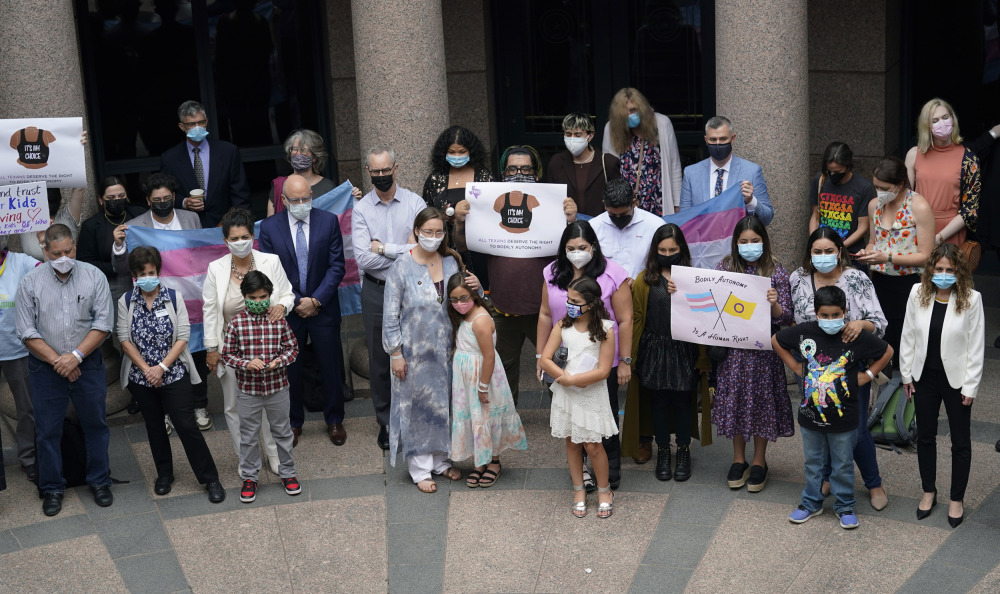 |
| Parents of transgender children and other supporters of transgender rights gather in an outdoor rotunda in Austin, Texas, to speak about transgender legislation being considered in the state House and Senate, on April 14, 2021. Eric Gay / AP file |
"I don't expect the detransition rate at a median two years to be terribly high, but if you follow these patients for five years, or 10 years, you might have a clearer picture.""[The finding that most youth prescribed hormones] does provide some reassurance that they're not just starting patients on hormones and they're desisting right away.""But [the researchers] don't talk about, were these patients seeing psychiatrists? Were they seen for other problems? Were they getting admitted to hospital for mental-health decompensation?""They're basically using persistence as a proxy for, 'Well, they're doing OK enough that they didn't have to abandon their transition or that their clinicians didn't feel that they were suffering from such a grievous harm that it had to be stopped."Dr. Laura Targownik, transgender woman"Individuals who do not support gender-affirming medical care for adolescents are likely to look for reasons that might discount the findings of our study and publication.""However, as principal investigator of this study, I can assure you that our study's methodology is extremely sound."Senior study author Dr. Margaret Lawson, scientist emeritus, CHEO Research Institute
Labels: Adolescent Transitioning, Cross-Sex Hormones, Gender Dysphoria, Gender Identity, Minimal Detransitioning, Scientific Studies
posted by Pieface @ 8:20 PM
0 comments


