Ruminations

Blog dedicated primarily to randomly selected news items; comments reflecting personal perceptions

Tuesday, June 23, 2026

Adolescent Gender Identity/Dysphoria

"These findings support that within a clinical context involving comprehensive psychosocial assessment and support, gender identity among adolescents is highly stable, and rates of reidentification with birth-assigned gender and cessation of [gender-affirming hormones] are low."
"Despite there being broad consensus among major medical organizations about the necessity of gender-affirming care, some government bodies continue to raise questions a bout access to gender-affirming care."
Recently-published Canadian study    Journal of Adolescent Health
 
"The study also found that no one who initially identified as non-binary returned to a binary gender aligned with their birth sex."
"For many youth, access to appropriate care is associated with improved well-being and mental-health outcomes."
"Other research has also reported low rates of detransition and treatment discontinuation, although findings vary depending on the population studied."
Daniel Metzger, paediatric endocrinologist, B.C. Children's Hospital, report first-author
 
"It's an open question whether the detransition rate of someone who started their transition in 2012 is going to be the same rate as someone who started their transition in 2020 or 2022."
"[The paper suggests that appropriately selected youth who undergo comprehensive holistic assessments] are likely to at least be persistent in the short- to medium-term."
"It could be that many of them are continuing to do great and if we reached out to them today, in 2025, they'd say; 'Hey, I'm doing great. Leave me alone'."
"Or we could reach out and they say, 'I desisted when I was 22'. We don't know. And we can't tell from this data." 
Dr. Laura Targownik, physician-scientist, professor of medicine, University of Toronto 
https://media.them.us/photos/62745743012ef49d5c175fe8/16:9/w_1920,c_limit/1056596624
New Study Shows Trans Youth Are Extremely Unlikely to Detransition   them.us
 
Only 2.9 percent of teens -- in a social period of rapid gender-affirming medical interventions -- referred to one of four specialized pediatric gender clinics, changed back to their original gender identity; detransitioned, over a median followup study of 2.4 years. The study authors felt the findings suggest stability in teen gender identity where their study appears to prove that actual detransitioning is 'uncommon'. The results of their study, they wrote "may offer reassurance to those concerned that adolescents are too  young to understand their gender identity or make decisions about medical transition".
 
As with any scientific study addressing controversial issues, critics find the study has the effect of inflating persistence while presenting a skewed picture, taking into regard the short followup window to detect a verifiable transition rate. Moreover, the study's structure leaves the authors incapable of asserting with any certainty what occurred when youth moved from adolescence into adulthood, and how that maturation affects their identity perception at that juncture.
 
The study encompassed children between between the years 2012 and 2017 prior to the more recent spike in gender dysphoria cases, alongside changing demographics. At the present time, predominantly biological females, many with accompanying complex mental health problems, many identifying as non-binary, are being seen by doctors. "Considerable uncertainty" remains of benefits of gender treatment for children, two recent Canadian studies concluded. 
 
https://smartcdn.gprod.postmedia.digital/nationalpost/wp-content/uploads/2026/06/transgender-1.jpg?quality=90&strip=all&w=564&h=423&type=webp&sig=eh4a0BkkMOLGOQAACt1Vnw
The number of children and teens seeking gender-affirming care almost tripled in Canada and the U.S. between 2017 and 2020, the study's authors note. Photo by Adobe Stock
 
The latest study research team involved reviewing 445 teens diagnosed with gender dysphoria and seen at gender clinics in Vancouver, Calgary, Ottawa and Halifax -- of which 74 percent were born female, most between the ages of 13 and 18 at time of referral, while the mean age of beginning gender-affirming hormone treatment was just over 16 years of age. At each visit, every six months, the teens were questioned about their gender identity and whether hormone use was being continued. 
 
Researchers looked at data in the youths' medical records between 2018 and 2020. There ensued at least one year of followup after each gender clinic visit. 95 percent -- 421 of the 445 -- continued with their presenting gender identity or re-identified as nonbinary: "from initial referral to end of the observation period". Of the 353 adolescents who began gender-affirming hormones, only one percent stopped taking them. Of the 24 that changed gender identity, 13 "returned to gender identity typically aligned with sex at birth".
 
Doctors have been sued by some detransitioners with the allegation that their wish for extreme interventions had never been challenged, nor were alternative treatments properly discussed. Detransitioners, surveys have found, may sometimes feel reluctant to inform their doctors, concerned they would waste people's time, even knowing that something was not quite right. Detransition "is very unlikely to occur even after 10 or more years identifying with [a] gender identity different than the identity aligned with birth sex", pointed out Dr. Lawson. 
 
https://media-cldnry.s-nbcnews.com/image/upload/t_fit-1000w,f_auto,q_auto:best/rockcms/2022-05/220504-transgender-rights-supporters-texas-al-0751-d8830e.jpg
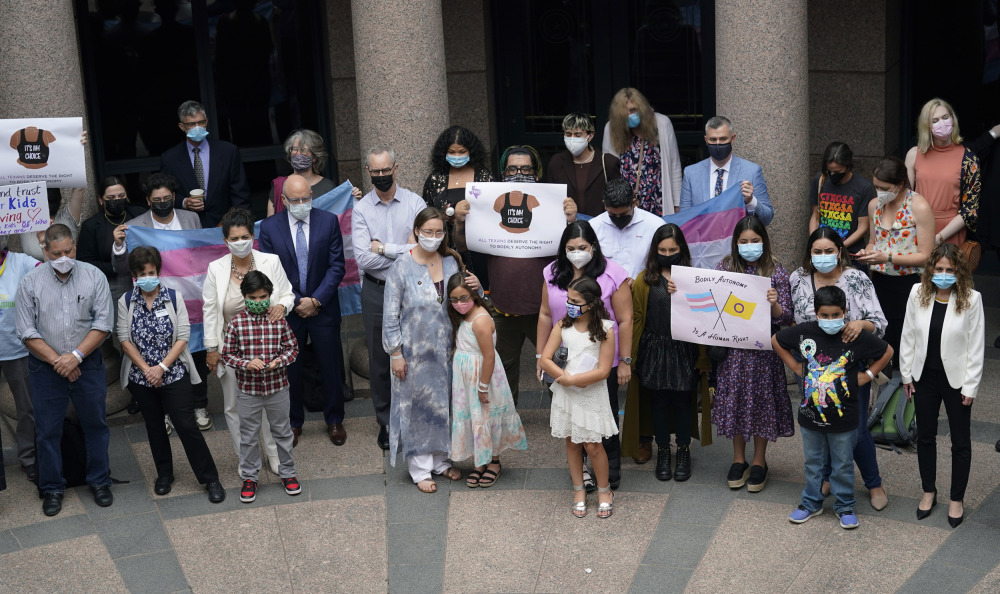
Parents of transgender children and other supporters of transgender rights gather in an outdoor rotunda in Austin, Texas, to speak about transgender legislation being considered in the state House and Senate, on April 14, 2021.   Eric Gay / AP file
 
"I don't expect the detransition rate at a median two years to be terribly high, but if you follow these patients for five years, or 10 years, you might have a clearer picture."
"[The finding that most youth prescribed hormones] does provide some reassurance that they're not just starting patients on hormones and they're desisting right away."
"But [the researchers] don't talk about, were these patients seeing psychiatrists? Were they seen for other problems? Were they getting admitted to hospital for mental-health decompensation?"
"They're basically using persistence as a proxy for, 'Well, they're doing OK enough that they didn't have to abandon their transition or that their clinicians didn't feel that they were suffering from such a grievous harm that it had to be stopped."
Dr. Laura Targownik, transgender woman 
 
"Individuals who do not support gender-affirming medical care for adolescents are likely to look for reasons that might discount the findings of our study and publication."
"However, as principal investigator of this study, I can assure you that our study's methodology is extremely sound."
Senior study author Dr. Margaret Lawson, scientist emeritus, CHEO Research Institute 
 

Labels: , , , , ,

Saturday, July 08, 2017

Neither-Nor Convulsions of Confusion

"I do not gender my child."
"It is up to Searyl to decide how they identify, when they are old enough to develop their own gender identity."
"I am not going to foreclose their choices based on an arbitrary assignment of gender at birth based on an inspection of their genitals."
Kori Doty, parent, British Columbia
A new poll from the Angus Reid Institute shows that 58 per cent of Canadians disagree with Ontario’s soon-to-be practice of issuing gender-neutral birth certificates for those who want them.Getty Images

Now that's different, one would have to admit, the name of Searyl. How many people have even ever heard of such a name. How might it automatically be assigned a gender? Searyl, a girl, or Searyl a boy. Take your pick. And 'taking your pick' is now high on the agenda of a number of righteous people who have become parents and who appear to resent biological gender identity. These are people who do not take kindly to being recognized as one of two sexes that nature endows her creatures with.

Certainly not all of her creatures, but most, and certainly by design, since the existence of those creatures, flora and fauna, were cleverly blueprinted by the originator of all that lives to reproduce. Survival and reproduction, and adaptation are all intertwined in the great design of existence. The great designs of science and nature focus on the most delicate and intricate of living systems, most of which co-exist in a great experiment of flourishing life.

Perhaps the most elemental and complex of the endowments we have been gifted with as humans is our brains, the capacity to think, to observe, to learn and to interact. Many do this as they were meant to do, developing their capabilities as they fit into and expand their potential. Many experience emotional temperamental resistance to the process, refusing to fit squarely into a diagram that fails to recognize their exceptionality.

And parents like the one quoted above fit some strange, preciously fey category where they themselves dabble in experimentation with their own. With themselves throughout their developing years to fashion a persona other than that which identifies with all others, and finally finding the opportunity to continue their experimentation into the following generation which they themselves have had a hand in nurturing to design.

Nature may have designed genitals for a distinct purpose, but anyone is free to reject that purpose with the claim that their minds and their physical purpose are at odds. Just as well for the future of the world that these are a distinct minority. Unfortunate that it is distinct minorities who make the most noise of being ostracized from the social contract, or suffering intolerance and discrimination, tweaking the conscience of the greater community.

Which in societies that have developed a collective conscience that recognizes human rights and the rights of minorities evokes a response that gratifies the demands of the minority. Leading to a situation where the LGBTQ2 communities scold and terrorize the greater balance of the wider community that has managed to shift their priorities to invite the minorities to stake their claims. Having done so, the position they occupy needs more room, and the majority is shoved over.

A poll conducted online by the Angus Reid Institute in the Province of Ontario discovered from responses that most people will not fully support non-binary identification of any kind. A majority of Canadians polled are prepared to oppose the province's plans to implement gender-neutral birth certificates, which are to be available to those who request them.


Even before that Draconian step in social-gender-identification accommodation, Ontario permits its residents to choose to place an X on their drivers' licence, eschewing the more identifying M or F. "There's a sense that with a driver's licence the person is at minimum 16 and has a sense of who they are and their gender by that age", observes Shachi Kurl, executive director of the Angus Reid Institute.

Men appear to be the most resistant to gender-neutral IDs; the older they are the more resistant, while women of any age have more tolerant tendencies relating to gender-neutral identification. Perhaps that is in recognition of women being more inclined to whimsy and playfulness generally, and men more practical-minded and direct in their mode of behaviour and expectations.

As far as absurd goes, can it go much further than a mother constraining the legitimacy of her language to use a plural to identify a singular individual? This is of course because that individual is so singular that nothing else does it justice. Instead of 'their', one might imagine the user having played with alternatives to 'he' or 'she' and in the end, deciding to reject 'it'. What a peculiar, preciously fey gift from a mother to her child, as though life is not sufficiently complicated.

Still from video CKNW

Labels: , , ,

Friday, January 13, 2017

The Cross-Wired Mind Motivating Gender Identity

"It is possible that kids who have a tendency to get obsessed or fixed on something may latch on to gender."
"Just because kids are saying something doesn't necessarily mean you accept it, or that it's true, or that it could be in the best interests of the child. A four-year-old might say that he's a dog -- do you go out and buy dog food?"
Dr. Kenneth Zucker, psychologist, past director, gender-identity clinic, Centre for Addiction and Mental Health, Toronto

"Autistic adolescents struggling to deal with their quirky cerebral wiring do not need to be told they are 'a girl trapped in a boy's body' or vice versa."
"[However], many parents are buying into this completely unscientific hypothesis."
Dr. Susan Bradley, former chief of psychiatry, Hospital for Sick Children, Toronto

"[A diagnosis of autism] should not exclude the potential for GD [gender dysphoria] treatment [inclusive of cross-sex hormones]."
Newly published guidelines aimed at the medical community

"Children and adolescents with autism spectrum disorders may be less aware of the social restrictions against expressions of gender variance and therefore less likely to avoid expressing these inclinations."
"It could also be theorized that excessively rigid or 'black and white' thinking could result in such a child's rigidly interpreting mild or moderate gender nonconforming inclinations as more intense or absolute."
Dr. John Strang, Children's National Health System, Washington
“It is possible that kids who have a tendency to get obsessed or fixed on something may latch on to gender,” Zucker says in the film, according to The Telegraph.
Getty Images    “It is possible that kids who have a tendency to get obsessed or fixed on something may latch on to gender” 
 
Medical science is constantly on the move, with new theories taking the place of old ones, usually after a struggle when those invested in the beliefs that are being contested take umbrage until such time as the evidence in support of the new theory becomes too persuasive to continue to resist. Perhaps there are as few puzzling phenomena to ponder as the dichotomy between those who believe that gender always has a fixed biological basis identifying children whose sex is determined by physical characteristics and those who believe that sex identity is fluid and can be whatever the child wants or believes it to be, despite those physical identity prompts.

But when a belief becomes widespread and accepted within society at large and the greater medical community, woe betide the scientific mind whose opinionated theory differs from that accepted norm. In Western societies there has been a steadily growing movement to allow children from infancy forward to declare their preferred gender, irrespective of their presentation at birth as male or female. If a little girl insists she is really a boy or a little boy yearns to be a girl, their declarations are taken at face value, owing in no small part to the efforts of the transgender and LGBTQ community whose voice has grown steadily louder and authoritative over the years.

A group that was once pitilessly hounded and discriminated against, once victims of violence, now lives in a gentler social climate that accepts their differentiated presence, as that society turned on itself driven by guilt, to become a more accepting society. And as acceptance became mainstream, the previously hard-done-by community of gays and lesbians, transgender and others become more abrasively vocal, demanding their just due as respected members of society. And there was an inevitable branching out to offer 'support' and advice to puzzled parents of children with confused gender identities.

Simultaneously, medical specialists in gender disorder clinics are facing a phenomenon of higher-than-anticipated numbers of children with autism spectrum disorder. Concurrently, recent studies have discovered that young people suffering from autism are eight times likelier to exhibit "gender variance", interpreted as the desire to be viewed as the sex opposite to what they have been identified with, in comparison to normally developing children harbouring no such confusion. Out of these studies comes the controversial opinion that autistic traits of fixation could be responsible for convincing children they are a sex other than the one they reject.

Dr. Kenneth Zucker, who brings that message, was summarily dismissed after 30 years as director of the gender identity clinic in Toronto at the Centre for Addiction and Mental Health, because his views deviated so egregiously with the prevailing accepted view that children's voice on the matter should be accepted. But he has not been silenced, and continues to voice his opinion despite the anger that voice is drawing from the LGBT community. Several studies suggest that autism and gender dysphoria co-occur more frequently than can be attributed to chance in adolescents. 
 
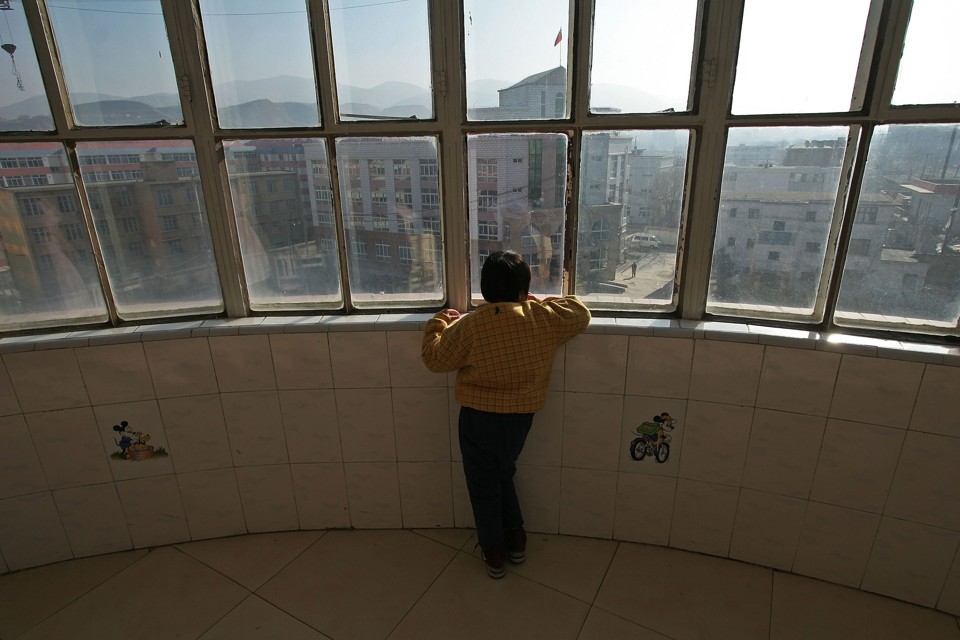
A child with autism looks out a window at the Xining Orphan and Disabled Children Welfare Center, in China.
A child with autism looks out a window at the Xining Orphan and Disabled Children Welfare Centre, China. The Atlantic
A ground-breaking study led by Dr. John Strang of the Children's National Health System in Washington, D.C. two years ago, discovered variance in gender to be eight times commoner in children with autism spectrum disorder, and seven times more likely to occur in children with ADHD. Although the conclusion may to some seem clear enough, the reason, is not. Autism, it has been noted, is described as "social blindness", and children are uninhibited by social expectations, leading to their unaware state of avoidance resulting in impulsive behaviour.

Dr. Zucker's theory leads to his belief that traits so common in autism of "fixating" could be responsible in influencing children to believe that are the wrong sex. While he was director of the Toronto clinic, an external review came to the conclusion that some of his practices were not "in step with the latest thinking", with his published research suggesting that 80 percent of children treated for gender dysphoria see that condition lifting by the time they reach high school, when they finally accept their "assigned-at-birth" gender.

Children on the autism spectrum are over-represented at his gender diversity clinic, feels Dr. Stephen Feder, co-director of the Children's Hospital of Eastern Ontario. "Our approach is still affirmative. But we perhaps take a bit more time to make sure that we get to know the kid as well as we possibly can. It doesn't change the overall approach. I think we're just even more vigilant about making sure we're responding to the appropriate needs of the kid. The issue of obsessiveness certainly comes up", said Dr. Feder.

However, he points out, when asked about their feeling of gender with obsessions of the past, adolescents "really identify it as quite different. This is not about interests. It's about how they see themselves. At the end of the day, we feel it's inappropriate to turn around and say, well if you're autistic , that probably explains your gender. The risk is that people will say, aha, that explains it And I think we want to move away from that."

Labels: , , ,

 
()() Follow @rheytah Tweet