Ruminations

Blog dedicated primarily to randomly selected news items; comments reflecting personal perceptions

Wednesday, May 27, 2026

Closing Down Open, Questing Minds

"For me, university was a place where you wrestled with new ideas."
"Sex, politics, religion, war -- we argued about all of it."
"But somewhere along the way, the climate changed. Students didn't just disagree with ideas. They felt harmed by them."
"And the only way to feel safe was to silence the people expressing them." 
Ric Esther Bienstock, film maker
https://i0.wp.com/biffbampop.com/wp-content/uploads/2026/04/cbc_speechless_ott_program_v02-ezgif.com-webp-to-jpg-converter.jpg?resize=1200%2C666&ssl=1 
"I want to keep my head down. I'm a student.
"I finally got in. I don't want to ask a  question because it might piss somebody off."
"I can't afford to lose marks or lose friends."
Typical response from students
 
"I'm worried about offending someone in the class with a reading, so I'm just going to change my reading list."
"[If they get reported they know the administration will not have their back]."
Untenured professorial class
https://i0.wp.com/biffbampop.com/wp-content/uploads/2026/04/69c2e15485cff.jpg?w=949&ssl=1
BifBamPop!
 
A movie has recently been produced by Montreal-born Ric Esther Bienstock, resident in Toronto. She has had interview experiences with students, professors and administrators at such academic institutions as Harvard, Yale, Cornell, Stanford, Penn State, Evergreen State College, the University of Sussex, and New College of Florida. 
 
Previous film work to her credit include Enslaved: The Lost History of the Transatlantic Slave Trade (with Samuel L. Jackson), The Accountant of Auschwitz, and Tales From the Organ Trade. The industry recognition she has received include two Emmys, two Edward R. Murrow Awards, and multiple Canadian Screen Awards. She is also an Officer of the Order of Canada. There is gravitas behind her image. 
 
"Students asking for safe spaces from emotional harm -- I found that just interesting, and I thought it would make for a good film." As an example ... former professor of evolutionary biology, Bret Weinstein, at Evergreen State College in Washington opposed the school's 2017 Day of Absence change that demanded whites leave campus. For this, he was called racist. "My filming began during a period of intense protests."
 
Her new film is titled Speechless, to be aired on both CBCGem and the BBC, focusing on the political upheaval that has transformed universities throughout North American and the United Kingdom. The film is a portrait of debates over race, gender and social justice escalating by way of 'viral outrage', 'reputational shrapnel' and 'institutional instability'. It also highlights the focus of campus concerns rolling out past university grounds.
 
New College of Florida, the first American institution to dismantle its DEI office and eliminate its gender studies program, initiates the film footage. "I worried about higher education and what's happening on campus. Higher ed is where we're shaping the minds of the future generation of citizens, leaders, doctors, lawyers, policy makers, politicians and teachers. If you can't engage with ideas that you don't agree with or that offend you, what does that mean?"
 
If questing minds who want answers or perspectives to help them digest information and reach informed opinions are shut down for fear of hurting someone else's feelings how does attendance at an institute of higher learning benefit either individuals or society at large? Where there is an imposition of firm self-censorship, free speech absents itself. Socially sensitive issues such as race, gender, terrorist violence such as October 7 must not be approached, as socially abrasive topics that must remain unquestioned.
 
https://canadiandimension.com/images/made/images/articles/_resized/53710108613_4d7cd6b51f_k_800_533_90.jpg
A protest encampment at the University of Chicago’s Main Quadrangle, featuring a sign reading: “As you go to class, remember that there are no universities left in Gaza.” Photo by wabisabi2015/Flickr.
 
A conservative legal organization, the Federalist Society, with chapters at many elite law schools had invited Judge Stuart Kyle Duncan of the U.S. Court of Appeals for the Fifth Circuit to speak at Stanford Law School. Many of the school's law students protested his appearance, attempting to prevent the event from proceeding, lest Judge Duncan's rejection of same-sex marriage alarmingly disrupt those he would address, claiming the school should not be allowing him a platform.
 
This played against the fact that the Federalist Society chapter at Stanford's president is gay, and though he doesn't agree with the judge's views, he argues that, at a law school, students should have the opportunity to listen to a sitting federal judge in light of the fact that they may some day appear before him to argue cases ending up at the Supreme Court. Lacking that opportunity, they remain fixed in a silo of 'approved' views rather than being in possession of well-rounded information/viewpoint exposure. 
 
Film maker Ric Esther Bienstock, points out what should be obvious to anyone; living in pluralistic societies requires those with the opportunity to gain experience through being guided in a university setting to questions that perplex and answers that render all possibilities of explanations to sift through and find the responses that fit the jigsaw puzzle of appropriateness, exceptionalism, social constructs and a balance that results in that fine-tuning of opinion. 
"When I spoke to students from that law school who would not speak to me on the record in the film -- which says something also -- they said to me, 'why do I have to listen to someone who denies my existence, whose views I don't agree with?"
"I wanted to show you, and take you into that world, and then let viewers decide if they think it's good or not."
"If you want to live in a pluralistic society, you should expose yourself to different ideas, different views, different cultures. You can't have institutions that are all monocultures." 
Ric Esther Bioenstock, ethical/social filmmaker 
https://i.cbc.ca/ais/18977efb-e2c1-4769-a447-d6f1089cde86,1776180285893/full/max/0/default.jpg?im=Crop%2Crect%3D%280%2C0%2C1920%2C1080%29%3BResize%3D620
Filmmaker Ric Esther Bienstock discusses how bias plays into every conversation we have while she sits down with Piya Chattopadhyay in conversation. Watch Speechless on CBC Gem.

Labels: , , , , ,

Sunday, September 21, 2025

The 'Monocultures' of Canadian Universities

"Allocating funding to scientists based on their race or sex works against the interest of science and the nation."
"It leads to rather monstrous consequences like saying there are too many Asians on this committee', or too many Asians are getting funding, or too many Jews, or too many Sikhs, or too many Arabs." 
"As a cognitive scientist, I can attest that the human mind is vulnerable to many biases and fallacies. the strongest is the 'my side' bias, the conviction that my tribe or coalition or party is correct and that a rival coalition is ignorant or evil or both."
Harvard cognitive scientist Steven Pinker
https://i0.wp.com/www.canadianaffairs.news/wp-content/uploads/2025/09/Steven-Pinker-Sept-2025-diversity-in-scientific-research-v-2.png?w=501&ssl=1
Harvard University professor Steven Pinker, testifying before a parliamentary committee on Sept. 15, 2025. Canadian Affairs
 
Basic science in Canada is being eroded by diversity mandates practised in the country, and in the process discrediting the academic system, according to Professor Pinker, who delivered his opinion in testimony recently to a House of Commons research committee.  Dr. Pinker ranks as one of the world's best-known Canadian academics, and his testimony amounted to a broad critique of diversity quotas. Such quotas originally dated to the 1970s in the United States, and in recent years have become standard practise in Canadian universities, from admissions to hiring, to grant-funding.  
 
"Universities should stanch the flood of DEI officials, expose their policies to the light of day, and repeal the ones that cannot be publicly justified." As it happens, the Aristotle Foundation for Public Policy revealed in a February report that race-based quotas have become a universal practice of Canadian universities in screening for candidates based on race or sexuality. Candidates are also required to file 'diversity statements' expressing an intention to adhere to 'anti-race' policies on campus.
 
His own Harvard students, explained Dr. Pinker, when faced with mandatory diversity statements, looking to be hired for a research position, fill them on occasion using ChatGPT, the AI program. "They could not honestly fill them out; it would go against their conscience to say things that they knew were not true, but they knew they would be blackballed and eliminated from a job if they expressed their true opinions." 
 
https://smartcdn.gprod.postmedia.digital/nationalpost/wp-content/uploads/2024/06/TMU.jpg?quality=90&strip=all&w=564&h=423&type=webp&sig=Ps96XNEuzQO9IQC7P23T9Q
 
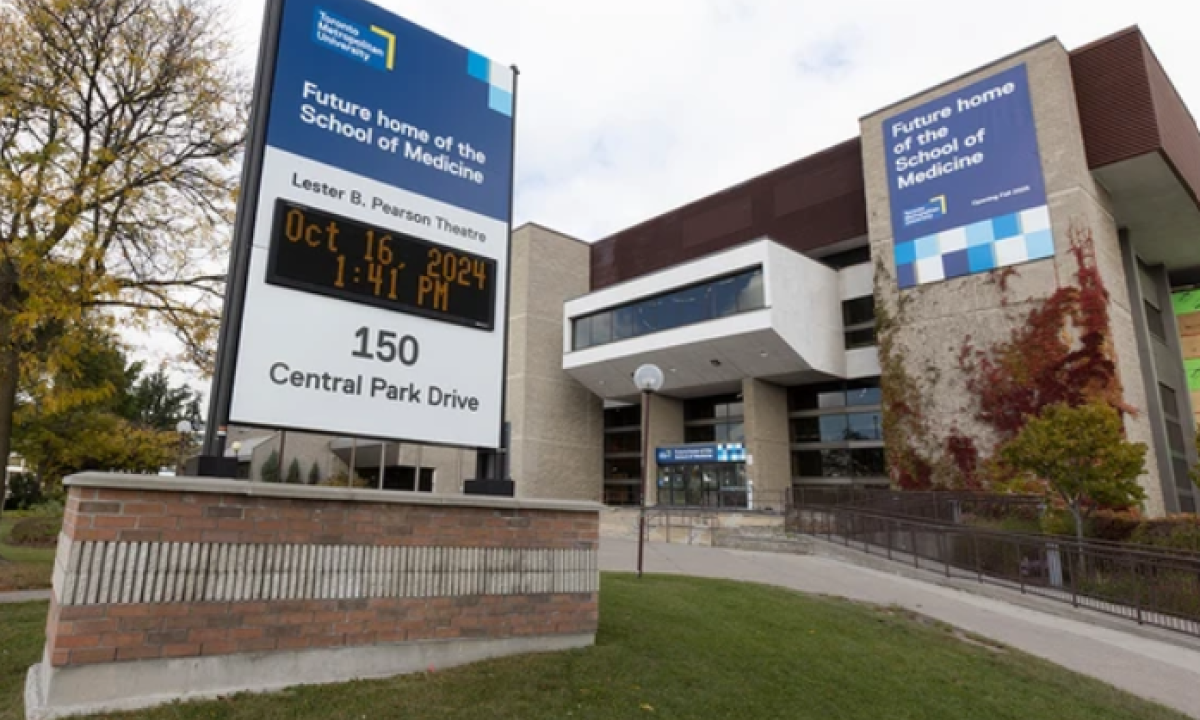
Program sets have been set aside at multiple Canadian universities, for members of a specific race. Last year, Toronto Metropolitan University, as example, opened its medical school with a requirement that 75 percent of all admissions be restricted to Black, Indigenous and other 'equity-deserving' applicants. Many identity-based policies have in fact been driven in Canada by federal order. Canada Research Chairs, as an example, come with a proviso requiring universities to meet firm hiring quotas on race, sex and ability in the disbursement of over $300 million in annual funding. 
 
The formula is laid out to ensure that 50.9 percent of funds must be allocated to females, 22 percent to 'visible minorities', and 7.5 percent to 'persons with disabilities'. In addressing the Commons committee, Dr. Pinker asserted the unreasonableness of the expectation that every single branch of science is to have an ethnic mix, directly proportional to the general population. Under the guise of 'looking' diverse, universities increasingly have become 'monocultures' shunning and punishing dissenting opinion.
 
The result invariably is the opposite of a healthy intellectual culture where biases can be attacked and criticized by colleagues with varying viewpoints. "One person can point out another's errors and the whole community can be more rational than any of the individuals in it", he explained. Dr. Pinker has become an outspoken critic of the "social justice monoculture" prevailing at North American universities. He co-founded the Council on Academic Freedom at Harvard, comprised of a group pledged to endorse free speech and diversity of viewpoints.
 
Dr. Pinker published a five-point plan in the Boston Globe on how to "save Harvard from itself", when multiple Harvard campus groups openly endorsed Palestinian terrorism in the immediate aftermath of the October 7 atrocities in southern Israel when thousands of Palestinian terrorists stormed into farming communities, raping and slaughtering. Dr. Pinker called for the university to 'disempower' DEI.
 
UBC psychology professor Azim Shariff also testified before the Commons committee; his  research led to a 2024 study which found that trust in institutions is lost when politics  align with individuals' personal biases. Science is meant to be objective, not subject to manipulation to have it reflect an ideology or a view based on preconceived social or cultural views. When personal views intersect with science what results is rejected by free and rational minds.
 
https://abrsdpeel.ca/sites/default/files/styles/blog_hero_banner/public/2024-10/Screenshot%202024-10-29%20110002.png?itok=y37obIJm
"We found that the perceived politicization of institutions -- the extent to which institutions were perceived as allowing their political values to impact their work -- was associated with lower trust toward those institutions as well as lower willingness to support and defer to their expertise."
"Canada, unfortunately, has a reputation for having a somewhat politicized academy."
"Politicization in science, it's like bacteria in an operating room. There's no way you'll be able to get rid of it entirely, but you do want to do as much as you can to remove it, and I don't think you should trust any surgeon who's not trying to do that."
Azim Shariff, psychology professor, University of British Columbia 

Labels: , , , , , ,

 
()() Follow @rheytah Tweet