Privacy, Please!
"I've had a shy bladder all my life. You tend to get cramped, minimal lavatories, and especially from the point of view of women, that's why you get inadequate numbers of cubicles [disinterest in designing adequate dedicated bathroom space in public buildings]."
"Personal space boundaries lie at around three feet around you, and you discover when standing side-by-side at a urinal that the distance is much less than that."
"Most councils realize they need to put lavatories in place. They want tourism, they have families, pregnant mums and kids. They want to bring all those people into the town to spend money and keep the whole commercial centre going. It's their money that keeps the shops and cafes open."
"What is very common among guys who have got parusesis who are struggling to use urinals, is they feel they're being noticed or even judged."
"They think normal behaviour is that you're able to start to pee instantly. They're unaware that's not the case."
"I tell people I'm on the shy end of the normal range."
Andrew Smith, 73, chairman, U.K. Paruresis Trust
"I avoid public bathrooms at all costs."
"When on a night out, I'll limit the amount I drink so [as] to avoid having to pee. Bars and nightclubs are the worst because they're so crowded."
Unnamed man, 30
"The figures are a bit rubbery, but the prevalence estimates you get for levels of inhibition and distress that gets to the point of being reasonably serious is around five to ten percent [of the population affected]."
"The main concern is just being observed and judged negatively while engaged in this behaviour [going to the bathroom]."
Nick Haslam, professor of psychology, University of Melbourne
"Cost is the issue. There is no government legislation to provide public lavatories, and there's no government funding."
"Most new lavatories, both private and public, are individual, lockable cubicles now."
"[In response to smelly urinals] The pipes build up uric salts and the ammonia leaches back into the room."
Raymond Martin, British Toilet Association lobby
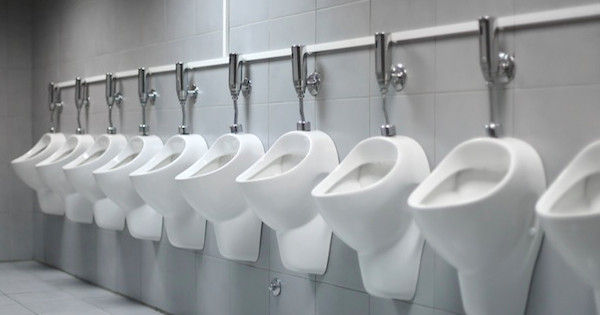 |
Thought it was just you, did you? Convinced it was only you who felt such a straitened distaste for doing private business in what is essentially a public place? You're not alone. Paruresis, the medical term for shy bladder syndrome, is a fear of publicly peeing that afflicts quite a few people, both men and women. Women, of course, don't have to make do with urinals placed directly beside each other where men casually unzip and let go in close proximity. Except that some men don't unzip and go. They agonizingly hold it all in.
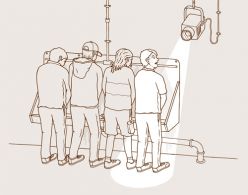 |
They may make the attempt, but are unable to perform. And sometimes the situation is sufficiently traumatizing that they will make a decision to stay home as much as they can so they can avoid a situation where they cannot relieve themselves. Some men on the mild end of the spectrum will make do when instead of urinals there are discrete cubicles, and they manage to convince themselves there is adequate privacy to unlock their frozen bladder.
Dr. Haslam, author of the book Psychology in the Bathroom, discusses what was once called a social phobia; fear of doing things while feeling you're being actively observed. A signal is sent to the brain when someone feels the urge to empty their bladder, to open sphincters allowing urine to flow. For some men and women, social fear is linked to another signal in the autonomous nervous system preventing the sphincter from opening.
Signs of Paruresis
Paruresis can range from mild to severe. Symptoms of paruresis include the following:
- Needing complete privacy when using a restroom
- Fear that other people will hear you when using the restroom
- Complete inability to use toilets other than at home
- Feeling anxious about needing to use a toilet
- Not drinking so that you won't have to use the restroom
- Avoiding events because of the need to use the public restroom
- Negative thoughts about yourself when using the restroom
Minimum guidelines for bathrooms to include privacy boards between each urinal to allow men a sense of modesty protection in the hopes of tackling paruresis so they can pee in peace, are his specialty. His success rate is modest, he admits, as a result of costs involved. But he sees hope in the fact that the rise of unisex lavatories is eliminating urinals in favour of compartmentalized bathrooms where doors can be closed and locked and the temporary residents can find privacy.
In the meanwhile, paruresis sufferers from age 14 to 85 can attend workshops for men and women run by the U.K. Paruresis Trust where courses designed by psychologists revolve around a "talking cure". Mostly, the workshops make an effort to dispel the myths associated with fear of public exposure such as those whose bladders freeze are unlike 'normal' people where free flow of urine is instant and over with. The social bonding that takes place at the workshops allows people to realize that the problem is widespread, they are not 'abnormal'.
:max_bytes(150000):strip_icc()/woman-sitting-on-toilet-108149497-58b59eb33df78cdcd876f178.jpg) |
| Joey Boylan / Getty Images |
Labels: Elimination, Health, Shy Bladder Syndrome, Social Phobia
posted by Pieface @ 6:39 PM
0 comments