Ruminations

Blog dedicated primarily to randomly selected news items; comments reflecting personal perceptions

Monday, April 10, 2023

Self-Check-out Machines Don't Ask Questions

"Theft is a taboo subject among grocers."
"People feel that grocers are profiteering. And if you believe that a retailer is profiteering, then you could argue that the company is stealing, so why not steal back?"
Sylvain Charlebois, professor, food industry expert, Dalhousie University, Halifax

"It is not that consumers are good or bad. It is that sometimes the opportunity makes the crime far more common."
"The situation can make that last-minute choice more likely."
"People steal to get back at retailers."
June Cotte, marketing professor, University of Western Ontario, Ivey School of Business, London, Ontario

"I feel no remorse. I don't steal frivolous things."
"I don't steal beer -- though some days I feel like I need it -- I just want to be able to feed my children some good, healthy food."
"I was like, 'Screw it, I don't care, I am taking the cheese', and that was the first thing I took."
"This is not about thrill-seeking. Everything has gone up in price."
Sam (assumed name), father of two, fully employed, home-owner
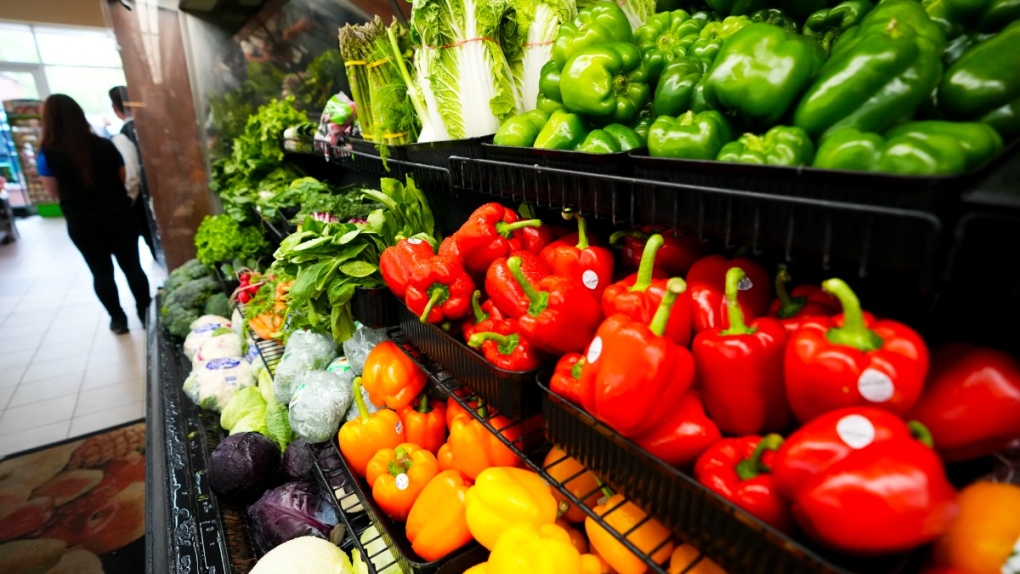
Produce vegetables are displayed for sale at a grocery store in Aylmer, Que., May 26, 2022. THE CANADIAN PRESS/Sean Kilpatrick
Produce vegetables are displayed for sale at a grocery store. THE CANADIAN PRESS/Sean Kilpatrick
 
The results of a recent survey conducted by Professor Charlebois and his colleagues at the Agri-Food Analytics Lab at Dalhousie University was that 30 percent of food shoppers believe grocers have been price-gouging consumers, the "main reason" for high prices. Food theft data is difficult to acquire, but Dr. Charlebois estimates that each grocery store loses between $2,000 and $5,000 every week to theft.

That doesn't sound like much, but in the aggregate it adds up; annual losses due to theft potentially ringing in up to $534 million (at Loblaw), $415 million (Empire), and $250 million (Metro); Canada's largest/leading food retailers. Major grocers' cumulative loss from theft is conceivably about $120 million annually, likely an underestimate.No verification nor loss estimates are available directly from the brand grocers, and franchise owners are  reluctant to give figures for fear of hearing back from head office.

When contacted for comment, parent company executives simply politely decline comment. For them the subject does not exist, at least externally. Logic has it that they are unwilling to register theft as being a "huge problem" since it would represent a public relations faux pas to speak of shoplifting, casting aspersions as it were, on their loyal shopper-base, the customers who come out weekly for their grocery shopping.

In admitting that it is an issue, publicly, there is the risk of alienating their honest and loyal customers, made to feel it is they who are suspected of being petty crooks, defrauding the grocers who trust them enough to make shopping more efficient by employing self-checkout aisles. And surprise, it is those self-checkout aisles where most of the theft is taking place. Where it is not a human cashier, but a machine that lends itself to such opportunities.

Some grocers are attempting to employ techniques meant to discourage theft; permitting only baskets, not carts at self-checkouts. No more temptation over wine and beer, taken completely off the shelves. In some stores shoppers are asked to empty their carts onto checkout stands. And elsewhere security guards are employed to stand watch or to ask for receipts at exit.

There is irony in the fact that the weak-theft-link is the automated self-checkout. Devices which substantially took the place of human cashiers. Increasing the bottom line for the grocers in fewer cashiers to employ, but at the same time, giving opportunity to the larcenous among shoppers who fail to check out their purchases properly withholding some and passing others through. Meat is the big one; setting it aside as a 'freebie', the shopper forgot to scan.

On TikTok, popular with the young, users post content promoting theft calling it "borrowing" and "racking" in reference to shoplifting from big corporations, rather than small mom-and-pop stores. That old 'honour among thieves' rubric reborn. Tutorials on stealth non-purchase can be found on the social platflorm, as well.

Labels: , , , ,

Saturday, December 24, 2022

Rising Inflation, Staff Shortages, Surging Food Theft

"There is a correlation between the two, absolutely. Theft is an ongoing issue. But the intensity actually does increase when food prices go up."
"If you see both food prices go up and ... the economy slows down, jointly that is when you basically see even more stuff [thefts]."
"Theft will cost everyone more because someone has to pay for that [stolen] food. You and I pay for theft."
Sylvain Charlebois, senior director, Agri-Food Analytics Lab, Dalhousie University, Halifax

"Retail crime, including theft and arson, is sadly  higher than it historically has been at Walmart Canada and across the entire retail industry."
"This is very concerning for our business, our associates, our customers and the industry."
Felicia Fefer, corporate affairs manager, Walmart Canada

"There is great concern among Canadian businesses right now about crime, and crime in Canadian workplaces."
"Shoplifting is definitely being felt more, especially as we've come out of lockdown and restrictions."
"If you have fewer people on the storefront, if you know if you have one person deep in the business at the back cash desk, it does lead to the business being a bit of a robbery target."
"Fewer people on the floor ... makes shoplifters feel a little less intimidated to go in and take something [Employees and customers alike feel more] intimidated and nervous [walking into the stores]."
Dan Kelly, president, Canadian Federation of Independent Business
“Thefts from grocery stores appear to be on the rise. With food inflation these days, that was to be expected; and the worst is yet to come. “

According to food industry insiders incidents of shoplifting from food stores has surged to unprecedented levels across the country, coinciding with inflation and shortages of labour, considered major factors leading to an increase in theft. Canadian retailers are recognizing this uptick with great concern. This, at a time that rising food prices helps cushion the bottom lines for food retailers. All of whom have posted record profits, at the same time.

Back in October groceries were priced 11 percent higher than the year before; rising food prices continue and are not expected to stabilize in the near future. For a family of four in Canada, the total cost of groceries is expected to be $1,065 more than the year before, reflecting the conclusion of the most recent edition of Canada's Food Price Report.

Shoplifting Surges To An Alarming Level Across Canada: Report
In Canada, grocery theft is increasing as a result of rising prices.  NDTV
 
Food price inflation is recognized as one of the major drivers inspiring greater numbers of people to begin stealing food, according to Sylvain Charlebois, senior direct of Dalhousie University's Agri-Food Analytics Lab. Meat and dairy products, he observes, appear to be the top two food items that tend to be stolen. The possibility as some economists suggest, that the economy will slow next year, will only exacerbate the problem, he fears.

Inflation, advises Mr. Charlebois, and grocery theft, affect one another; when prices go up, shoplifting tends to surge. To offset the loss, businesses are faced with little option but to further increase prices. Walnart, on the other hand, according to its corporate affairs manager, is implementing measures to prevent and reduce theft with the intention of keeping prices low and to ensure its employees and customers are safe.

The issue of labour shortages -- too many jobs going unfilled because too many people are no longer feeling compelled to join the active workplace -- is also a contributing factor in the shoplifting epidemic, according to the president of the Canadian Federation of Independent Business. Some grocers are struggling to recruit new staff. When a business cannot hire enough employees to perform physical monitoring, this places businesses in a vulnerable position.

This has resulted in retail stores turning to hiring security guards which may include off-duty police officers. Other steps such as retrofitting to ensure clearer sightlines to aid in monitoring events within the business are other steps being taken with the use of more electronic monitoring technology and limiting the number of people in the store in hopes of providing one-to-one service.
"[The council isn't collecting data on whether there is any connection between inflation and shoplifting, but] theft tends to spike during economic downturns." 
"We also know that break-ins, armed robberies, and physical and especially violent incidents are higher than they have been in previous years."
Michelle Wasylyshen, spokesperson, Retail Council of Canada
Produce vegetables are displayed for sale at a grocery store in Aylmer, Que., May 26, 2022. THE CANADIAN PRESS/Sean Kilpatrick
Produce vegetables are displayed for sale at a grocery store in Aylmer, Que. THE CANADIAN PRESS/Sean Kilpatrick

Labels: , , , ,

 
()() Follow @rheytah Tweet