Canada's Universal Medicare in Crisis
"ER [emergency-room] 'chair medicine' in Ontario [the awful cousin of hallway medicine] is unacceptable. Full Stop.""We need to get rid of it. We must fund hospitals and fix the problem of critically ill patients put in a chair.""There is zero exaggeration here. I am sounding the alarm. Hear it."Toronto emergency physician Dr. Raghu Vengopal"It would have been very easy to say, 'Well, if things get worse, come back later'. Who knows how long she could have sat there? And what if that stretcher hadn't become available, and her bleeding had gotten worse? She shouldn't have been assessed in a chair in the first place.""Unconventional spaces [can include any carved-out space. Hospitals are converting ambulance bays into patient wards.] No heating, no plumbing, but, 'Hey, it's great -- we're taking care of our patients by sticking them in a cold garage'.""More and more we're recognizing that we just want to see the patients. We want to try and find those ticking time bombs. We want to get people out of the department [ER] that have been there for 12 hours."Dr. Fraser Mackay, chair, Canadian Association of Emergency Physicians, rural, remote and small urban section
 |
| “Chair medicine" and "waiting room care" have become routine and common, default responses to Canada's severely gridlocked emergency rooms. Photo by Peter Power /Postmedia |
In hospitals across Canada, wait times at emergency rooms have become brutal. People arrive at hospital emergency rooms for the purpose their names suggest; they have a medical emergency and urgently require care. These are people for whom some kind of accident, a malady accelerating, inexplicable pain onset or any number of medical events from heart attack to kidney stones or a burst appendix, that occur beyond their doctors' normal office hours, on odd night or weekend hours, having no option but to rush to emergency rooms, only to be triaged by worn-out nurses and told to take a seat in the emergency waiting room alongside hundreds of others that one on-call emergency doctor will eventually get around to seeing, one by one.
Wait times began to extend from an average of five hours to as long as 12 hours and longer before a physician is free enough to thoroughly examine and then determine a course of action for a presenting accident victim, a kidney patient, someone internally bleeding from a catastrophic fall. Because of an acute scarcity of beds, even of gurneys set up in hallways, many emergency rooms have taken to placing desperately ill people on chairs where attending emergency doctors have no option but to examine them there and then.
 |
| “If a physician … lets the public know that you are in an unsafe environment right now, that we’re doing the best we can, that overcrowding puts you at risk, that we have people dying in our waiting rooms across the nation — those are facts,” says emergency physician Dr. Trevor Jain. Photo by Logan MacLean/Postmedia/File |
Canadian hospitals have reached the point where 'chair medicine' and 'waiting room care' are now common, routine default responses, driving doctors to absolute distraction in distress over the kind of low-access, low-level care that is made available to vulnerable people in medical distress. Dr. Venugopal in Toronto spoke of witnessing people in "extremis from pain" but "put and kept in a chair", when extremis is a word describing people doubled over-in-agony kind of pain. That represents cruel and unusual punishment for anyone desperate for medical care.
"It slowly becomes normalized -- the frog in the boiling water. 'We just wanted to see them to get things started or get things moving along', and then it becomes two patients, then eight, then ten.""You've normalized a patient population through one of these zones that isn't appropriate for them. That can be risky with 'undifferentiated' patients: Is the chest pain acid reflux, pneumonia or an evolving heart attack?""That's the five-alarm fire situation many of us worry about every day.""You cannot appropriately examine a patient in a chair, physically, or from a patient privacy perspective. You have to lift up shirts, take off pants, put on monitors, get your stethoscope out."Dr. Michael Herman, Ottawa-area emergency physician
 |
| In a lawsuit against B.C.'s Fraser Health Authority, emergency doctor Kaitlin Stockton alleged she was threatened and harassed for speaking out about critical overcrowding. Photo by Tiga Ivsins |
This is what medical care in Canadian hospitals has been reduced to, as the population base continues to increase through unprecedented levels of immigration, refugee and migrant intake, on an already-overburdened system with a steadily aging population. Hospital emergency rooms have been 'coping' for years, with steadily increasing wait times, overburdened medical staff and greater demands than ever before for universal health care service. 'Unconventional places' never designed for patient care have become the back-stop for patient care.
These are spaces where emergency medical care is reduced to looking after people with no access to oxygen or suction, no nurse call bell, no ready access to a washroom or a sink, and not a whit of privacy. In desperate coping reaction, patients are examined in closets and washrooms, with doctors directing ill patients into corners and cubby holes, blankets hung off IV poles for makeshift curtains in chaotic hallways. Doctors have had to depend, more than ever, on their physician-instinct in many cases, to ensure that people they examine in such circumstances are not given short-medical-shrift.
 |
| The exterior of the Windsor Regional Hospital emergency department photo. (Jennifer La Grassa/CBC) |
"[The pressure to provide treatment in whatever space they can is creating a moral] damned if you do, damned if you don't [dilemma for emergency staff across Canada].""You don't want to watch suffering and see patients not doing well and lingering in the waiting room. But you also know that, when you walk out there, you don't really have a nurse, you don't have monitoring, you don't have the standard things you would have if you had a normal care space.""You, by definition, are basically kind of MacGyvering-it and giving suboptimal care to a degree."Dr. Paul Parks, emergency physician, Medicine Hat, Alberta, former president, Alberta Medical Association
On any given day in Ontario an average of 1,390 people in 2023-24 were given care in an unconventional space. Emergency departments over the years have designed 'minor treatment' spaces where for example, three chairs separated by office dividers in a public hallway outside the waiting room gave birth to 'chair care'. Then 'rapid assessment zones' designed for the 'less acutely unwell' arrived on scene where people with sprains, cuts requiring stitches, sore throats, ear infections could be tended to.
Where danger enters the picture is when the emergency department gets 'jammed up with admits'; every cubicle or hallway stretcher filled with people requiring hospital admission, but no empty beds are available; scarce beds used for people who no longer require hospital care, but there is no space in nursing or long-term care homes, no home care or rehab bed available to them. Known as 'access block'. A system in free fall lacks the capacity to adequately assess, treat and discharge acutely ill patients.
The growing practice of boarding -- admitted people kept on a hallway stretcher for one, two, three days awaiting an open bed has become inevitable under these circumstances. Recently, a systematic review discovered notable evidence that links boarding with higher hospital death rates, longer hospital stays, more medication errors and burdensome staff burnout. There is a chronic hospital bed shortage in Canada, with an obvious obligation for hospitals to be able to discharge patients once their need for medical care is completed.
"None of this has anything to do with the emergency department. That's the frustrating part.""But it's a huge burden on staff and a huger burden on the patients, because they're not getting the care they need in the place they need it."Dr. Fraser Mackay
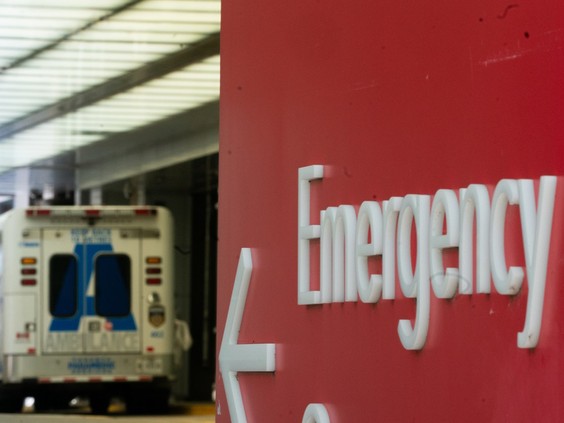 |
| “Chair” and “waiting room” medicine have become routine and common, default responses to Canada’s severely gridlocked emergency rooms, doctors say. Photo by Peter Power/Postmedia |
Labels: Bed Shortages, Hospital Deaths, Hospital Emergency Rooms, Inadequate Care, Medical Examinations in Chairs, Patients in Duress, Staff Burnout
posted by Pieface @ 8:25 PM
0 comments