The Undocumented Non-Deaths
 |
| Rosanne Casimir, chief, Tk'emlúps te Secwépemc |
"While we want facts and answers as quickly as possible, we face significant challenges in accessing government and Catholic Church records for the 88-year-period the school operated. Our progress has been hindered by government restrictions on certain records and slow response.""Indigenous communities place deep importance on honouring and protecting ancestral remains, and with 38 affected Nations involved, we must seek consensus on any future outcome.""No interviews will be granted at this time, and Tk'emlups te Secwepemc will continue to provide updates as the investigation develops."Tk'emlups Chief Rosanne Casimir
 |
| The Ahousaht First Nation released findings on April 10 from their ground-penetrating radar search for possible graves of missing residential school children. (Chris Corday/CBC) |
The history of the particular residential school that Chief Casimir focuses on may reflect 88 years of abuse of aboriginal children in her opinion when religious institutions in Canada -- primarily Catholic -- in agreement with the federal government of the time instituted elementary schools on and around traditional Indigenous land for the purpose of exposing children from nearby reservations to an education system reflecting the European roots of the mainstream Canadian population, to prepare the children to take their place within the greater Canadian population. But five years on from her declaration of unmarked graves no proof of her claim has surfaced despite millions provided for that purpose.
At that time and in those places, most Indigenous families were supportive of having their children receive a formal education. It was, unfortunately, an educational system unsupportive in its focus, of Indigenous history, tradition, language and values, exchanging them for a European style of education focusing on the elementals of education with the perspective entirely that of a Europe-centered ideological bent, meant to ignore and deliberately downplay the students' origins. Its intention was to prepare the children to go on to higher education and some did, exposed to the professions whose purpose they entered and took advantage of.
The modern perspective of the residential school system was that it erred in separating and alienating Indigenous children from their heritage, language and customs, which the schools substituted with the intention of preparing students to disown their own and adapt to the colonialist views of education leading to a participatory workforce. Well intentioned for the most part, but oblivious to the harm being perpetrated even while endowing the children with knowledge relating to the world outside the confines of the cloistered communities in which they came from. Which the outer world disdained, leading to societal prejudice.
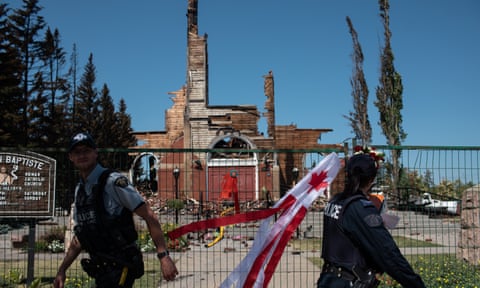 |
| Firefighters inspect the damage at the burned-out Roman Catholic St Jean Baptiste church in Morinville, Alberta, Canada. Photograph: Anadolu Agency/Getty Images |
In 2021 Canada awoke to the startling news that a ground-penetrating radar survey of the Kamloops Indian Residential School grounds had revealed that unmarked graves were identified, holding the remains of bodies of hundreds of aboriginal children. "Ground-penetrating radar primarily detects changes in the soil and we want to emphasize that we do not see any bodies or bones using this particular technique. This does not work like an X-ray" an explainer published by the Canadian Archaelogical Association stated.
That explanation followed directly on the statement in May of 2021 announcing "confirmation of the remains of 215 children" at the site of the former Kamloops Indian Residential School, by the local Tk'emlups te Secwepemc tribe. The announcement spoke of "lost children" whose remains were discovered as "lost loved ones", including ages of those buried: "Some were as young as three years old", added Tk'emlups Chief Rosanne Casimir who sponsored a resolution that year at the Assembly of First Nations that referred to a "mass grave".
No one questioned the details and the accuracy of the charges, and the Trudeau government immediately ordered the lowering of the Canadian flag for six months of mourning. Stories appeared in all news media mourning the unspeakable discovery of undocumented, unidentified remains of Indigenous children who attended the school and never returned home. The shocking news was picked up by the international press, and the Liberal government under Trudeau labelled the news as proof of a 'genocide' carried out against Canada's First Nations.
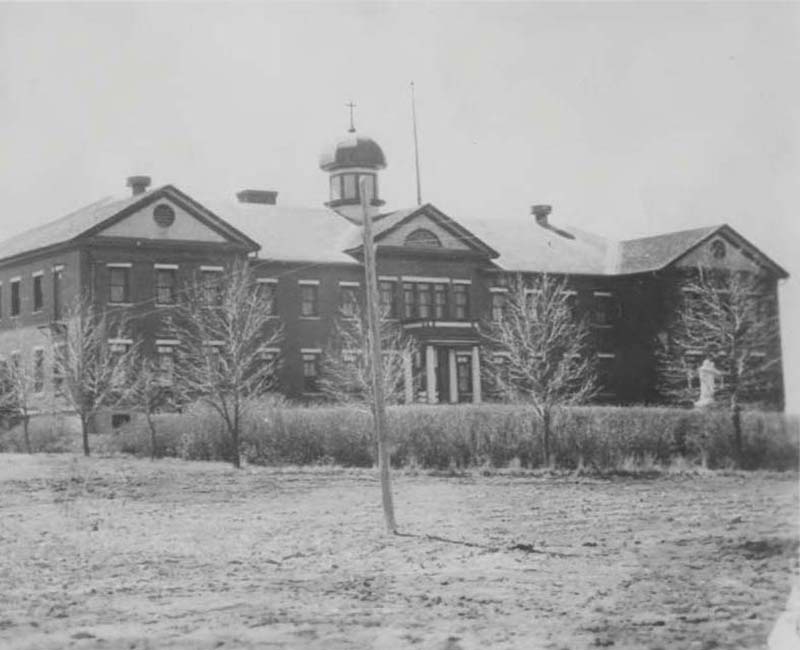 |
| Crowfoot St.Joseph's Residential School |
From the aboriginal communities the reaction was incendiary -- literally. Churches, mostly on aboriginal land, were burned down and destroyed. There was no government action, little effort at investigation, much less taking any perpetrators into custody. Demands from aboriginal groups and their supporters that Canada's Prime Minister at the time of the residential school inauguration be censured, statues memorializing Sir John A. Macdonald, Canada's first prime minister be taken down, as well as that of Queen Victoria, along with others that were vandalized with no consequences for those besmirching the reputations of people who in actual fact were concerned for the future welfare of the aboriginal communities.
Following the initial declaration of the discovery of a "mass grave", when doubts began to set in, Chief Casimir walked back the definite nature of her revelations, to begin referring to 'anomalies' revealed by the ground-penetrating radar; disturbances in the earth, and not verification of bodies buried in those areas. Funding was given to the Kamloops area First Nations as well as others across Canada, to dig in the suspected burial areas at the discredited schools and disinter any possible body remnants to affirm the reality -- or not -- of the allegations. Five years later, no First Nation group has used that funding to prove the accusation levied of 'genocide'.
Now, Tk'emlups te Secwepemc claims no exhumations would be performed in the absence of unanimous agreement from every other First Nation whose ancestors were known to have attended the Kamloops Indian Residential School. But they still speak darkly of the sinister intent of the non-aboriginal community whose agenda was clearly to destroy First Nations dignity, heritage, culture, language and the next generation. There is, said Chief Casimir "a knowing in our community that we were able to verify" in the "undocumented deaths".
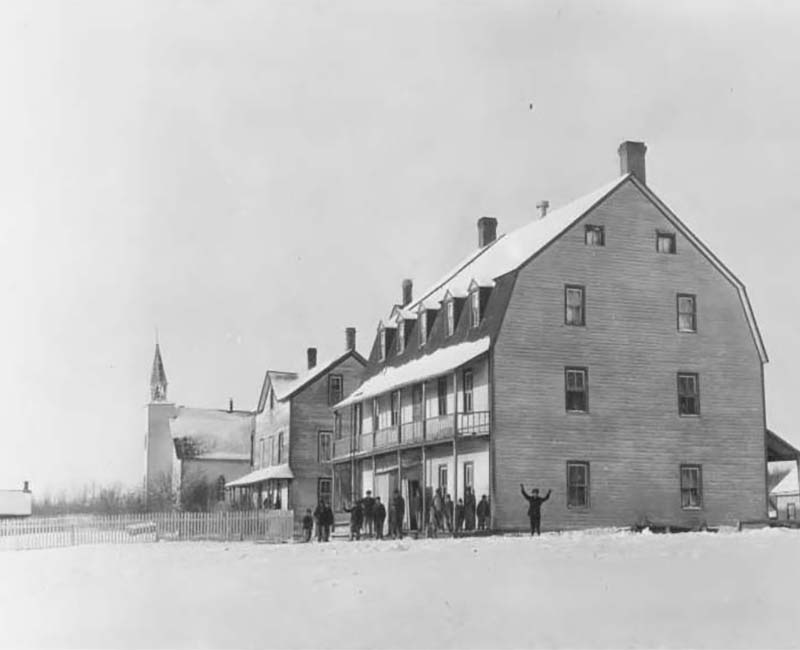 |
| St.Anthony's Sacred Heart Residential School |
Labels: "Undocumented Deaths", Canadian First Nations, Canadian Residential School System, Indigenous Communities, Kamloops Indian Residential School
posted by Pieface @ 8:17 PM
0 comments