Ruminations

Blog dedicated primarily to randomly selected news items; comments reflecting personal perceptions

Sunday, November 05, 2023

Israel's Bomb-Proof Underground Blood Bank

"It became very clear we needed to move with the war plans because this was exactly the moment, the event it was built for."
"We worked very hard to supply everything they needed [units of blood following the Hamas attacks]."
"We had many injured [patients] and we had to treat them."
Dr. Eilat Shinar, director, Magen David Adom national blood services division
https://dims.apnews.com/dims4/default/192f8d8/2147483647/strip/true/crop/6000x4000+0+0/resize/1440x960!/format/webp/quality/90/?url=https%3A%2F%2Fassets.apnews.com%2Fa8%2F86%2F60dfd4255f5a65ec06d9bee35f3f%2F7b85308e6b8a434880de48362eb44991
Staff at work at the Magen David blood services center in Ramla, Israel. Bernat Armangue/AP
 
Israel's newly-planned and built blood bank went into premature, but immediately-required action mere hours following the terrorist attacks in southern Israel perpetrated by Hamas on October 7. The Marcus National Blood Services Center in Ramla, located close to Tel Aviv, a new, fortified, subterranean blood bank was scheduled to open within days -- and then October 7 arrived. With over 1,400 people in Israel murdered, and thousands wounded, that timeline was expeditiously moved up with the urgency of need.
 
Staff members immediately responded by moving equipment into the underground bunker to begin their Herculean task of saving lives. At its lowest level, the six-storey, state-of-the-art medical facility, some 15 metres under ground, is built to standards that protect it from rockets, missiles, chemical attacks and earthquakes to ensure that blood processing can proceed when most needed.

The centre, an arm of the Israeli medical emergency, disaster, ambulance and blood service, was able to provide tens of thousands of units of blood mere days following the Hamas attacks. Since the conflict began, thousands of people have donated blood, standing in line for hours to be able to do so. Early in October, 5,000 units of blood were received in one day alone, representing five times the usual contributions, as an overall sense of emergency and preservation settled over the nation.
 
Built in the 1980s, the former blood bank was incapable of handling the country's needs in times of great stress such as conflict. It had additionally been exposed, although not damaged, during earlier conflicts. Following the third war against Hamas in 2014 when rockets reached Tel Aviv and other major cities, plans began following discussions over the need to create a more protected and upgraded facility.

Now almost twice the amount of blood can be stored in the new centre in comparison to the utility of its predecessor -- half a million units annually, compared with 270,000 -- more blood has been processed than has ever been available in Israel's reserves. All of Israel's donated blood is processed in the new steel and concrete 51,000 square-metre facility. Which has a transportation centre, a molecular lab, and an air-filtration system, allowing staff to work even in the potential of chemical or biological conflict.

There is a 300-square-metre safe room whose construction shields it against the most penetrative missile threats.

https://dims.apnews.com/dims4/default/3b359a4/2147483647/strip/true/crop/6000x4000+0+0/resize/1440x960!/format/webp/quality/90/?url=https%3A%2F%2Fassets.apnews.com%2Fdf%2Ffb%2F80bb3164e0a25f598baba4c83f52%2Fdb958c051efa4632a64bd15da3aaa5e8
Staff at work at the Magen David blood services center in Ramla, Israel. Bernat Armangue/AP

Labels: , ,

Tuesday, October 24, 2023

Where There's a Pressing Need

"We worked on the individual for such a long period of time and eventually, we're so thankful that we were able to save a life today."
"I couldn't sit down and stay home."
"On October 7 the world witnessed a massacre of Jewish people the likes of which we haven't seen since the Holocaust, and I never thought in my wildest nightmares that such a thing could possibly happen."
Ira Price, Canadian physician, Hamilton, Ontario
 
"Israel has a near universal conscription system and conscription doesn't end when your army duty ends, you do reserve duty until you're 45."
"In times of national crisis, army reservists are called into active duty and many of them are paramedics, which means there's a shortage of paramedics in the system."
"We got a phone call from Magen David Adom [Israeli Red Cross] that we were needed, and we dropped what we were doing to come and help."
"This is a new situation for all of us. It's been busy but with the routine stuff, life is going on behind the front."
"People are still getting hurt, people are still getting chest pains, people still need an ambulance to get to the hospital, and so we're making sure that goes on as it should."
Michael Schweitzer, family doctor, Hamilton 

"We arrived in Ashdod and initially it wasn't clear where we were going to sleep at night, and this other medic who came in, she overheard the conversation and said 'Here are my house keys, I'm doing the night shift, go sleep'."
"I spoke to a crew that went and resuscitated a Hamas prisoner of war."
"Imagine the conflict emotionally, they had. I asked the guy, and he said 'it doesn't matter, I have a person in front of me who needs medical care and we're going to resuscitate'. And they did."
Daniel Kollek, emergency Md, Joseph Brant Hospital, Burlington
https://smartcdn.gprod.postmedia.digital/nationalpost/wp-content/uploads/2023/10/MDA-2.jpg?quality=90&strip=all&w=1128&h=846&type=webp&sig=3O2BUrJAfQ0gkIDaxpwFqg
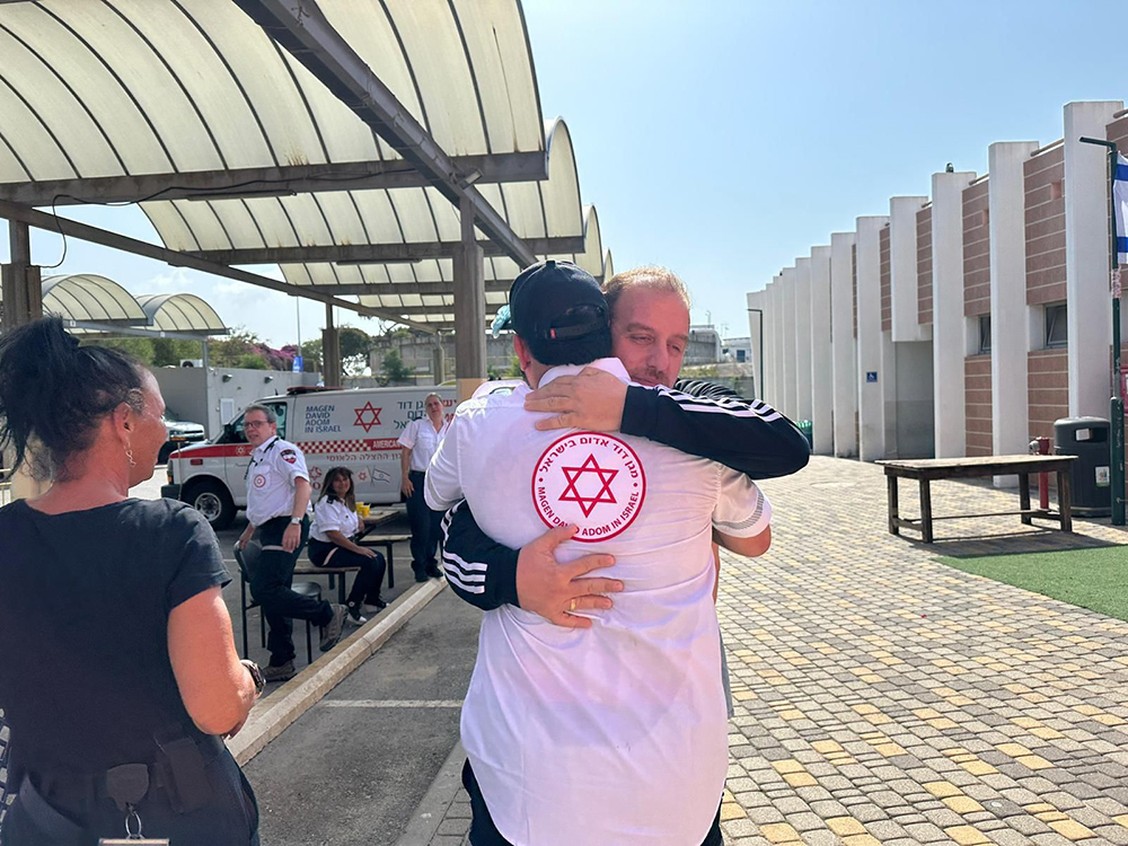
When sirens blasted their warning of rocket fire on Friday close to Ashdod, southern Israel, located 30 kilometres from the border with Gaza, while rushing toward shelter, a ten-year-old girl collapsed in cardiac arrest. Arriving with life-saving equipment, an emergency medical unit, among whom one of which was a Canadian doctor, barely managed to save the girl's life after a stressful lengthy team effort succeeded in saving the girl.
 
With the local MDs and ambulance crews of paramedics, three Canadian doctors have become party temporarily to a co-ordinated effort to persuade emergency doctors abroad to come to Israel to fill emergency services gaps working with Magen David Adom, Israel's national emergency medical service, officially recognized under the International Red Cross and Geneva Conventions. They're not deployed to the front lines, but they are providing wartime medical assistance.
 
https://smartcdn.gprod.postmedia.digital/nationalpost/wp-content/uploads/2023/10/MDA-3.jpg?quality=90&strip=all&w=1128&type=webp&sig=hhstSJ4Z4aT0acToYrhkJQ
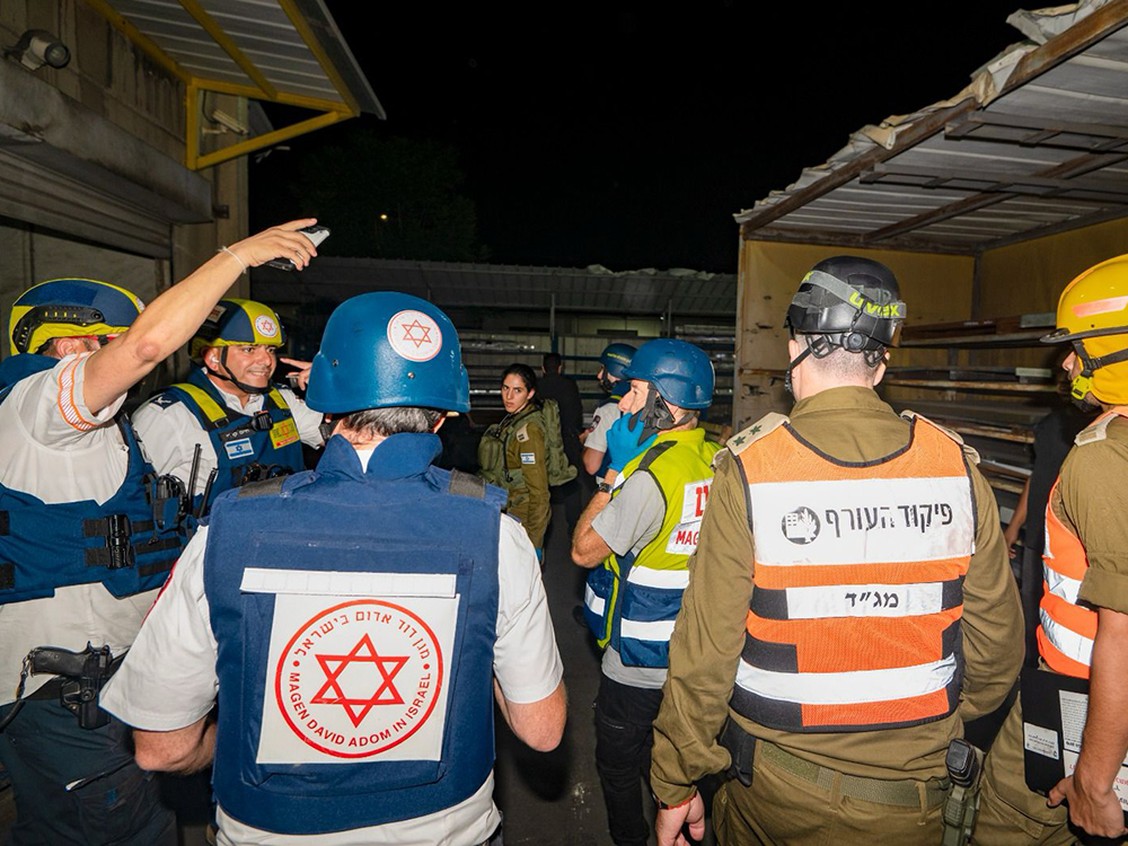
MDA officers on the weekend respond to calls for people injured by shrapnel. Photo by MDA

 One among them, Dr. Schweitzer, had performed MDA shifts on six previous occasions, from 2015 forward. this time, against a war backdrop, interruptions by air raid sirens, his experience is quite different from his previous bouts of co-operation with the MDA, irrespective of the fact that the emergency calls are similar to what he had previously taken part in.The deputy director of MDA's training department is himself a Canadian, before emigrating with his parents to Israel.

In the area they were all deployed in, southern Israel, where the October 7 invasion and resulting carnage took place as Hamas terrorists slaughtered 1,4000 Jews in border towns and kibbutzim, Dr. Pollack described the area after it was retaken by Israeli forces, finding their ambulances had been heavily damaged by the Hamas intruders intent on inflicting as much pain and damage on people and property as conceivably possible. Clearly the ambulances were meant by Hamas to be so badly destroyed they could never again be  used to provide medical assistance to the afflicted.

A regional director for MDA in Canada, Hershel Recht is involved in contacting and training medical volunteers who prove willing to perform short-term duty in Israel. He started out with a list of eight volunteers prior to the attacks. That list has since increased to 118. "We never thought there would be such a need. The urgency is like nothing before", said Mr. Recht.

https://smartcdn.gprod.postmedia.digital/nationalpost/wp-content/uploads/2023/10/MDA-1.jpg?quality=90&strip=all&w=1128&type=webp&sig=7-Hd1kTGUjzOitsY9sXuVg
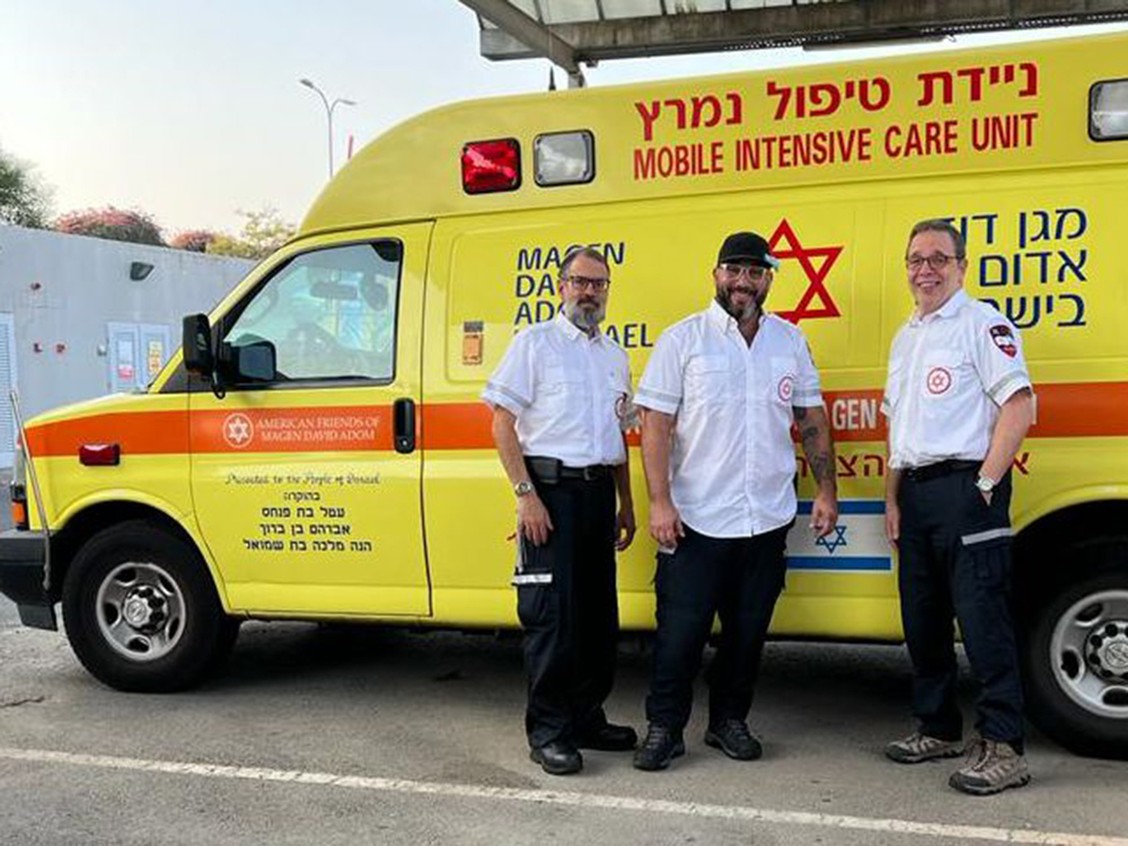
Three Canadian doctors who traveled to Israel to help relieve emergency medics during the war with Hamas: left to right, Michael Schweitzer, Ira Price, Daniel Kollek, all from Hamilton, Ont. Photo by MDA
"This is a very difficult time here in the country and at MDA [Magen David Adom]."
"MDA has lost good people who rushed into the combat zones to provide medical assistance and were killed in action while doing so. Others were injured."
"One was trying to get an ambulance to reach some of the injured and he was shot and killed on the spot."
"We're still on the front lines and also on the home front, trying to provide any medical assistance to anyone in need. We have many Muslims, many Jews, as staff members and volunteers, Christians also. All are united to provide medical assistance."
"Our staff members did transport injured terrorists, We'll treat them. We don't differentiate between anyone who's injured and needs medical attention."
Daniel Pollack, deputy director, training department, MDA


Labels: , , , ,

 
()() Follow @rheytah Tweet