Ruminations

Blog dedicated primarily to randomly selected news items; comments reflecting personal perceptions

Monday, April 08, 2019

Rational Explanations Collide With Local Legend

"I was sure she was dead. Something overcame Bonnie as soon as we approached the bridge. At first she froze, but then she became possessed by a strange energy and ran and jumped right off the parapet."
"It was a miracle that she survived."
"Other bridges don't have troubled spirits lurking about."
Lottie Mackinnon, Dumbarton, Scotland

"The lady [White Lady of Overtoun, widow of John White] lived alone in grief for more than 30 years after her husband died in 1908."
"Her ghost has been lurking around here ever since."
Marion Murray, resident, Dumbarton, Scotland

"I've walked the bridge. The first time I reached a point, and it was as if the air got thinner and my stomach jumped, a bit like when you miss a step going down a flight of stairs. The second time, I just couldn't stop feeling like something bad was going to happen."
"There was a woman with a dog at the edge of the bridge, and the dog would not take a step forward. Later, I found out that a couple of dogs had jumped to their death from the bridge that weekend."
Jenna, 20, from Glasgow
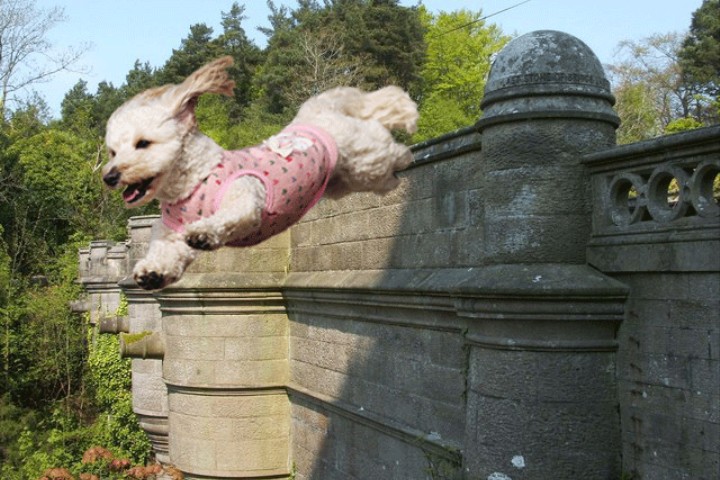
Overtoun Bridge  Dog photo: Ray Larabie
A legend and a mystery. Ms. Mackinnon's Bonnie is a Border collie whom Lottie Mackinnon was walking in Dumbarton, over the Overtoun Bridge. She describes her dog's strange behaviour ending in the dog leaping off the bridge into the wooded ravine below. Suddenly, uncharacteristically, frighteningly. The woman felt certain her dog would not survive. She was fortunate it did.

Evidently an estimated 300 dogs are said to have done the very same thing; arrested in motion at a certain place on the bridge, then some peculiar force compelling them to leap over the rampart into the forest far below. Since the 1950s when this strange, unaccountable phenomenon began occurring with local dogs, fifty have died. The valley bed, littered with rocks that they dashed themselves upon killed them.

Northwest of Glasgow, Dumbarton residents started to regard Overtoun, a hundred-year-old bridge stretching across a 15-meter gorge, the "dog suicide bridge". The bridge leads to grounds surrounding a 19th-Century manor, Overtoun, built by a wealthy industrialist, James White. The bridge is actually an extension of a long drive leading to the manor. And the grounds are a popular walking destination for nearby residents.
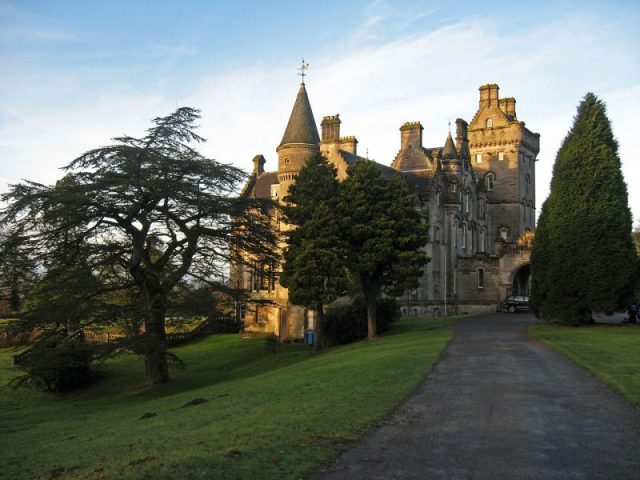
Overtoun house Author :dave souza

The bridge was built in 1894, in the manner of the Gothic era, as was the manor house. "After 11 years of research, I'm convinced it's a ghost that is behind all of this", stated Paul Owens, author of a recently published book featuring the mystery of the bridge. He had grown up in a nearby town, and had obviously been familiar with the area and the legend around Overtoun as locals are wont to discuss such things.

Local residents believe the paranormal is the answer to the mystery, that the restive ghost of the widow of the manor's builder's son, called irresistibly to dogs to end their lives there, at the bridge. An animal behaviorist -- David Sands -- looked into the phenomenon of the bridge and its deathly attraction to dogs, in 2010. He conducted a number of experiments that led him to believe that the dogs were attracted at the site to the scent of animals living below in the ravine.

He held that the limited perspective of the dogs, along with their lack of knowledge that the path changes from level ground to a bridge spanning a deep gorge, linked to the challenging odours wafting upward from the ravine enticed the dogs to try to track the animal scents as dogs are wont to do, often giving chase to other animals when on walks through forested areas.

While his theory makes sense, the mystery remains for local residents over the fact that it is this bridge and this one alone, not other bridges over ravines where mammals roam below that appears to have this irresistible draw to dogs, leading to their sudden, explosive action where they leap from the bridge into the vast empty space, to land in the densely treed ravine below, some to survive and others not.
Overtoun Bridge in Dumbarton, Scotland, has played host to a bizarre trend of cancines leaping off it. 
Overtoun Bridge in Dumbarton, Scotland, has played host to a bizarre trend of canines leaping off it.  Credit: gerard ferry
"I was up there one summer’s day and I felt a very strong jab — like a phantom finger — twice in my back. It was the sensation you get when you fear someone might push you over the edge of a train platform."                                                                                                            "It’s a very strange place. One of the things peculiar to the location is that it can seem very peaceful and tranquil, but it can turn at a moment’s notice."                                                                                                          Paul Owens, Author


Labels: , ,

Saturday, May 19, 2018

Deciphering A Mystery

"We [in professional vocabulary] call it an accident because that's our terminology [as air accident investigators]. But this is a criminal act. It's not an accident."
"If someone does this intentionally, you can call that suicide. The pilot took his own life and he took the lives of everyone who was on board that aircraft."
"People accuse me of being insensitive to families. I don't mind taking the question, but if someone challenges me, I say, 'I don't need any lessons from you. How many grieving families have you talked to after an airplane accident? I've done it by the hundreds. Don't tell me that I don't have any sympathy. I've had people faint in my arms."
"What they're [searchers for the wreckage of MH370] proving every day they search is that their assumptions were wrong."
"[The Malaysian Airline pilot’s] intention was to make the plane disappear forever, and make it so that no one would ever find it."
Larry Vance, retired Ottawa air accident investigator

"When you start looking at them [identifiable parts of MH370], there's a story in every one of them. And the story is consistent."
"When the airplane is coming in [vertically] at 300 to 600 feet per second, everything is shattering into a million pieces. In a third of a second to half a second, it's gone."
"There's no way you could end up with a piece like this with the leading edge absolutely intact."
"Wreckage analysis is a dying art. They're depending on the recorders [recovered black box]. They tell you what happened -- maybe. But they don't tell you the sequence or why things are happening. You need to be able to do wreckage analysis."
Terry Heaslip, retired Transportation Safety Board investigator
A flaperon from MH370 recovered from the Indian Ocean, showing the intact rounded leading edge that air crash expert Terry Heaslip says proves the plane was ditched at sea and didn’t crash at high speed. AFP/Getty Images
Three investigators with the Transportation Safety Board, a federal Canadian investigative authority, retired to launch their own consulting company into accident disasters, calling it HVS Aviation. Larry Vance, Terry Heaslip and Elaine Summers, all retired, thought their own independent investigation into the mystery of Malaysia Airlines Flight 370 might represent a good joint exercise, whose conclusion might have a twofold purpose; their effort leading to success would give comfort to the grieving families in solving the mystery, and the results would give closure to a puzzle.

Vast sums of funding went into international searches, at first desperate in nature, in hopes of being able to rescue survivors lost at sea awaiting help, or marooned on a remote island somewhere. When the critical  time frame for rescue had passed, it became an international search without anyone knowing precisely where to search in a confused and confusing scenario that placed hope on various areas of vast oceanic searches. Airplane parts were found and  discovered not to be those being looked for, though eventually some pieces did surface and were identified as having come from Flight 370.

That the Boeing 777 had simply vanished with all 239 passengers and crew aboard on March 8, 2014 was a shocking catastrophe. Explanation eluded, and searches were futile. In all of aviation accident history this single flight disaster likely epitomizes the most puzzling. In a later flight of a German airliner in the remote French Alps a brief mystery also puzzled investigators when in March of 2015 Flight 9525 crashed into mountains with the loss of 144 passengers and six crew. Its young co-pilot had carefully planned his own suicide and sacrificed the lives of all aboard to his plan. That conspiracy, however, was solved with the aid of recordings and a successful investigation.


The mystery surrounding the Malaysia Airlines flight is more enduring, however, and it isn't that long ago that the last of a succession of searches was called off with a sense of hopelessness. There were 20 confirmed and identified MHY370 pieces retrieved since the plane and its human cargo vanished. It was some of those pieces that have helped this investigative team who took on this investigation of their own initiative, to solve the seemingly unsolvable. They examined all available data and came to their conclusion.

Mr. Heaslip, an expert on wreckage analysis, who with the Transportation Safety Board was its director of engineering and his partners were convinced the crash resulted from a deliberate action on the part of one of the pilots. Whom they theorize in all probability killed his passengers through depressurizing the plane. And then he deliberately flew toward a remote stretch of the Indian Ocean and ditched the plane to end his life, taking so many others with him, becoming a mass murderer in one fell stroke.

Their theory bears no resemblance to the official story which holds that the plane flew in a straight line until running out of fuel when it plunged vertically into the sea. Quite dissatisfied with the official theory, the Ottawa-based investigators examined wreckage photographs, the flight path maps and schematic drawings of the aircraft. Their investigation transcended a cold analysis of engineering calculations and cockpit procedure, however; their concern also lay with the need of the families to know the truth of what had occurred.
"This is an attempt by us to give some amount of closure by telling them [families of the victims] what happened. Because if people in the end -- I don't care who they are -- if they know the truth it's better in the long run than if they never know what happened."
Larry Vance
And so they zeroed in on pieces that had washed ashore and identified as having belonged to flight MH370; the aircraft's right flap, a part of the wing extended when the plane slows before landing, and the adjacent "flaperon", used to control the plane in low and slow flight. Along with the eight-by twelve foot piece also examined which they knew could not possibly have survived a high-speed vertical impact. Both it and the rounded leading edge of the flap and flaperon were undamaged.

Relying on tried-and-true wreckage analysis; studying stresses and fractures visible on the recovered pieces Heaslip and Vance deduced the forces that tore apart the plane; an exercise that no electronic data of a black box recorder could reveal. Earlier parts of the flight, including the pilot turning off the plane's transponder to make it invisible to radar before reversing direction and flying along the boundary point of two different air traffic control regions to ensure the plane would be missed by controllers, all contributed to their analysis and final conclusion.

The team documented their careful study of all available evidence and their professional analytical methodology, to reach their final, informed conclusion, and it all appears in a book titled MHY370 Mystery Solved which can be ordered online at hvsaviation.com.

Labels: , , , ,

Tuesday, March 28, 2017

Deconstructing an (Ancient) Crime

"He's in better condition than recent homicide victims I've worked on who have been found out in the open."
"Imagine, we know the stomach contents of a person [who lived] 5,000 years ago. In a lot of cases we are not able to do that even now."
"It was a very active defensive wound, and interesting in the context that no other injuries are found on the body, no major bruises or stab wounds, so probably he was the winner of that fight, even possibly he killed the person who tried to attack him."
"Roughly half an hour before his death he was having a proper meal, even a heavy meal."
"If you're in a rush and the first thing is to get away from someone trying to kill you, that's not what you do [pay attention to details]."
"The aim of the offender was to kill him, and he decides to take a long-distance shot -- could be a learning effect from what happened one or two days before. Which is pretty much what you see all the time nowadays. Most homicides are personal and follow violence and an escalation of violence. 'I want to follow him, find him and kill him.' All the emotions we have in homicide, these things have not died out in all these years."
"This was not a robbery gone bad or something. You go back to your village with this unusual [copper] axe, it would be pretty obvious what had happened."
Detective Inspector Alexander Horn, Munich Police
Otzi the Iceman: Forensic artists put face to victim of 5,300 year old murder
Dutch forensic experts Alfons and Adrie Kennis create the first image of Otzi (inset) Photo Heike Engel, South Tyrol Museum of Alchaeology

The man was not lean, not overweight, but well muscled and in fine shape for someone of 45, obviously accustomed to moving about a lot on his size 7-1/2 feet. He had brown eyes and shoulder-length dark brown hair, was five feet, five inches tall, weighed 110 pounds, and lived and died five thousand years ago. His body was found intact, encased in a glacier at the northern Italian border with Austria, by two hikers, in 1991. And his discovery caused a worldwide sensation. His well-preserved body was the finest and most complete ever discovered of a human being who lived during the Copper Age.

And his body is being preserved at the South Tyrol Museum of Archaeology, in Bolzano, Italy. He is known as 'The Iceman', and also as 'Otzi', named for the geography where he was found, close to the crest of the Otztal Alps. Detective Inspector Horn had been approached by Angelika Fleckinger, director of the Bolzano, Italy museum where Otzi was being kept, with the request that he agree to some forensic work in determining the cause of the Iceman's death, and Mr. Horn was agreeable to the prospect, the 'coldest case' he had ever been assigned to.

Because the high humidity of the ice in the glacier in which he had been frozen after death was instrumental in preserving his organs and skin in intact condition, the forensic experts who went to work on Otzi the Iceman were able to reach useful conclusions on the basis of the evidence they found. Traces of pollen found in his digestive tract enabled scientists to place his death to have taken place in late spring or early summer.
Otzi the Iceman’s Homeland


In the several days preceding his death, he had eaten three substantial meals, and descended from an elevation of some 6,500 feet to the floor of the valley below, then ascended the mountains once again. He was discovered 10,500 up the mountain where his death had occurred. A deep, disabling cut which had been sustained mere days before his death, was noted in his right hand, penetrating the bone. Mr. Horn theorized from what he saw, and from his vast store of experience as a detective, that Otzi might have been embroiled in a violent altercation in his village.

The theory went so far as to assume that whoever the violent contest was with, Otzi might have prevailed, then decided to leave the village, provisioning himself for a trip with food, fire embers wrapped within leaves inside a birch-bark cylinder, and assorted equipment. He had with him a small flint dagger, and an almost completed bow, along with arrows, also in a state of near completion. Clearly, he meant at some point in his journey to finish his weapons, but seemed in no particular hurry to do so. He was not expecting to encounter any problems on his journey.

He made camp in a gully on the saddle of the mountain, had his dinner of Ibex meat, einkorn wheat, fat and bracken. A half hour later someone appeared behind him at a distance of  30 metres, took aim and shot him in the back. The arrow entered under his left armpit, ripping a half-inch section of his subclavian artery, a deadly wound. The angle of the wound led to estimations that he would have been shot from below and behind.

Nothing, it seems, from the investigation, that Otzi had taken with him was spirited away. He had a copper axe, which at the time would have been a tool/weapon of estimable value. And nor was his clothing disturbed, made from leather and fur of ten animals representing six species common to the geography. To take possession of either axe or clothing items, returning to the village with them, would have represented a dead giveaway of the perpetrator's intent, success and spoils.

Labels: , , ,

 
()() Follow @rheytah Tweet