Ruminations

Blog dedicated primarily to randomly selected news items; comments reflecting personal perceptions

Thursday, January 04, 2024

A Violence-Prone Community in Somali-Canadians

"It's the best part of the wedding. I was sitting at a table. We had just had dinner. The room was nicely decorated. It was beautiful, it was joyful. There were people from overseas from both sides of the family."
"The victims rushed in and we realized what was happening."
"The fear, the cries, the noise. We're a people who like to get together and celebrate. There's a huge trauma that comes with experiencing something like this."
"This trauma will linger."
"Even if someone was charged tomorrow, it would not help with the trauma and it wouldn't prevent something like this from happening again. There are a lot of historic events that made people fearful in dealing with police. We want that to change."
"I have chosen to use my experience to advocate for victims and to advocate for myself and change the future of the city."
Fowsia Hussain, Somalian-Canadian, Ottawa, Ontario
 
"We ... acknowledge that many incidents that negatively impacted our community are due to easy access to firearms. Together, we are responsible for addressing these issues and working toward creating a safer environment for everyone."
"Over the past decade, our community has mourned the loss of 24 Somali Canadians. Unfortunately, a high number of these cases remain unresolved to this day."
Somali community leaders' statement
 
"Crimes are solved with witnesses. They are solved with forensics. They are solved with interviews."
"Would it be nice to have a dedicated squad [working only on issues of violence from within the Somali community]?"
"Yes, but it's a resource issue."
Superintendent Jamie Dunlop, Ottawa Police Service organized crime division
 
"I have reached out to the Somali community and I have spoken to some people within the community. We're trying very hard to solve and resolve this."
"It's devastating to the Ottawa community at large, let alone specific communities."
Ottawa Police Services Chief of Police Eric Stubbs
https://i.cbc.ca/1.6956228.1696248938!/fileImage/httpImage/image.JPG_gen/derivatives/16x9_780/ottawa-shooting-homicide-20230903.JPG
An Ottawa Police Service officer walks outside the Infinity Convention Centre one day after the Sept. 2 shooting that left two men dead and six others injured. (Justin Tang/The Canadian Press)

When crimes are committed in Ottawa, invariably the names of perpetrators belonging to the Somali-Canadian community appear disproportionate to their numbers as residents of the capital city. Those who are involved in drug operations, in gangs, and in revenge killings. On September 2, a wedding was taking place at the Infinity Convention Centre in the south end of Ottawa. The wedding ceremony was over, dinner had been served, the attendees were awaiting the appearance of the bride in white as the celebration progressed. 

Suddenly pandemonium ensued as someone still unidentified entered who disrupted the proceedings. Two men were shot dead, six others injured. The police investigation revealed that 50 rounds of ammunition had been discharged into the crowded venue. The wonder was, investigators mused, that more people hadn't been injured or killed. Four days following the event where police had earlier arrived on a scene of chaos, multiple people injured and the bulk of those present still trying to flee the area, they implored witnesses to reveal what they might know of the violent event.

Appeals were even given for members of the public who might have dash cam or doorbell camera videos to help with clues to further the investigation. Two Toronto-area men, Said Mohamed Ali, 26, who had been in Canada for four months, and Abdishakur Abdi-Dahir, 29, an engineer by profession, were identified as the men who lost their lives that evening. Another six men, aged between 22 to 35 had been injured in the violent melee. 

Police now, four months after the event, reveal that while some leads have resulted from their appeal for evidence from witnesses, they cannot comment on whether any charges or arrests can be expected "so as not to jeopardize the integrity of the investigation". They continue to believe people can still come forward with information that can be useful to them. Investigators know that the shooting was a targeted event; however, those injured or shot to death were not the intended targets.

Unknown, because the police have not yet revealed details, is whether multiple shooters were involved, or whether shooting emanated from a vehicle. Members of the Somali community state that unresolved questions regarding the investigation's progress has left them with feelings of disappointment and frustration, yet few are willing to come forward and relay to investigators what they themselves know. The community leaders call for a dedicated cold case homicide unit operational from within the Ottawa Police Service.
"This is a very complex investigation, with multiple witnesses, many of whom are hesitant to come forward and speak to police. This limited cooperation has impeded our progress with the investigation."
"The firearm used was illegal and considered a crime gun."
"We have interviewed many people, and there are people who were there that night that have not come forward to speak to police."
"We continue to encourage those people to do so."
Ottawa Police Services statement
https://i.cbc.ca/1.4357203.1696249027!/fileImage/httpImage/image.jpg_gen/derivatives/original_1180/farah-aw-osman.jpg
Farah Aw-Osman said it's a 'piece of crap' to claim that members of the Somali community aren't coming forward. (CBC)
 

Labels: , , , ,

Sunday, September 06, 2020

Shutting Down Illegal Gun-Running between the U.S. and Canada

"I want to apologize on behalf of the people of the United States of America for our guys bringing guns to your country."
"The guns were purchased at different locations here, and they were making a lot of money bringing them to Canada. There's a huge markup. The idea was to bring them to a place where they could sell them for a lot of money."
David DeVillers, U.S.Attorney for the Southern District of Ohio
 
"He [Abdirahman O.Abdirahman] showed up at the courthouse."
"He showed up and he chose not to testify… He was always reluctant to [testify], though, and didn’t really tell me why, but we probably can guess why."
Eric Hoffman, Abdirahman’s lawyer
Guns are killing Canadians at a rate not seen in a decade, and gun control can only address part of the problem. Police suggest about half of the guns used to commit crimes are smuggled from outside the country. Most of those are believed to be coming from our southern neighbours through an illegal pipeline
  
New indictments against ten people were posted this week  following a series of prosecutions and arrests in the U.S. Details have slowly begun to be revealed that instruct just how it is that guns from the United States are illegally smuggled into Canada. Where a handgun that smugglers buy in the U.S. for $500 can be sold on the street or by pre-arrangement on order to gang members in Canada, where the going price can be up to ten times higher, assuring a tidy profit for the gun-runners. 

Federal agents with the Bureau of Alcohol, Tobacco, Firearms and Explosives were on watch when a young man visiting from Toronto and his partner, a local Columbus, Ohio resident ambled around the Ohio Expo Center gun show going from vendor to vendor looking at handguns, passing time talking to sellers at the show. Then they quietly spoke with two women to whom they had entrusted several thousand in cash. As the men walked off, the women approached several vendors to buy four semi-automatic handguns.

Outside the center, the two women casually met up with the two men, handing the weapons over, and accepting their agreed-upon bonus of $500 for their usefulness as 'straw' buyers. And that's when the jig was up, so to speak, and the agents moved in to make an arrest and take possession of the firearms. A gun-smuggling group in operation for a number of years moving firearms across the border into Canada was being put to rest. Only one of many operating for huge profits, but it's a start.

On Wednesday, seven men were arrested for conspiracy, while four others are considered fugitives whom U.S. authorities are searching for. One of them, 23-year-old Hussain Ahmed whom Ohio authorities identify as a resident of Toronto, Canada who has helped to both legally and illegally buy guns to be smuggled into Canada for resale there. The guns to be stockpiled and smuggled in bulk into Canada by female drivers recruited with the prospect of a free trip to Canada, drugs and alcohol thrown in for good measure.

Hidden in rented or leased Toyota Camry sedans in the vehicles' centre console, handy for storage, it is believed the group succeeded in moving over 30 guns into Canada. While crossing back into the U.S. in April, 2018 two of the men were found with $11,000 in their possession -- while in September of that same year, another pair was found with $25,000 at Columbus airport in a flight back to the U.S. from Canada.

Omar Sharif Mohamed Hassan, 24, a resident of Columbus, is identified as one of the leaders of the smuggling gang, according to U.S. prosecutors. Recruiting other members to the scheme he purportedly instructed them on how they must carry out the process, overseeing the buying and stockpiling of guns, along with the smuggling activities into Canada. He evidently also disciplined those who made errors during the operation, as an enforcer, according to the indictment.

Cars were apprehended while attempting to cross into Canada on at least three occasions, and guns discovered inside the vehicles; on March 22, April 20, and April 23, 2019 -- according to Canada Border Services Agency. Before the final one of those border stops, Hassan was seen driving the wrong way on a one-way street in Columbus, where police discovered two guns during the traffic stop that ensued. By then the border smuggling trips had been on the increase.

In the wake of the event at the Ohio Expo Center gun show, the man from Columbus, Abdirahman O.Abdirahman had been arrested and charged for his part in the illegal purchase of guns. Authorities had attempted to persuade the man to co-operate, but called to testify before the grand jury against co-conspirators, he balked. Prosecutor DeVillers assured that the current indictments do not spell the end of the case.

Once Ahmed is located and an extradition hearing takes place, additional arrests will occur. "The investigation is ongoing. We are not done yet. We are still investigating other defendants and other circumstances with your [Canadian] law enforcement", the state prosecutor for Ohio stated in an interview with Canadian news.

Wes Winkel, is the owner of the Ellwood Epps sporting goods store in Severn, Ont. He says it can be tough for retailers to pick out a possible straw buyer, and law enforcement authorities have been slow to identify them based on sales records. (Mia Sheldon/CBC)

Labels: , , , ,

Sunday, May 26, 2019

The Online SuckerPunch

"We created a project just so we could capture when people are seeing these fake ads and being sucked down this rabbit hole. It's been going on for a long time."
"They've [on-line fraudsters] gotten very good at doing these things. They can make almost any email or website look authentic. You've got all these authentic-sounding terms. You've got the names and business names that are real, to trick people into believing this is good and it makes sense."
"The spoof websites are the icing on the cake."
"We conservatively estimate that we only capture five percent of reporting. Fraud is under-reported often because of stigma/shame, embarrassment, etc. and we do not have the capacity to handle all the calls or validate all the online fraud reports we receive."
"What we capture provides a snapshot of what is occurring in Canada."
Jeff Thomson, senior intelligence analyst, RCMP Canadian Anti-Fraud Centre
Image result for online fraud
ripandscam.com

"The 2018 [FBI] report shows  how prevalent these crimes are. It also shows that the financial toll is substantial and a victim can be anyone who uses a connected device."
"Awareness is one powerful tool in efforts to combat and prevent these crimes."
Donna Gregory, chief, FBI complaint centre

"In today's complex digital landscape, hackers are becoming increasingly sophisticated, which means it's becoming more difficult to tell real from fake, phishing from friendly."
Rob Fodor, chief data scientist, vice-president of fraud, Interac

"We're finding that it's increasingly difficult for criminals to steal from Canadians using old methods. They constantly evolve. They're going at it through trickery."
"[The] CRA scam [Canada Revenue Agency, case in point, where a fraudster attempts to extract money from victims, claiming to be a government tax collector]."
"Who would have thought in the past about [scam artists] using the government to try to get money from us?"
Rachel Jolicoeur, Interac
CAFC logo

The Canadian Anti-Fraud Centre is operated jointly in Canada with the RCMP and the Ontario Provincial Police and the Competition Bureau; 466 reported attempts to defraud with fake car sales ads came to their attention in 2018. Of that number, 168 people became victims of the scam, with a reported loss of close to $860,000. The schemes these fraud artists devise are so increasingly slick and believable, with the use of connections and assurances that look absolutely legitimate, there's little wonder so many people get sucked in.

And as increasingly professional as these come-ons have become, all signs point to even more robust and well-planned, completely believable schemes in the planning stages, to entice and abuse even more peoples' trust, and scam them of their money. The FBI recently released its 2018 annual Internet Crime Report with the finding that complaints at its Internet Crime Complaint Center -- designed to capture calls regarding Internet-enabled theft, fraud, and exploitation -- totalled 351,937 last year.

Those complaints led to a loss of over $2.7 billion for the people so ignominiously gulled by credulous-seeming on-line fraudsters. The FBI made good use of those statistics to re-awaken the public to the extent of the fraud, and to persuade them to increase their vigilance against being taken by a fraud artist. The agency figures that the more people are reminded of the plight being visited on the unwary with a related loss of hard-earned cash, the more dedicated people will become to protecting themselves.

Online fraud has become so complex, according to Interac, out of 1,064 Canadians who took part in a new study, over 96 percent failed to identify online fraud on being confronted by it. Many people who took part in the study believed the most effective way to respond to fraudulent activity would be to swiftly react by shutting down their computer, or turning their Internet browser off. It does work in the immediacy of the situation when the screen is suddenly blocked and a large red notice screams that one's computer has been compromised -- call the number given, immediately.

There is so much fraud and it is on the increase simply because it is worthwhile someone's effort; the returns on the investment, so to speak, means that even if a small number of people fall prey, the amount of money they are cheated out of, makes for a rewarding enterprise from the fraud artists. A total of $97.7 million was reported stolen from Canadians linked to online fraud in 2018; an increase over the $83.3 million lost in 2017, by varying methods geared to profit the crooks.

Romance scams netted $22.5 million in 2018 from over 760 Canadians. This kind of scam with online dating, revolves around a fraud artist meeting another person online, cultivating a relationship, and eventually asking for cash. The figures don't actually reflect in total the numbers involved; in that only about five percent of all fraud is reported to police. Fraud reported to local police departments runs into a dead end.

When money is sent to someone online, ending up in another country, local police departments are stymied, so many victims fail to report the fraud, given personal issues of embarrassment or shame suffered when nothing is gained from reporting the crime, other than teaching the victim to be a little more wary next time around.

Typically, phishing messages will ask you to "update," "validate," or "confirm" your account information. They might even ask you to make a phone call. Watch out for these catch phrases: 
  • “E-mail Money Transfer Alert:  Please verify this payment information below…”
  • “It has come to our attention that your online banking profile needs to be updated as part of our continuous efforts to protect your account and reduce instances of fraud… “
  • “Dear Online Account Holder, Access To Your Account Is Currently Unavailable…”
  • “Important Service Announcement: You have 1 unread Security Message!”
  • “We regret to inform you that we had to lock your bank account access.  Call this number to restore your bank account.”
Often, the message or website includes official-looking logos and other identifying information taken directly from legitimate websites. Government, financial institutions and online payment services are common targets of brand spoofing.
http://www.rcmp-grc.gc.ca

Labels: , , ,

Saturday, September 29, 2018

Inmate NN7687's Presence Certain to Offend Prisoner Honour Code

"Flanked by armed sheriff's deputies, he disappeared through an arched doorway, bound for a holding cell -- Cosby's first stop in a journey that will take him to a state prison where he'll be confined to a tiny cell that could have fit into the corner of a room in any of his mansions."
Manuel Roig-Franzia, The Washington Post

"It's basically his own space. He's a high-profile inmate ... and obviously, safety is the paramount issue inside a prison."
"He still has to do it. [Stand outside his cell for a regulated head count.] It's part of the prison ritual."
"He didn't have Jell-O [for his dessert]. The word 'Jell-O' may appear on the menu, but it is not a Jell-O brand [which brand Cosby touted on TV] product."
Amy Worden, press secretary, Pennsylvania Department of Corrections

"They're going to have to put him in protective custody."
"The problem is the nature of the crime. Rapists are frowned upon in prison."
O.J. Simpson
Image

How utterly deranged, that a man who for many decades reached the pinnacle of public acclaim and respect for his immaculate personification as a trusted mentor to young black males, exhibiting good humour, impeccable social manners, empathy for those in trouble, and a masterful control of acting's accolades as a sterling example of the most respectable traits in human kindness, restraint, and strict adherence to society's contract with law and justice, would turn out to be among one of society's most reviled sexual predators.

His persona as the exemplary father-figure, the guide of the young and impressionable toward a life of service to others, tolerance for those who err, and a willingness to point them gently in the right direction was a carefully guarded facade, one which crumbled when the rising clamour of those whom he molested finally gained traction beyond their initial dismissal by authorities who simply couldn't conceive that this master thespian could possibly be the monster who stalked women, drugged them and raped them.

The long-awaited trial and the testimony aired therein was sufficiently convincing that one woman's tribulation and memory brought justice to the estimated sixty women who had suffered in silence. The celebrated master of comedy is no more. What is left is an elderly man whom his wife continues to support and who insists he is too ill to be incarcerated. A man who slept in a cot bolted to the floor of a cell, a man who is temporarily being kept incommunicado, who must undergo an evaluation before he is released from his current state of solitary sensory deprivation.

At the State Correctional Institution Phoenix, Bill Cosby is the lone occupant in a unit where he is in partial isolation, taking his meals without company, walking its yard on his own, standing to be counted by a guard to ensure that no prisoners are missing, though he is the lone prisoner in that unit; protocol and routine that he will become familiar with, barring some changes in the near future. Simply put, prison administrators are wrestling how they can accommodate the presence of an infamous sex offender for three to ten years.

To rise eventually from the ashes of his disgrace to embrace his legendary persona once again as the emblematic Phoenix of antiquity?
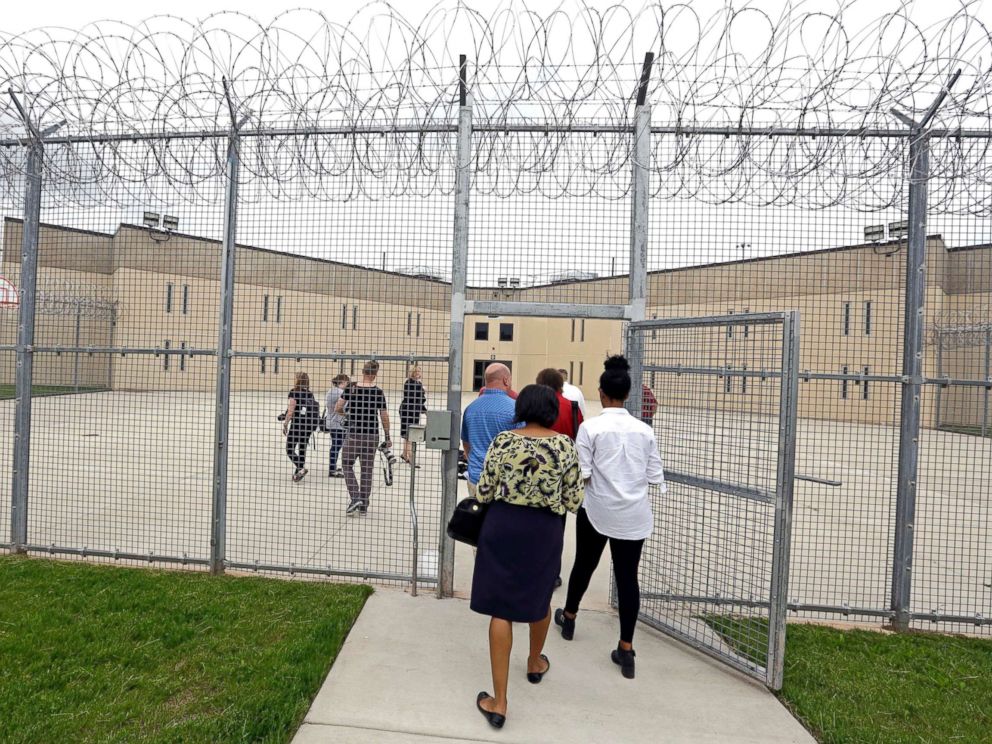
PHOTO: A tour group enters block D in the west section of the State Correctional Institution at Phoenix in Collegeville, Pa., June 1, 2018.
A tour group enters block D in the west section of the State Correctional Institution at Phoenix in Collegeville, Pa., June 1, 2018. Jacqueline Larma/AP, FILE

While there are roughly 3,600 inmates in this new prison -- or will be once it is at capacity -- how one singular inmate's needs will be catered to remains an as-yet unanswerable question. While the potential for "violence" to be wrought against this man by other prisoners contemptful of the acts he committed are for now held at bay, the man himself must contend with the debilitating psychological impact of loneliness and boredom.

Following this normally jovial man's sentencing he was driven to SCI Phoenix, through a rainstorm; even nature recognizing the solemn, dark occasion of a man fallen from grace; the institution a 164-acre compound of cellblocks surrounded by a mile and a half of razor wire and electronic fencing. Could anything be more foreign to this man's experience, more alienating, more deserving than his transition from admired social celebrity figure to scorned incarcerate?

Prison guards guided him into the prison's central building where the obligatory pose for his mug shot took place and he was outfitted in a prison uniform and boots and given his distinguishing number as Inmate NN7687. From someone to nothing in one fell swoop. In his empty corner of the prison, he eats, sleeps and takes his recreation.

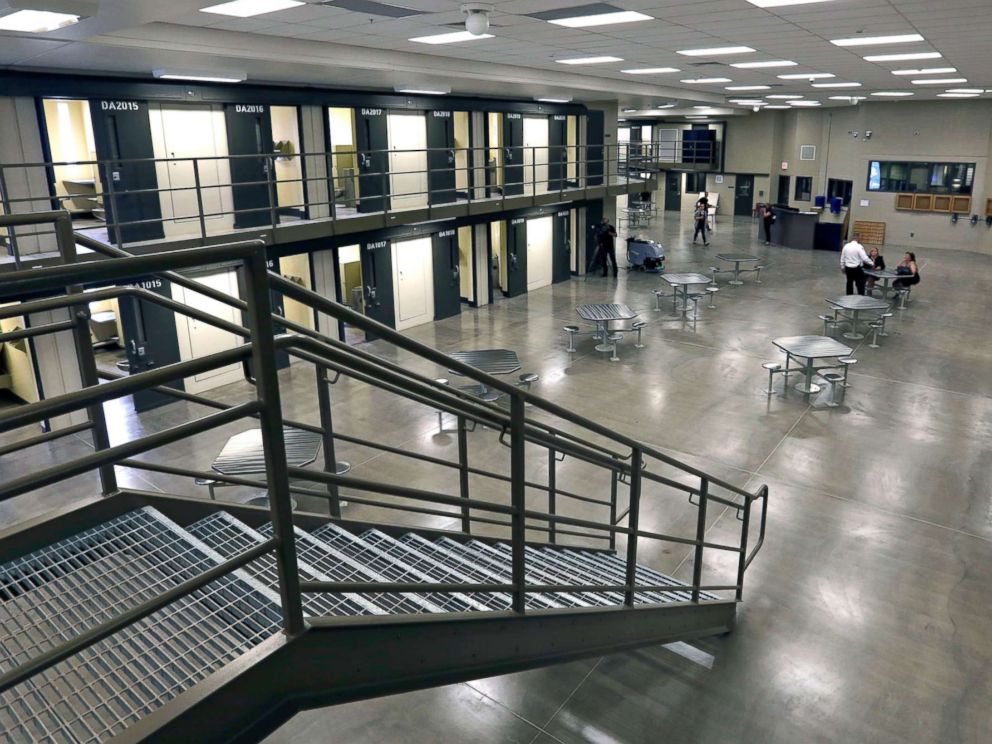
PHOTO: A housing unit is pictured in the west section of the State Correctional Institution at Phoenix in Collegeville, Pa., June 1, 2018.
A housing unit is pictured in the west section of the State Correctional Institution at Phoenix in Collegeville, Pa., June 1, 2018.   Jacqueline Larma/AP, FIL

Once he has undergone the formality of completing a standard battery of psychological and medical tests designed for new inmates and sex offenders -- a ten-day process -- he will be permitted family visits, he will be able to procure a TV and tablet for his cell. And he will be enabled to take advantage of available classes or work positions for inmates.

Word from the prison is that Cosby is adapting to his new life and appears to be in "good spirits". "We are taking all of the necessary precautions to ensure Mr. Cosby’s safety and general welfare in our institution. The long-term goal is for him to be placed in the general population to receive the programming required during his incarceration", explained corrections secretary John Wetzel.

Labels: , , ,

Wednesday, August 08, 2018

Desperately Seeking Justice....

"We wanted to see how many people we were losing along the way. It is pretty significant."
"We see a significant volume of patients within our program and there's great attrition in the rates of people who are going to pursue the whole justice side of things."
"It can be very overwhelming for someone who's been victimized [to commit to going through the process of using the rape kit, returning it for examination, and preparing to be involved in criminal prosecution resulting from rape]."
"People are afraid of what the process will be. They've seen this kind of case play out very publicly sometimes and they really don't want to be part of something that's going to potentially affect their life that much."  
Dr. Kari Sampsel, The Ottawa Hospital, medical director, Sexual Assault and Partner Abuse Care program
The research was done at the Sexual Assault and Partner Abuse Care program at the Ottawa Hospital. (Danny Globerman/CBC)
"Improving the continuum of care from the hospital to justice system is a complex process where many survivors are lost along the way."
"However, achieving just outcomes is of critical importance and the evidence from this study will go to support advocacy and inform best practices for survivors of sexual and gender-based violence."
Dr. Kari Sampsel, The Ottawa Hospital department of emergency medicine; Dr. Katherine Muldoon, The Ottawa Hospital Research Institute
The Ottawa Hospital study found only a small number of survivors turn over rape kits to police. (CBC)

"Being able to prove that as a survivor, where the evidence is just based on your body or your narrative, is a really challenging thing to do, not because it didn't happen necessarily but because there isn't physical evidence in terms of consent."
"The problems are not in the fact that they don't wish to come forward. I would say the larger problem lies in the fact our criminal justice system doesn't have the teeth often to be able to progress survivors' stories in the way they can other crimes."
Nicole Pietsch, co-ordinator, Ontario Coalition of Rape Crisis Centre

"They have their fears and self-blame ... where somebody says 'This happened because I was out drinking' or 'I shouldn't have invited him home'. So those myths are already out there and they're internalized in people, so there's a huge reluctance to come forward and report."
"What is it in the structure and the system that's creating these barriers that somebody who can be so violated can say 'I can't come forward?' That's where our focus needs to be."
Sheila Macdonald, director, Ontario Network of Sexual Assault/Domestic Violence Treatment Centres


According to research from University of Ottawa criminologist Holly Johnson, a mere 33 of every thousand sexual assaults in Canada end up being reported to police and of that number that are reported, only six are taken to prosecution -- and finally, three (out of every one thousand) conclude with a conviction. Now, new research findings out of The Ottawa Hospital's sexual assault and partner abuse care program has been published in the Emergency Medical Journal.

The research results offer for the first time hard data relating to the number of people treated for sexual assault in a hospital emergency setting, where rape kits are available and who agree to release the resulting evidence to police with a view to setting the justice system in motion. This study was undertaken during a period of focus on the national level on the high rate of sex assault cases that police deem to be "unfounded" once they have scrutinized the evidence presented.

What this new research does is to emphasize challenges faced in simply getting evidence out to police to begin with. The sexual assault evidence kits are offered in the hospital setting, yet fewer than one-third of victims of assault release the completed kits to police as evidence. Many people contemplating the level of scrutiny that will follow, including gratuitous attacks on social media once they reveal their victim status by calling on the justice system, are convinced to just let it go. 

Among 406 victims of rape from the Ottawa area for example, 64.5 percent (262 of the total) who had been the subjects of sexual assault, appeared at the hospital through their special program in 2015. Of the total of 262, 202 were deemed eligible for collection of evidence through the use of a rape kit to collect the required forensic evidence from bodily fluids and DNA fibre samples as well as other criteria of evidence of assault.

Yet of that number, of 202 patients eligible to submit forensic data only 129 chose to do so, representing 64 percent of those eligible -- and a further reduction took place, with only 60, representing fewer than one third of the final total managed to hand over the evidence to police. Those in a younger age bracket were likelier to submit the evidence to police, as well as those victims who didn't know their assailants, and those who had been out-of-doors when the assaults occurred.

Numbers for 2016 are undergoing similar analytical treatment in an effort to determine whether any change in the number of people agreeing to release forensic information to police has taken place in the wake of the universal calling out of sexual aggression related to the #MeToo movement that has roiled business, politics, and the field of entertainment as women have been revealing their experiences of body politics.

The wide coverage through social media given to the cascading number of accusations against men in powerful positions demeaning, humiliating, physically manipulating and attacking women in inferior, dependent positions has given impetus and confidence to greater numbers of women to come forward and pursue their human right to a life without sexual aggression. In Canada in particular an increased focus has been shed on the low number of sex assault cases that end up at trial.

A recent investigation by a leading national Canadian newspaper discovered one in five sex assault cases was coded unfounded, in that police deemed no crime had occurred, a situation that has led to questioning the criteria used to reach that conclusion and leading to a review of the handling by police of those cases. In Ottawa, the Philadelphia Model has been adopted, where a panel of outside experts are given access to a sample of unfounded sexual assault cases to judge whether missteps in the investigation were committed.

New research by Ottawa doctors shows that an alarmingly small number of sex assault survivors consent to have rape kit evidence shared with police. Tony Caldwell / Postmedia Network

Labels: , , , , , ,

Tuesday, June 19, 2018

Grim Deprivation

"The Charter [Canadian Charter of Rights and Freedoms] does not protect against trivial limitations of rights."
"I find that the provision of powdered milk does not constitute cruel or unusual punishment."
Federal Court Judge Alan Diner

"Not surprisingly, when these changes were introduced, inmate grievances related to food issues spiked."
"Unresolved demands regarding inmate dissatisfaction with food [likely played a role in triggering the December 2016 Saskatchewan riot]."
"Playing with the food of hungry and frustrated prisoners can have unintended detrimental effects."
Ivan Zinger, correctional investigator, Office of the Correctional Investigator
Warkworth prison. Pete Fisher/Postmedia

The Correctional Service of Canada introduced a new National Food Menu in January of 2015. as a cost-saving measure. The new menu brought in standardized meals to be served across the country to federal inmates. Part of a larger cost-cutting program, federal costs for inmates' meals were cut back by an estimated total of $6.4 million, the 2017 annual report o the Office of the Correctional Investigator pointed out.

The new, standardized menu reduced the cost of the prison service on meals to $5.41 daily for each inmate in the federal incarceration system. The menu is construed to provide 2,600 calories as a daily intake as recommended for men between the ages of 31 and 50, while meeting all the nutritional requirements for good health set out by Canada's Food Guide. An estimated $3 million was saved with the elimination of fresh milk alone, and the substitution of powdered milk.

English muffins were replaced with toast, and vegetable selection was also reduced; type, not quality or quantity served. The investigator, Mr. Zinger, attributed this very issue, the food menu change, to a riot that left one inmate dead, and eight inmates injured as they went berserk in January of 2016, at Saskatchewan Penitentiary. The riot caused roughly $3.6 million in damages to register inmates' ostensible dissatisfaction with the newly-introduced food cost-saving measures.

More latterly, another inmate has registered his outrage that fresh milk is no longer available for his breakfast cereal, that he must make do with powdered milk, claiming that his Charter rights have been infringed. The man is a dangerous offender, locked up at Warkworth Institution in Ontario. Being forced to use powdered milk, argues 58-year-old William A. Johnson, represents cruel and unusual punishment, violating his right to "security of the person".
There is no constitutional right to fresh milk.Getty Images

This convicted sex offender, serving an indeterminate sentence and imbued with a robust sense of entitlement, filed his grievance back in January of 2015. Warkworth, he insists, unfairly denies its inmates fresh milk, bacon, and french fries, none of which appear on the National Food Menu for federal inmates. This violent sexual predator clearly has a dim awareness of his obligation within society to respect others' right to "security of the person", much less realize that the food menu is favouring his health by withholding bacon and french fries.

Much less does he quite understand the obligations of citizens to respect the social contract between civilized people that views it as a severe criminal offence to viciously harm other people. The correctional investigator speaks of food as being "foundational to health and safety" within a prison. Food of choice clearly in his estimation, viewed as a reward by society to criminals who prowl about on the lookout for opportunities to do harm to innocent people.

Food complaints evidently rank as the third most common grievance spelled out by inmates during the past three years. Over 6,000 complaints were received by the prison service about the food it has served since 2014, clearly pre-dating the introduction in 2015 of the inmate-offensive new menu. These grievances were outnumbered by complaints focusing on prison staff and outside communications.

The moral of the story: If you want personal free choice, obey the law and respect the human rights of others. The unfortunate lack of tablecloths and cloth napkins alongside well designed silverware may in the future represent a new focus of complaints. Could be if word gets out about this lamentable lack of attention to proper table settings, it might be enough to turn the criminal element toward embracing the law and becoming model citizens.

The Correctional Service of Canada provides 2,600 calories worth of food a day at a cost of $5.41 per prisoner per day. Some say it's not as tasty as it looks. (Office of the Correctional Investigator)

Labels: , , , , ,

Sunday, June 03, 2018

Treating A Community To Treat Criminal Offenders

Former gang members Neil Snowden (left) and Niko Williams (right) say CeaseFire completely changed their lives along with their attitudes about violence and retaliation.
Cheryl Corley/NPR
"I've never seen anyone be killed."
"I'm 54 years old and I think I will probably not see that in my life."
Bruce Western, sociologist
Well, Mr. Western's experience lacked exposure to the kind of raw life-and-death values that many inner-city children with underprivileged backgrounds consider to be part of their growing years, inuring them to violence. Because it is so prevalent in the society that they inhabit they think it is normal. For whatever effect it has on them; revulsion, fear, it has become normalized through repetition and they accept that because they have been patterned to do so.

Which is why when Boston researchers asked 122 men and women who were part of a study of prisoners having served their sentences for crime committed, and were asked a series of questions about their childhood, the last question being had they ever seen someone killed?, an astonishing 42 percent responded in the affirmative. They were not only patterned to accept that lethal violence was part of their social background, that patterning and that acceptance trained them to follow similar paths.
"A disease is a condition with identifiable symptoms that causes sickness or death. That describes violence."
"And we know it spreads itself. There is overwhelming evidence that hurt people hurt other people."
"The reasons the young man stays on the corner might be completely different from what we imagine. He might, after all, want that park job, and want to get off the corner, but not know how [to]."
Tina Rosenberg, journalist
Image: Fabrizio Rinaldi/Flickr

Enter epidemiologist Dr. Gary Slutkin. His experience has been with containing contagious diseases. And his experience expanded to encompass a 23-year-old program named Cure Violence which began in Chicago and has long since expanded to cities in Latin-America, Africa and the Middle East. From his work with diseases such as cholera and H.I.V., Dr. Slutkin is very aware that treating an epidemic so it will not spread further has its genesis in changing human behaviour.

To that end, he is convinced, community values and normatives must first be altered. Simply put, those raised in communities where social and criminal violence is the norm, accept that behaviour as the norm and practise it themselves for want of a more civil pattern of a social contract that benefits those who practise it. "The best predictor of condom use is whether people think their friends use condoms", he offered, by way of comparison.

So the platform most useful to Cure Violence and its guiding philosophy is that of altering consciousness through exposure to different values accepted by the entire community. Instead of becoming a victim of a victimized society, the goal is to convince the community that self-harm is of no use to anyone, that acceptance of communal values to improve the quality of life will result in and of itself in an improved quality of life for everyone concerned, most notably from childhood to adulthood.

"Violence interrupters" from the community are trained to react when in the presence of troubled human relations; they step in to mediate disputes and guide people toward more reasonable behaviour. Treating social deviance as a community-based disease that can be treated by the community itself in turning itself away from deviant and violent behaviour. "Consciously or unconsciously, they want someone to talk them down", observed John Hardy, a one-time violence interrupter in his community.

Cure Violence also works toward inoculating potential victims with an adjunct program of jobs such as cleaning litter out of parks, to steer the vulnerable in an alternate direction averse to violent street corners. While conventional wisdom dictates that young men versed in gang culture would scorn such menial work, the truth appeared otherwise when the anticipated uptake of between 25 to 30 percent turned out to be 60 percent signing on to these work assignments.

In East Oakland, California, Planting Justice operates in a similar vein, hiring former prisoners to tend 30,000 fruit and nut trees. Anthony Forrest, 56, five days out of prison after serving a sentence of 25 years for armed robbery, began work with Planting Justice, earning $25 hourly, with health benefits. "Working in the garden calms me down", he stated.

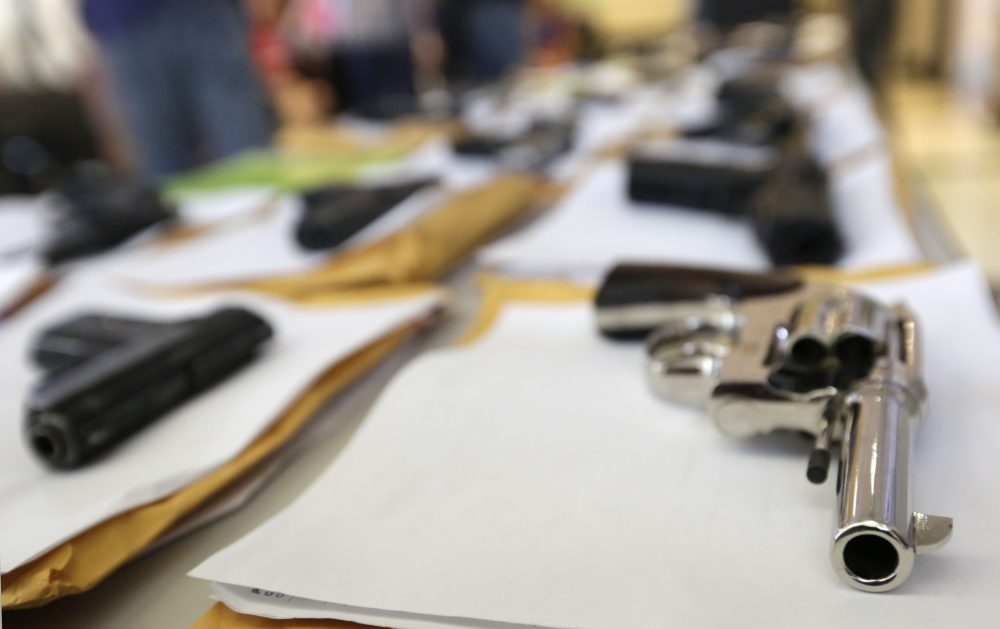
In this Monday, July 7, 2014, file photo, Chicago police display some of the thousands of illegal firearms they confiscated so far that year in their battle against gun violence in Chicago. (M. Spencer Green/AP)

"It's public health, and the way that public health works is that you have health workers, and health workers are the ones who have the access to people whose behaviors you want to help change. So we have sex workers reaching sex workers, if you're talking about HIV/AIDS. You're talking about moms who are reaching moms for breast feeding or nutrition, refugees reaching refugees, and various situations possibly related to cholera or tuberculosis. Here you have people who used to be involved in violent behavior now helping to access the people who are doing it, or thinking about doing it."
"So this is a basic, essential, public health technology. It's the same thing with Ebola. They tried police responses to Ebola, and it spread. It wasn't until there were health workers who could talk to people on why not to touch the person who is sick, how to bury safely... all these behaviors that we deal with in health — violent behaviors, sexual behavior, hand washing or sanitation — they are very difficult behaviors to change. Violence, by the way, is not one of the harder behaviors to change. Smoking behavior is much harder, and sexual behavior is much harder. The difficulty we're having in the realm of violent behavior, really relates to the public's understanding of it, because it's still being characterized as some kind of a moralistic problem, rather than a scientific, health-based problem. And we used to do this with other issues in health, too."
Dr. Gary Slutkin, infectious disease control specialist, University of Chicago, Illinois 

Labels: , , , , ,

Thursday, March 08, 2018

A Pernicious Social Malaise

"Our plan is absolutely addressing all aspects of this crisis. I'm confident that we're putting our resources into all the areas that are so important in addressing this public health crisis."
"[Ontario's government is doing everything it can to combat an] avoidable tragedy."
Helena Jaczek, Ontario Health Minister

"This crisis has been on the radar in Western Canada for years, yet this [Liberal-led] government [of Ontario] chose not to take preventive measures to protect Ontarians from the dangers of opioids."
"Both the government and the previous health minister have clearly failed to properly address this crisis."
Progressive Conservative health critic Jeff Yurek

"Mr. [Waseem] Shaheen used his specialized knowledge as a pharmacist to hide his activities from other employees, the College of Pharmacists and the police, and when confronted, planned and carried out a fake robbery to cover his illicit activities."
"He is an educated, intelligent person who set out to benefit himself with no regard to the consequences to the community at large. As a pharmacist, his moral blameworthiness could not be higher."
Public Prosecution Service of Canada

"[Shaheen, a professional entrusted with securing access to dangerous drugs, chose to traffic fentanyl] that is at the forefront of the opioid crisis that is ravaging our cities."
"[The drug, meant to be prescribed to people in pain, can result in] crippling addiction or death [on the streets]."
"His only apparent motivation was greed."
Ontario Court Justice Robert Wadden
An Ottawa pharmacist who faked a robbery at his own drugstore to cover up the "mountains" of fentanyl patches he trafficked has been found guilty of his crimes. The police case against Waseem Shaheen began in October 2014 when he reported a knife-point robbery at his Rideau Street I.D.A. pharmacy. (Google Street View photo). / OTTwp

The government of Ontario has pledged over $222-million over a three-year period in an effort to tackle the opioid crisis being experienced in the province. Funding is meant to expand harm-reduction services and to enable the hiring of greater numbers of front-line staff. Funding has also been approved for seven supervised injection sites, five already in existence. That there is a crisis across Canada is not in question.

According to provincial statistics there were 7,658 hospital emergency visits for opioid-related overdoses last year, significantly higher than the 4,453 that occurred the previous year. There was a documented 1,053 deaths from opioids in 2017, in comparison with 2016, when there were 694 such deaths. According to the Public Health Agency of Canada, the number of deaths due to overdose was expected to surpass the 4,000 for all reporting provinces for 2017, surpassing the 2,861 opioid-related fatalities reported for 2016.

There is no charge for acquiring naloxone kits from pharmacies whose purpose as an emergency treatment for such overdoses is known to have reversed the deadly effects of overdoses fairly effectively if and when administered in a timely fashion. A new version of the overdose-reversing drug is set to be released through pharmacies, available without cost to anyone requesting such a kit as a matter of ensuring that people are prepared to commit to preventing such tragedies in the circles in which they move.

The stiffest sentence ever handed down in Canada to a pharmacist for fentanyl crimes was made public when Ontario Court Justice Robert Wadden handed down a 14-year incarceration sentence for Waseem Shaheen, who in October of 2014 reported a robbery at knifepoint at his Rideau Street I.D.A pharmacy. He reported that a masked man had threatened him and coerced over $25,000 in fentanyl patches in the robbery, caught on surveillance video. The robbery, however, was a ruse revealed to police by the man addicted to drugs whom Shaheen had hired to execute the robbery.

Justice Wadden, in the wake of a fall trial that had found Shaheen guilty of trafficking fentanyl, of public mischief for reporting a fake crime, and insurance fraud, handed down the sentence committing Shaheen to serving five years each for the mischief and fraud convictions concurrent with his longer sentence for trafficking fentanyl. The judge cited the position of public trust that Shaheen had violated when arriving at an appropriate sentence.

Waseem Shaheen was a pharmacist who operated three pharmacies, he was in no desperate need of cash, to convince him to sell dangerous drugs on the street in violation of the law. He had trafficked over 5,000 patches of the highest strength of fentanyl over a two-year period, a scheme that profited him over $1-million; according to Justice Wadden, "profiting on the misery of others." Shaheen had been suspended by the Ontario College of Pharmacists from practising as a pharmacist since March of 2016.

"I'm hopeful this sentence is a signal of just how seriously these types of crimes will be dealt with in our community", commented Staff Sgt. Michael Haarbosch of the Ottawa police robbery unit, adding that investigators who had dedicated a significant amount of their professional time and resources to this case, feel pleased with the outcome.

Waseem Shaheen covers his face and rushes into the Ottawa Courthouse. Postmedia

Labels: , , ,

 
()() Follow @rheytah Tweet