France, in Social Disarray Once Again
"The French doctrine of crowd control and riot policing is certainly very different from that in the UK, and the police have a formidable array of ostensibly defensive weapons that include batons, tear-gas grenades fired from launchers and blast balls. All of these can inflict serious injury if not handled correctly. In some cases over the past week, ill-prepared authorities were obliged to deploy local officers with little experience of riot policing, and mistakes were undoubtedly made.""Yet the armoury of the most violent protesters was also formidable. Apart from bricks and other heavy projectiles, the weapon of choice is the firework launched from a tube. These fireworks have been turned not only on the police but also on firemen who attempted to put out blazes. Another favourite tactic of rioters is to throw aerosol cans into fires and watch them explode. Among other weapons seized by the police were knives, hammers, baseball bats, Molotov cocktails and bottles of hydrochloric acid."Jeremy Stubbs, Spiked"Since the protests began in mid September, roughly 6,000 people have been arrested. About 300 students and staff have been injured, as have some 700 police officers. France's interior minister says the police response has been proportionate in -- quote -- "almost all cases.""But it's also fueling defiance and anger, leading to today, as union activists joined 250,000 protesters nationwide, demanding more education funding amid understaffed schools, overcrowded classrooms, and dilapidated academic buildings.""Students vowed to continue to mobilize as more blockades formed around hundreds of high schools."Deema Zain, National Public Radio"[French] police said on Tuesday alone 488 people were arrested and 43 police officers were injured.""There have been 18 internal probes launched in response to allegations of police brutality since the end of September.""The Education Ministry said 528 high schools were 'totally or partially suspended' on Wednesday.""Scenes in Paris, Marseille, Bordeaux and Lyon, among other cities showed hundreds to thousands of students, along with teachers and other protesters, voicing how fed up they were with the school system.""Police used tear gas and water canons, in some cases, to break up clashes and riots. Protesters can be seen in videos and photos setting bins on fire and throwing objects.""A 15-year-old student reportedly had his hand blown off by a stun grenade deployed by police. A source told RFI that the student grabbed the grenade and it exploded while he was holding it."Courtney Greenberg, National Post
 |
| Protesters gathered at Paris’s Place de la République, on October 6th. Photograph by Geoffroy Van Der Hasselt / AFP / Getty |
In the third week of unrest over dilapidated schools and the lack of funding, a high school in the north-central region of Beaugency saw students chanting to M*R*H*, a song bearing the initials of Mohamed Merah, a French-born terrorist of Algerian descent who murdered three soldiers in 2012, then did the same to a teacher and three Jewish children in Toulouse, targeting a Jewish school. He chased down an eight-year-old child and shot her at point-blank range. The song by the rapper Boro700 evidently resonated with the protesting high school students.
Obviously in some arcane manner, the song celebrating the murder of Jews by an Islamist terrorist found favour with the protesting students whose complaint was of a funding lack for schools, crowded classrooms, too few teachers, and decrepit schools lacking air conditioning in intolerable summer heat conditions. In Nice as well, protesting students have seen fit to play the song and sing along with it, as though delivering a message of vital importance to government that has failed to live up to an older generation's responsibility to the emerging leaders of tomorrow's France.
Students at Saint-Exupery located in a disadvantaged Paris suburb blockaded their high school on September 17 in a show of support to their teachers striking over under-staffing and overcrowded classrooms, inspiring pupils to take up the torch of furious indignation over France's failure to adequately fund its schools preparing the younger generation to take their place as adults in representing their communities, their districts, their social and cultural peers as per the overall social contract.
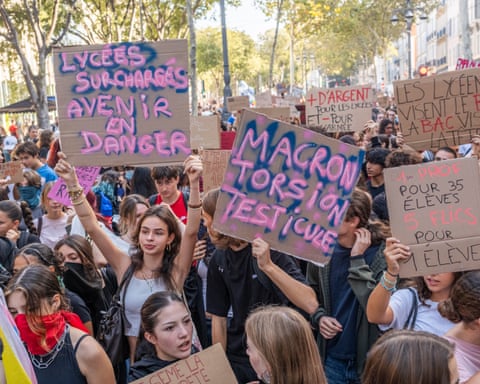 |
| Protesters marching in Marseille. Photograph: Sener Yilmaz Aslan/Getty Images |
These are not quiet, orderly protests held by respectfully obedient-to-lawful-order students; there has been violence as the accusations escalate and students are joined by those with disparate axes to grind. Parents of course, and teachers have also joined the chaotic protests. Along with those who march to their own resentful and vicious aggravation against the state. A masked man in Marseille sprayed an aerosol at a woman's face, then lit it afire.
Among teachers who have come out to support and march alongside their pupils there have been incidents of teachers being assaulted. Arsonists have set fire to some high schools. Figures released to the public of 700 police officers, 85 school staff and 215 teens having been injured attests to the tempestuous tenor of the times. "Our country is witnessing the most powerful movement of high school and college students it has seen since May 1968", stated socialist presidential candidate JeanLuc Melenchon, galvanizing his followers to join suit.
Viral social media footage is rife with the vision of a preponderance of rioters clearly the offspring of migrants from the banlieus, a political bonus to Marine Le Pen's National Rally party. As for the legacy French media, they are content to publish righteous stories of youth disappointed and angry over a government that fails to heed their needs and complaints. The lyrics of the song that has proved so popular among the rioting students who set fire to trash bins and toss Molotov cocktails at shield-bearing police, revel over the Bataclan massacre's success in murdering innocent people.
 |
| Protesters hold a banner reading 'Rostand angry, Rostand supportive' during the protest in Caen, France, on Oct. 6. (Guillaume Saligot/AFP/Getty Images) |
Labels: Injuries, Police Response, Political Maneuvering, Rioting, Student Protests, Underserved Schools
posted by Pieface @ 8:19 PM
0 comments


