Ruminations

Blog dedicated primarily to randomly selected news items; comments reflecting personal perceptions

Friday, August 07, 2026

Poland, Building a Resilient Defence System Against Russian Expansion

"This is a watershed moment in the history of both Poland and the European Union [with the signing of the Security Action for Europe defence budget]."
"Poland will be safer in these difficult and highly risky times."
Polish Prime Minister Donald Tusk (May 2026), Warsaw
 
"Poland has long warned the rest of Europe of Russia's expansionist ambitions, even when other EU leaders weren't always willing to listen."
"Poland sees itself as a guarantor of regional security along the EU and NATO's eastern frontier, including the more vulnerable Baltic states. 
"[Poland's history with Nazi and Communist occupations has made its leaders] wary of being caught unprepared for foreign aggression."
"NATO's resolve is the single biggest deterrent to a westward expansion of the current conflict. Poland led the way at the start of the full-scale [Russian]invasion of Ukraine by supplying weaponry to the Ukrainians, that some said would lead to 'escalation'."
"[A key indicator of the program's success] will be a strong and sovereign Ukraine, because stability to Poland's east is inseparable from Poland's own."
Dominic Roszak, president, Canadian Polish Congress
https://d39raawggeifpx.cloudfront.net/styles/16_9_desktop/s3/articleimages/bneGeneric_Poland_soldiers_military_army_Military_uniforms_of_Poland_(5)_WIKI_COMMONS_Cropped_7.jpg
Poland is spending more on defence than any other large EU nation. / WIKI COMMONS
 
With mysterious cyberattacks on Polish railways and hospitals; drones and missiles straying across Polish borders; jets scrambling to intercept Russian aircraft over the Baltic, it is more than obvious to Polish politicians that the imperative for deterrence is here and now, not at some indeterminate time in the future when it might face an existential crisis. Now, a European Union loan has enabled Warsaw to commit close to 44 billion euros toward upgrading its military infrastructure.
 
Poland has become the largest single beneficiary of Security Action for Europe's 150-billion-euro defence budget to modernize its military, expand its domestic arms sector and reward Polish companies collaborating with defence manufacturers. Poland has long plannede to commit 4.8 percent of the Nation's GDP to defence. Poland's link with Canada will see them pursue "joint projects involving emerging technologies", according to the Canadian Department of National Defence.
 
https://smartcdn.gprod.postmedia.digital/nationalpost/wp-content/uploads/2026/08/0801-na-poland_299930040.jpg?quality=90&strip=all&w=564&h=423&type=webp&sig=dFF6cMDVssLG_Izia8_hPg
Poland is investing billions in a major military build-up to deter Russia, strengthen NATO and bolster European security. Photo by WOJTEK RADWANSKI /AFP via Getty Images
 
"For us, safety -- or I would say lack of safety - is a very present topic. It started long before the full state invasion of Russia to Ukraine."
"Russia has been always a threat for centuries. And we know that there is not much needed for Russia to be encouraged to attack again, either us or Baltic states."
Natalia Walsh Iwaszko, former vice consul economic affairs, Consulate General of the Republic of Poland in Toronto  
According to Minister Bartosz Grodecki, head, National Security Bureau of the Republic of Poland, in the almost 30 years in NATO, Poland has "transformed from a recipient of security to a creator of it". Poland, he stated, is aware that in "the event of an attack,the costs of a defensive operation and the consequences of wartime destruction will be far greater than those incurred in building a resilient defence system." 
 
https://www.fondapol.org/app/uploads/2025/09/capture-decran-2025-09-11-a-09.51.43-1210x806.png
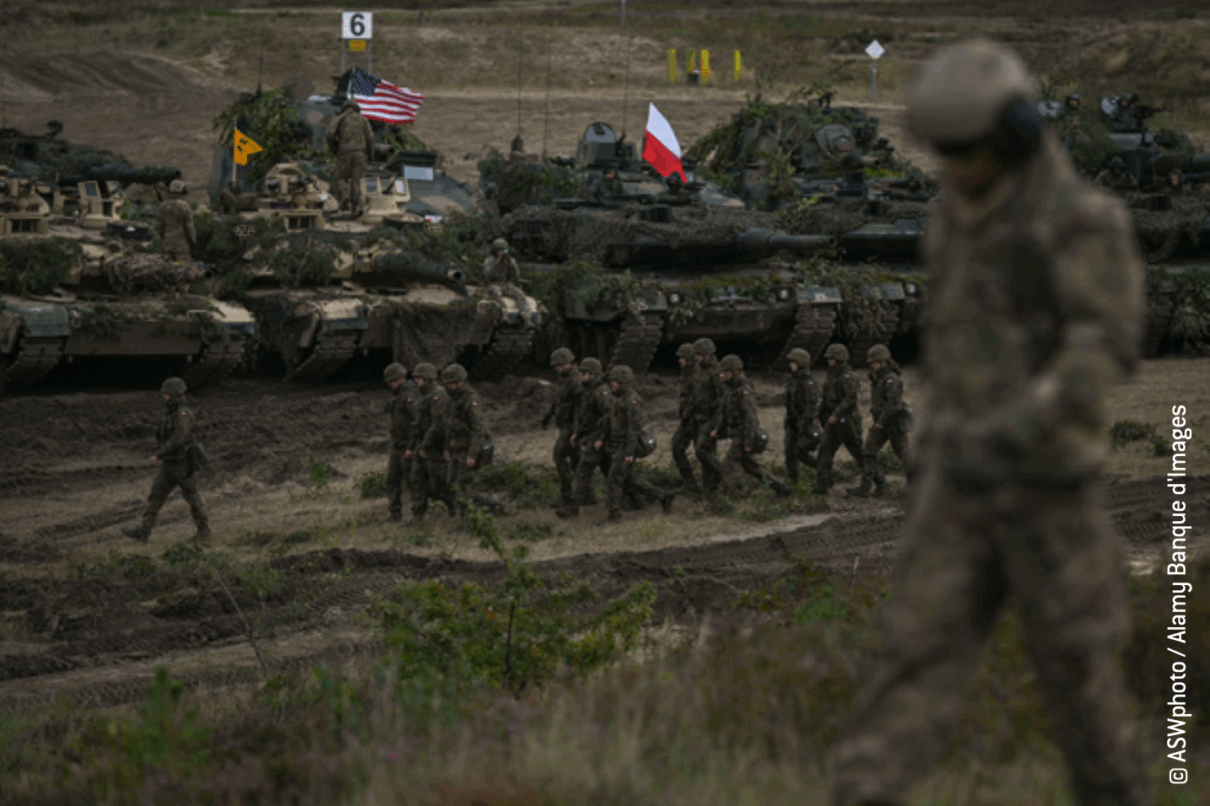
As a result of the current paradigm shift and the consequent reconstruction of the international order, Poland is taking massive action to ensure its national and international security.  fondapol.org
 
"[Poles today] are conscious of bad things happening. It's a part of Polish history ... So they are attuned to kind of, better be prepared, and prepare for the worst, hope for the best, and work for the best."
"Reliance on America for moneys [sic] and/or sophisticated systems, which need constant replacement and upgrading [is precarious and unpredictable] with [U.S. President] Donald Trump being Donald Trump." 
David Lesperance, Lesperance & Associates, Gdynia, Baltic port city, northern Poland 

Labels: , ,

Wednesday, September 24, 2025

A Relationship Maintained on Distrust

"Fully abandoning the legacy of this agreement would be, from many perspectives, a mistaken and short-sighted step."
"To avoid provoking a strategic arms race ... Russia is preparing to continue adhering to the central quantitative limitations of the New START Treaty, for one year after February 5, 2026."
"We believe that this measure will only be  viable if the United States acts in a similar manner and does not take step that undermine or disrupt the existing balance of deterrence potentials."
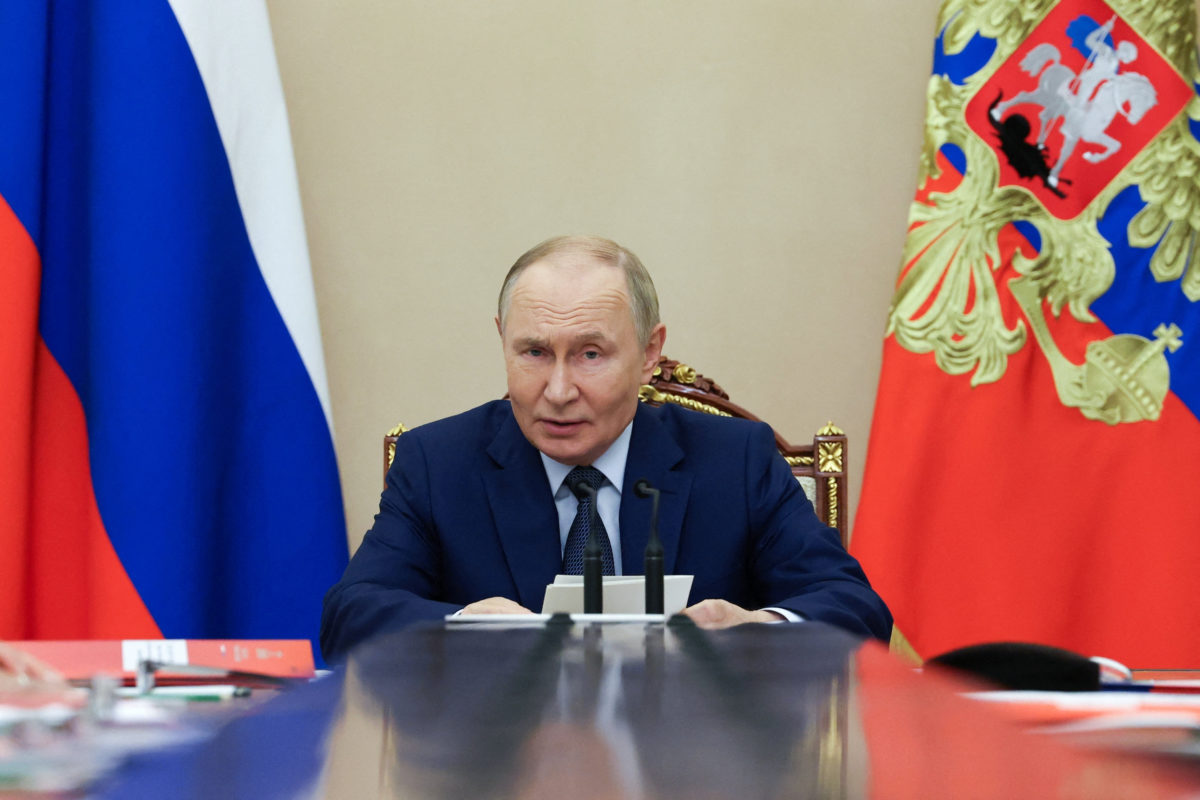
Russian President Vladimir Putin
https://d3i6fh83elv35t.cloudfront.net/static/2025/09/2025-09-22T120441Z_69692257_RC2ZWGAHN4VN_RTRMADP_3_RUSSIA-USA-NUCLEAR-1200x800.jpg
Vladimir Isachenkov, Associated Press
 
While this key treaty with the United States is set to expire in February, Russia has offered to extend the treaty for another year -- out of the goodness of  Mr. Putin's heart. He does not wish to 'provoke a  strategic arms race', but he is not averse to threatening use of the nuclear arsenal in Russia's possession whenever he feels particularly paranoid, fearing that things are not quite going his way. Just a little self-protective tic of his personality.
 
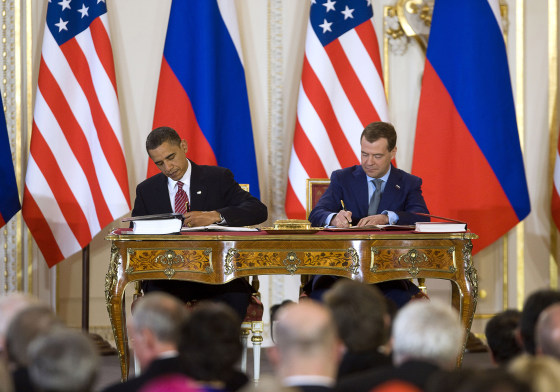
Signed by both parties in 2010, this treaty is the remaining nuclear arms reduction agreement shared by the globe's two atomic powers in possession of the greatest number of nuclear warheads, one that limits the number allowable by each side. Tensions over the Ukraine conflict have not been conducive to amicable relations sufficient to ensure the world's two top nuclear powers share a desire to lower the nuclear threat; leaving each with the impression that the other is preparing to breach the limits.
 
It was in fact, Russia that froze participation on its part in New START in 2023, while continuing to honour the treaty limits restricting both sides to a maximum of 1,550 deployed strategic nuclear warheads each, representing a nearly 30 percent reduction from the previous 2002 limit. Together the two countries control over 80 percent of the world's nuclear warheads in an atmosphere now prevailing of mistrust and calculated risk.
 
https://media-cldnry.s-nbcnews.com/image/upload/t_fit-560w,f_auto,q_auto:best/rockcms/2025-09/250922-Barack-Obama-and-Dmitry-Medvedev-rs-c739ee.jpg
Barack Obama and Dmitry Medvedev sign the New START treaty at Prague Castle, Czech Republic, in 2010. Getty Images
 
The two countries withdrew from the landmark Intermediate-range Nuclear Forces (INF) treaty in 2019, which had been concluded by U.S. President Ronald Reagan and Soviet leader Mikhail Gorbachev in 1987. That agreement limited the use of medium-range missiles, conventional and nuclear.  A law revoking Russia's ratification of the Comprehensive Nuclear Test Ban Treaty was signed by Mr. Putin in 2023 even while Moscow claimed it would honour the moratorium on atomic testing.
 
Shortly following the Russian invasion of Ukraine in an all-in military assault, Russia's nuclear forces were placed on high alert. A decree lowering the threshold for using its nuclear weapons was signed by the Russian leader in 2024. So the question lingering in knowledgeable minds is why this outreach by Putin, however temporary, at a time when Putin is playing cat-and-mouse games with his neighbours in his near-abroad, convinced that if his Ukraine adventure succeeds, they may be next in line.
 
https://thebulletin.org/wp-content/uploads/2025/05/RS-24_Yars_ICBM_Victory_Day_Parade_May_2023-crop.jpg.optimal.jpg
The eventual replacement of single-warhead Topol-M intercontinental ballistic missiles (ICBMs) with RS-24 Yars ICBMs—seen here on display at the Victory Day Parade in May 2023 in Moscow—equipped with multiple independently targetable reentry vehicles could potentially add several hundred warheads to Russia's ICBM force. (Credit: President of the Russian Federation)
"[This is] an important and positive move."
"More nuclear weapons will not make anyone safer."
"By agreeing not to exceed the current strategic nuclear limits, they could reduce tensions, forestall a costly arms race that no one can win, create diplomatic leverage to curb the buildup of China’s arsenal, and buy time for talks on a broader, more durable, treaty."
Daryl G. Kimball, director, Arms Control Association, Washington 
Has anyone reminded Mr. Kimball that Russia and China have signed a new mutual engagement pact that ensures each has the other's back? Trust Russia? Putin enjoys putting his neighbours on tenterhooks of apprehension; last week warplanes and drones overflew the sovereign airspace of Estonia and Poland,  Russia violating their airspace in separate incidents. Romania also said Russian drones breached its airspace. And more recently Denmark and Norway were treated to mystery drones flying over their airports. 
"[Russian agencies are tasked to] closely monitor relevant American activities, particularly with regard to the strategic offensive arms arsenal [with a particular emphasis on plans to] expand the strategic components of the U.S. missile defense system, including preparations for the deployment of interceptors in space."
"The practical implementation of such destabilizing actions could undermine our efforts to maintain the status quo in the strategic offensive arms sphere."
Vladimir Putin 
https://thebulletin.org/wp-content/uploads/2025/05/rbul_a_2494386_t0001-2048x2032.png
Bulletin of the Atomic Scientists


Labels: , ,

 
()() Follow @rheytah Tweet