Ruminations

Blog dedicated primarily to randomly selected news items; comments reflecting personal perceptions

Wednesday, November 27, 2024

Urban Health Myth: Standing Desks Superior to Sitting

"Standing is generally better than sitting."
"To improve your overall health and lower your risk of heart disease, you have to mix in actual movement."
Matthew N. Ahmadi, research fellow, University of Sydney, Australia
 
"What our research and other literature suggest is that both sitting and standing are part of the problem of physical inactivity."
"[Standing involves few muscular contractions and] muscular contraction is a necessary condition for any activity to maintain or improve health."
"[The supposed health benefits of standing over sitting have been] hugely exaggerated."
"Transitioning frequently from sitting to standing is a good idea, as there will be some muscular contractions while doing that."
Emmanuel Stamatakis, professor of physical activity, lifestyle and population health, University of Sydney

https://domf5oio6qrcr.cloudfront.net/medialibrary/12518/f9d7d752-b126-4430-93be-19f530fec169.jpg
Photo: Harvard Health

Published in the International Journal of Epidemiology, a large new study of over 83,000 adults found that standing for over two  hours daily -- which many people with standing desks do -- offers no protection against the risks of too much sitting, for the cardiovascular system. Scientists at the University of Sydney and other colleagues used records of over 83,000 men and women from the U.K. Biobank study.
 
The researchers found that hours of standing presented their own problems which in the end still increased the likelihood of developing serious circulatory problems -- varicose veins, abnormally low blood pressure and blood clots -- in comparison to people who infrequently stood. A standing desk in and of itself does little to reverse the health risks inherent in sitting. Despite that researchers have been inspiring people to sit less based on studies indicating long hours in a chair contribute to greater risks of heart disease, vascular problems, joint pain, diabetes, obesity and other chronic health conditions.

As a result of public health authorities urging people to sit less, there has been a proliferation of workers using standing  desks as an alternative to sitting at their desks. According to recent epidemiological studies, many workers stand for three to four hours daily, yet little credible science supports standing; some of the studies in fact raise doubts about its effectiveness.

It was found that people who stand for an hour burned a mere nine calories more than than had they remained seated, according to a 2019 experiment; so much for warding off obesity. The most damaging impacts of sitting, however pose risks to the cardiovascular system. The Biobank records the researchers studied gave extensive data relating to lifestyles, health and daily habits along with a typical day's movements.

A sophisticated algorithm allowed the researchers to analyze movement patterns so the researchers could realize whether someone was sitting, standing or in motion through every waking minute of their days. The next step was to check medical databases in Britain to determine whether these same individuals had died from or been hospitalized for a cardiovascular problem in the seven years or so following their participation in the Biobank study.
 
https://www.ctvnews.ca/content/dam/ctvnews/en/images/2023/9/8/worker-working-in-office-stock-generic-1-6553351-1694192599704.jpg
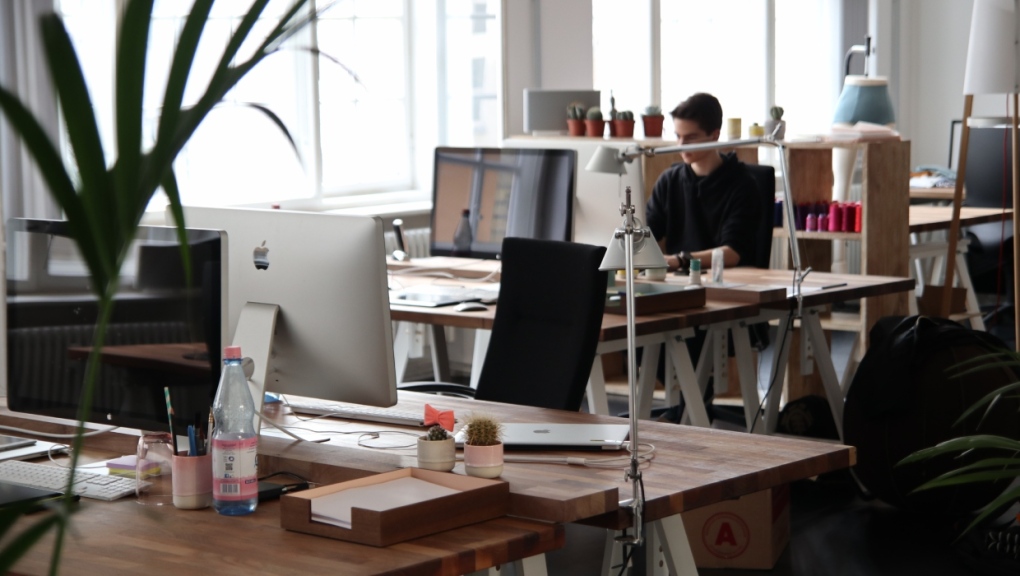
Working in an office. (Pexels/Marc Mueller)
 
Movement patterns were cross-checked against medical outcomes, searching for links between sitting and standing and serious heart conditions such as heart disease, heart failure and stroke, or circulatory problems including venous ulcers, varicose veins and blood clots. People, it turned out, who sat for over ten hours daily -- most people -- were 13 percent more likely to develop serious heart problems in the intervening years than those who sat less. There was also a 26 percent higher risk for circulatory disorders. Standing for over two hours a day saw risks of circulatory problems rise by some 22 percent.

Risks for severe heart problems did not develop for those standing for more than two hours daily in comparison with people who stood less, but the risks did not diminish, either. As one stands, blood flows through legs at a sluggish rate and tends often to pool there, a potential contribution to circulatory disease. One's heart rate is barely raised; necessary to improve cardiovascular health. 
 
A solution to this conundrum is fairly simple; move about, both researchers advised. Make it a point to stroll about in brief breaks every half-hour; use the stairs, slip in some squats while remaining in place at one's desk. Sit down, stand  up, sit down and stand again.
 
https://media.cnn.com/api/v1/images/stellar/prod/gettyimages-1455543750.jpg?c=16x9&q=h_653,w_1160,c_fill/f_webp
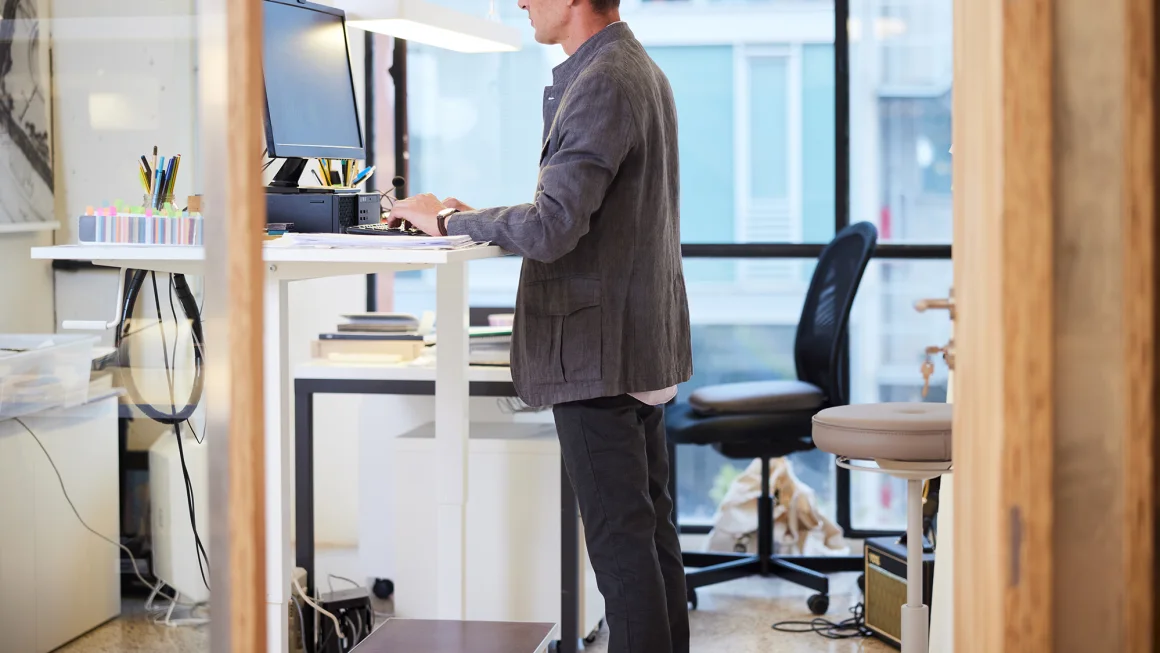
Standing desks became a popular choice for people concerned about the effects of sitting all day but they might not have many advantages, a new study has found.

Labels: , , , ,

Monday, May 20, 2019

Consider The Choice

"There has been a great deal of scientific research about sit-stand desks in the past few years, but we have only scratched the surface of this topic."
"With my background in occupational injury prevention, I wanted to gather what we know so far and figure out the next steps for how can we use these desks to better benefit people in the workplace."
"There are health benefits to using sit-stand desks, such as a small decrease in blood pressure or low back pain relief, but people simply are not yet burning enough calories to lose weight with these devices."
"Though these are mild benefits, certain populations might benefit greatly from even a small change in their health. In order to achieve positive outcomes with sit-stand desks, we need a better understanding of how to properly use them; like any other tool, you have to use it correctly to get the full benefits out of it."
"There are basic ergonomic concepts that seem to be overlooked. Many workers receive sit-stand desks and start using them without direction. I think proper usage will differ from person to person, and as we gather more research, we will be better able to suggest dosage for a variety of workers."
"There is still more to learn about sit-stand desks. The science is catching up so let's use what we've studied in this area to advance the research and answer some of these pressing questions so that people can use sit-stand desks correctly and get the most benefit from them."
Dr. April Chambers, assistant professor of bioengineering, Swanson School of Engineering, University of Pittsburgh

 
"In general, prolonged static postures including both sitting and standing, are associated with poor health and increased injury risk and discomfort."
Study conclusion
Sit-stand desks, once a novelty, have become the mainstream, a response to the crisis headlines that report too much sitting equals serious health risk. Given that office workers tend to spend eight to ten hours daily seated, the new office features sit-stand desks as standard equipment. These desks offer an alternative to all-day sitting; the user can opt to stand while they're working, or alternate between sitting and standing throughout the work day.

Claims by marketers for the manufacturers of these desks are that sit-stand desk use ends up burning more calories since more energy is needed to stand rather than sit; they lead to improved work habits, better blood circulation and posture is maximized with these desks as compared to a traditional desk-and-chair.

Those claims propelled workers to opt for the sit-stand version of the old desk-and-chair. Since then, research to measure the impact of the new office equipment has reached its own inconclusive conclusions. Nothing is ever as simple as it seems.

Recently a multidisciplinary team of American researchers conducted a review of sit-stand desks for their role in improving [or disproving claims] mental and physical health, work performance, discomfort, behaviour and posture. Of the 549 publications the team studied, the outcome was narrowed to the most relevant 53 of which 21 took place in the workplace, 25 in the laboratory, and 7 in the field.

People who use a sit-stand desk for work stand more, between an estimated 30 minutes and three hours, as opposed to those workers who relied upon a traditional desk. On the other hand, health benefits appear to be more tenuous than advertised, between standing versus sitting, since the majority of studies noted no significant alteration in blood pressure, cholesterol levels or other markers linked to cardiovascular health among those who used sit-stand desks.

Exceptions related to several studies making use of subjects who were obese, and they realized small improvements in energy expenditure and glucose levels. Some study subjects reported that they felt less tired at work, and others noted the opposite effect. Swollen feet resulted for some subjects, common among people required by the nature of their work to stand on their feet all day.

Moving from one stationary position to another made little difference in the number of calories burned; about 6 calories more per hour, equivalent over the course of a day to the number of calories in a small slice of bread.

And while some of the subjects felt they were increasingly productive while standing, others found that sitting while working was easier. As for mood improvement whether standing or sitting, it proved to be inconclusive. One positive conclusion emerged from standing where study subjects felt that after 12 weeks their low back pain had eased at work as well as during other daily activities.

Study authors are unanimous on one shared conclusion; the need to get up from a desk regardless of whether it's a conventional one or a sit-stand desk, and to move away and move about. The sedentary effects of office work can be temporarily dispelled by leaving the desk and taking a break for a brief period of exercise, of walking about, and it is those breaks that aid in boosting mood, burning calories, and improving work productivity, and toward overall improved health.

Back to the old standbys of walking where and when one can; taking the stairs rather than elevators, walking down the hall to another office to convey a message otherwise sent by email; leaving the building and indulging in an outdoors walk, just simply moving about rather than remaining tethered to a desk -- any kind of desk.
Credit: Sun Lee

Labels: , , , , , , ,

 
()() Follow @rheytah Tweet