Ruminations

Blog dedicated primarily to randomly selected news items; comments reflecting personal perceptions

Saturday, November 15, 2014

Exploring Nature's House

It is beyond difficult for the ordinary human mind to grasp the significance and wonder at the colossal advance in space exploration made manifest by the European Space Agency's success in landing a tiny robotic science laboratory on a speeding comet that made a ten-year journey across 6.4-billion kilometres through the solar system to succeed in what surely must have seemed a dauntingly impossible mission.

That the Space Agency could even predict with such accuracy when the first signal from Philae would reach Earth to confirm that landing after the suspenseful detachment from its mother ship Rosetta is nothing short of amazing; they predicted the first signal would come in at 11:03 a.m. and so it did on Wednesday, November 12. Capping a journey and an intent beyond mere imagination of even the most feverishly aware science fiction writer.

"We are on the comet. We are sitting on the surface and Philae is talking to us", announced the lander manager, Dr. Stephan Ulamec. "It's complicated to land on a comet. It's also complicated to understand what has happened during the landing. What we know is that we touched down and we landed on the comet We had a very clear signal and we also received data from the lander. That is the very good news.
"The not-so-good news is that the anchoring harpoons did not fire So the lander is not anchored to the surface. Did we just land in a softsand box and everything is fine? Or is there something else happening? We still do not fully understand what has happened.
"Some of the data indicated that the lander may have lifted off again. It touched down and was rebouncing. We saw data on the solar generator which could be interpreted that the lander lifted off and started to turn itself. About two hours later this information of turning stopped. So maybe today, we didn't just land, we landed twice."

Twice indeed; the initiating bounce sent Philae into a seven-hour-long lift-off from which it returned to the comet finally, to rest under the shade of a cliff in that landscape of house-sized boulders, craters and alien cosmic rockface. The little science laboratory went right to work, sending back reams of data to the excited scientific minds sifting through it all, beyond joyful at the success of the mission. With the realization that because of where the little lab had finally landed its solar-fuelled generators would soon lapse into deep sleep for lack of sunlight, under the shade of that great cliff.

Even trying to imagine the cold black indifference of outer space, and a space ship hurtling purposefully through it all to finally put a distance of a half-billion kilometres between itself and Earth, to obey instructions it received from the command centre in Darmstadt, Germany to focus on landing on the surface of a speeding comet, everything depending on precise follow-up, boggles the mind. Let alone the design of the ship and its landing cargo, and the inputting of instructions for geological-scientific retrieval data to be beamed back to Earth.

The dazzling enormity of the wonder of human inquisitiveness aligned with the magnitude of human scientific ingenuity is difficult to quite comprehend. The colossal wonder that is Nature, and the incredible functioning capabilities that she endowed Earthling human beings with to enable them to explore her magnificent house of existence reflects a reality resistant to complete mindful digestion.
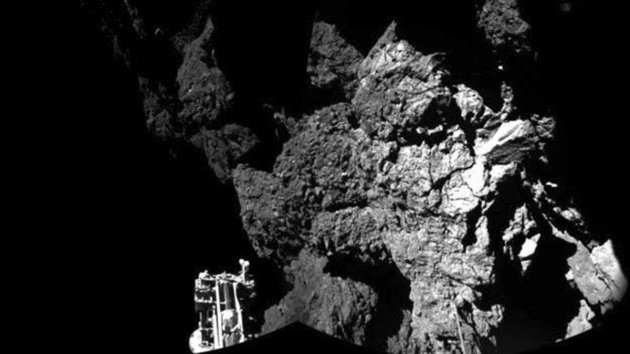
A probe named Philae is seen after it landed safely on a comet in this CIVA handout image. 
A probe named Philae is seen after it landed safely on a comet in this CIVA handout image

Labels: , , , ,

Monday, October 27, 2014

Egypt-inspired probe explores our galaxy’s secrets

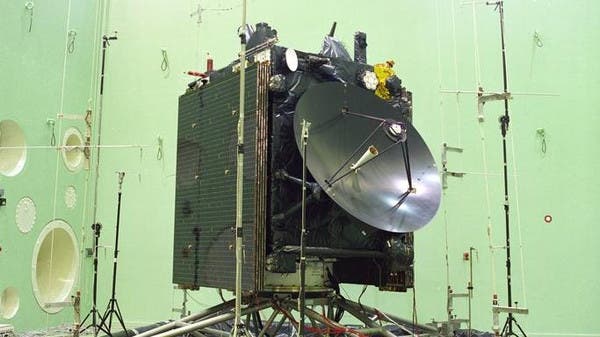
The Philae lander is attached to Rosetta’s side. (Photo courtesy: esa.int)
A space craft named after the Nile’s Isle of Philae will land on a comet following a 10-year mission through space aimed to unlock some of the universe’s secrets, the Guardian reported.

As part of the Rosetta Mission, organized by the European Space Agency, Philae is due to land on the comet on Nov. 12 where it will map the body and drill into the surface to obtain material that may reveal clues about the origins of the galaxy and earth.

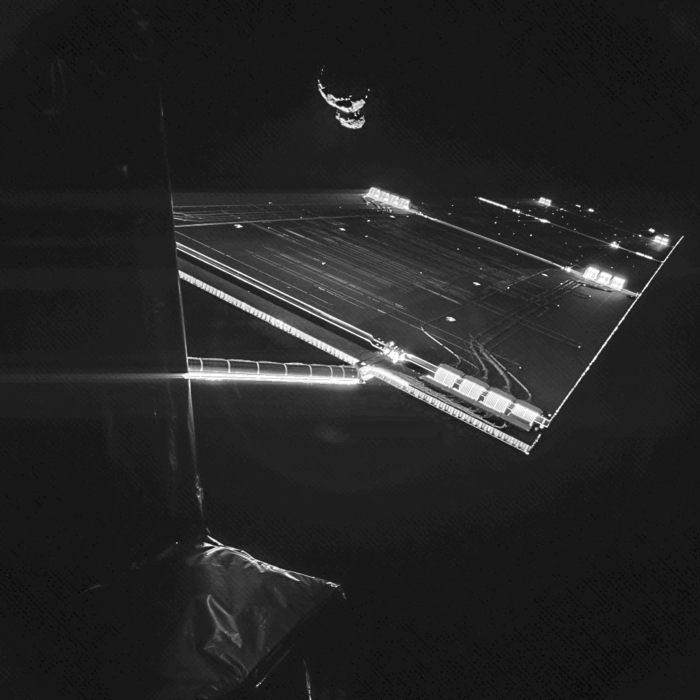
Rosetta mission selfie at comet. (Photo courtesy: esa.int)

On Wednesday, scientists behind the mission met with Egyptologists at an English country estate to mark the link between the trip and a 19th-century adventurer responsible for the Egypt-inspired names in the trip.

Kingston Lacy, where the scientists and Egyptologists met, was the home of William John Bankes, the adventurer who found the Philae Obelisk in Egypt in 1815 and brought it to his estate where it stood for almost 200 years.

Bankes deciphered the Greek inscription on the Obelisk. His work led others to “crack” the code to the hieroglyphs, which allowed archaeologists and Egyptologists to decrypt the Rosetta stone and other ancient Egyptian artifacts.

The Philae obelisk at the Kingston Lacy Estate near Wimborne, Dorset. (Photo courtesy: collectingegypt.blogspot.ae)

The architects of the mission were drawn to the significance of the Rosetta Stone, and more towards the mysterious Philae obelisk.

While scientists continue to map encryptions on the obelisk revealing more information about the time and age it came from, James Grasby, a curator for the modern custodian of Kingston Lacy, the National Trust, described the events as a “wonderful collision” between the two different fields.

“The Philae obelisk led to a greater understanding of the ancient world. The Philae probe may lead to greater understanding of the planets and life on earth,” he told the Guardian.

Last Update: Monday, 27 October 2014 KSA 09:46 - GMT 06:46

Labels: , , , ,

Sunday, June 15, 2014

 Creation

"It would have been a very, very bad day for the Earth. One potential outcome could have been complete destruction."
"Subsequent to that bad day, it was a good thing."
"It's quite possible that by probing material from the deep Earth we may learn something more about the different formation stages of the Earth, how it was put together... We don't quite know what fraction melted, what vaporized, what stayed solid."
Sujoy Mukhopadhyay, associate professor, Earth and Planetary sciences, Harvard University
Apollo 8 astronauts took this photo of the Earth while on the Moon. Scientists say the Moon was created when the Earth collided with another planet 4.5 billion years ago.
NASA   Apollo 8 astronauts took this photo of the Earth while on the Moon. Scientists say the Moon was created when the Earth collided with another planet 4.5 billion years ago.
"This hypothesis [the Big Splash] can explain a lot of features of the moon, but there is one problem, that if you model this process [by computer], these computer models predict that most of the debris [that forms the moon] is coming from the impacting body [Theia], and because every body in the solar system has its own unique fingerprint, you would expect to have different isotopic compositions of the Earth and the Moon."
"Until now, this difference has not been found, and we've now found it."
"We really don't know if we could find this material anywhere on Earth ... We don't know if it's anywhere. It might have been all mixed away."
"If I find this, if you can give me like 10 milligrams of proto-Earth, I could tell you how large the impactor was and what its composition was. This would be very exciting, but currently we have no idea where that might be in the Earth."
Daniel Herwartz, University of Cologne, Germany
NP

A new creation story, or at the very least, a theory of the Earth's final creation was presented at a geophysics conference that took place in California recently, of a violent collision in primordial space between what is called proto-Earth and a much smaller object named Theia. The result of which was a melding of the two through a force so powerful both were reduced to molten rock and silicate vapour.

This collision has been named the Big Splash. An event that spun the earth, and tilted its axis by 23 C, creating the moon from the resulting debris blasted into orbit. This might-have-been cataclysmic collision resulted in the Earth that presents itself today, and the moon that shines overhead. It resulted in the protective atmosphere of the Earth, seasonal cycles, polar ice caps, moon-driven tides and the eventual emergence of life.

Mr. Mukhopadhyay has analyzed material derived from deep within the Earth, from places like Iceland and Hawaii where "mantle plumes" forcefully dredge up materials through volcanoes. He posits that though the initial impact reduced both planets  to melting stage through the force of the impact, the side opposite the collision on proto-Earth was shielded, remaining partially solid, settling into a layer deeply close to the Earth's molten iron core.

When the planetary crash occurred, gravity held all the succeeding exploded bits together, and they gradually settled into a slightly flattened sphere we call Earth and upon whose crust we all live and thrive. The occurrence represented what scientists name a "giant impactor".  As for the moon, it formed from the spinning detritus of the Big Splash, in less than a millennium: "Geologically that is incredibly fast", explained Mr. Mukhopadhyay.

And the date when that is intelligently hypothesized to have occurred? How does 4.5-billion years ago sound? A French team felt that the collision occurred 60 million years earlier than had been thought. In other words scientists believe Earth was formed about 40 million years after the solar system itself began its formation, the product of perhaps ten billion years of cosmic evolution.

The beginning, of course, was the Big Bang; an expansion with space and time flooding from a single point, creating a universe where matter and antimatter were created in almost equal measure, each contesting the other in existence to create the flash of light that telescopes of today are still capable of detecting, called the Cosmic Microwave Background. Because there was slightly more matter than antimatter, even though each set out to annihilate the other, when antimatter was exhausted, matter was left.

The gravitational pull of dark matter gathered the basic elements into strands that eventually came together to form stars, where hydrogen and helium fused to create heavier atoms. When the stars died and exploded they seeded the universe with stardust, over time forming into spinning discs of diffuse matter that eventually became asteroids, comets and planets orbiting newer stars distributed within spiral galaxies.

One of those stars was our very own Sun which back then had perhaps 20 planets orbiting it, including proto-Earth and Mars-sized Theia. How's that for a creation story?

Labels: , ,

Tuesday, March 25, 2014

Spinning Up a Nearby Galaxy


March 25 2014 7:30 AM

Spinning Up a Nearby Galaxy

Photo by NASA, ESA, R. van der Marel (STScI), and N. Kallivayalil (University of Virginia). Click to galactinate.


Well, this is simply too cool: For the first time, astronomers have directly measured the rotation of another galaxy. How? By actually measuring the stars in that galaxy physically move over time!

This really is pretty phenomenal work, and scientifically it’s pretty important, too. Let me ‘splain.
First, the galaxy in question is the Large Magellanic Cloud (or LMC to those of us in the know), an irregular-looking fuzz ball that just so happens to be one of the closest galaxies in the Universe. It actually orbits our Milky Way like the Moon orbits the Earth. Its distance is about 160,000 light years away—compare that with the Andromeda Galaxy, the nearest large spiral to us, which is 2.5 million light years distant.

There are billions of stars in the LMC, and they all orbit the center of the galaxy. It’s a bit like the way planets orbit the Sun, but in our solar system the Sun has essentially all the mass, and therefore all the gravity. In a galaxy, the mass is distributed throughout in the form of stars and gas, giving an overall gravitational field, not a concentrated one. Still, this means stars orbit the center, and their speed depends on the mass of the galaxy and their distance from that center.

The speeds sound ridiculously huge: An average star might be zipping around at 90 kilometers per second, which is 200,000 mph! But remember, in human terms the LMC is a long way off, and that distance shrinks that velocity to something that’s pretty small and hard to detect. Think of how fast an airplane flies, but how slowly one appears to move when it’s far away, and you get the picture.
LMC
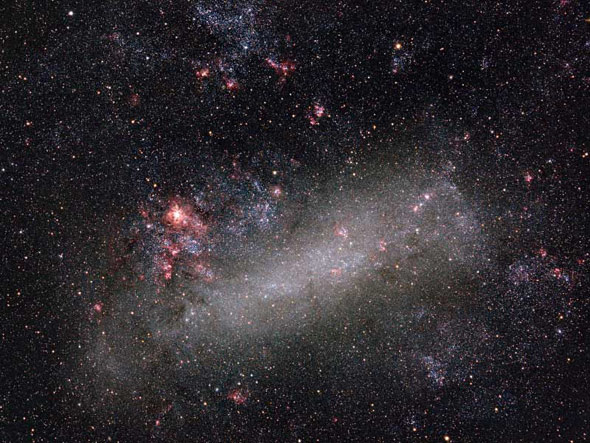
One of my favorite images of the LMC; it's far larger than the full Moon on the sky.
Photo by Wei-Hao Wang(IfA, U. Hawaii)
We do have an indirect way to detect that motion: the Doppler effect. If a star is heading more-or-less toward us, its light gets shifted to the blue end of the spectrum, and if it moves away the light gets redshifted. As a star orbits the galaxy center, it spends half its orbit heading toward us, and half heading away, and this is betrayed by its Doppler shift. We’ve measured the motions of thousands of stars in the LMC this way, but it doesn’t give us the physical direction of the motion; a star heading away from us at an angle is difficult to distinguish from one heading directly away from us. We need that space motion to get the actual directions the stars are moving, but that is so small it’s incredibly difficult to measure.

But we have an extraordinary tool at our disposal: Hubble. Not only does it have excellent eyesight, capable of detecting small changes in a star’s position even in the LMC, but Hubble has also been in use a long time, providing a nice long baseline. After all, if the stars are moving, the longer you wait the more they move! In this case, many years elapsed between observations, providing good coverage of the stars’ motions.

For this study, the astronomers observed nearly 6,800 stars over about seven years. During that time, the teeny tiny amount those stars moved was enough for Hubble to detect. And what they found was pretty dang cool: The stars in the LMC can be seen to orbit the center of the galaxy in a clockwise manner. Not only that, but the overall rotation tells us more about the galaxy, too. For example, although it looks like an irregular mess, the stars appear to be more or less in a flat disk, like Milky Way stars are.
lmc-rotation
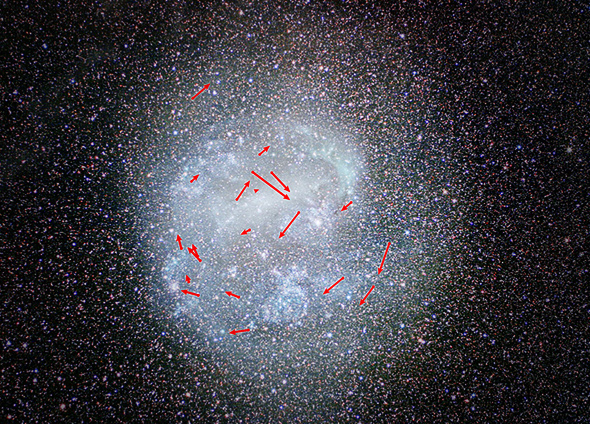
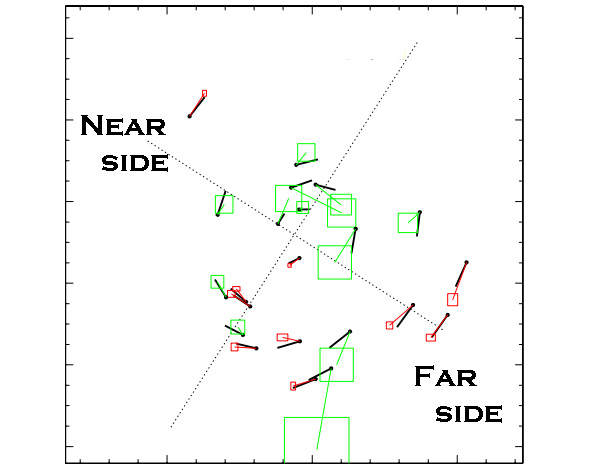
In this diagram, the Hubble observation locations are marked as black dots, and overall direction of the stars' motions shown as red or green lines. (Red is for longer time baseline observations, green for shorter.) The black lines are what computer models give for the star motions. The boxes are uncertainties in the masurements, smaller is better. I rotated this to match the image at the top of the post; the upper left side is closer to us, the lower right farther. The line between them shows the axis of the galaxy projected on the sky.
Plot by van der Marel and Kallivayalil, from the paper.
That disk is tilted to us by about 40°, so we’re looking down on it at an angle. But it gets a bit more complicated: When the astronomers split the stars up by age, they found that older stars tend to be in a slightly different plane than the younger ones, like there are two separate disks of stars. It’s not clear why that might be, though I suspect it may be linked to another problem …

The center of a galaxy can be found in many ways. One way is to look at all the gas orbiting it, and use that information to map out the location of the galaxy’s center. Another is to use the motion of the stars themselves, measured as done in this new study (see the picture above). A third way is to find the center using the combined light of all the stars, what’s called the photometric center. Because the galaxy is a bit messy (and has what’s called a bar, a more-or-less rectangular clump of stars across its middle), the photometric center is off a bit compared to the other two. This may be because the galaxy recently had a close encounter with another galaxy, called the Small Magellanic Cloud (guess why?). This near passage may have poked a cosmic stick into the LMC, riling it up and distorting its shape. This would explain the difference between the centers, and it may also explain why young and old stars appear to be laid out in slightly different disks. Gas clouds may have been disturbed in the encounter, so stars born from them could have been born in slightly different orbits from the older generation. I’m speculating here, but it makes a sort of sense.

There’s actually quite a bit more learned from this study, including the overall motion of the LMC in the sky, its mass, the distribution of its mass, and so on. All of this is important for us to understand, because the galaxy is close by and used in many ways as a proxy for more distant galaxies. It’s our baseline, in a sense, and the more we know about it the better we can understand the more distant Universe.

And I’m all for that. Up until recently we didn’t know much about the cosmos outside our galaxy because we simply couldn’t study it in detail (heck, we were unsure of the nature of our own galaxy until less than a century ago). Now, though, we have the tools and the means to get to know it a lot better, and to me that’s one of the greatest achievements of our species. We were born of this Universe and we’re part of it. Understanding it better should always be at the top of our list of priorities.

Labels: , , , ,

Wednesday, January 29, 2014

A Cosmic Bubble That’ll Soon Pop. Hard.

Sometimes, I’m pretty happy our planet circles a relatively calm, normal star. Because when I look at stars like EZ Canis Majoris (aka WR 6, HR 2583, HD 50896, and other aliases), I think that things around here could be a lot less conducive for life.
Why? Because this:
Sharpless 2-308
The nebula Sharpless 2-308 around the violently unstable star EZ Canis Majoris. Click to embiggen.
Photo by Jess Huisted, used by permission
Pretty, isn’t it? But the beauty belies a true monster.
This photo was taken by Jeff Husted, an astrophotographer who observes in the western U.S. It shows the star EZ CMa (for short), the star just left of center of that ethereal glowing bubble of gas. It’s what’s called a Wolf-Rayet star, one of the more terrifying beasts in the galaxy’s menagerie. It’s a star that started out life with more than 40 times the mass of the Sun, which made it super-hot and extraordinarily luminous. Stars like that can be hundreds of thousands of times as bright as the Sun! A planet orbiting it as close as the Earth to the Sun would be cooked to a vapor pretty rapidly.

Wolf-Rayet stars lead short, violent lives. They’re so bright that pressure from light itself can blow material off the surface, leading to strong winds of gas blasting out from the star. Some time ago, EZ CMa blew out just such a wind, which expanded away from the star in a roughly spherical manner. It slammed into the gas floating in between the stars, sweeping it up and heating it, creating that magnificent bubble. The gas cloud itself is called Sharpless 2-308.
Phil Plait Phil Plait
Phil Plait writes Slate’s Bad Astronomy blog and is an astronomer, public speaker, science evangelizer, and author of Death from the Skies!
It’s when I look at the numbers that this starts to make my brain tingle. The distance to EZ CMa is difficult to determine, but it’s most likely about 5,000 light years away. Even from that stunning distance—that’s 50 quadrillion kilometers (30 quadrillion miles)—the star is almost bright enough to be seen with the naked eye. If the Sun were that far away, you’d need a pretty good telescope to see it at all.

In the sky, as seen from Earth, Sharpless 2-308 is bigger than the full Moon. That means it must be a staggering 60 light years across. That’s huge. When a star like the Sun dies, it might blow a bubble (called a planetary nebula) a couple of light years across. The wind from EZ CMa is more like a cosmic gale.

The structure of the bubble is interesting. It’s brighter on one side than the other, and you may notice the star is off-center in that direction as well. That’s probably not a coincidence. I suspect the star is moving rapidly in space toward the left in this photo, and so the speed of its wind is faster in this direction as felt by the gas around it. That means the gas piles up more in that direction, making it look brighter.

The weird blister next to the bright section is probably a blowout, a place where the outside gas is thinner. Like a weak spot on a balloon, the wind from the star pushed through there more easily, expanding and rupturing it. Essentially the bubble has popped there, the gas from the star poking through the shell of gas piled up around it. We see this sometimes in the rapidly expanding debris in a supernova explosion, too.

When I contacted Husted about his photo, he asked me an interesting question: Are there any stars inside that bubble? The answer is emphatically yes. In our local neighborhood, stars are about 4 light years apart on average. EZ CMa is located in a region with a much denser stellar population, and with the bubble being dozens of light years across, it must enclose hundreds of stars. Thousands. It’s a weird thought, made even more bizarre to think that from their viewpoint, the bubble might be almost invisible! To them, it would be spread out over the entire sky, its light diluted almost to nothing. Some of those tendrils and filament might be visible in deep exposures, but I suspect the overall bubble might go unnoticed to any alien astronomers.

Unless they were clever. The gas also emits X-rays, and is actually pretty luminous: In X-rays alone, it gives off as much energy as our Sun does at all wavelengths! If the aliens had X-ray telescopes, they might notice they’re immersed in the glow of Sharpless 2-308.

And here’s the kicker to this whole thing: EZ CMa doesn’t have long to live. Soon enough—in some thousands of years, more or less— it’ll explode. That’s what Wolf-Rayet stars do. And when it does it’ll be a huge explosion, blasting out as much energy in a few weeks as the Sun will over its entire 10-billion-year lifetime. At 5,000 light years distant it’s too far to hurt us, but wow, what a sight that will be. It’ll easily outshine Venus in our night sky, and be visible to telescopes all over (and above) Earth. It would be a big boon to astronomy, to see such a thing … and a reminder to everyone, once again, that with our own relatively quiet and even-tempered Sun, we have it pretty good.

Labels: , ,

 
()() Follow @rheytah Tweet