Ruminations

Blog dedicated primarily to randomly selected news items; comments reflecting personal perceptions

Sunday, November 24, 2024

Laotian Tourist Town Tragedies

"Obviously it's like a famous backpacker place."
"You go from Thailand Luang Prabang and then to Vang Vieng and then  you keep going."
"I've just heard good things about it and it's where most people go."
Frida Svedberg, Swedish tourist in Laos
 
"[Canadians should] exercise a high degree of caution, never leave your food or drinks unattended or in the care of strangers [and be wary of accepting food or drinks from strangers as] they may contain drugs that could put you at risk of sexual assault and robbery."
"[Watch out for food and drinks like] happy pizzas [and] special shakes [that may contain unspecified amounts of opium or] other unknown substances."
Canada travel advisory
https://dims.apnews.com/dims4/default/ca79eee/2147483647/strip/true/crop/7000x4667+0+0/resize/1440x960!/format/webp/quality/90/?url=https%3A%2F%2Fassets.apnews.com%2Fa8%2Ffd%2F32d80f28f258b0dfcc48a0b20fe4%2Fe5241b15a2fe4f438bb8126d72872ff1
Nana Backpackers hostel, Vang Vieng, AP

Vang Vieng in Laos, one of South-east Asia's poorest nations, is a one-party communist state. It is also a go-to place for fun, easy living, outdoor adventure, companionship, and food and drink destination for young people in their late teens and twenties. It teems with young people from all over Europe, North America and Asia looking for a good time. All these tourists are a source of revenue for the village, its environs and Laos in general.

There was a time that the town was celebrated as a venue for partying when young backpackers thronged there. At night the town is full of visitors along its main neighbourhood bursting with bars, restaurants and food stalls. Daytime activities focus on the nearby river thronged with kayaking tourists, expressing exhilaration in their dalliance with nature, making friends with other tourists and anticipating a night on the town after dark.
 
Around the years 2005-06 Vang Vieng became popular among European backpackers for whom exposure to the serenity of nature surrounding the area with available opportunities of tubing along the river -- tourists seated on a tube, floating along the Nam Song River would stop to party impetuously along its banks where a variety of bars invited their presence. 
 
https://dims.apnews.com/dims4/default/511f291/2147483647/strip/true/crop/6000x4000+0+0/resize/1440x960!/format/webp/quality/90/?url=https%3A%2F%2Fassets.apnews.com%2Fa8%2F4e%2Feb8101630581dff5b52902d1f70b%2F834564fbdd69443a82c2c6b8bb10aa2f
Backpackers roam the main street of Vang Vieng, Laos November 22, 2024. Associated Press
 
The combination of cheap liquor, illegal drugs and river sports drew people into a free atmosphere of exuberance and rowdiness. On occasion that exuberance linked with alcohol and drugs could become deadly. People drowned, or after leaping into the river on a rope swing, would suffer a fatal blow to the head in accidents from which there would be no recovery.

There was a record of 27 deaths linked to river activities in 2011, when the government felt obliged to react by passing a number of mandatory safety regulations to stem the tide of deaths, and with them bad international publicity and a reduction in the number of tourists, impacting deleteriously on the country's tourism industry.

Since that time Vang Vieng has seen a return of tourism in greater numbers, but tourists not necessarily of the backpacking set they were previously accustomed to. While  young western backpackers still arrive, there are plentiful visits now by Chinese and South Koreans, looking to enjoy a wider range of activities.

Over 600,000 tourists visited Vang Vieng in 2023. Expectations were that even greater numbers would arrive in 2024. Sometimes methanol is added to mixed drinks at disreputable bars. Methanol is a cheaper alternative to ethanol but severe poisoning or death can result from imbibing it. Inadvertently this byproduct of poorly distilled homebrew liquor could have been used to make liquor go a little further.

https://dims.apnews.com/dims4/default/68ede48/2147483647/strip/true/crop/6000x4000+0+0/resize/1440x960!/format/webp/quality/90/?url=https%3A%2F%2Fassets.apnews.com%2Fa4%2F20%2F3c26eab764e9e729843a2844f693%2F96fbc057ffdb420b9e574d2ceea406ce
Foreign tourists boating along the NamSong River, Laos, November 22, 2024. AP

Earlier this week, news of two Australian teens becoming critically ill following a night out drinking in Vang Vieng went into circulation. Hospitalized in Thai medical facilities neither survived, and methanol poisoning was confirmed in one case. A woman from Britain also died. As did an American and two Danes, while their exact causes of death have not yet been revealed. It is as yet unclear how many tourists have been affected, although a New Zealander has also become a victim.

Despite the concerns of perplexed and worried tourists and the dark memories stirred of the town's past of reckless partying, the situation does not appear to have affected the many tourists circulating in and around the town, crowding its downtown bars and restaurants as usual, come night.

https://dims.apnews.com/dims4/default/afe6875/2147483647/strip/true/crop/7000x4666+0+0/resize/1440x960!/format/webp/quality/90/?url=https%3A%2F%2Fassets.apnews.com%2Fd8%2Fa9%2Fd8573c3b0ea119a9ffc38a254847%2F47a3eb37d1a54a0b90640a9624da9a61
Foreign tourists enjoying activities in Vang Vieng, AP

Labels: , , , , ,

Friday, September 09, 2022

The Estimable Benefits of Communing With Nature

 
"[Although having diverse research is critical], it becomes a little bit difficult to bring everything together."
"[The new study, however representing a systematic review of approximately 300 peer-reviewed scientific papers creates] an excellent knowledge base. The whole point of doing this exercise is to understand the connection [between human health and exposure to nature]."
"In reality, you don't just have one pathway. It's not that if I go to the forest, I receive one thing."
Alexandros Gasparatos, associate professor, Institute of Future Initiatives, University of Tokyo
 
"If we understand the underlying process, we can help to design better interventions for ecosystem management.:
"We can help to improve the contributions of nature to human well-being."
Lam Thi Ma Huynh, doctoral candidate, University of Tokyo
 
"It's a long time coming to have a study like this that makes some of these linkages a little clearer."
"This stuff has been scattered all over the place for a long, long time, and this paper takes a huge step forward in sorting out what has been previously pretty muddied."
"What this is going to be seriously useful for is to be able to continue to work to make the case that physicians and clinicians can actually prescribe outdoor time, outdoor recreation, even outdoor space because of these pathways that they've identified in this paper."
"If we continue on a pathway as a species of being in a state of ecological amnesia, we're going to find ourselves out of habitat and out of time and, therefore, out of luck."
 Keith Tidhall, environmental anthropologist, Cornell University, Ithaca, New York

"That sets us up to be able to say that when we facilitate this kind of interaction with nature, you see this kind of benefit."
"Or have policies that say that you're really depriving someone of their mental health if you destroy these natural landscapes."
Elizabeth Hasse, chair, American Psychiatric Association committee on climate change and mental health 

Amongst genteel society in 19th century England, it was a common practise to take a post-prandial walk on the estate grounds to aid digestion, a notable part of human health. In America, Henry David Thoreau gained an impressive following when he wrote about his Walden retreat, to live within nature. There have been countless people through the ages and in all parts of the world that have recognized the benefits inherent in close proximity to green vegetation, to communing, as it were, with nature.

Many great thinkers found inspiration for their writing while walking through a forest, or solutions to problems they mulled over while walking bending their minds to the solace and solitude of exposure to the natural world. It is the kind of exposure that leads to clearer heads, silent appraisal of the world around us, contemplative serenity, and inspiration. Municipal councils are well aware of the importance of the 'urban forest' within cities, not only to cleanse the air we breathe, but to clear our minds of detritus through exposure to green surroundings.

It is interesting that a new study has come out of a mega-study of previously published papers on humanity and exposure to natural environments; and the benefits thereof, coming out of Japan. The Japanese venerate nature, as do many other cultures. They are famed for their 'green thumbs' and the sought-after adventures of trekking mountains and forests. The Zen Buddhist gardens that can be found in Japan are places of rest and beauty. Carp ponds abound in the green environs of urban Temples.

And now a new paper published in the journal Science Advances, outlines the spiritual, mental and physical benefits to be had through exposure to natural surroundings. Researchers identified no fewer than 227 unique pathways reflecting people's interactions with nature resulting in positive effects, but they also outline some areas that negatively affect human health. The latter somewhat less convincing than the former.

The paper's lead author, doctoral candidate Lam Thi Mai Huynh, was led to this research out of curiosity and a wish to improve knowledge surrounding the underlying complex process bespeaking nature's intangible effects; opportunities for recreation and leisure or spiritual fulfillment and their impact on well-being. Existing scientific literature appeared "highly fragmented" in its views of cultural ecosystem affects.

Hundreds of possible links between individual aspects of human well-being (mental and physical health, connectedness and belonging, and spirituality, among others) and cultural ecosystem services such as recreation and tourism, aesthetic value and social relation are broken down, with researchers going on to identify over a dozen distinct underlying mechanisms where people's interactions with nature can affect their total well-being.

The highest positive contributions were seen by researchers in mental and physical health. The 'regenerative' mechanism of experiencing restorative effects from being in nature were attributed to recreation, tourism and aesthetic value. Stress relief, according to the paper, was an absolute positive. On the other hand, they were moved to link negative effects to mental health through a 'destructive' mechanism; direct damages associated with the degradation or loss of cultural ecosystem services.

As an example, they wrote, a well-designed park can be a place for recreation and leisure, along with being a designation to connect with other people. A poorly maintained natural space could lead, they believe, to an ugly or visually threatening landscape that might make some feel uncomfortable or fearful of its environment. Which seems counter-intuitive to anyone who regularly makes it a practise to hike through the trails of a natural forest. Where, needless to say, the maintenance is nature's own and it does not resemble a well-manicured park in any way.

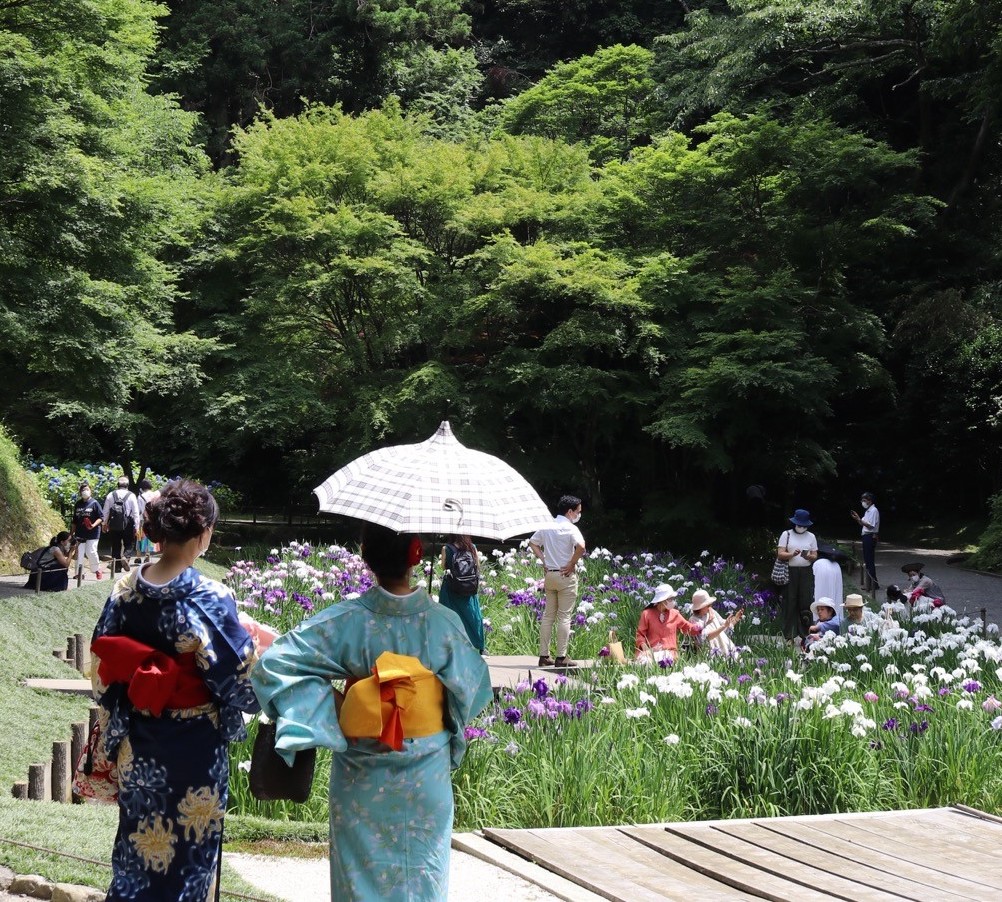
Visitors leisurely enjoy an iris garden in Japan
Visitors leisurely enjoy an iris garden in Japan. Of all the pathways linking a single cultural ecosystem service to a single constituent of well-being captured from the academic literature, 86.3% represented positive contributions compared to just 11.7% negative contributions. 2022 Nicola Burghall CC-BY-NC


Labels: , , ,

Friday, October 29, 2021

Spiders Steering Clear of Spider-Predators

A jumping spider is seen lounging on a tree. Researchers used baby jumping spiders to test their predator-recognition instinct with other spiders.
"Jumping spiders are absolutely amazing because they have this incredible eyesight. And they can see almost as good as we do, so they pay attention to detail."  
"There’s a lot of assessment of the risk in this moment, so they assess how big is that thing? How quick could it get to me?"
"And then also knowing that motion really triggers what jumping spiders perceive, like, moving away in this choppy fashion and really slowly maybe is also a strategy of not getting the attention from the predator."
Daniella Roessler, study lead researcher
 
According to a new study's analysis of spider reaction to the presence of other, predatory spiders, it is not only humans who react negatively to the presence of spiders. The instinct of survival informs spiders when one of their own species known to hunt and eat smaller spiders is around, and that the situation calls for speedy removal from the scene. Hastily extracting themselves from the presence of a hungry spider out to make a meal of a smaller spider is an exercise in survival.  

Published by the British Ecological Society in the journal Functional Ecology, the study looked at the behavioural responses of baby jumping spiders when confronted by predator and non-predator spiders -- with a view to identifying the test-subject spiders' predator-recognition instincts. In the study process Roessler and her research team placed before baby spiders a variety of objects to elicit responses. 
 
A spheroid 3D printed model was first to act as the experimental control. A 3D printed spider and an actual larger, dead spider matched in size, came next.
 

When confronted with a spider-like 3-D model, jumping spiders freeze and back away slowly, especially if the model has eyes.  Daniela Roessler

The jumping spider was placed under observation to determine whether its reaction would be based on its ability to detect which of the objects might cause a survival response, despite that the objects were stationery. The spiders' reactions were videoed, the first of which shows a baby spider seemingly assessing the black 3D spheroid model. Without hesitation, the spider scuttles over to the object, leaping it on the platform and clambering over the model, an obvious indication that fear of repercussions was not involved.

This changed when the baby spider was confronted by a 3D printed black spider, but this one fitted with frontal eye features, the presence of which caused the baby spider to freeze, move cautiously to the side and finally turn decisively away, leaping off in the opposite direction. Again, the same sphere, lacking frontal eye features provoked a more confident reaction in the baby spider, where it moved forward as though assessing the large object before it. Within seconds it turned in the opposite direction away from the object.

When presented with multiple species of dead jumping spiders, the researchers made note of the baby spiders becoming more fearful of the species that appeared just as it did; the brown marpissa muscosa. It refused to approach any nearer the dead specimen; freezing, then slowly backing away...

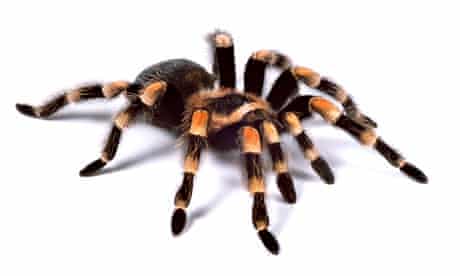
Red-kneed tarantula Brachypelma smithii
Tarantula ... Photograph: Redmond Durrell/Alamy

Labels: , , , ,

Friday, July 03, 2020

Ravaging Forests

"Our forests are under attack here in Eastern Ontario. We had the forest tent caterpillar. Now we've got the Gypsy moth. And you've got the drought. We're getting  hammered."
"We knew they were here. We just didn't know what numbers there were. It really blew up at this end of the province."
"You can scrape those [egg masses laid by the moths] off the tree and destroy them. You can use soapy water or you can just crush them."
"If people want to take matters into their own hands, that's something you can do, especially if you're a cottage owner. But it's very difficult to do if you have a woodlot."
"Our regional forest health network is watching at what's coming at us from across the border in the States. We're looking at oak wilt. We're looking at hemlock woolly adelgid. The list goes on."
"But right now, it's the Gypsy moth."
Jim McCready, forester, arborist, Eastern Ontario
A full-grown gypsy moth caterpillar, about 6 cm in length, in late June. Joe Shorthouse

Mr. McCready is past president of an agency dedicated to protecting and managing forests of the region of eastern Ontario. He has identified the Gypsy moth hatch this year as being particularly acute for the health of the forest mass, a destructive outbreak in a wide swath across the region. Foresters failed to anticipate that this year would be particularly bad for the presence of the moths in huge, destructive numbers. On top of which is the problems generated for the forests by a years'-long drought situation, leaving trees in an already weakened state, vulnerable to the damage caused by the moths.

My daughter lives on a rural property on White Lake, not far from Arnprior. She's seen such infestations before, but her trees have been impacted by the drought situation where no rain of any significance has fallen year after year, even when more than ample rain falls a little further to the north-east where we live, and where there has been no paucity of rain whatever. Here, in the Ottawa area, rain has been a constant throughout the spring, to the extent where the vegetation growth in our nearby forests have been even more vigorous than usual.

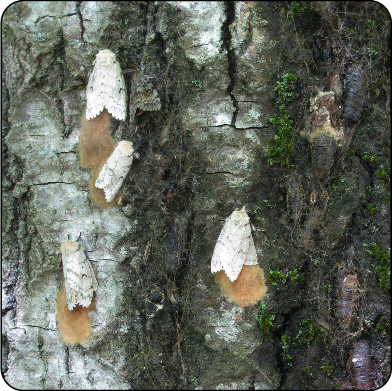
Gypsy moth adults laying eggs
Mature female Gypsy moths laying egg masses

Originating in Europe, the
Gypsy moth is one of many invasive species that have devastated local forests. Several years ago it was the Emerald Ash borer beetle that destroyed ash trees. Those that were cut down years back in an effort to stop the advance of the beetle and to protect woodland hikers from the potential of falling trees, are struggling to re-establish themselves, putting out new growth around the ash stumps in a bid to survive.

In 1859 a silkworm breeding experiment took place in Massachusetts with the Gypsy moths. While the experiment failed to succeed, the gypsy moths themselves succeeded in escaping, becoming a destructive pest in an environment where it has no natural predators. The caterpillars can grow to over six centimetres in length, recognized by bristles and a twin row of blue and red dots on their backs. A square metre of foliage will do an individual caterpillar initial to pupation and hatch, when it becomes a grey-brown moth in late summer.

The caterpillars have been present in Ontario since 1969, with intermittent outbreaks. Creeping up trees to feed in the canopy at night, they creep back down during the day making themselves less visible. Forest tent caterpillars, native to the region, feed early in spring and summer when they present an outbreak, so trees have the opportunity to put out a second covering of foliage. With fewer predators compared to the tent caterpillars, the Gypsy moths wreak far more lasting damage.

The only bright spot in defence against their depredations is a virus called baculovirus that they're susceptible to, that destroys the caterpillars from inside out.They lay buff-coloured egg masses on tree trunks providing an opportunity for the less squeamish to scrape them away and destroy them before hatching.


Labels: , , , ,

Wednesday, July 01, 2020

 COVID Fallout: Orca Whales in the Salish Sea

"The anticipation is that the quieter environment will help the killer whales in communicating, in socializing, in navigating and most importantly, in finding food."
"What we are seeing in the Salish Sea is levels of shipping noise that haven't been present for three or four decades. So we would have to go back to the 1980s before we would have heard such a quiet environment."
"They [killer whales] echo-locate to find their salmon. It's a very sophisticated sort of acoustic capability and the quieter the environment, they would have more success in finding prey." 
"If we see them returning and staying in their critical habitat for longer periods ... if we have evidence of successful feeding on the salmon, then those are all good signs and in some sense the quieter environments can only have helped their survival."
Richard Dewey, associate director of science, Ocean Networks Canada
An endangered female orca leaps from the water while breaching in Puget Sound west of Seattle, Wash. Ocean Networks Canada says the drop in sea traffic brought on by COVID-19 will be a boon for killer whales. (The Associated Press)
A calming effect has been noted thanks to the COVID-19 pandemic in the diminution of sea traffic off the coast of British Columbia, affecting southern resident killer whales. Which has led to a study, given this rare occasion of relative quiet in normally busy traffic in sea lanes, threatening the existence of these mammals. Ocean Networks Canada has stated its belief that the change will result in a positive outlook for the survival of endangered marine mammals like orcas.

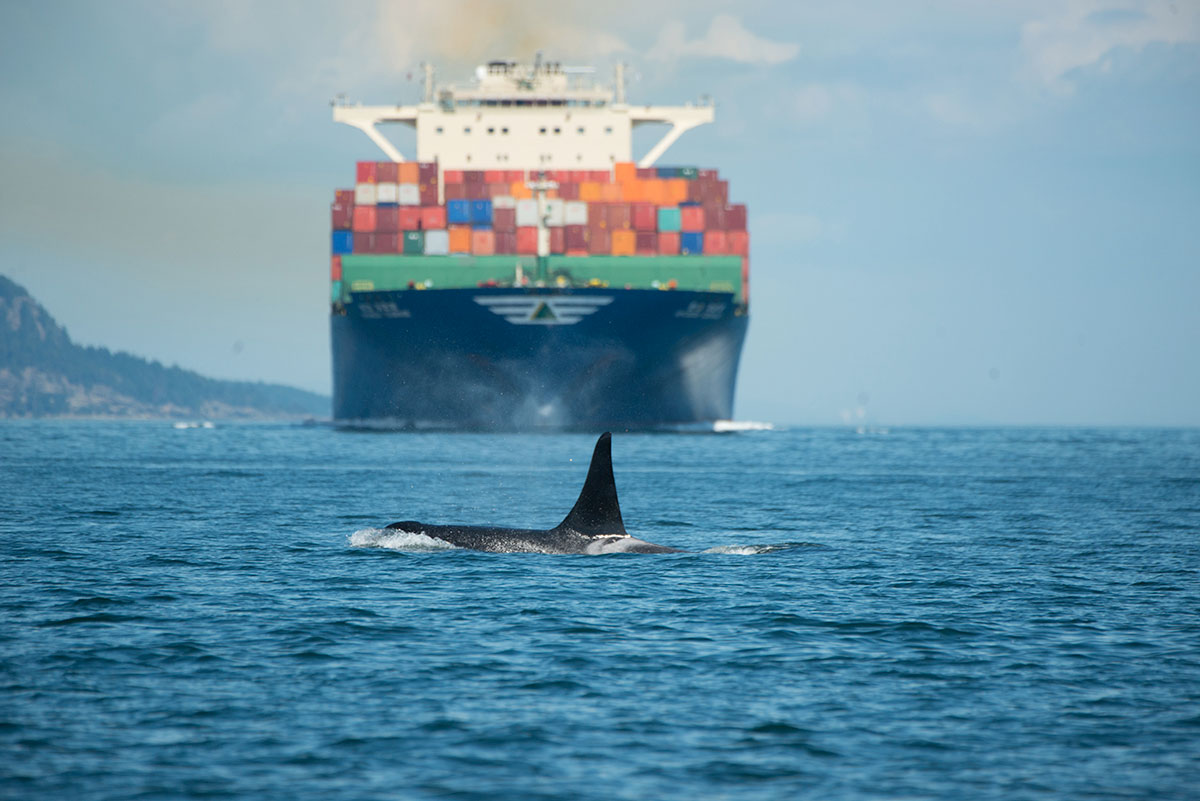
Orca L87 as a ship approaches. Capt. Alan Niles/Maya's Legacy Whale Watching

Noise from ships and sounds made by marine mammals have been studied for years, as the commotion brought about the presence of heavy traffic in the ocean has complicated and endangered life for marine animals. Last month a paper was published in the Journal of the Acoustical Society of America which concluded that a rough 30 percent decrease in commercial shipping traffic into the Port of Vancouver from China alone in the first four months of 2020 has been occasioned as a by-product of COVID-19 which has impacted on world shipping.

Along with a diminished commercial sea traffic, a pause in whale-watching boats, cruise ships, recreational vessels and tankers has also been occasioned. All of which has led to a 75 percent noise reduction. Shipping noises have been steadily increasing, close to doubling every decade, creating a major concern for the endangered southern resident killer whales. Their hearing is similar to that of humans, communicating in a frequency band also similar to that of humans.

Orcas use sound to hunt and communicate. (Elaine Thompson/Associated Press)

Whales use sound "continuously and all the time", in the ocean, said Dr.Dewey. Sound enables the whales to scope out kilometres' distance, while their eyesight allows them to see up to a distance of approximately five to ten metres in a very "turbulent" and murky environment in the Salish Sea. Loud sounds emanating as a result of human activity has a deleterious impact on the whales, increasing stress hormones when the whales are forced to 'shout' to make themselves heard in communicating over large distances.

By the time killer whales accomplish their seasonal return to the Salish Sea, scientists will have put in place 30 hydrophones to record the volumes of the sounds they make. The aim of the study is to yield vital data so that policy and regulatory changes can be enacted to aid survival of the animals.

In the past, killer whales would be seen in the Salish Sea in May and June, but their arrival has been delayed for the past four years, according to the director of the University of British Columbia marine mammal research unit.

Hypothetically, one reason for their late arrival -- sometimes as late as September -- may be insufficient numbers of salmon to feed on, although researchers believe that enough fish are present for the 72 remaining southern resident killer whales. Which has led scientists to wonder whether the whales are unable to hunt as a result of sound disruption from vessel traffic.

An orca swims in the Burrard Inlet near Port Moody. (Red Boat Charters)


Labels: , , , , ,

Tuesday, June 16, 2020

Crisis Management : Great Barrier Reef Corals

"Because COTS [Crown-of-Thorns starfish] juveniles have the ability to stay in an algae feeding form for up to six years, there could be an accumulation of multiple generations of juveniles that are happily feeding on algae until there is a specific cue that catalyzes their transition to feeding on corals."
Paul Barber, professor, Department of Ecology and Evolutionary Biology, University of California at Los Angeles

"The science tells us that elevated fertilizer and other pollutants from primary production run-off is causing an increase in phytoplankton, which is the main food source for COTS larvae."
Anna Maraden, managing director, Great Barrier Reef Foundation

"Given the extreme size of the Great Barrier Reef and many threats to humans, we wanted a 'tool' that could allow the authorities to scale back the manual eradication program."
"In 2006, I developed a robot which proved that vision can be used to allow a robot to estimate its position in the reef and avoid obstacles."
"[We] have been integrating them with robotic boats to further increase their ability to deliver large amounts of coral larvae to damaged reefs."
Matthew Dunbabin, professor of science and engineering, Queensland University of Technology
crown of thorns starfish.jpg
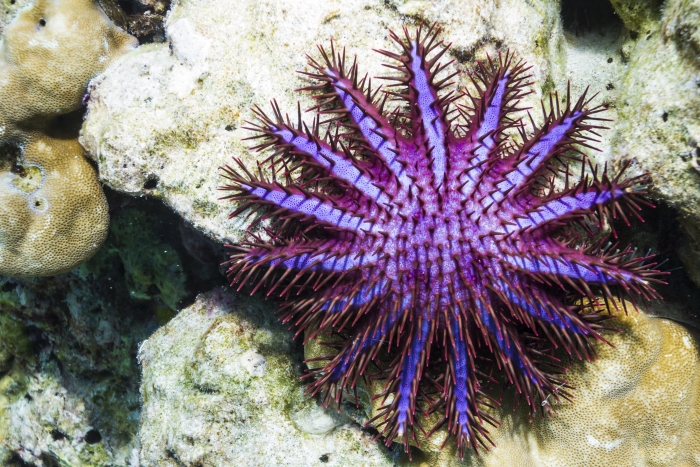
Crown-of-thorns starfish eat coral, and their booming population is causing major problems in Australia’s Great Barrier Reef. (Tarasovs/iStock)

As an irreplaceable wonder of the natural world, the Great Barrier Reef is immense, with its 3,000 reef systems spanning over 214,000 miles, home to over 1,500 species of fish, 400 kinds of hard coral, and one-third of the planet's soft coral. Half of that coral has been lost in the past thirty years, however, both to bleaching events and to outbreaks in the communities of crown-of-thorns starfish which feast on the coral.

As the world's largest coral reef system, the Great Barrier Reef has been attacked by this starfish with its long spikes covering its body, capable of reaching 2-1/2 feet in diameter, looking somewhat like a colourful landmine with 14 to 21 movable arms. The crown-of-thorns matures at four months of age, eating live coral continuously, up to their own body weight in one sitting. One such animal alone is capable of consuming 20 to 32 feet of living coral annually.

The 865 acres the Great Barrier Reef covers off the coast of Australia is host to an estimated 350 billion of the starfish considered to be the most fertile invertebrate in the world. They have stripped 150 reefs of coral and damaged 500 more, in just a few years within the Great Barrier Reef. It was recently discovered that crown-of-thorns are able to delay transition to adulthood for up to six years during which time they can be static, awaiting the healing of a damaged reef, which when healed, and healthy coral regrown, is ripe for the COTS to mature and resume feeding.

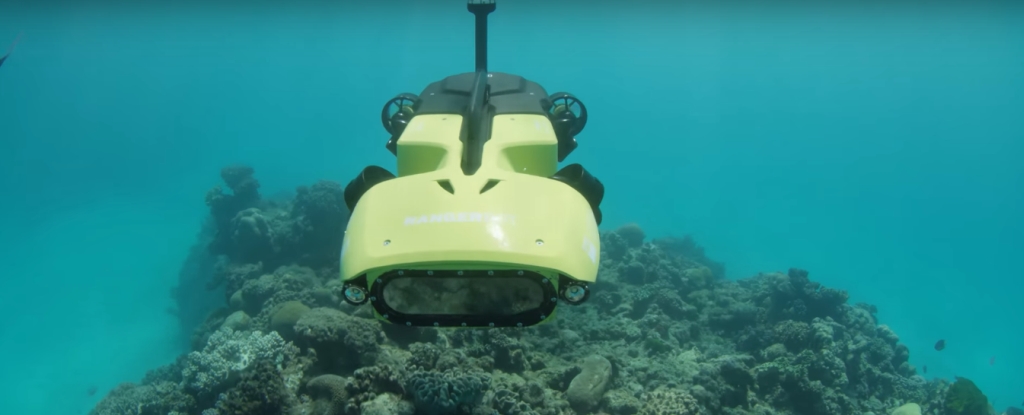
Reef RangerBot becomes 'LarvalBot' to spread coral babies
LarvalBot gently squirts the coral larvae onto damaged reef areas. Credit: QUT Media

Yet overfishing and the absence of the starfish's natural predators, the giant triton snail, have also contributed to outbreaks. Where under normal circumstances crown-of-thorns starfish have a useful role in reef vitality and diversity, preferring to consume the faster-growing coral which helps slow-growing coral varieties gain a foothold, when their population is not kept in check they have the capability of becoming a devastating invasive species.

The Great Barrier Reef Foundation recently launched a $37.5 million crown-of-thorns starfish control program, exploring innovative surveillance and control methods. The foundation has also been working with local farmers in reducing the amount of pollutant (fertilizer) run-off into the reef's waters to decrease outbreaks. Since the early 1960s when the escalation in outbreaks was first seen, scientists have been exploring methods of crown-of-throrns outbreak mitigation. Researchers at James Cook University in 2015 discovered a 20-millilitre dose of vinegar would kill a starfish in 48 hours.

crown of thorns starfish inset
A crown-of-thorns starfish. (tae208/iStock)

A practical, workable culling tool was considered only part of the battle of injectable poison such as bile salts or vinegar where diving crews were tasked with hunting the starfish one by one, making it difficult through such a laborious regimen to much diminish the population. Between four and 12 million crown-of-thorns starfish lived at the Great Barrier Reef in 2015. Two crews working full time were able to eradicate 350,000 of the creatures. To place matters into perspective, a female lays roughly 68 million eggs yearly.

A seemingly hopeless situation, but one with a more practical solution in scooping them up when an autonomous underwater vehicle, a vision-based robot specifically designed to protect coral reef systems was devised. Developed by a team of scientists led by Matthew Dunbabin, with Deep Learning technology, by 2014 Professor Dunbabin's team constructed a robot that could be programmed to detect and inject the starfish with bile salts, through autonomous operation.

The Ranger Bot is programmed to accelerate the development process. Fully operational by late 2018 in the Great Barrier Reef, the team that assembled it was able to increase its capabilities to the point where it can help with coral larvae reseeding along the Great Barrier Reef and reefs in the Philippines.

rangerbot august 2018
Ranger Bot   (TheQUTube/YouTube)


Labels: , , , , ,

Monday, May 18, 2020

Micro-Earth, Biosphere 2 -- The Ultimate Haven

"We were in quarantine for two years. Or we put the rest of the world in quarantine for two years."
"Any time there was a special occasion of drink or food, all the conflict [among the eight people who volunteered to live within the confines of Biosphere 2 for two years] drained away. No one wanted to spoil it."
"Whatever food and drink really makes people happy in quarantine should be pursued. This isn't fun unless we can have feasts and parties and do home brewing [under quarantine from COVID-19]."
"Wherever you are, you are supported, and you are living, because we have a healthy Earth biosphere. Fall in love with every bit of it. The plant on the windowsill, the tree on the corner. We have to understand that every breath of air that we take, every drop of water, every bit of food is produced by our biosphere."
"That's the awareness we need to come out of this pandemic. We're all connected. It's showing us the downside of it. But we need to recognize the flip side. Think of this amazing biosphere that's given us birth."
"Biosphere 2 was so far ahead of its time that it offered an understandable way of getting around what a biosphere was. We weren't making a model of planet Earth, thank you very much. It was a little slice."
"It totally transformed me, and everyone else who was in there. I'm still digesting it. The incredible bodily connection that all of us felt with that living system, to where it was unthinkable that we would harm it in any way. The mindfulness with which we took care of the biome. The tender loving care that we took, and the visceral sense that we were connected was also part of the human dimension."
"That knowledge and that love went from my brain, my mind, to my body. To where my body got it. My bodily understanding that I was connected to that world."
On one level being alone with seven people was like being in an encounter group, or group therapy, for two years. I got to see ways I related to other people that I didn't like. I had to change who I was."
Mark Nelson, 77, former 'Biospherian'
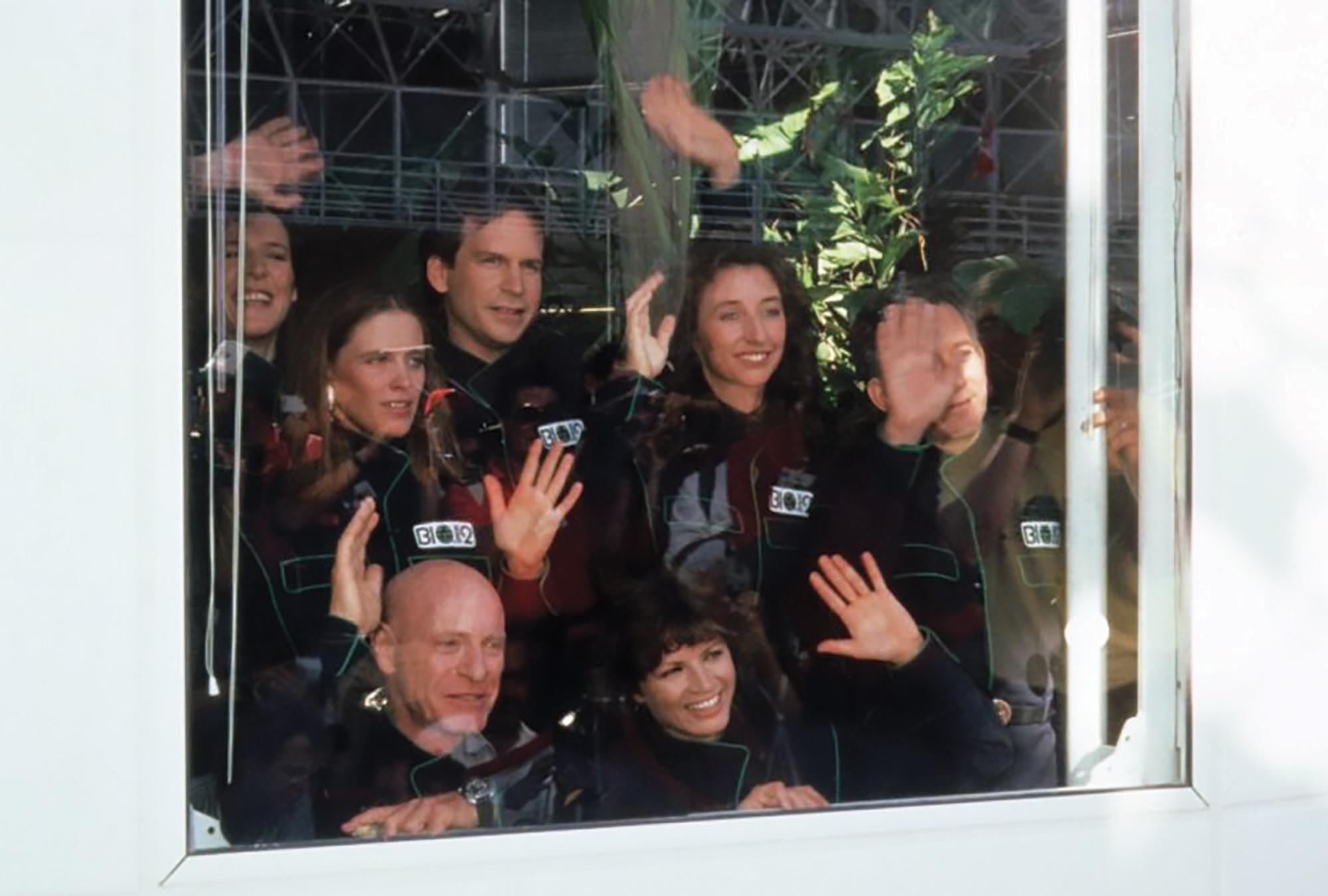
Biosphere 2, Mark Nelson, 1991

"Leonardo da Vinci talked about flying machines. Centuries later the Wright brothers built one. Biosphere 2 may prove to be the Kitty Hawk of biospheric life-support systems."
"Then again it may prove to be one of those airplanes everybody sees in the movies and laughs at that had 16 wings flapping at the same time."
Biosphere 2 patron Ed Bass, 1991

It was an imaginative, forward-looking experiment. A costly one, to invest in the needed infrastructure, to develop a system that was as true to the Earth's atmosphere and support of living creatures and vegetation as possible, to allow for self-isolation in a grand experiment where a group of eight people intended to see whether they might succeed at being self-sufficient, as stewards of a miniature Earth, drawing from its resources whatever they needed to sustain life, not only for themselves but for the creatures living alongside them, from insects to birds, mammals to vegetation.

It was quite an ad hoc experiment. The inhabitants of Biosphere 2 who named themselves 'Biospherians', were five Americans, two Brits and a Belgian, comprising four of each gender, included among them a botanist, a marine biologist and a physician. The very same professions, in fact, that sea-voyaging geographical exploratory missions of the past setting out to discover new continents and other inhabited locations worldwide with different cultures and levels of civilization generally brought along, in humanity's search to know the world they lived within, through the ages.


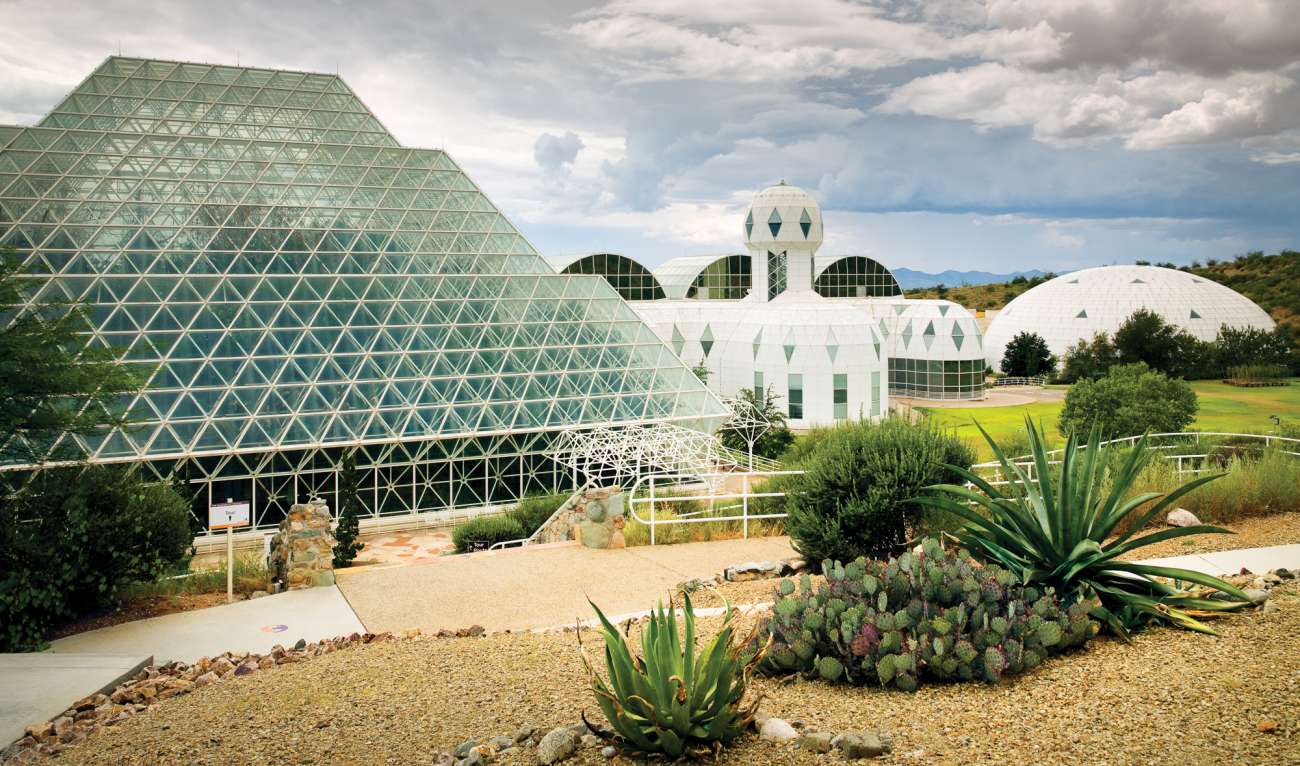
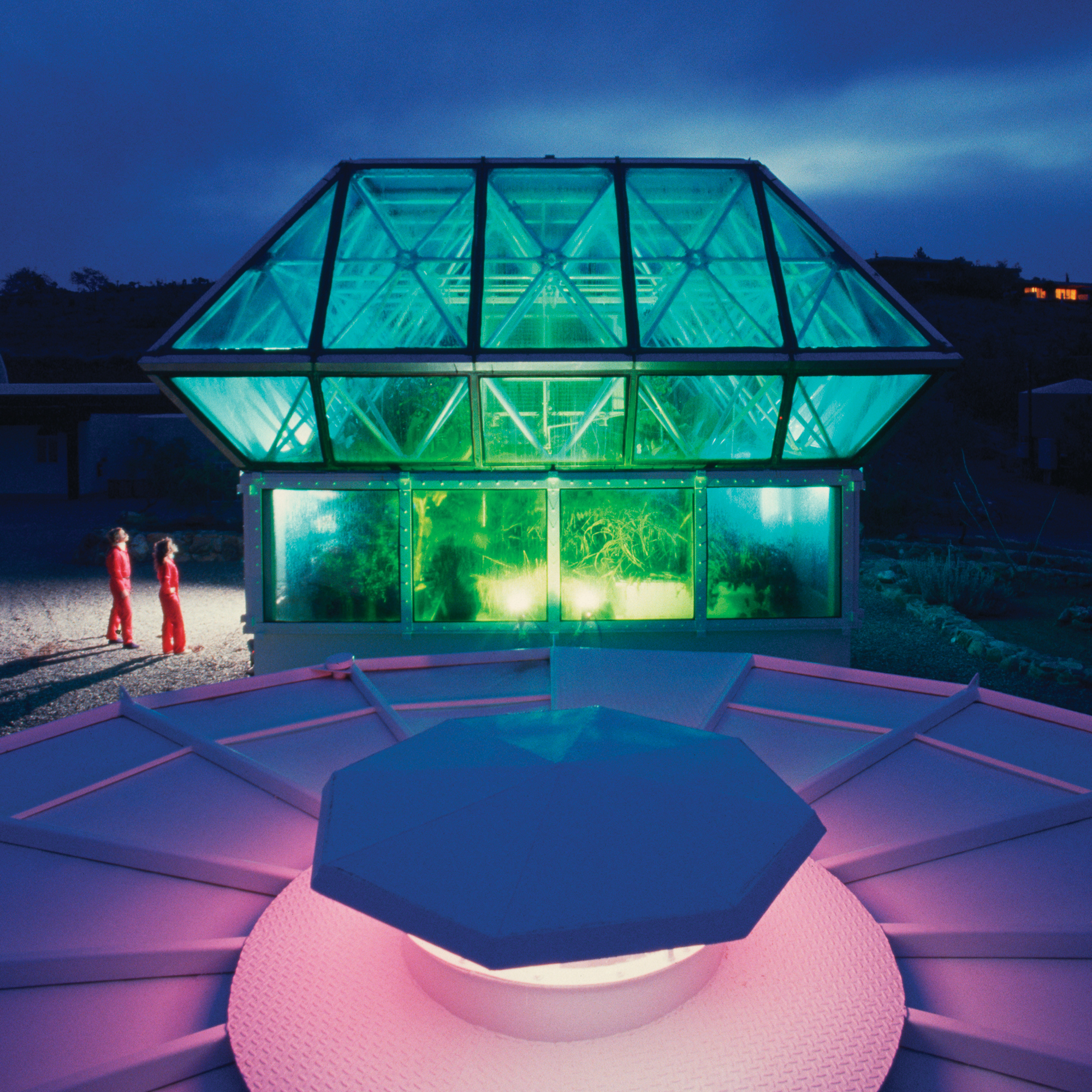
In cloistering themselves and shutting themselves away from the outside world, their adventure in living was meant to instruct the participants on how to manage lives separated from all that was familiar as they re-acquainted themselves with the natural world at a level none had ever before experienced and developed sustainable techniques. Biosphere 2 was planned and created to enable the eight people within to creatively live independently. The complex into which they had sequestered themselves was of an immense size, purpose-built through the 1980s in the Arizona desert..

The Biosphere had an ocean with coral reefs, a miniature rainforest, a desert, and a wide range and plenitude of flora and fauna, living among the eight humans. One of whom badly injured herself which mandated she be withdrawn from the closed atmosphere to undergo surgery on her hand. Once her injury was resolved, she returned to the Biosphere. Among a few controversial revelations was that the 'all-natural system', of the breathing, living atmosphere meant to sustain life 'naturally' through its micro eco-system, was the presence of a carbon dioxide scrubber to ensure fresh air could be pumped in to avoid potential hypoxia.

As Mark Nelson wrote for publication in a Dartmouth College journal, as a former Dartmouth alumni, the group grew all their food, raising and slaughtering livestock. They had a laboratory, they were busy maintaining equipment and had their personal living quarters. Everyone was required to work from three to four hours daily, five days a week, to help produce the food they depended on for nutritious health. With no agricultural background among any of them, they were spurred by the reality that if they didn't produce they wouldn't eat.


And eat they did, learning to produce 80 various crops, from rice to yams, peanuts, sorghum, millet, beets, wheat, carrots, peppers, bananas, figs, tomatoes, kale, eggplant, onions, papaya, beans, sweet and white potatoes, squash and herbs. Biosphere 2 was host to 3,000 species of plants and animals.
Crops were grown with biological controls, and organic matter was recycled for composting. And lessons were learned; the cockroaches they hosted meant to recycle organic matter grew exponentially in numbers and began threatening the crops. A situation seen in ants, as well.

Bees and hummingbirds, two of the most delightful animals, and reliable pollinators eventually failed to survive the atmosphere. And eventually the atmosphere itself failed in its purpose to sustain life when oxygen thinned out necessitating the opening of the sealed domes so fresh air could be circulated and replenished. Despite inconveniences and downright emergencies where the inhabitants of Biosphere 2 had little option but to temporarily abandon the airtight sanctity of the domes, they persevered and lived for the appointed two years, isolated and self-sufficient.

Mr. Nelson himself now lives and works on a working farm, serving as an ecology research centre and retreat in New Mexico, called Synergia Ranch, a group he first joined after graduation from Dartmouth College in 1968.

biosphere1
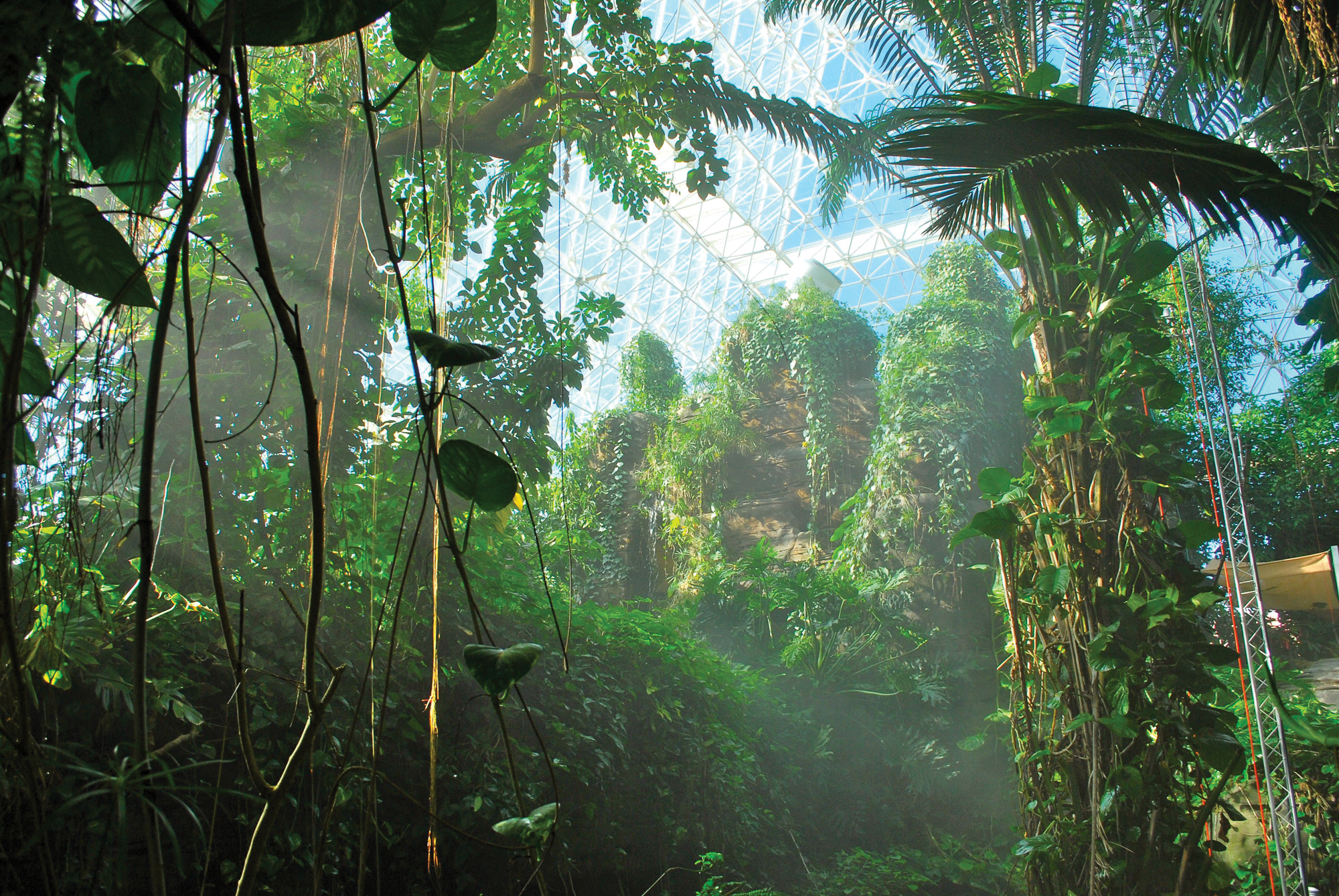
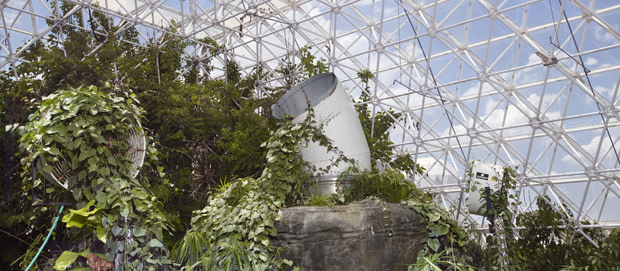
Biosphere 2's 91-foot-tall rain forest contains more than 150 plant species and now provides scientists a test ground for ecosystem experiments. Douglas Adesko

Labels: , , , ,

Saturday, April 04, 2020

The Sequentially Awakening Spring Forest

"The thing about being a tree is you're stuck there all winter in the cold. You've got a big stem and you're very exposed to the cold."
"If you look at an oak, for example, you can see pores in that wood -- big dead cells that are open. They are like straws, one stacked on the next. Or pipes."
"And those specialized cells move water. And what the tree has to do is produce a new set of pipes before it can leaf out. Or around the same time [while producing the pipes] it can leaf out. It has to have a plumbing system to get the new leaves."
"So in those species like oaks, the wood will start growing before the trees leaf out, and produce a new plumbing system for the year."
"All of this is about synchronizing with the season [flowering spring wildflowers advantaged by the sun warming the forest floor before deciduous trees leaf out blocking the sun]."
"Things are constrained by when it gets warm enough. But if the overstory trees are deciduous, there is lots of light available for those very early spring plants, so ... they can photosynthesize and grow and flower before they are heavily shaded."
"The result is that we get this beautiful sequence of plants that really give us a sense of season because things are happening at different times."
Sally Aitken, researcher, associate dean of forestry, University of British Columbia

On spring's arrival, a steady succession of early season changes begin to take place. At less than dizzying speed, it often seems, for those anxious to see the woods transform from the sere appearance of winter, with its monotones of black, grey and white. It takes a considerable length of time, when the atmosphere is in its warming phase, the sun rises higher in the sky and becomes notably warmer, and copious spring rain along with snowmelt irrigates the roots of trees in the forest, both deciduous and coniferous.
Pink Trillium

We see the gradual appearance of familiar woodland plants on the forest floor as ferns begin to poke through the warming soil and unfurl, when woodland violets begin their bloom, along with coltsfoot, resembling early dandelions, and in North America trilliums and Ladies Slipper orchids, Trout lilies and Jack-in-the-Pulpits make their appearance. They take advantage of the leafless deciduous trees which, when fully leafed, block the sun from warming the forest floor, to make the most of that brief time, to flourish and to flower.

When we look up at the forest canopy and see the bare branches of conifers it seems to take forever before poplars, elm, maples, beech, birch and oak among others finally begin to leaf out. They do so gradually, some species earlier than others, until eventually all are in leaf. And though we're impatient about the process, anxious to see that familiar, reassuring green screen of foliage, the trees themselves are doing their best to prepare for leafing out, unknown to us.

Trout Lilies

Evergreens, though they keep their green throughout the winter months, also begin to produce new 'foliage' in spring needles, casting off the old dead ones. They begin the process of photosynthesis quicker than the trees that have shed their foliage in fall. All trees use sunlight to produce food as sap begins to run up from their roots to suffuse the entire tree and begin the process of renewal. The ritual of the deciduous trees is locked into their cells absorbing water.

They have been deprived during the winter months of liquid, awaiting spring when the cells that pick up water are once again fully functioning, casting off the air bubbles that result in the winter when water freezes in the cells and growth is apprehended. And while the trees are awakening and resuming their growth periods throughout the warm months that follow, photosynthesizing to put out new foliage, the forest has long since awakened, as evidenced by the wide array of spring-flowering plants taking their turn, one after another.


Labels: , , , ,

Saturday, March 07, 2020

Feeling Tired? Sleep-Deprived?

"It's what you would consider a modest effect. What's really important is it affects everybody. If you have a large portion of the population that is affected, then you would say even a small effect definitely has a public health impact."
"If it's really DST [Daylight Saving Time] that leads to that increase in traffic accident risk, then we should see that before 2007, the peak in traffic accident risk in spring that has been reported before should move to that week."
"It's hard when you use this large-scale observational data, so it's always really hard for us to say it's really that thing. But this is a novel piece of evidence that further supports our observations."
"Because DST is changing the timing of when you have to get to work -- it doesn't change when the sun comes up, it's just a change of  your clock -- you get less morning light and more evening light."
"Translation always takes some time. I think every change is hard. I think now is a good time [to do away with DST]."
Celine Vetter, director, Circadian and Sleep Epidemiology Laboratory, University of Colorado Boulder
  Getty Images
A new study. Which is to say, yet another study. To augment common-sense attitudes that argue against continuation of Daylight Saving Time. Said to have originated with the needs of a farming constituency, a century earlier. And having no place whatever in the world of today, where its seasonal implementation has been identified as a source of making people generally miserable adjusting to the daylight/time change, and bringing harm to a number of people in any community through fatal traffic accidents.

Tomorrow is the day that practise, not purpose, mandates that all clocks in most of North America jump forward an hour, back to Standard Time. The negative health effects outlined by scientists have long been pointed out but studiously ignored by those 'experts' in public policy who administer these long outlived guidelines of preserving light by timing our days differently. The new study published in Current Biology, traces a link between spring's transition to Standard Time with an increase in fatal vehicle accidents in the United States.

Such that, according to the researchers involved, the rate of fatal car accidents increases by roughly six percent in the week following the clocks being moved forward an hour annually, in the United States. Sleep deprivation is pointed to as the logical culprit; the misalignment of circadian sleep rhythms. Dr. Vetter's research team analyzed a database of fatal accidents that occurred in the United States between the years 1996 and 2017, a total of 732,885 cases, documenting date and time of each collision.

Other possible variables exist to determine whether DST was a factor in the accidents that the research team examined; changing weather patterns for one. One factor, however linked as proof of the time change's impact. The duration of daylight saving time in both Canada and the U.S. by four to five weeks took place in 2007. Prior to 2007 the first Sunday in April would begin DST, which would end on the last Sunday in October. Since 2007 DST begins the second Sunday of March, ending on the first Sunday of November.

daylight-saving-time-clock
Researchers found, through analyzing the accident data, that the increase in fatal car crashes certainly did move from April to March in 2007 when DST made its move. In Western time zones, Dr.Vetter noted, the accident rate increases since the sun rises at a later time there than in the east, requiring people to awaken earlier for work or studies and they are then exposed to less morning sunlight. That causes them to feel less rested; a term she has named "social jet lag". The study's conclusion was that DST be abandoned.

A return to Standard Time should be permanent, not only between the designated months of November and March, but throughout all months of the year. The 28 deaths a year caused by the time change, points out Dr.Vetter, could be prevented through abandoning the time change. And there is no reason whatever to remain on daylight saving time, other than inaction. The Province of Saskatchewan stopped switching clocks, preferring to remain in perpetual daylight savings time, since 1966. And that's a traditional farming province.

Rush hour traffic lines the horizon of a sunrise on March 18, 2014.ELIZABETH McSHEFFREY/DAILY HERALD-TRIBUNE/QMI AGENCY

Labels: , , , , ,

Tuesday, January 21, 2020

Another Animal Species Abused by Human Culture

"The bees in the almond groves are being exploited and disrespected."
"They are in severe decline because our human relationship to them has become so destructive."
Patrick Pynes, organic beekeeper, environmental studies, Northern Arizona University

"We have to think about how we grow monocultures. And that is much bigger than an individual issue."
"We have to look at regions, like the Central Valley of California where we take billions and billions of bees to pollinate the almonds and say, 'Okay, what could we plant here so that we could have bees here all the time'?"
"Because ultimately, bees are not supposed to move. They build a colony, they stay there, they map out where everything is ... they're like us, moving into a new city."
"The solution might be diverse enough agriculture in the region so that the pollinators don't have to move."
Lenore Newman, author of Lost Feast: Culinary Extinction and the Future of Food

Over the past few decades Western society in its search for the perfect food, has invented substitutes for certain products that food 'experts' deem can be harmful to human health, or conversely reflecting a movement away from animal products to provide people with foods that are similar, considered more healthful, and aren't derived from an animal source. Almond milk falls into that category. Blended and strained in huge quantities to serve a specialized market, nut milk is seen as a nutritious and sustainable non-dairy beverage popular among today's consumers.
Image result for almond crop, california
Food Navigator, U.S.A.

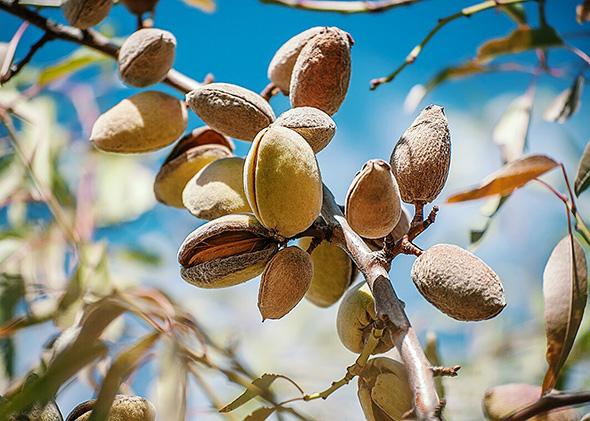
Almonds, originating and native to the Tian Shan Mountains of Central Asia, hosts a honeybee population that specializes (as in species-specific) in pollinating almond blossoms, as a byproduct of their honey-making process. Almond tree seedlings have long since been transplanted to California which now grows 82 percent of the world's almonds, in a hot, dry climate, requiring a huge amount of irrigation in what is also a water-deficient landscape. Above all, the vast mega-farms in the state require pollinators since almond production is reliant on honeybees for pollination of the millions upon millions of blush and white blossoms on millions of trees.

Image result for almond crop, california
Slate Magazine

For over a full one-third of vegetation bearing food for our species, without pollination there would be no resulting fruit. The huge demand of the almond blossoms has created a situation of frenzied deliveries of bee pollinators. The bees packed in boxes are loaded onto trucks and vast numbers are transported to the huge California forests of almond trees. This is yet another industry linked to the growing of almond trees; bees for hire. And those hard-working bees are seen to be perishing at what beekeepers and scientists speak of as unprecedented rates.

For California, the almond industry represents a $14-billion crop. Which has resulted in fifty-billion bees dying, themselves representing 40 percent of the honeybee colonies in the United States, not surviving last year's winter, according to a national survey. Once considered an efficient and high-yielding process, mass pollination of monocultures appears to be failing. In view of almost universal record losses of bees, beekeepers were placing blame on pesticide exposure and parasites.

Organic beekeepers, on the other hand, along with environmentalists, beg to differ, placing their belief in a more fundamental causation. No other California crop uses bees in the numbers that almond orchards require. Pesticides like glyphosate (an active ingredient in the Monsanto product Roundup) is pointed out as the leading cause of colony collapse disorder, but bees also face other threats threatening their longevity.

The bees' winter dormancy is being disrupted by transporting them to California almond orchards. They are placed under huge stress by concentrating them in an area that facilitates the spread of disease. Lacking diversity in a monocrop places them under additional stress.

The full causes of colony collapse remain elusive. But it does seem clear to environmentalists that the very shipping of pollinators from crop to crop represents part of the problem. Bee die-off during the winter months is not unusual. It is the sheer scope and scale of the bee die-off that is so troubling and not reflective of nature's programming.


We ourselves discovered decades ago the presence of wild-bee hives in a forest near where we live. And winter after winter, we see hundreds of bee corpses flung out of the hive. Which each successive snowfall that occurs, new dead bees appear, in a presumed ritual of perpetual house-cleaning by the remaining hale and healthy bee population in that hive located thirty feet in height inside the trunk of a venerable, stout pine growing deep in a forested ravine.


In spring, when the forest recovers itself after a long cold, snowy winter, wildflowers begin to blossom, long after we see bees flying about the undergrowth on the forest floor when warm spring weather reactivates the bees, awakening them to activity, heralding the beginning of their busy season and nature-lovers' appreciation of the appearance of huge arrays of wildflowers.


In that forest there are wild apple trees and hawthorns, along with honeysuckle and grape vines as an understory. The forest is also rife with the growth of berries; tiny strawberries, stands of raspberries and blackberries and thimbleberries, none of which would bear their delicious fruit without the vital intervention of the wild honeybees.

Labels: , , , , , ,

Tuesday, January 14, 2020

Leisure Pleasures for Grandmothers in New Caledonia

"The study zone is in the most touristic bay in Noumea, so I often meet people when I am doing field work on sea snakes. When I was snorkelling on my own studying sea snakes, I used to meet a friend of mine called Aline that was snorkelling and taking photos on the same reef. In order to help me, she started taking photos of sea snakes and would send them to me by mail."
"We stated chatting in the water and I explained to her what I was doing, and she told me she wanted to help."
"As soon as the grandmothers set to work, we realized that we had massively underestimated the abundance of greater sea snakes in the bay. We realized they are important mesopredators on the reef."
"If there is one thing I want everyone to learn from this, it's that you should never underestimate grandmothers."
Claire Goiran, marine biologist, University of New Caledonia

"We meet every morning between 8 a.m. and 8:30 a.m. We wear our diving equipment and we swim for one hour or two."
"Sometimes in summer, we can swim for three  hours. Back on the beach we have tea and enjoy the beauty of the site. It is very relaxing."
Marilyn Sarocchi, 63, New Caledonia, Coral Sea
The “fantastic grandmothers,” from left: Geneviève Briançon, Aline Guémas, Monique Zannier, Monique Mazière, Sylvie Hébert, Cathy Le Bouteiller and Marilyn Sarocchi. Image by Claire Goiran/UNC.

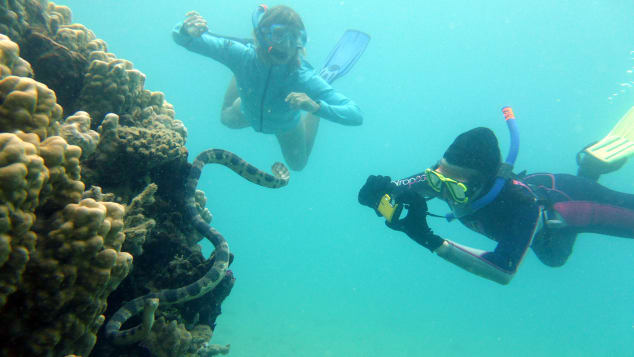
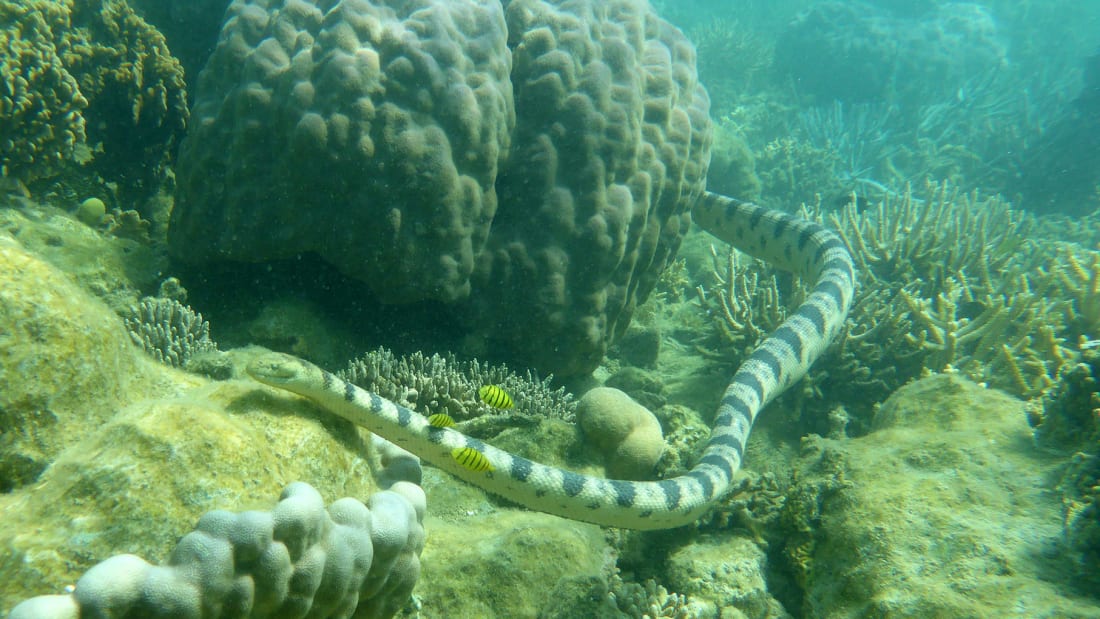
The journal Ecosphere recently published an article highlighting an unusual collaboration between scientists studying the presence of sea snakes around the waters off the coast of Australia and the French territorial island archipelago nearby of New Caledonia teeming with over 9,300 marine species, including dugongs, manta rays and venomous sea snakes. The greater sea snake, which can reach close to 1.5 meters in length, capable of killing a human with a single bite, among them.

Sea snakes for the most part live offshore and given that they are expressly dangerous to handle, few scientists are inclined to risk studying the species and their hard-to-reach habitat. Rick Shine, an evolutionary biologist at Macquarie University, Australia, and Claire Goiran from the University of New Caledonia paired up to find out what they were able to, about the greater sea snake.

Their efforts to survey the Baie des Citrons, a bay in Noumea, the capital of New Caledonia, were not very effective. They had a limited time frame to spare, and lacked full-time volunteers as assistants so theirs was a slow start. In the first three years of their study they managed to catalogue a mere 45 greater sea snakes. But then, in June of 2017, a fortuitous meeting took place on a beach between Dr. Goiran and Aline Guemas, a 61-year-old retiree, who offered to help in the search.

snorkeling grandma photographs sea snake
Monique Mazière and Sea Snake 79, nicknamed "Déborah."
Claire Goiran/University of New Caledonia

Ms. Guemas came along with Dr. Goiran on weekly surveys to photograph sea snakes and record the location where they were found. This turned out to be extremely useful for Dr. Goiran who soon suggested to Ms. Guemas she might recruit other retirees to volunteer for the same purpose. Soon, a team of seven volunteers had been assembled, their enthusiasm and usefulness soon becoming obvious, earning them the sobriquet of the "fantastic grandmothers".

Since they began their volunteer work on the bay, hundreds of snorkel surveys have taken place in the Baie des Citrons, where they identified hundreds of greater sea snakes. Monique Zannier, 75, one of the women whose ages range from 60 to 79, admits to no concern over the reputation of the sea snakes. "The Baie des Citrons is our playground", she boasts.

A group of snorkeling women who call themselves the “fantastic grandmothers” is helping scientists better understand the venomous greater sea snake. Image by Claire Goiran/UNC.

The researchers now rely on the women to help numerate and track the hundreds of greater sea snakes that come into Noumea's bays. Their data collection includes greater detailed information on the ecology of greater sea snakes than is found for any other wide-ranging sea snakes worldwide, according to Harold Heatwole, professor of zoology at the University of New England in Australia.
"Remarkably, they found a large number of lethally toxic sea snakes in a small bay that is occupied every day by hordes of local residents and cruise ship passengers — yet no bites by the species have ever been recorded at Baie des Citrons, testifying to their benevolent disposition."
Rick Shine, evolutionary biologist, Macquarie University, Australia 
Two of the grandmother dive to photograph the snake's tail for identification.
Claire Goiran

"I have been studying sea snakes in the Baie des Citrons for 20 years, and thought I understood them very well — but the Fantastic Grandmothers have shown me just how wrong I was."
"The incredible energy of the Grandmothers, and their intimate familiarity with ‘my’ study area, have transformed our understanding of the abundance and ecology of marine snakes in this system. It’s a great pleasure and privilege to work with them."
Claire Goiran

These remarkable women have documented at least 250 of the snakes. They showed through photographs they've taken, that within a 25-month period 140 greater sea snakes visited the Baie des Citrons, suggesting that greater sea snakes may have a larger role in the ecosystem function than previously thought, as animals in the middle of a food chain; both predators and prey.

The conservation status of at least 23 species of the sea snakes is unknown, resulting from a lack of data, leaving Dr. Goiran to hope that their data collected by the grandmothers will be of help to conservationists in improving protection for sea snakes of which only two of the 60 species in total are considered critically endangered.

A greater sea snake in Baie Des Citrons in New Caledonia, a French territory in the South Pacific.

Labels: , , , ,

 
()() Follow @rheytah Tweet