Ruminations

Blog dedicated primarily to randomly selected news items; comments reflecting personal perceptions

Monday, January 17, 2022

Hunga Tonga Undersea Volcano : Violent Eruption

"We have a  nightmare situation of an isolated community experiencing the effects of a large volcanic ash plume producing significant volcanic lightning, as well as a tsunami."
"Seeing that ash plume, that volcanic lightning, and that tsunami leave me feeling sick thinking about the people being impacted by this large eruption."
Janine Krippner, volcanologist, Smithsonian Global Volcano Program
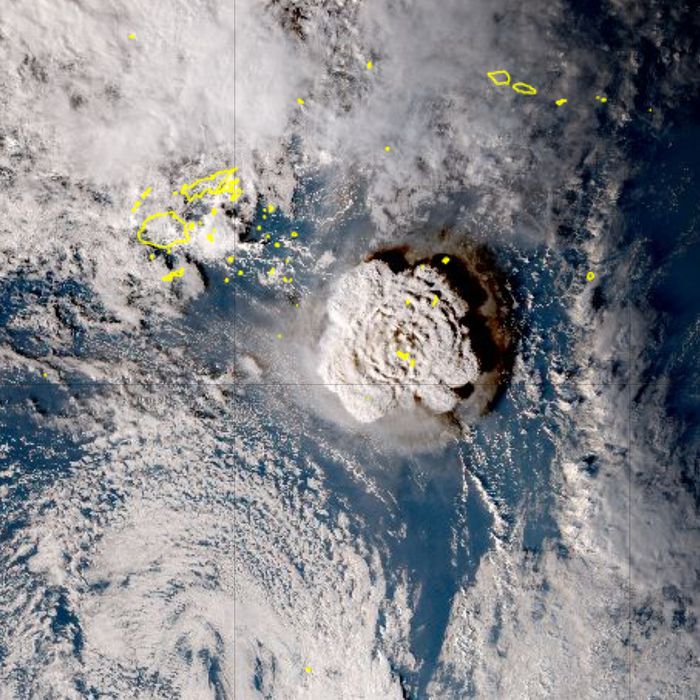
Satellite image of eruption of the Hunga Tonga Hunga Ha’apai volcano on Saturday. Photo: Himawari-8/Japan Meterological Agency
 
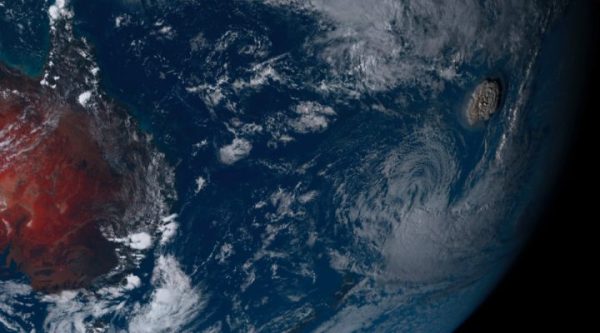
How large, how powerful? The ash and smoke plume from Hunga Tonga volcano covered a vast area, the plume thick enough to blot out the sun, though this was a night-time eruption. Within the plume static discharges towered twice the height of Earth's most fiercely volatile thunderstorms, the result of which was barrages of volcanic lightning striking out of pyrocumulonimbus clouds produced by volcanoes. 
 
It is not yet known how much danger Tongans faced, how many people may have died if any or been injured, much less the damage to infrastructure.

Sensitive lightning detection networks and satellites following the volcano's initial blast counted the equivalent of 70 lightning strikes per second. A tsunami of several metres was generated by the powerful blast, leading to warning of tsunami advisories for Tongans to immediately seek higher ground. Advisories were also promulgated across Hawaii, Alaska, British Columbia and the west coast of North America; Washington, Oregon and California included.
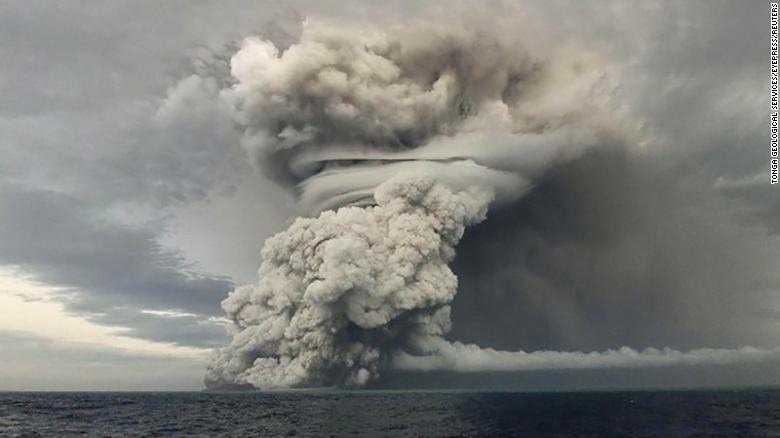
 
Ash rises into the air after a powerful underwater volcanic eruption in the South Pacific.
 
"Gravity waves" captured by satellite imagery were seen rippling outward from the area that the plume punctured in the layer of the lower atmosphere. The result was dense perturbations sent outward similar to waves surrounding a stone tossed into a lake.The volcano, located about 65 kilometres north of the main island of Tongatapu in the southwest Pacific explosively erupted Saturday evening sending ash 100,000 feet in height, generating an atmospheric shock wave rippling across the globe.
 
The eruption was heard in Alaska, 8,000 kilometres distant from Tonga. Home to 135,000 people, Tonga is northeast of New Zealand, southeast of Fiji. There is speculation that the volcano could be responsible for affecting the Earth's climate. Atmospheric scientists are collecting data to determine what role the volcano's eruption can produce atmospherically across the world.
 
Hunga Tonga is an active underwter volcano which erupts from time to time; as it did in 2009, in 2014 and in December of 2021. Since the December eruption it has sporadically exhibited spurts of activity Until January 15 when an especially explosive eruption occurred to produce the most remarkably striking display of volcanic power that weathere satellites captured.
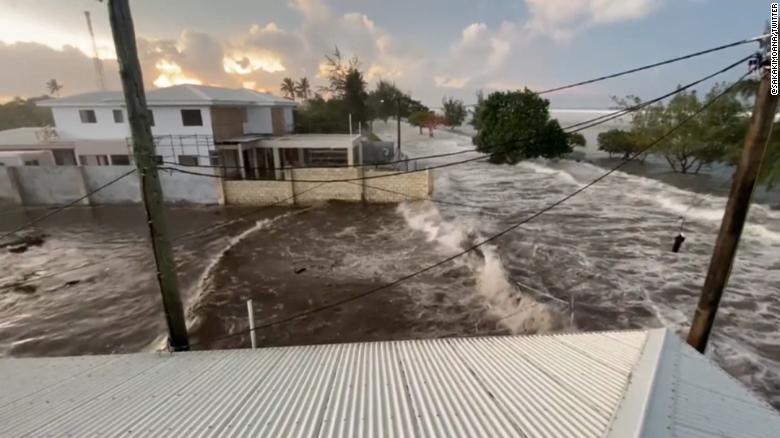
 
A tsunami has hit Tonga's largest island, Tongatapu.

The plume the eruption produced was spectacularly towering, reaching a height of 30,500 metres, approximately three times the altitude a commercial aircraft achieves in flight.  Tonga's plume was buoyant enough to earn it the capacity to penetrate the lowest level of Earth's atmosphere and from there continue to pierce the stratosphere until pockets of air and ash subsided.
 
Experts at the National Weather Service in Anchorage and University of Alaska Fairbanks confirmed reports of audible booms early Saturday in Alaska that originated from the volcano. A phenomenon that affirms the sound travelled at close to 1,300 km/h. Much of the sound produced fell within the spectrum of what can be detected by humans.
"It’s not yet clear how powerful the eruption was or what long-term impact it could have. Volcanologists have developed a scale that describes the size of explosive volcanic eruptions based on magnitude and intensity — the volcanic explosivity index, or VEI. Prior eruptions from the undersea volcano near the nation of Tonga were 2. (For context, Krakatoa’s 1883 eruption, which was one of the most deadly volcanic eruptions of modern history, had a VEI of 6.)"
"But while some experts predict Saturday morning’s eruption could be, at least, a VEI of 4, it’s too soon to tell. “Until we know how much material has been ejected (made harder by the underwater component), we can’t use the scale,” volcanologist Jess Phoenix tweeted. “This means that while we know this eruption is consequential, we won’t have all the info on it for a while.” Since the eruption is still ongoing, there could be more explosions, collapses, and tsunamis to come — or this could be it for a while."
Intelligencer
Our research into these earlier eruptions suggests this is one of the massive explosions the volcano is capable of producing roughly every thousand years. (NICT via AP)
 

Labels: , , , , ,

Wednesday, May 12, 2021

Finding Adventure

"I’ve got six kids here."
"Stand by."
"You found them! These boys have been given up for dead."
"Funerals have been held. If it’s them, this is a miracle!"
Peter Warner to Nuku‘alofa Radio Operator
 
"[‘Ata is considered uninhabitable. But] by the time we arrived the boys had set up a small commune with food garden, hollowed-out tree trunks to store rainwater, a gymnasium with curious weights, a badminton court, chicken pens and a permanent fire, all from handiwork, an old knife blade and much determination."
"And this first figure was swimming towards us ... And then another five bodies leapt off the cliff and into the water and followed him."
Peter Warner, Australian Fisherman/Adventurer
A Caucasian man stands with Tongan men on a boat.
Peter Warner with his crew and the six Tongan boys on January 6, 1968.(Supplied: Sione Filipe Totau)

This is the story of an Australian sailor who famously (at the time) happened to be in the right place at the right time to rescue six Tongan teens who had felt bored with schoolwork and decided among themselves to do something different, interesting and exciting. And they did. They waited for nightfall and took possession of a boat owned by someone else, then sailed off. Only to end up marooned on a remote Pacific island, where they stayed, involuntarily, for well over a year. And being resourceful they set up their isolated commune, and through consensus doled out regular tasks among them and managed to survive their isolation.

They were on an uninhabited island, where few boats passed by, in a little world of their own. Not because they wanted to be there, but because a sense of adventure had led them astray, and then they found themselves on the island with no escape route available to them. The boys, between 13 and 16 years of age, attended a boarding school in Nuku'alofa, the Tongan capital. They saw fit to steal a fishing boat in the depths of their boredom, and set sail for Fiji, roughly 800 kilometres from Tonga. 

Fate had other ambitions for them, to test their mettle and to see whether they would survive. Without a marine map or compass in a boat with no engine one can assume that the boys in their zeal for adventure failed to think through the necessity to have with them certain elemental resources to aid in their mission of seaborne adventure. This was the Pacific, after all, a great wide ocean, where unexpected conditions could erupt at any time, challenging the capabilities of six young teens to rise to the occasion of survival.

 On the first night out at sea the sails were ripped from the mast by a violent storm. The rudder was torn off and for over a week they drifted on a swell, all the while feeling that things would not end well for them. They survived by collecting rainwater in coconut shells. On day eight they came across a volcanic island, a land anomaly popped out of the never-ending sea. As they neared the island a sudden burst of a wave sent them crashing to the shore, their purloined boat no longer intact. The boys, exhausted by 'adventure', struggled ashore. 

Their drift had been a total of 160 kilometres from the beach at Nuku'alofa. The island they were marooned on, they later learned, had a name; 'Ata, uninhabited at that point, but it once had a small Tongan community living on that lump of rock in the Pacific. The entire community had been abducted by slave traders in the 19th Century, and no one had ever returned, until the six adventurous Tongan boys dropped by unexpectedly. 

By September of 1966, fifteen months had passed since the boys had disappeared. Search parties had failed to find any evidence of where they might be. Their disappearance was a mystery to everyone, and eventually they were assumed to have come to an early sad end. It was at that time in September of 1966 that Peter Warner was searching out new fishing grounds and he was near 'Ata when he looked up, and saw that the cliffs looked as though there were burnt areas where none should be.

The tropics weren't known to burst into spontaneous fires. Peering through his binoculars he saw a naked boy with long hair leap from the cliff, plunging into the water and begin swimming toward his boat. Soon followed by five other swimmers, all swimming toward him. Their savage appearance had the boat's crew load their guns just in case. When the first boy reached their boat he spoke in perfect English, identifying himself as "Stephen", and explaining that he and his companions had lost their way, and had been alone for a long time.

When the boys were later examined by a local physician he was amazed at how well they appeared, with muscled physiques. The boy whose name was Stephen had once sustained a serious fall that broke one of his legs. His companions tended to him, setting his leg with a straight branch and padding the stick with leaves. His leg had set perfectly, with no trace of sustained damage. When they arrived back in Nuku‘alofa police boarded the boat, arrested the boys and sent them to prison. 

The fisherman whose boat they had borrowed almost a year-and-a-half earlier was angry, and decided to press charges. Peter Warner paid the fisherman for the value of the boat, and the boys were freed. Their families were jubilant when they returned to the island of Ha'afeva, with its population of 900, all of whom turned out for a huge welcome-home greeting for the boys' arrival. Peter Warner was considered a hero, invited to meet with Tonga's King Taufa'ahau Tupou IV. Who thanked him for his services, and offered to grant him a wish.

"Yes!" Mr. Warner responded. "I would like to trap lobster in these waters and start a business here." His wish was granted and Mr. Warner returned to Sydney where he resigned from his father's company and commissioned a ship for his lobster-fishing enterprise. The boys were given the opportunity to work with him on the boat as ship's crew of the new fishing boat. And their thirst for adventure was satisfied when, on the boat they had an opportunity to see the world from time to time, beyond Tonga. The boys are now in their 70s.

Mr.Warner, on the other hand was 90, still sailing. And he died in a boating accident, swept overboard at sea by a rogue wave, in April in Ballina, New South Wales.

Six, smiling, well-built shirtless men in front of a thatched roof hut.
Sione, Stephen, Kolo, David, Luke and Mano were shipwrecked on Ata Island in 1965. (Supplied: Sione Filipe Totau)

Labels: , , ,

 
()() Follow @rheytah Tweet