Blog dedicated primarily to randomly selected news items; comments reflecting personal perceptions
Friday, September 11, 2026
Facilitating Gender Dysphoric Children's Transition Defies Human Rights...
"I noticed that the injection is for gender re-assignment as patient is already in the waiting room with [her] mother."
"I called mother into the room and explained to her that I would not be able to give the injection. Based on my religious belief and cultural background."
"I believe in God created man and woman. And I find it difficult to be involved in anything against that."
Dr. Henry Ajaero, British Columbia family medical practitioner
"He testified that he had never interacted with a trans person [to his knowledge] or been involved in any 'gender therapy.' He had never administered Lupron for any purpose. It was apparent from his evidence that, in all the circumstances, he felt uncomfortable and unprepared."
"I accept that these feelings motivated his decision to deny services to Child Q, and were not based on an intention to discriminate against her."
"Dr. Ajaero has not established that either the Religion Standard or the Expertise Standard were reasonably necessary to achieve their purposes. This is likely because they were developed quickly, in the context of a busy and stressful day, with incomplete information."
"This context is an explanation for Dr. Ajaero’s decision, but it does not justify his decision to deny medical services to a vulnerable trans youth because of her gender identity."
"While it is true that Lupron was prescribed through the Gender Clinic, and was intended to give Child Q time to consider options relating to her gender identity, it is not medication for gender re-assignment."
"It does not, on its own, conflict with Dr. Ajaero’s stated religious belief that 'God created man and woman.'"
B.C. Human Rights Tribunal
The B.C. Human Rights Tribunal office,Vancouver. (Ben Nelms/CBC)
For refusing to administer a puberty-blocking drug to a transgender-identifying teen, the Human Rights Tribunal of British Columbia has ordered Henry Ajaero, a provincial family doctor, to compensate the transgender youth in the amount of $28,100. Dr. Ajaero practices in Delta, British Columbia. His is a busy practice, seeing an average of 50 patients a day out of the almost three thousand Delta residents his practice looks after. Dr. Ajaero, a practicing and devout Christian, is from Nigeria. He speaks of a religious devotion that "is an important part of his life".
"I had begun puberty fairly early on, so I was already feeling a lot of the effects of testosterone and what testosterone was doing to my body."
"I can't describe in words the amount of pain that caused me."
Patient Q
At age 14, Patient Q, a patient of Dr. Ajaero's since 2017, was referred by him to a gender clinic at the Children's Hospital, in 2020 where an endocrinologist prescribed the drug Lupron for her, which through regular injections, blocks release of testosterone and estrogen to apprehend body changes normal with the onset of puberty. These puberty blockers were banned for use in trans-identifying youth in the United Kingdom.
With the prescription requiring an injection every three to four weeks, Child Q was given the option of learning to administer the injections on her own, but decided she would prefer it be done by a doctor. Accordingly a March 2021 appointment was booked at the Delta clinic with Dr. Ajaero. As they were seated in the waiting room, the doctor became aware what the injection was meant to do. Whereupon he informed Patient Q's mother he had "religious and cultural reasons" for not administering the drug.
Puberty blockers have come under increasing scrutiny, including in the U.K, where a major review led to their ban for use in trans-identifying youth.Photo by Unsplash
Child Q's mother lodged a complaint against the family physician. It was Dr. Ajaero's position that providing any care in relation to "gender reassignment" was inconsistent with his religious beliefs; the administering of Lupon was additionally outside his scope of practice and expertise, he added. The College of Physicians and Surgeons of British Columbia was moved to reprimand Dr. Ajaero in 2023.
"I am not persuaded that this [denial of medical services based on gender identity] was justified by [Ajaero's] religious beliefs or lack of medical expertise."
[Dr. Ajaero violated the B.C. Human Rights Code] by "continued use of he/him pronouns and [Child Q's deadname".
"[I] corrected D. Ajaero's chart notes to properly reflect Child Q's gender."
Tribunal vice-chair Devyn Cousineau
Adrienne Smith, counsel for Child Q in Child Q v. Ajaero (No. 2), 2026 BCHRT 189, over a gender-identity demonstration. Western Standard photo illustration by Alex Zoltan.
"She was self-harming. She had suicidal thoughts, with a plan" and was hoarding Tylenol, the ruling finding Dr. Ajaero in violation of the B.C. Human Rights Code, noted. Later that same day, Child Q received the injection at a walk-in clinic. According to the tribunal, the injections fall within a family doctor's scope of practice. "Until he learned what it was for", Dr. Ajaero had been prepared to give the injection. Dr. Ajaero was forthwith ordered to compensate Child Q for expenses incurred and for "injury to her dignity, feelings and self-respect".
"The evidence] does not establish that refusing to administer medication whose purpose is to suppress puberty in trans youth is a particular line of conduct called for by Dr. Ajaero's religious custom or connection to God."
"What happened here should not happen in a democratic society. The Human Rights Code does not prohibit public discussion of issues related to transgenderism or minors and transgenderism. It does not prohibit public discussion of anything."
"They [school board] accused her of breaching the Human Rights Code, questioning the right of trans persons to exist and engaging in speech that included hate. She did not do any of those things."
"The chairman of the board acted with malice or at least, with a reckless disregard for the truth. He had made an embarrassingly erroneous and arbitrary decision to silence a legitimate expression of opinion and he was widely criticized for it. It is not a stretch to infer that, realizing that, he tried to justify himself with the public by assassinating the plaintiff's character."
"I find it regrettable that the defendant who is trying to shut down debate is an arm of the government. Regard for the historical and present plight of the transgendered ... does not negate section 2(b) of the Charter."
Ontario Superior Court Justice James Ramsay
Epoch Times
The Waterloo Region District School Board sought to have former teacher Carolyn Burjoski's defamation lawsuit against the board and its former chair, Scott Piatkowski, thrown out. Justice James Ramsay was rather less than impressed with their argument which led him to rule for Ms. Burjoski who was summarily ousted from a board meeting on January 17, 2022 for her insistence on her right and personal obligation to speak to an issue the board had no interest in hearing, but was of great societal moment.
During the board meeting she initiated a discussion of school library publications, available to children from kindergarten to Grade 6. She just began pursuing her point that much of the printed material now in school libraries made it appear simple and "cool" to medically transition to another gender, when the board chair Piatkowski cut her presentation off. The event caused quite a stir, not only locally, but there were interested reports on the incident in the international press.
This seasoned and concerned teacher was by no means the first individual to voice similar concerns. Concerns which have become controversial, opposed by most advocates of transgender rights. Leading figures in the transgender movement itself have expressed concern that gender-dysphoric young people on occasion are too aggressively ushered toward medical transition.
The board chair, Piatkowski, explained his position, that Burjoski's comments were transphobic, and "questioned the right to exist" of trans people. He therefore had no choice but to expel the teacher from the meeting. Burjoski, he said was "disrespectful" toward transgender people and "not promoting healthy debate" at the meeting. The recording of the meeting which was a normal public session of elected officials, was taken down and the board persuaded YouTube to remove another copy of the video.
Carolyn Burjoski, who had over twenty years of experience as an English-as-a-second-language teacher, specializing in teaching immigrant children, was then served with a "stay-at-home order", and informed she was not to communicate with colleagues or students. An episode in her long career that propelled her into voluntary early retirement after having been hospitalized for extreme anxiety.
She then launched a defamation lawsuit which Justice Ramsay responded to by dismissing the bid, ordering the board to pay Burjoski $30,000 in costs. Her claims had merit and her lawsuit should be permitted to proceed, since the comments made against her were "defamatory". When the board decided to conduct a system-wide removal of books it considered "harmful" comprised of old children's literary classics, she had commented against the move.
The "affirmation" approach to children identifying as transgender now in wide use, has raised concerns elsewhere as well. Two psychologists in the transgender medical community, one a trans woman, had pointed out sloppy and dangerous assessments of young people presenting as trans, deploring the overly hasty resort to hormone treatment. Burjoski has filed a separate legal challenge of the decision to stop her presentation and now awaits a verdict in that effort.
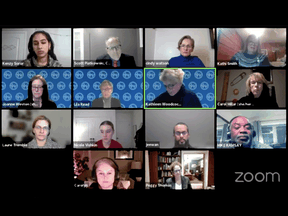
Retired teacher Carolyn Burjoski launched a defamation lawsuit against
the Waterloo Region District School Board and former chair Scott
Piatkowski. Last week, a Kitchener, Ont., judge ruled the case can carry
on after lawyers for the school board and Piatkowski put forward a
motion to have the case dismissed. (Carolyn Burjoski/YouTube)
"It is a significant victory and vindication, not just for me, but for everyone who dares to voice their valid concerns publicly."
"I hope this decision sends a strong message to school boards that the weaponization of human rights codes against concerned citizens is an undemocratic abuse of the code."
"I do have the same concerns the Tavistock clinic faced. I think it just moves us to, let's slow down and make sense of what is going on."
"All of these decisions ... concerning social, medical or surgical transitions, these are big decisions and they deserve the time, they deserve the respect that's needed."
"The changes that have occurred in Sweden, Finland and now the U.K. should give us food for thought . Let's evaluate what is going on here."
"I think frequently professionals, doctors feel pushed to make these decisions around medications sooner than probably what we would feel comfortable with. That really results in a type of care that is not thoughtful and that could lead to negative outcomes."
"With this cultural shift in the way we are looking at gender, there are definitely youth who are transgender who feel more comfortable and safe to come out. And that's wonderful."
"We also have to acknowledge that at the same time ... there are also probably going to be some who are identifying as transgender who maybe are not."
Dr.Joey Bonifacio, pediatrician, gender identity, St.Michael's Hospital, Toronto
"No one makes these decisions lightly."
"They are made very slowly very cautiously, after long discussions with these youth and their parents."
Dr.Margaret Lawson, medical director, gender diversity clinic, Children's Hospital of Eastern Ontario
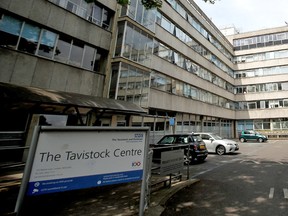
The
Tavistock clinic in London was the only specialized centre for gender
care in Britain until it was shut down amid controversy.Photo by Peter Nicholls/Reuters
There has been a surprising and undeniable spurt of young people presenting with gendr dysphoria. And as their numbers soar the health care system should be careful to spend some time examining just why these trends are occurring; at the same time as they assume a thoughtful, 'neutral' approach to each young patient, urges Dr. Bonifacio. Who could argue with that common-sense recommendation in the face of overwhelming numbers of children suddenly coming forward as rejecting their birth-designated gender?
Britain's recent decision to close down its Tavistock clinic for gender issues to replace it with a network of smaller centres, made headlines in gender health care groups. According to an independent review the clinic was seen to be giving short shrift to patients' non-gender mental health problems when it was unclear regarding the long-term effects of puberty-blocker drugs often representing the first step in gender transition.
Patients await long lists of others before them seeking medical attention, Dr. Bonifaio acknowledged -- but doctors and other professionals still must see their way clear to thoroughly addressing mental health issues if any, that children experience as well as gender dysphoria -- the belief one does not belong to birth-assigned sex -- before gender transition begins with hormone treatment and eventually, surgery.
Dr. Bonifacio has subspecialty training in adolescent and social pediatrics behind him as a former medical director of the SickKids Hospital gender clinic in Toronto. His recommendations ring in as a rare case of an expert at the heart of transgender health care in Canada questioning some of its practices. The rapid increase in patients presenting as transgender in the last few years, dominated by girls just entering adolescence, underscores the ongoing debate on the topic.
Gender dysphoria in the past was likelier to appear in younger boys, but the Trans Youth Can! research project shows that patient volumes at ten participating clinics swelled from virtually none in 2004, to over 1,000 in 2016. Of that number, some 80 percent were born female. Children on the autism spectrum and other neurodivergent patients also show up, accounting for roughly a third of patients at the Tavistock clinic, according to the U.K. review.
According to epidemiologist Greta Bauer, co-director of Trans Youth Can!, the explosion in patient demand reflects the growing acceptance of transgenderism following years of stigma and hatred -- underestimating the number of youth "who know they're trans and need gender affirming care". Clinics believe that puberty-blocking drugs safely provide a reversible 'pause' in hormonal development while young people negotiate their options.
Last year Swedish authorities decided to ban the use of puberty blockers and cross-sex hormones for most minors, under the argument that insufficient evidence existed to support the treatment. Similar steps were taken by Finland which felt that psychotherapy should be pursued as an investigative tool to determine the authenticity of transgender claims before drugs are prescribed for children.
In Canada, the Gender Pathways Service at London Health Sciences Centre in Ontario states that family physicians referring patients should consider beginning the patients on puberty blockers prior to first appointments at the clinic. A form letter sent out to physicians notes wait times are long and the drugs may decrease distress while awaiting appointments.
Some health care providers, points out Dr. Bonifacio, misinterpret what 'affirmative' care is meant to represent as the predominant approach. "They think affirmative care is you follow whatever pronouns (patients) care to use and start medication as soon as possible." He cited a commentary published by a major Canadian journal that the term means to holistically support the patient in their identities and needs and "refrain from directing a child toward any particular identity".
Parents sometimes speak of multiple pupils in their children's classes at school suddenly presenting with gender identity issues. Leading many gender-treatment professionals to reject the notion that the growing cohort of adolescent girls identifying as transgender may be the result of influence through "social contagion".
Symptoms
Gender dysphoria might cause adolescents and adults
to experience a marked difference between inner gender identity and
assigned gender that lasts for at least six months. The difference is
shown by at least two of the following:
A difference between gender identity and genitals or secondary
sex characteristics, such as breast size, voice and facial hair. In
young adolescents, a difference between gender identity and anticipated
secondary sex characteristics.
A strong desire to be rid of these genitals or secondary sex
characteristics, or a desire to prevent the development of secondary sex
characteristics.
A strong desire to have the genitals and secondary sex characteristics of another gender.
A strong desire to be or to be treated as another gender.
A strong belief of having the typical feelings and reactions of another gender.
Gender dysphoria may also cause significant distress that affects how
you function in social situations, at work or school, and in other
areas of life.