Ruminations

Blog dedicated primarily to randomly selected news items; comments reflecting personal perceptions

Friday, September 11, 2026

Facilitating Gender Dysphoric Children's Transition Defies Human Rights...

"I noticed that the injection is for gender re-assignment as patient is already in the waiting room with [her] mother."
"I called mother into the room and explained to her that I would not be able to give the injection. Based on my religious belief and cultural background."
"I believe in God created man and woman. And I find it difficult to be involved in anything against that." 
Dr. Henry Ajaero, British Columbia family medical practitioner
 
"He testified that he had never interacted with a trans person [to his knowledge] or been involved in any 'gender therapy.' He had never administered Lupron for any purpose. It was apparent from his evidence that, in all the circumstances, he felt uncomfortable and unprepared." 
"I accept that these feelings motivated his decision to deny services to Child Q, and were not based on an intention to discriminate against her." 
"Dr. Ajaero has not established that either the Religion Standard or the Expertise Standard were reasonably necessary to achieve their purposes. This is likely because they were developed quickly, in the context of a busy and stressful day, with incomplete information."
"This context is an explanation for Dr. Ajaero’s decision, but it does not justify his decision to deny medical services to a vulnerable trans youth because of her gender identity."
"While it is true that Lupron was prescribed through the Gender Clinic, and was intended to give Child Q time to consider options relating to her gender identity, it is not medication for gender re-assignment."
"It does not, on its own, conflict with Dr. Ajaero’s stated religious belief that 'God created man and woman.'" 
B.C. Human Rights Tribunal 
https://i.cbc.ca/ais/1.6793273,1680015620000/full/max/0/default.jpg?im=Crop%2Crect%3D%280%2C329%2C6383%2C3590%29%3BResize%3D860
The B.C. Human Rights Tribunal office,Vancouver. (Ben Nelms/CBC)
 
 For refusing to administer a puberty-blocking drug to a transgender-identifying teen, the Human Rights Tribunal of British Columbia has ordered Henry Ajaero, a provincial family doctor, to compensate the transgender youth in the amount of $28,100. Dr. Ajaero practices in Delta, British Columbia. His is a busy practice, seeing an average of 50 patients a day out of the almost three thousand Delta residents his practice looks after. Dr. Ajaero, a practicing and devout Christian, is from Nigeria. He speaks of a religious devotion that "is an important part of his life". 
"I had begun puberty fairly early on, so I was already feeling a lot of the effects of testosterone and what testosterone was doing to my body."
"I can't describe in words the amount of pain that caused me."
Patient Q 
At age 14, Patient Q, a patient of Dr. Ajaero's since 2017, was referred by him to a gender clinic at the Children's Hospital, in 2020 where an endocrinologist prescribed the drug Lupron for her, which through regular injections, blocks release of testosterone and estrogen to apprehend body changes normal with the onset of puberty. These puberty blockers were banned for use in trans-identifying youth in the United Kingdom. 
 
With the prescription requiring an injection every three to four weeks, Child Q was given the option of learning to administer the injections on her own, but decided she would prefer it be done by a doctor. Accordingly a March 2021 appointment was booked at the Delta clinic with Dr. Ajaero. As they were seated in the waiting room, the doctor became aware what the injection was meant to do. Whereupon he informed Patient Q's mother he had "religious and cultural reasons" for not administering the drug.
 
https://smartcdn.gprod.postmedia.digital/nationalpost/wp-content/uploads/2024/12/0412-tj-cass-report.jpg?quality=90&strip=all&w=564&h=423&type=webp&sig=n1h740InLVH9aDRcIOBnqg
Puberty blockers have come under increasing scrutiny, including in the U.K, where a major review led to their ban for use in trans-identifying youth. Photo by Unsplash
 
Child Q's mother lodged a complaint against the family physician. It was Dr. Ajaero's position that providing any care in relation to "gender reassignment" was inconsistent with his religious beliefs; the administering of Lupon was additionally outside his scope of practice and expertise, he added. The College of Physicians and Surgeons of British Columbia was moved to reprimand Dr. Ajaero in 2023. 
"I am not persuaded that this [denial of medical services based on gender identity] was justified by [Ajaero's] religious beliefs or lack of medical expertise."
[Dr. Ajaero violated the B.C. Human Rights Code] by "continued use of he/him pronouns and [Child Q's deadname". 
"[I] corrected D. Ajaero's chart notes to properly reflect Child Q's gender."
Tribunal vice-chair Devyn Cousineau   
https://cf-images.assettype.com/westernstandard%2F2026-09-10%2Fd1rpc5fb%2Fsmithhero16x9.jpg?w=1024&auto=format%2Ccompress&fit=max
Adrienne Smith, counsel for Child Q in Child Q v. Ajaero (No. 2), 2026 BCHRT 189, over a gender-identity demonstration. Western Standard photo illustration by Alex Zoltan.
 
"She was self-harming. She had suicidal thoughts, with a plan" and was hoarding Tylenol, the ruling finding Dr. Ajaero in violation of the B.C. Human Rights Code, noted. Later that same day, Child Q received the injection at a walk-in clinic. According to the tribunal, the injections fall within a family doctor's scope of practice. "Until he learned what it was for", Dr. Ajaero had been prepared to give the injection. Dr. Ajaero was forthwith ordered to compensate Child Q for expenses incurred and for "injury to her dignity, feelings and self-respect". 
"The evidence] does not establish that refusing to administer medication whose purpose is to suppress puberty in trans youth is a particular line of conduct called for by Dr. Ajaero's religious custom or connection to God."
Devyn Cousineau, Tribunal vice-chair 


Labels: , , , ,

Saturday, April 18, 2026

Much Ado About Nothing : Canada's Shakespearean Farce

"I told her: 'I wish our people could grab you, drag you over to the Kamloops residential school, put you into the basement, speak our language to you, rape you, hurt you."
"And maybe you'd understand what our people went through."
Charlene Belleau, elder, Esk'etemc First Nation, British Columbia 
 
"I don't think they're a threat I think there's a lot of comments about how she should be charged and punished in various ways, and I'm opposed to that, because I think people should e able to speak freely about everything, as long as they don't incite violence or engage in threats."
"I think they're deplorable comments, and it reflects the fact that Aboriginal leaders are pandered to constantly and never challenged, so they become more and more unhinged as time goes on."
Frances Widdowson, academic; Economics and Indigenous Policy 
 
"I'm not sure what the member [MLA Tara Armstrong] is referring to, but I do know what she's tried to do in the past, insisting that the bodies of children who died at residential schools should be dug up."
"Something that you would never insist at any other place in t he world where  holocausts or genocides occurred."
"That's not how we do these things. [She is] trying to further divide us over an issue that is very emotional, troubling and challenging."
B.C. Indigenous Relations Minister Spencer Chandra Herbert
a large brick building
The main administrative building of the former school is pictured in 1970. (Department of Citizenship and Immigration- Information Division / Library and Archives Canada)
 
In 2021 at the former Kamloops Residential School, the chief of the Tk'emlúps te Secwépemc Kukpi7 (Chief) Rosanne Casimir made a riveting public statement that sent shock waves through the country, a statement picked up by international news media, and which prompted then-PM Justice Trudeau to order Canadian flags at half-mast and held them that way for six months, in honour of the 215 Indigenous children Chief Casimir claimed lay in unmarked graves at the school site. Her band had hired a specialist in ground-penetrating radar, the results of which led her to make these remarks to the media: 
"To our knowledge, these missing children are undocumented deaths."
"Some were as young as three years old. We sought out a way to confirm that knowing out of deepest respect and love for those lost children and their families, understanding that Tk'emlúps te Secwépemc is the final resting place of these children."  
That shocking declaration galvanized Canada into a state of mourning, of self-blame, of acceptance of the charges that a 'genocide' took place. Government at every level genuflected in shame and remorse, pledged that this horrible sin against humanity and Indigenous children who attended Indian Residential Schools, who had suffered loneliness and misery, neglect and humiliation, condemned if they spoke their native language, were exposed to life-changing, long-lasting trauma that affected following generations.
 
On the rare occasion, some individuals who had attended these schools denied those charges, countered that their exposure to educational opportunities aided them in their later lives to make a life for themselves outside of aboriginal communities, adjusting to the outside world and finding professional occupations that satisfied their personal aspirations. These voices were swiftly condemned and stilled. Then someone observed there was no proof presented. And eventually Chief Casimir altered her story in line with what she had been informed by the professionals using the ground-penetrating radar, that it identified underground 'anomalies', which could be anything, from dead wood to inanimate buried items -- and just possibly bodies.
A plaque is seen outside of the former Kamloops Indian Residential School. (Andrew Snucins/The Canadian Press)
 
Funding was made available to look deeper into the situation. Including disinterring whatever lay underground identified as anomalies by the ground-penetrating radar.  In the years since the original 'discovery' no attempts were made to investigate any further. The story of unmarked graves continued and persist to this day, most particularly in British Columbia. Professor Widdowson objected to this unquestioned and unproven claim and paid dearly in her professional life, when her colleagues and her university employment isolated her.
 
While Professor Widdowson offered to civilly debate anyone who was interested over the issue, her offer was rejected. During an event called 'My name is Charlene: Perseverance and poise in an era of truth, reconciliation, anger and rage', hosted by the Office of Respectful Environments, Equity, Diversity and Inclusion under the medical faculty of UBC, guest Charlene Belleau recounted a comment she had made to Professor Widdowson at a campus event; in disagreement with the professor's position, she had addressed her saying she would like to see  her beaten and raped.
 
When the B.C. Legislature met last Friday, a question was put to the Indigenous Relations minister to comment on Chief Belleau's statement. Refusing to respond, the minister instead accused the questioning member of attempting to foment confusion and division. Yet the B.C. government in 2021 had allocated $12 million to finance First Nations' investigation into the unmarked grave sites. At that time Chief Belleau said it represented an "important first step in supporting the resiliency and healing of B.C. First Nations people". And then: nothing. 
 
The former Kamloops Indian Residential School is seen on Tk’emlups te Secwépemc First Nation in Kamloops, B.C., on May 27, 2021. The remains of 215 children were purported to have been found buried on the site, the First Nation said. (Andrew Snucins/The Canadian Press)
"The UBC [University of British Columbia] faculty of medicine does not condone any speech that endorses or promotes harassment or violence of any kind."
"An invitation for a community member to participate in an event does not constitute endorsement of their specific remarks or views."
Mieke Koehoorn, vice-dean of academic affairs, Faculty of Medicine, UBC 

Labels: , , , , , ,

Thursday, February 12, 2026

Canada's Grief

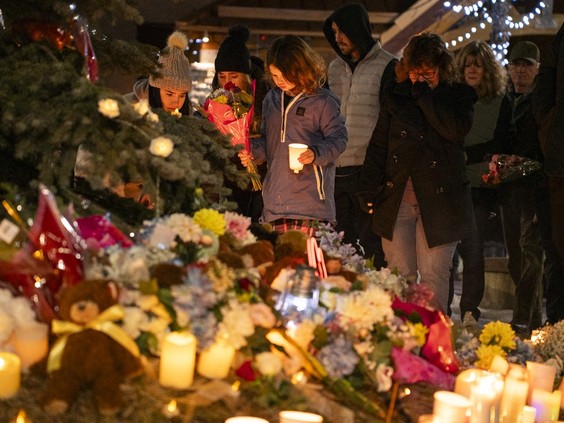
"These kids should be playing hockey or just being kids but life has just been completely turned upside down."
"We know every single person that lost a child, it's a tragedy that has hit our quiet town ... and I just don't really have the words to describe what happened."
"We stayed for those families whose children were not accounted for, it's what we do."
"The number of family members who are dealing with this ... the moms and dads, the sisters and brothers and grandparents ... suddenly people from our congregation are gone."
"It's overwhelming." 
Reverend Gerald Krauss, New Life Assembly 
 
"As we come together in grief and solidarity, it is clear that those impacted will need our support-- not only emotionally but also financially -- as they navigate the challenges ahead."
"Our community has always stood strong in times of adversity, and this is an opportunity for us to extend a helping hand to those who need it most."
Tumbler Ridge Parent Advisory Council
students walk out of a building with their hands raised
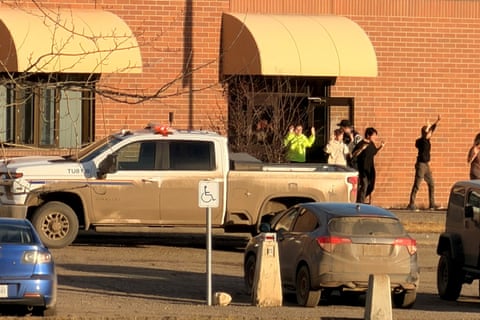
Students walk out of the school building with their hands up after an assailant opened fire in Tumbler Ridge, British Columbia, Tuesday. Photograph: Western Standard/Jordon Kosik/Reuters
 
It's a modest goal ... to raise $30,000  in support of the families impacted by the dreadful mass shooting that took place in the small remote community of Tumbler Ridge on Tuesday, when a former pupil at the Tumbler Ridge Secondary School armed with deadly weapons rampaged through the school on a killing mission. The killer, named by the RCMP as an 18-year-old who had never completed school but left four years earlier and who, around that same time began to transform himself from a male to a female, showed up at the school dressed identifiably as a woman.
 
He/she shot to death a 36-year-old teacher, three 12-year-old girls, a 12 and two 12 and 13-year old boys. There were 26 students who suffered gunshot wounds, a number of them in critical condition. Two children were in critical condition, one 12-year-old girl was airlifted by medical helicopter to Vancouver. She had been shot in the head and the neck and it was uncertain whether she would survive. Police also went to a house about a five-minute drive from the school, where they found the killer's mother and his 11-year-old stepbrother, both shot dead.  
"This community only has 2,400 people ... That community will have almost every single person affected directly."
"Who do you lean on, when everybody is affected?"
Stephen Fuhr, Member of Parliament for Kelowna, B.C. 
Jesse Van Rootselaar, 18, transgender, will live on in infamy as having perpetrated one of the worst mass shootings in the  history of Canada. Both a long gun and a modified handgun were taken into evidence by police. The town in northwestern British Columbia will never be the same again. Tumbler Ridge RCMP had been alerted to an active shooting at 1:00 p.m. on Tuesday. It took little time for them to find six people dead; five in the school library and the sixth in a stairwell. Dead also was the killer who had committed suicide.


Most of the young people who had been injured in the shooting melee were treated at the site. The emergency alert received by police  described the suspect as "a female in a dress with brown hair". Police did not just spontaneously appear at the private home; they were contacted, the home identified as one where a dread scenario had played out prior to the killer's appearance at the school.  Students whom police had led out of the school for safety were released to their parents' care at the nearby town community centre once the lockdown was lifted.
 
School District 59 officials circulated a decision to suspend normal school activities for both the Tumbler Ridge Secondary School and Tumbler Ridge Elementary for the remainder of the week. Trauma counselling and other supports were in the process of meeting the needs of students, teachers and school staff.
https://smartcdn.gprod.postmedia.digital/vancouversun/wp-content/uploads/2026/02/2260625085_301332347.jpg?quality=90&strip=all&w=564&h=423&type=webp&sig=1GA06KQFozCtGE7jdlFDaQ
Photo by PAIGE TAYLOR WHITE /AFP via Getty Images   Vancouver Sun
 
"This was a rapidly evolving and dynamic situation, and the swift cooperation from the school, first responders, and the community played a critical role in our response."
"Our thoughts are with the families, loved ones, and all those impacted by this tragic incident."
"This has been an incredibly difficult and emotional day for our community, and we are grateful for the cooperation shown as officers continue their work to advance the investigation."
Superintendent Ken Floyd, North District Commander, B.C. RCMP
 

Labels: , , , ,

Friday, November 21, 2025

Prejudicially Discriminatory to Label Drug Users as Addicts

"[The overdose crisis is] rooted in colonial approaches that prioritize individualism over community, wealth over health and power over empathy."
"Using punitive tactics by criminalizing people who use drugs and doubling down on prohibition policies have proven to be ineffective and harmful for decades."
"There is no evidence supporting claims that diversion is increasing overdose deaths, or leading increased rates of youth to become substance-dependent." 
Kasari Govender, human rights commissioner, British Columbia
https://i.cbc.ca/ais/a770dcb9-b418-4af9-ba19-21426c5657ce,1763099313283/full/max/0/default.jpg?im=Crop%2Crect%3D%280%2C390%2C6500%2C3656%29%3BResize%3D860
B.C. Human Rights Commissioner Kasari Govender, seen here in March 2023, said that stigma against drug users is driving harmful policies that are causing deaths. (Darryl Dyck/The Canadian Press)
 
In British Columbia alone, over 15,000 people have died as a result of the overdose crisis, since 2016. A death toll that finally hit home for the government of British Columbia which has gone through a decriminalization process, providing drugs and paraphernalia to chronic drug abusers, with the intention of slowing down and possibly even stopping the rising tide of untimely deaths of addicts. The province's experience with the 'safe houses' that were intended to serve a drug-addicted population, to steer them away from dangerous street drugs such as fentanyl, failed when it became obvious that the oxymorphone being supplied to users was being sold on the street for the much-more favoured fentanyl, after all.
 
The B.C. Human Rights Commission published a 22-page report, stating that to even mention that the province is coping with an 'overdose' crisis, is in and of itself discriminatory. Falsely implying that doing drugs like meth or fentanyl is inherently dangerous. The commissioner made it clear that in her opinion the entire cause of the crisis can be summarized as "illicit drug manufacturers and dealers adding unknown toxic substances". This, in a province where a month earlier the Coroners Service confirmed an average of five overdose deaths each day.
 
https://i.cbc.ca/ais/1.7101288,1706753801000/full/max/0/default.jpg?im=Crop%2Crect%3D%280%2C0%2C1920%2C1080%29%3BResize%3D805
Former B.C. chief coroner Lisa Lapointe has said she was disappointed by the province's decision to limit its safer supply program so people can no longer take their prescribed opioids home with them. (CBC News)
 
The solution as far as the commissioner is concerned, is that British Columbia must subscribe more diligently into policies allowing drug users to do drugs 'without stigma', in real support of 'human rights'. Greater dedication to decriminalization, more low-barrier shelters and more 'safer supply' in the province's program to distribute free recreational opioids to drug users. This, in direct contradiction to the province's official movement away from the kind of harm reduction its human rights commissioner is now pressing.
 
British Columbia took steps to backtrack on its safer supply program after reports that users were reselling free government opioids for cash. 'Safer Supply' is now only to be consumed before a clinician, replacing the system of opioids handed out daily as take-home rations. Leading the provincial premier to publicly disown the former policy -- that the experiment in hard drug decriminalization was "not the right policy". Where in 2022 federal permission was sought and given to legalize possession of 'personal use' amounts of illicit drugs like heroin, fentanyl and meth, branded as a bold, new stigma-reduction strategy to "decriminalize people who use drugs". 
 
Downtown Eastside, Vancouver, B.C.
 
Premier David Eby elaborated when he stated that instead of the intended outcome, decriminalization became a "permission structure" assuring drug users that "it was OK to use drugs anywhere". The premier promised an increase in involuntary treatment for severe addicts, along with tougher crackdowns on criminal drug networks. The official position of the B.C. government for over two decades was to view addiction as a public health issue, instead of a criminal justice issue. 
 
The report by the B.C. Human Rights Commission attributes the "deep-rooted history of colonialism, racism and discrimination" as the primary cause of drug addiction. The commissioner, Kasari Govender, is one of the highest paid civil servants in the province, while an arm's-length agency of the government. In 2024 she was paid an annual salary of $351,847, whereas the premier himself had an earning of $227,111. 


Labels: , , , , , ,

Friday, June 06, 2025

Far Reaching Consequences in Air Quality From Canadian Wildfires

https://www.ctvnews.ca/resizer/v2/QVD62FH6MRGUFHHMBHLHHJQI4Y.png?auth=b2a28004f09139fff52987be801292dc377f1790dfbec36664f6778f7241792c&width=1440&height=810
A smoky haze continues to linger over Ottawa on Friday afternoon.  (Westin Camera)
 
"We have these massive fires going on out west in Manitoba, in Saskatchewan, and all this smoke is being lofted high up into the atmosphere and then you have the jet stream, the strong winds higher up in the atmosphere blowing it over to Ontario."
"Even if you’re not smelling it at the ground, you’re probably noticing the sky is a bit of milky colour, kind of a white colour, this is all smoke that’s just been blown over from these massive prairie fires." 
Environment Canada meteorologist Crawford Luke
 
"Things like asthma, cough, headaches — we know that over time [smoke exposure] can increase your risk of things like respiratory infections. It can also increase your risk for long-term disease like lung cancer if you have high exposure."
"Clean air quality is definitely becoming more of an awareness concern because we are experiencing more wildfire seasons that are increasing. They’re longer, they start earlier, they get worse. We’re noticing a lot more air quality alerts."
"Check the air quality and if it’s over five, six, seven, that’s when you need to pay attention. That means air quality could be bad, even if the sky looks clear." 
"This affects the youth, seniors, as well as people with lung disease, heart disease. Anyone with a lowered immune system tends to be considered higher risk. They would be the ones we’d want them to watch the alert a little bit earlier."
Jamie Happy, health promotion coordinator, Alberta Lung
 
"The particle air pollution event is the result of extensive wildfires in central and Western Canada."
"Wind patterns are forecasted to transport plumes of smoke from these fires across much of New England and New Hampshire."
New Hampshire Department of Environmental Services 
https://i.cbc.ca/1.7554388.1749245549!/cantoImage/httpImage/image.jpg_gen/derivatives/original_1180/ottawa-gatineau-weather-wildfires-2025-smoke-downtown-parliament.jpg?im=Resize%3D1180
A skateboarder cruises down Rideau Street in Ottawa on Friday as drifting smoke from wildfires in Western Canada shrouded the city. (Gabrielle Huston/CBC)
 
Hundreds of wildfires are burning across Canada, many of them out of control with flames sending plumes of smoke skyward, resulting in unhealthy air wafting off with the prevailing winds, reaching distant places. The more gigantic of the blazes deliver thick smoke spreading southward into the United States and far across the Atlantic Ocean to the United Kingdom. 
 
Fires in British Columbia, Alberta, Saskatchewan, Manitoba, from Western Canada, as well as northern Ontario in central Canada burning out of control. Some of the fires range between 100,000 to 300,000 hectares. Fire season in Canada is earlier than usual this year. And this year more of the fires are considered to be man-made; fewer have resulted from lightning strikes and excessively dry conditions along with warmer temperatures than usual. 
 
These early-appearing wildfires have already consumed vast tracts of land and forest, in comparison to the long-term average with about a normal half year's worth of land at this early stage already scorched.  
 
https://static01.nyt.com/images/2025/06/04/multimedia/31int-canada-wildfires-explainer-hmlz/31int-canada-wildfires-explainer-hmlz-superJumbo.jpg?quality=75&auto=webp
A photo released by the government of the Canadian province of Manitoba shows wildfires burning last week in Flin Flon, Manitoba.   Credit...Government of Manitoba
 
Three provinces have evacuated over 25,000 people altogether, whose habitation is in the line of fire. In Manitoba alone 17,000 of the evacuations have left people stranded away from their homes in fire-vulnerable towns and villages. In Alberta roughly 1,300 people were forced to relocate, as well as some 8,000 people affected by the need to evacuate in Saskatchewan.
 
The largest of two fires in Manitoba scorched 189,834 hectares on the border with Ontario, about 100 km northeast of Winnipeg. On the border with Saskatchewan several fires around Flin Flon are responsible for most of the evacuations there, where this fire season has been recognized as the worst in decades. The fires burn largely in rural forest, threatening communities nearby that remain under evacuation orders, among 20 towns forced from homes in the province. 
 
Smoke that crossed the Atlantic Ocean is blowing over the United Kingdom, contained in a thin, high-altitude layer not expected to seriously affect air quality. "No impacts expected as it remains at height, but could lead to some striking sunsets and sunrises", advised Georgie Myers of the UK's Met Office.  
 
https://static01.nyt.com/images/2025/06/06/multimedia/06int-canada-wildfires-explainer02sub-photo-kzgt/06int-canada-wildfires-explainer02sub-photo-kzgt-superJumbo.jpg?quality=75&auto=webp
Members of the Royal Canadian Air Force help evacuees board an aircraft in Norway House, Manitoba, on June 3.   Credit...David Lipnowski/The Canadian Press, via Associated Press
 
Smoke, carried by the river of air in the sky known as the jet stream, ended up south as far as the coastal Southeast United States where skies turned hazy as far south as northern Florida. The Midwest saw smoke particularly thick with  high temperatures held down several degrees, irrespective of sunshine. Visibility dropped as low as a kilometre or so in North Dakota as smoke drifted groundwise. 
 
Parts of British Columbia to Ontario south of Hudson Bay, saw air quality alerts warn populations. Environment Canada warns residents in harder-hit areas of northern Alberta, Saskatchewan and Manitoba to limit outside time and cancel or reschedule outdoor events. Much of Minnesota, Wisconsin and close locations are under a code orange alert. 
 
The Canadian wildfires have already early in this season burned about half of the average major fire seasons up to 2023 and 2024, translating to over 1.1 million hectares this year so far.  Seasonal wildfire burns saw a yearly average of 2.1 million hectares as opposed the 2023 historic season when 17.3 million hectares were scorched.  
 
https://static01.nyt.com/images/2025/05/31/multimedia/31int-canada-wildfires-explainer03-photo-wzlc/31int-canada-wildfires-explainer03-photo-wzlc-superJumbo.jpg?quality=75&auto=webp
A photo from the Manitoba Royal Canadian Mounted Police shows firefighting efforts in northern Manitoba, in May.   Credit...The Canadian Press, via Associated Press


Labels: , , , , , ,

Sunday, April 06, 2025

A Loaded Word Like Genocide

"[These northern community school programs were needed because many of the students coming to the schools were] behind in school three, four, five and six years."
"So we established a number of classes, which we have given the name special classes for want probably of a better word, and these classes are structured in such a way that the academic skills that are so important, to any child living in the 20th century, that these skills are taught in an appropriate manner."
"This [the Royal Commission on Aboriginal Peoples' report] is clearly a slanted account of these institutions, and therefore should be viewed cautiously because, to cite one of the problems, it tells only part of the story."
"The phenomenon of Aboriginal residential schooling is too complex and requires considerable nuance."
Robert Carney, Catholic educator, federal day school principal (Father of Mark Carney) 

"We must acknowledge the terrible mistakes of our past and learn from our history while celebrating Canada as the greatest country on earth."
"Why are the report authors [and now Trudeau] sensationalizing truly horrific events that need to be examined honestly and seriously, with a loaded word like 'genocide' that doesn't remotely reflect the reality of what happened?"
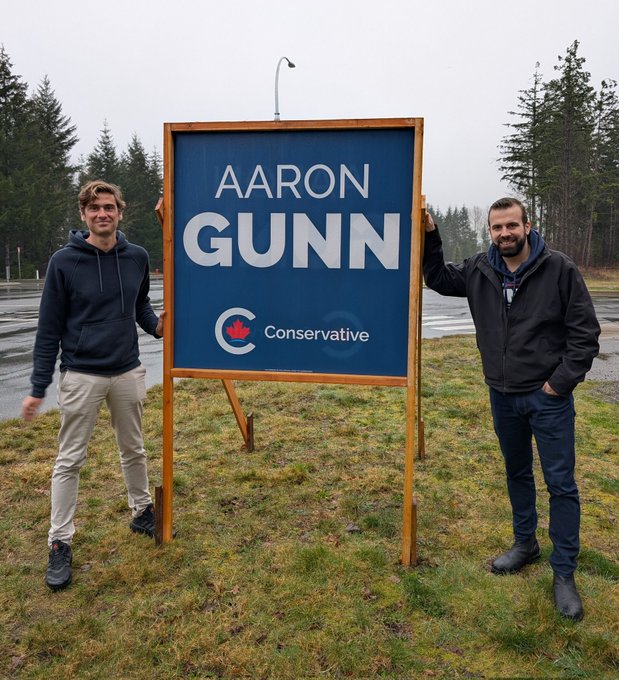
Aaron Gunn, documentary filmmaker, Conservative candidate for federal election, North Island -- Powell River 

"He [Aaron Gunn] has said that he wants to continue to condemn the residential schools and build stronger partnerships with First Nations people to unlock our resources so that we can produce incredible paycheques and opportunities for First Nations communities."
Conservative Party leader, Pierre Poilievre 
Image
 
Conservative leader Pierre Poilievre rejected calls from Indigenous leaders and other critics demanding that he drop Aaron Gunn from running for the Conservative Party, while at a campaign stop in Osoyoos, British Columbia. Social media posts from Mr. Gunn dating from between 2019 and 2021 where he denied the label of 'genocide' respecting Indigenous Peoples' treatment in Canada has occasioned a stream of outrage from a group of Indignous leaders in British Columbia.
 
The First Nations Leadership Council has called upon Mr. Poilievre to remove Mr. Gunn as a Conservative candidate for Parliament in the upcoming general election, pointing out social media posts denying 'genocide'; one where Mr. Gunn stated that some residential schools "were asked for by Indigenous bands". Now considered to be colonial institutions whose design  was to pull Indigenous children away from their cultural roots, they contend.
 
These posts, according to the council were "horrific and offensive". "Such attitudes are extremely harmful and divisive and should not be held by those in public office", they stated. 26 municipal mayors, councillors and B.C. Indigenous leaders called through an open letter for Mr. Poilievre to remove his candidate for election, citing  his statements as "concerning", and "despicable", "Incompatible with a Canada where reconciliation is a priority".
 
In response it was pointed out that former federal justice minister, human rights lawyer Irwin Cotler as well as Romeo Dallaire whose experience leading the United Nations peacekeeping mission during the Rwanda genocide also questioned the report's conclusion into missing and murdered Indigenous women and girls that concluded Canada had -- and continued to -- commit "colonial genocide" against Indigenous Peoples. 

Mr. Gunn was also defended by Conservative campaign spokesperson Sam Lilly who pointed to a statement when the candidate stated he has "never wavered" in condemning residential schools, describing them as "institutions of abuse, where countless First Nations suffered at the hands of a patronizing federal government". 
 
In 2015, the Truth and Reconciliation Commission, examining the history of residential schools, concluded that the institutions were part of a long-running government policy to erase Indigenous identity through assimilation. A policy, according to the report that "can be best described as 'cultural genocide'." Florid language that assaults the very deep meaning of 'genocide' with its intention to extinguish the lives of an entire people in a campaign of mass murder. 
"There was no genocide. Stop lying to people and read a book. The Holocaust was a genocide."
"Get off Twitter and learn more about the world."
Aaron Gunn
Clearly, Aaron Gunn has his impassioned albeit uninformed detractors determined to unseat his aspirations to represent the area in Parliament. But then, this man also has supporters who feel strongly enough about the campaign to dislodge  him, to speak out in his favour. To that end, eight elected officials including a former mayor, signed a letter that they "feel compelled to speak out in strong support of ... Gunn, whose character and record have been profoundly misrepresented in a troubling smear campaign." 
 
https://scontent-lga3-3.xx.fbcdn.net/v/t39.30808-6/488648926_122223815270212398_4284441062528199337_n.jpg?_nc_cat=106&ccb=1-7&_nc_sid=833d8c&_nc_ohc=93NijsZmLCUQ7kNvwFl9eBH&_nc_oc=Adk_rt8bd3561GHVhc8NbmNYZ_3uQXY1z5hzeLXF3CSMQKalKVesrx3edMXI3Zt1OVU&_nc_zt=23&_nc_ht=scontent-lga3-3.xx&_nc_gid=21OXxzI2gwPEoebGF-FLYQ&oh=00_AfEuuvDoWPo2EQF8NpT4-ZJViM6XQ0Hw5L9rveQ9lz1-Uw&oe=67F8FD9B

Labels: , , , , ,

Monday, February 17, 2025

Pioneers in 'Safer Supply' British Columbia Benefits the Opioid Black Market

"Significant [quantities of] safer supply [opioids are being diverted to the black market with assistance of organized gangs and some unscrupulous health-care providers]."
"Taxpayer-funded 'safe supply' drugs are flooding the streets, enriching organized crime, in some cases with diversion fraudulently facilitated by pharmacies and medical professionals."
"A significant portion [of safer supply opioids are being diverted to the black market, where they are being trafficked] provincially, nationally and internationally."
Power Point presentation produced by British Columbia's Ministry of Health 
https://static01.nyt.com/images/2024/07/11/multimedia/00canada-overdose-01-vmcg/00canada-overdose-01-vmcg-superJumbo.jpg?quality=75&auto=webp
A memorial wall for people who died as a result of using drugs is featured inside the offices of the Vancouver Area Network of Drug Users, a nonprofit group. The New York Times
"The last six months of 2020 they dispensed 577,000 opioid pills. In the two years between 2022 and 2024, it was over 22 million. It's humiliating. How many people are living in British Columbia, for goodness sake?"
"We've got to stop calling things harm reduction. It's not proven."
"Is giving people giant buckets full of hydromorphone to dump into the community harm reduction? No. It's not proven to reduce harm. It's not evidence-based. It's an experiment."
"Of course we need to deal with kickbacks from pharmacies. Even if every pharmacy is on the straight and narrow, it would still be a problem. A huge problem."
"We're not talking about safe injection sites at all. You're giving dope to people who are addicted and they're not taking it. They're using it as a currency to buy street drugs and still put themselves at risk."
B.C. MLA Elenore Sturko
https://i.cbc.ca/1.5896676.1684427088!/cumulusImage/httpImage/image.jpg_gen/derivatives/16x9_1180/hydromorphone.jpg?im=Resize%3D780
Hydromorphone, a type of opioid, is pictured at a managed opioid program in 2019. The drug is among those whose prescriptions have dramatically increased in recent years. The province is investigating the diversion of a 'significant portion' of opioids. (Ashley Burke/CBC)

Part of a confidential report produced by British Columbia's Ministry of Health summarizing findings of a special investigative unit looking into the fallout of the province's initiative to react to the growing phenomenon of fentanyl overdoses leading to death that has swept Canada, and manifested hugely in British Columbia, has been leaked. Its findings discovered that the freely distributed hydromorphone that has been handed out to people addicted to opioids has flooded the streets, the result of that free hydromorphone being bartered for more potent fentanyl craved by drug addicts.
 
The cheaper and more freely available handout drugs on the streets have made their way into the hands of teenagers which has resulted in a growing use of drugs with occasionally fatal consequences for young people. Government agencies have denied that the 'safer supply' they have invested so heavily in relating to their open-minded search for a solution to the fentanyl black market, could be ending up on the streets in a black market bonanza. Yet reports from hospital personnel, police, and community investigators have all held the government to fault for a situation that really is imperilling a greater swath of the population, despite government denials.
 
Now, years after the accusations of government ineptness and malcompetence made the news, a leaked document -- that investigators have produced verifying the accusations -- has surfaced. Even before that, however, the government of B.C. came to a decision to curtail their experiment in 'harm reduction' through 'safer supply'. No longer able to deny that throughout this experiment, accidental deaths due to overdoses have increased, not diminished, and a wider net has been cast in the process, capturing a younger cohort in the drug spiral.
 
Within the presentation photos of diverted safe supply prescriptions still in their original packaging were included; evidently having been confiscated during vehicle searches by police. At least 60 British Columbia pharmacies were identified by the investigative unit as having provided prohibited paid "incentives" to clients, doctors and assisted living residences for the purpose of increasing their operating profits. 
 
https://smartcdn.gprod.postmedia.digital/vancouversun/wp-content/uploads/2025/02/0907-bi-qw-council-addictions-bi.jpg?quality=90&strip=all&w=564&h=423&type=webp&sig=WKvXF3OKFTn4nSlCv_3Fnw
 
A dispensing fee is charged for each prescription filled; in this instance billed to the provincial government. Up to three prescriptions a day can be dispensed for a single safer supply patient. Dispensing fees are around $10 each, so the potential for pharmacies to earn up to $11,000 annually for each safer supply patient served is a compelling temptation. Normal customers are worth around $120 in dispensing fees yearly. The obvious conclusion is that a single safer supply patient can result in more revenue than 90 others not related to safer supply combined, would produce.
 
According to the leaked presentation, some 'incentivized' patients may procure only one of their three daily prescriptions while diverting their extra opioids to the black market. Alternately, the pharmacy involved could fraudulently bill the province while failing to dispense the drugs, so that patients don't receive some or all of their prescriptions. Either way, extra opioids end up on the black market fueling organized crime and leading to an increase in drug use in the population. 

According to the presentation, between 2022 and 2024, some 20-million milligrams of hydromorphone (an opioid as potent as heroin) and 232,000 fentanyl patches were dispensed through safer supply, equal to 19 percent of all the hydromorphone and 13 percent of all the fentanyl patches dispensed during this period in the province.
 
https://i.cbc.ca/ais/1.7156186,1717224314156/full/max/0/default.jpg?im=Crop%2Crect%3D%280%2C0%2C1919%2C1079%29%3BResize%3D620
Some pharmacies are paying cash kickbacks to vulnerable patients in Vancouver’s Downtown Eastside to attract more business — years after crackdowns related to the practice.    CBC News
 

Labels: , , ,

Friday, February 07, 2025

British Columbia's Experimental 'Safer Supply' Flop

"A significant portion of the opioids being freely prescribed by doctors and pharmacists are not being consumed by their intended recipients."
"[Those opioids are being trafficked]provincially, nationally and internationally."
"As long as [safer supply] gives valuable things away for free, or for far below market prices, one should expect there to also be 'profiteers' wishing to profit by obtaining supply for resale."
Leaked B.C. document
 
"You can stand in front of just about any of these pharmacies that are involved in this -- usually close to the safer supply prescribing office -- and you can sit outside for five minutes and watch all kinds of transactions going down."
Addiction outreach worker David McEvoy
 
"We have noted an alarming trend over the last year in the amount of prescription drugs located during drug trafficking investigations, noting they are being used as a form of currency to purchase more potent, illicit street drugs."
RCMP spokesperson Cpl. Jennifer Cooper 

"We have been concerned about this increasingly polarized rhetoric that is not informed by evidence, that is not paying attention to evidence, as a matter of fact, and is sharing opinion or anecdote that, in fact, is clearly not defensible if you look at the data."
"[Hydromorphone was not] present in a significant number [of the bloodstreams of the roughly 200 people per month dying of overdoses in B.C.]" 
Former B.C. Chief Coroner Lisa Lapointe
https://i.cbc.ca/ais/1.7156186,1717224314156/full/max/0/default.jpg?im=Crop%2Crect%3D%280%2C0%2C1919%2C1079%29%3BResize%3D620
Some pharmacies are paying cash kickbacks to vulnerable patients in Vancouver’s Downtown Eastside to attract more business — years after crackdowns related to the practice. Still from video
 
For years health officials in British Columbia dismissed concerns expressed relating to freely handed out opioids to drug addicts through 'safer supply' outlets, in a program designed to charitably provide a product considered safer than street opioids, in an effort to wean people off more dangerous drugs like fentanyl in response to an epidemic of deadly overdoses. Those overdoses have occurred across Canada, but British Columbia remains the poster child of drug-induced accidental overdoses. 

Which is what led the government of B.C. to develop a ground-breaking system of 'safer supply', representing, since 2020, one of the world's most comprehensive such programs. Once the program was operational, sharp eyes began to notice a proliferation in the illicit street market of diverted opioids and it wasn't difficult to conclude that the giveaway drugs were being sold on the black market in exchange for more powerful drugs like fentanyl. 
 
And while the less dangerous drugs were selling on the street at very competitive prices, they lured teenagers into venturing into the temptation of 'trying them out', creating a new generation of drug users.
 
The evidence of diversion was clear, and investigative reportage delved into the problem, publishing their damning results; the larger availability of drugs flooding the marketplace thanks to 'safer supply' initiatives, doing far more harm to society broadly; in effect enabling addicts who spurned the lesser highs of hydromorphone for the attraction of infinitely more potent (and dangerous) fentanyl-laced street drugs. These were dismissed by the province's health authorities as unsubstantiated rumours and 'false news'. 
 
This week, however, the provincial Opposition Conservatives in the province released a leaked presentation that had explored the issue without prejudice, finding that those accusations of 'safe supply' boosted opioid availability at the street level, and leading in fact to more accidental drug overdoses rather than preventing them as intended, were indeed reflecting reality. The Conservatives labelled the issue of diversion, as evidence of "taxpayer-funded drug trafficking".
 
https://smartcdn.gprod.postmedia.digital/vancouversun/wp-content/uploads/2024/09/png-0502n-overdose-037.jpg?quality=90&strip=all&w=564&h=423&type=webp&sig=SwU4R5fpM3qvebKB1TNPlg

The undeniable evidence that the government health authorities had been apprised, despite their denials, even led B.C. Health Minister Josie Osborne to confirm that the claims about diversion outlined in the report were a reflection of reality, that the report's destination was intended for the attention of law enforcement. "These allegations are here. There's absolutely no denial of it. There's no diminishing of it, and there should be no acceptance of it."
 
The very direction of distributing free recreational drugs to addicts was meant for the purpose of weaning them away from illicit drug supplies tainted by fentanyl or heroin. "Safer supply services can help prevent overdoses, save lives, and connect people who use drugs to other health and social services", an official Government of Canada policy backgrounder explained. 

In the years from 2022 to 2024, 19,751,000 mg of hydromorphone was handed out representing safer supply equivalent to 2.5 million 8-mg pills, while 1.4 million mg of oxycodone was also distributed, equating to 70,000 20-mg pills. When the program was initiated, critics gave warning that users would end up selling their rations of 'safer sup' to use the profits from their sale to acquire illicit drugs. Which led to government-supplied drugs flooding the market and addicts gaining money to buy illicit drugs.
 
"We ... know that about 50 percent of the hydromorphone pills that we come across can indeed be attributed to safe supply", the Standing Committee on Health was told by Vancouver's Deputy Chief Constable Fiona Wilson. Which did not deter drug policy advocates and government of B.C. officials from repeatedly insisting diversion was no problem; contending otherwise represented misinformation or political posturing.
 
https://i.cbc.ca/1.5896676.1684427088!/cumulusImage/httpImage/image.jpg_gen/derivatives/16x9_1180/hydromorphone.jpg?im=Resize%3D780
Hydromorphone, a type of opioid, is pictured at a managed opioid program in 2019. The drug is among those whose prescriptions have dramatically increased in recent years. The province is investigating the diversion of a 'significant portion' of opioids. (Ashley Burke/CBC)


Labels: , , , , , ,

Monday, November 04, 2024

RCMP Apprehend Lethal Doses of Fentanyl in British Columbia

"The precursor chemical in combination with the finished fentanyl products seized at this location could have amounted to 95 million potentially lethal doses of fentanyl, which have been prevented from entering Canadian communities and markets abroad."
"To put things into more context, the over 95 million potentially lethal doses of fentanyl that have been seized could have taken the lives of every Canadian at least twice over."
"Investigators seized a total of 89 firearms, which included dozens of handguns, AR-style assault rifles and submachine guns, many of which were loaded and ready to use."
"The searches also yielded several explosive devices, a massive amount of ammunition, firearm silencers, high-capacity magazines, body armour, and $500,000 in cash."
Assistant Commissioner David Teboul, head, RCMP federal policing program, British Columbia
https://dims.apnews.com/dims4/default/4832b42/2147483647/strip/true/crop/3000x2000+0+0/resize/1440x960!/format/webp/quality/90/?url=https%3A%2F%2Fassets.apnews.com%2F65%2Fb7%2Fcd74655dc7d68a97a881d9f8bec6%2Fb3aa250f4d6a43c4ad9ea0bde42e6f97
RCMP in Surrey, B.C.drug seizure,  David Teboul second from left. The Canadian Press via AP
 
The largest illicit drug lab ever discovered in Canada has been taken down by a specialized RCMP unit, which seized record amounts of drugs, precursor chemicals and firearms. A clandestine operation in Falkland, British Columbia, east of Kamloops was the venue that was raided. To this point one person only has had a number of drug and firearm charges lodged against him. More arrests are expected as the investigation continues, and it is anticipated that Gaganpreet Randhawa will not be long in his solitary charges before he is joined by others in the  group.
 
According to RCMP Assistant Commissioner Teboul, 54 kilograms of finished fentanyl was seized, 390 kilograms of methamphetamine, 35 kilograms of cocaine, 15 kilograms of MDMA, and six kilograms of cannabis. Tonnes of precursor chemicals used in the production of crystal meth "has not been seen in Western Canada until now". The dismantling and clean-up of the Falkland lab had a hefty price tag of over $1million. "These expenditures have a direct impact on our operating budgets, resources, and ultimately take away from funds that are provided by Canadians for police to do its work".

Destined both for the domestic market and for export, the synthetic drugs are linked to the expansion of Canadian gangs in connection to smuggling tonnes of methamphetamine through the Port of Vancouver to waiting markets in Australia and New Zealand preying on populations in some Pacific Island nations. "Super labs" in B.C. make use of  sophisticated methods in evading prosecution. Reports identified groups such as Hell's Angels, Wolfpack and United Nations working alongside Mexican cartels, Asian triads and Middle East organized crime groups whose profits enable terrorism.
"[The British Columbia investigation and resulting seizures have] also served to deny this transnational organized crime group an estimated $485 million in profits."
"This enforcement action has neutralized a key production facility that is believed to have been responsible for the production, the distribution of unprecedented qualities of fentanyl and methamphetamine into Canada and abroad."
Assistant Commissioner, David Teboul, RCMP
The RCMP special unit has been working in tandem with "five eyes" partners; the U.S., U.K., Australia and New Zealand. "Canada's Border Services Agency along with the RCMP also detected and interdicted 310 kilograms of methamphetamine prior to the international departure", stated Asst. Commissioner Teboul. Investigators linked the Falkland lab to a property nearby located in Enderby where a huge stash of precursor chemicals was found, long with a truck owned by Independent Soldiers gangster Donnie Lyons, assassinated in June.
"I think it's time for our justice system to catch up to the reality of the danger of these drugs."
"Investigators are working to determine the common source of these chemicals and all individuals involved."
"And I think it's time for a justice system to be increasingly stiff to this parasitic behaviour, whether it's by people that are operating in Canada or out of Canada."
Assistant Commissioner, David Teboul, RCMP
Image
Firearms and illicit drugs seized last week. Canadian Press

Labels: , , , , ,

Monday, September 16, 2024

British Columbia's 'Safe Consumption Sites'?

"I think a lot of the reasons she was doing the drugs was the mental health problems she was having, and she was trying to drown them with drugs."
"I mean, I begged them [hospital child psychiatrists] and so did her dad ... "
"We said she's not mentally capable. She was sticking pencils through her hand when she was in the psych ward there."
13-year-old Brianna's mother, Sara MacDonald
https://smartcdn.gprod.postmedia.digital/nationalpost/wp-content/uploads/2024/09/Brianna-MacDonald-1.jpg?quality=90&strip=all&w=1128&h=846&type=webp&sig=230Xbg8BkcjwuY5M2uqLaQ

Discharged from a psychiatric care facility even as her frantic parents attempted to persuade medical authorities at the hospital that their daughter was incapable of caring for herself as a result of her mental distress, only to be informed that in their opinion the girl was old enough to make up her own mind and be in charge of her own health outcomes. Twelve years old at the time of her discharge, her parents were informed as far as they were concerned, that represented their considered opinion as mental health experts dealing with vulnerable children.
 
"The parents have to be able to mandate that the kids stay [in a care facility]", responded Jesse Griffiths, Brianna's father. Parents should have the legal right to insist their children receive appropriate care, he reasoned, since parents have legal responsibility for their children's welfare. An obvious extrapolation from one responsibility under the law to the other. 
 
Brianna had been placed in a youth centre in Abbotsford after her discharge; her disruptively violent behaviour at home should have been treated in hospital, her parents contend. Her mother was concerned over the influence her older daughter could have on her younger siblings. Brianna left the youth centre, ending up in a homeless camp. It was there, in the tent she occupied, that she died from a drug overdose on August 23. Efforts to save her life failed. 

At the age of ten and a half, Brianna began smoking marijuana and soon graduated to ecstasy which can cause users to experience euphoric highs and hallucinogenic effects, while in high doses it could lead to a sharp increase in body temperature, resulting in liver, kidney or cardiovascular system failure, brain swelling, and potentially a final outcome of death.

And then it was revealed that age aside, the young girl obtained drug paraphernalia including needles, naloxone kits and pamphlets on the safe use of drugs from none other than the Fraser Health Authority, the largest regional health authority in the province. Her parents expected that Fraser Health, in light of their daughter's age, would provide her with treatment. Because of an overdose Brianna had been hospitalized in February.

"We believe it is crucial to honour her memory by carefully examining what happened, learning from this tragedy, and working together to ensure that such a heartbreaking loss doesn't happen again", promised Fraser Health. According to Fraser Health records, British Columbia is burdened with an overdose crisis. Toxic, unregulated drugs took the lives of 2,511 people in 2023 throughout the province; an average of 6.9 deaths daily.
 
https://pbs.twimg.com/card_img/1835066262642180096/7smfjIFl?format=jpg&name=large
The Publica on X
"Tragically, toxic, illicit drugs are continuing to cause unprecedented numbers of deaths across our province."
"We cannot bring our deceased loved ones back, but we can and must do much more to protect the lives of tens of thousands of our family members, friends and colleagues still at risk."
Lisa Lapointe, British Columbia chief coroner

Labels: , , , ,

 
()() Follow @rheytah Tweet