Ruminations

Blog dedicated primarily to randomly selected news items; comments reflecting personal perceptions

Thursday, August 26, 2021

Magnifying Grief

"Grief is a normal response to the loss of someone close, but traumatic losses may severely harm survivors for years."
"Our findings suggest that when treating trauma survivors, targeting symptoms of PTSD early might help them avoid complicated grief later on. Complicated grief has been defined as a persistent, intense yearning, longing and sadness, usually accompanied by insistent thoughts or images of the deceased and a sense of disbelief or an inability to accept the painful reality of the person's death."
"The fact that we found that PTSD symptoms predicted complicated grief reactions at a subsequent time point, but complicated grief did not predict the development of PTSD, is interesting because it suggests that targeting PTSD symptoms may hinder later development of complicated grief."
"This may have important implications for clinicians working with bereaved trauma survivors."
Kristin Alve Glad, researcher, Norwegian Centre for Violence and Traumatic Stress Studies

Armed police aim their weapons while people take cover after the shootings on Utoya island, some 40km south-west of Oslo, 22 July 2011
Terrified youngsters hid in the woods, with some jumping into the water to escape the hail of bullets.  AFP

A new study placed its focus on survivors of the terrorist attack that took place in Oslo, Norway, and on the nearby island of Utaya in 2011, when 77 people lost their lives. This event -- a shooting spree combined with a bombing -- represented the deadliest attack to take place in Norway since the Second World War. Published in the journal Psychological Trauma: Theory, Research, Practice and Policy, the research found symptoms of a more complex grief can intensify over time with the potential to prevent survivors from leading normal lives.
 
In most instances when people suffer a shocking loss such as the death of a loved one, the sorrow it brings tends to recede with the passage of time. However, those people who experience PTSD resulting from a traumatic event which directed involved/impacted them personally and that also claimed the life of someone near and dear, according to the study conclusions, may end up suffering from a persistent sense of sadness which leaves them with an inability to cope, years on.
 
A total of 275 people were interviewed for the study; of that number 256 had lost a close friend, six lost a family member, and thirteen lost a close friend and family member/partner. In face-to-face interviews conducted by health-care professionals on three separate occasions -- five months after the attack, 15 months later, and finally 30 months later -- participants were asked questions relating to symptoms of post-traumatic stress syndrome.
 
Other questions were asked with a view to revealing feelings of complicated grief; as example, those related to difficulty in accepting the loss, managing intense grief and coping with thoughts focusing on death. The researchers found that those who reported symptoms of PTSD to be significantly likelier to relay feelings of complicated grief; those who still felt the effects of PTSD a year following the event were seen to struggle with the most intense symptoms of this severe form of grief.
 
Survivors were seen to have taken on a particularly heavy toll of grief from the terrorist attack since while they lost loved ones, they were also participants in the traumatic event, the researchers found. Leading to the conclusion that the "dual burden" of unexpected loss in combination with high exposure to the event steered PTSD symptoms in the direction of complicated grief, not identified in those who were removed from the violence.
 
The hope is that this refined understanding of the relationship between PTSD and complicated grief may lead to assisting in the development of targeted therapies to be used in giving aid to survivors who have lost loved ones to unexpected trauma. 
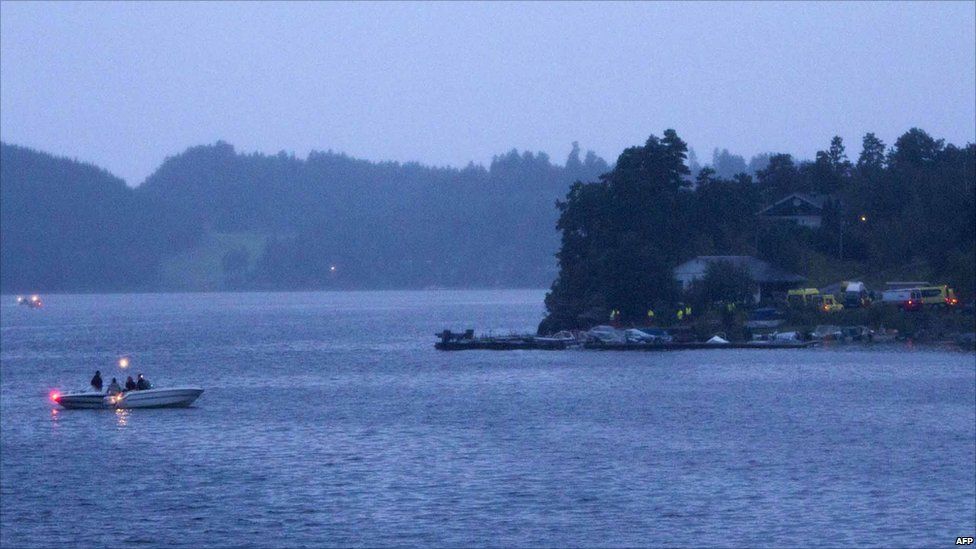
Police in boats and emergency services vehicles around Utoeya island, Norway, 22 July 2011
Locals gathered boats near the island to try and help those jumping into the water to escape   AFP

Labels: , , , ,

Sunday, December 30, 2018

Inheriting Markers of Trauma

"These are, in fact, extraordinary claims, and they are being advanced on less than ordinary evidence."
"This is a malady in modern science: the more extraordinary and sensational and apparently revolutionary the claim, the lower the bar for the evidence on which it is based, when the opposite should be true."
Kevin Mitchell, associate professor, genetics and neurology, Trinity College, Dublin

"The effects we've found have been small but remarkably consistent, and significant."
"This is the way science works. It's imperfect at first and gets stronger the more research you do."

Moshe Szyf, professor of pharmacology, McGill University, Montreal

"These are clear, consistent findings."
"The field has advanced dramatically in just the past five years."
Tracy Bale, professor, pharmacology, psychiatry, University of Maryland School of Medicine, Director, Center for Epigenetic Research in Child Health and Brain Development

"It’s either the stress of war or the malnutrition of war or both."
"The stress on the system moves the machinery to put down or not put down epigenetic markers."
Randy L. Jirtle, epigenetics researcher. North Carolina State University
The team’s work is the clearest sign yet that life experience can affect the genes of subsequent generations.
The team’s work is the clearest sign yet that life experience can affect the genes of subsequent generations. Photograph: Mopic/Alamy
A study of American Civil War prisoners led by researchers in California led to an odd conclusion; that male children of war prisoners who suffered abuse were more likely to die than their peers in any given year after middle age by a factor of ten percent. An "epigenetic explanation" appears the only reasonable conclusion that it is conceivable that trauma will leave a chemical mark on genes subsequently passed down to following generations.

The gene won't be damaged leaving a mutation, but alters the mechanics where the gene becomes converted into functioning expressions.

A decade earlier, scientists reported that children exposed in the womb to the Dutch Hunger Winter -- representing a time of famine toward the end of World War II -- carried a distinguishing chemical mark, or epigenetic signature, on one of their genes. That finding was later linked to differences in health in later life of those children; among distinguishing markers, higher than-average body mass. This new field of study has generated additional studies including those of Holocaust survivors' children.

Studies of the descendants of Holocaust survivors post hints at the heritability of trauma through generations where it is suggested by the studies that some trace of parents' and grandparents' experience with an emphasis on suffering, modifies the following generations' health and that, in turn of the generations that follow; from grandparents to parents to children. Rachel Yehuda of Mount Sinai Hospital and colleagues concluded in 2016 that Holocaust survivors and their children had evidence of methylation on a region of a gene associated with stress, suggesting that the survivors’ trauma was passed onto their offspring.
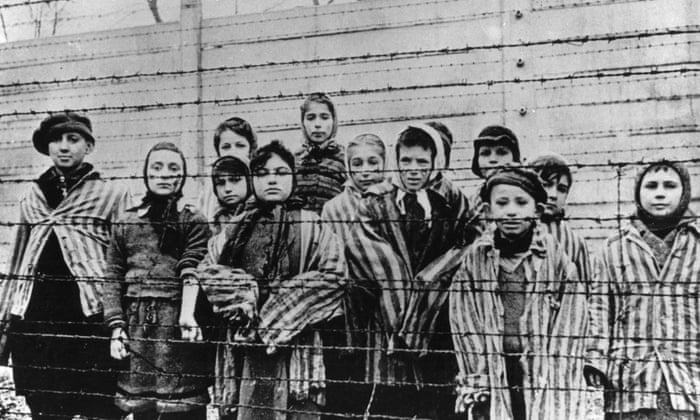
Children in the Auschwitz-Birkenau concentration camp. Photograph: Imagno/Getty Images

There are tantalizing hints of the heritability of trauma where studies appear to suggest that some trace of our parents' and grandparents' experience is inherited, and most particularly their suffering in turn modifying the health of descendants, and continuing on to affect their descendants' children. Not all researchers are convinced, however; critics among them contend that biological alterations such studies imply are quite simply implausible. On the other hand, epigenetics researchers insist the solid evidence is more than convincing.

Studies of mice have been cited in support of evidence of trauma-transmission in this debate revolving around genetics and biology. Unlike direct effects, as when a pregnant woman heavily imbibes in alcohol causing fetal alcohol syndrome, the issue is one of stress wearing on a pregnant mother's body, being shared to an extent with her fetus; interfering directly with the normal developmental stages in utero.

The trouble is that no researchers are as yet able to explicate precisely how brain cell changes caused by abuse might be communicated to sperm or egg cells prior to conception.

Following conception, when sperm meets egg the process of cleansing or 'rebooting' occurs when most chemical marks on the genes are stripped away. As the fertilized egg grows and develops, genetic reshuffling takes place with cells specializing into various components of functionality such as brain cells, skin cells and so on. The big question: How is it possible that a signature trauma might survive all these processes?

Scientists at the University of Maryland School of Medicine have raised male mice in difficult environments, such as periodically tilting cages or leaving lights on throughout the night hours which effects alter subsequent behaviour of the affected mice's genes, known to alter how the mice manage surges of stress hormones. It is that change, associated with alterations in the manner in which their offspring handle stress that is notable.

According to Dr. Bale who led that research, young mice become less reactive with their hormones in comparison to the behaviours of control animals. The generational changes are not inevitable, however; nutritional intervention can alter the course of those behavioural changes. For example, should the father be possessed of generational markers and the mother the benefit of good nutrition the child born to them can be free of such markers.
"By no means is it saying that whenever there’s trauma, that means it’s going to be transmitted."
"The epigenetic story is optimistic because it allows for the possibility of reversibility through maternal nutrition."
Professor Dora Costa, lead author, Civil War study, economist, UCLA
A Civil War reenactment in 2013     Gary Cameron / Reuters

Labels: , ,

 
()() Follow @rheytah Tweet