Ruminations

Blog dedicated primarily to randomly selected news items; comments reflecting personal perceptions

Wednesday, August 24, 2022

Hope for New Diabetes Treatment

"We consider the research novel and an important step forward towards developing new therapies."
"[Our research shows that a diabetic pancreas is] not incapable of producing insulin [their proof of concept addresses] unmet medical needs in Type 1 diabetes."
Sam El-Osta, diabetes expert, Monash Department of Diabetes, Melbourne, Australia
Type 1 diabetes used to be referred to as Juvenile-onset diabetes. It is always insulin-dependent because the beta cells of the Isles of Langerhans located in the pancreas are destroyed in a presumed attack by the immune system erroneously; theoretically the result of the bodily entry of a foreign substance; for example a vaccine of some kind that provokes the body's immune system to attack, but it mistakes the beta cells for a foreign substance to be destroyed. 
 
Until Banting and Best's discovery in a small makeshift laboratory at University of Toronto in 1921 of injecting missing insulin to achieve blood-glucose control by delivering blood-glucose to body cells, the diagnosis of diabetes onset for young people was a death sentence. They would simply waste away, the delivery of converted food sugars from the body's bloodstream by insulin to body cells to feed the brain and muscles gone completely awry.
 
Adult-onset diabetes (Type 2) on the other hand, was considered to be a lifestyle-disease, the result of sedentary practices and poor nutritional choices leading to overweight and the weakening of the production of insulin, usually treated by appropriate medication to tweak insulin production, unlike the more severe Type 1 for which multiple-daily insulin injections are required to maintain life. Both must test blood-sugar levels frequently to avoid both hypoglycemia and hyperglycemia. Both types have a genetic component.
 
In Canada alone, the Diabetes Canada group claims that one in three Canadians live with prediabetes or diabetes where the body is no longer capable of producing insulin, or is unable to properly utilize the insulin that is produced. That describes Type 2 diabetes. Chronic diabetes takes a dreadful toll on the body, even when the condition is under strict control through a combination of insulin injections, adequate exercise and an appropriate diet plan.
 
In the province of Ontario alone it is estimated that there are more people living with diabetes than elsewhere in Canada; rates of both Type 1 and 2 diabetes have risen by 42 percent in the last decade. The national economic burden for the treatment of diabetes is estimated at $30 billion in 2019, which represented an increase of $14 billion over 2009 figures.
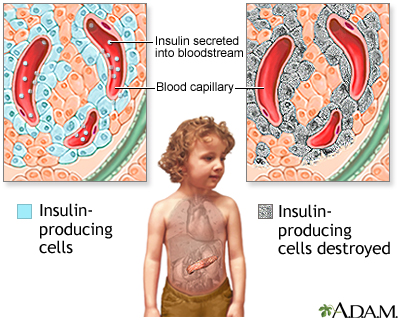
 
Type I diabetes
Medline Plus
 
Now a major breakthrough reflecting the results of new research out of Australia affecting both Type 1 and 2 diabetes promises to completely turn diabetes management on its head. The study reflects the discovery of a treatment that would replace insulin-producing cells in the pancreas. The study, published in the journal Signal Transduction and Targeted Therapy, saw researchers able to reactivate pancreatic stem cells from a Type 1 diabetic donor with the use of a drug approved by the U.S. Food and Drug Administration, not licensed for diabetes treatment.
 
The beta cells, upon reactivation, once again become capable of expressing insulin, functionally resembling the beta cells that produce insulin in non-diabetic people. The new therapy could one day -- according to the team behind the study -- allow insulin-producing cells destroyed in Type 1 diabetes to be replaced with new cells functionally capable of producing the same result. 
 
Once it was believed that a diabetic pancreas was too damaged to be corrected. Now, although more research is required before the therapy can be applied to human subjects, the research team is optimistic about the potential for an entirely new game plan in responding to the chronic disease that threatens peoples' lives with the prospect of a reduced lifespan, an increased chance of diabetic retinopathy, amputations caused by nerve damage, heart failure, strokes and kidney failure.

WebMD

Labels: , ,

Wednesday, January 12, 2022

Type 1 Diabetes on the Rise : COVID Link

"A virus -- it could be just a cold -- puts stress on the body. We see this all the time. They [genetically pre-disposed children] have pre-diabetes for a period of months or years then they tip out [through an autoimmune response triggered by a COVID infection]."
"It's going to take us a few years to see if we have had a bump in the rate of diabetes. COVID-19 may have triggered that first bump."
"This is just one more reason for kids to be vaccinated."
"I want to reassure people. I'm not anticipating a huge spike. But we want parents to be aware of the symptoms and to bring their kids in [to see doctors] if they notice any of these [symptoms]. It needs to be monitored."
Dr.Sarah Lawrence pediatric endocrinologist, associate professor of pediatrics, University of Ottawa

"At this early point in time, the research shows an association between contracting COVID-19 and then being diagnosed with diabetes -- but there's no definitive evidence that shows new onset diabetes is caused by COVID-19."
This is very concerning and we must undertake  high-quality research to determine exactly what is happening with these youth and why."
Dr.Seema Nagpal, vice-president of science and policy, Diabetes Canada
US-HEALTH-VIRUS-VACCINATION-TEENS
Studies of European children and youth during the pandemic have brought to light the occurrence of Type 1 diabetes diagnoses increasing along with increased frequency and severity of diabetic ketoacidosis at time of diagnosis. The result of undetected diabetes in children, bringing them to a dangerous level of approaching endocrine malfunction.  
 
Diabetes in adults could conceivably be connected to COVID-19 as a long-term consequence. As well the pandemic may have increased diabetes risk through increases in body mass index however indirectly, since this is one of the risk factors for both serious COVID-19 outcomes and diabetes.

The emerging realization of a connection between the coronavirus and diabetes onset in children has seen researchers and physicians urging parents of young children to be aware of diabetes symptoms in children who have been COVID-infected. All indications point to children being likelier to be newly diagnosed with diabetes a month or so following a COVID-19 infection, as opposed to those who hadn't been infected with the virus.

Findings corroborated by new research published by the U.S. Centers for Disease Control and Prevention. The CDC study authors have brought attention to health-care providers, urging them to screen for diabetes symptoms in children and youth who have been infected with COVID-19. To be alert to the classic symptoms of frequent urination, increased thirst, increased hunger, weight loss, tiredness or fatigue, stomach pain and nausea or vomiting, any of which symptoms could indicate diabetes onset.
 
Researchers with the Centers for Disease Control and Prevention (CDC) report that children who have recovered from COVID-19 may be at an increased risk of being diagnosed with diabetes. JDRF
 
Children and youth who had been diagnosed with COVID-19 in two American medical claims databases were the subject of the CDC study; IQVIA and HealthVerity, in the past two years. Claims of 80,893 young patients at IQVIA and 439,439 patient claims of youth at HealthVerity were reviewed for the study. Which resulted in identifying new diabetes diagnoses being 166 percent likelier to occur at IQVIA, and 31 percent more likely at HealthVerity among those who were infected with COVID-19 as opposed to the uninfected.

The researchers involved in the study found that patients under 18 years of age with COVID-19 were more likely to have new diagnoses of diabetes than those who had pre-pandemic acute respiratory infections. There is an expressed requirement to better understand the underlying causes, whether the COVID-19 infection, or treatment for an infection, the CDC study pointed out. Of interest is whether diabetes associated with COVID is transient or whether it will be chronic.

According to Diabetes Canada, diabetes prevalence among young people between the ages of one and 19 has increased. There were about 26,000 individuals between age one and 19 living with Type 1 and Type 2 a decade earlier. Type 1 diabetes, formerly referred to as Juvenile diabetes, strikes youth under 18 years of age, and the condition is insulin-dependent. Type 2 is generally connected to a sedentary lifestyle and overweight conditions, and can be controlled with drugs rather than insulin injections.

Dr.Lawrence, practising out of Children's Hospital of Eastern Ontario, recalls that when she began practising endocrinology in 1995, approximately fifty patients were diagnosed annually with Type 2 diabetes. Now the numbers hover around 120 cases yearly.
 
Administering a coronavirus test to Penelope Ramirez, 6, in Gardena, Calif., on Thursday.
Credit...Allison Zaucha for The New York Times
 

Labels: , ,

 
()() Follow @rheytah Tweet